You know the scene. Eight people around the table, the kitchen a thirty-second walk away, and you’re playing human conveyor belt between courses — four plates balanced up one arm, a sauce boat in the other, silently hoping the gravy hasn’t gone cold on the counter. The flat-pack trolley you bought eighteen months ago turned out to be the wobbly, one-direction-rolling disappointment you half-suspected it would be, and now it lives in the garage alongside other optimistic purchases. So here you are doing it all by hand again: missing conversations, arriving at the table slightly flustered, and wondering why this problem isn’t easier to solve.
A well-made serving cart with locking wheels and sensibly designed shelves does solve it. Load everything in one go in the kitchen, wheel it smoothly to the dining room, and spend the recovered time actually being a host rather than a shuttle service. Done properly, a serving cart doubles as a bar trolley for drinks evenings, a kitchen supplement during busy cooking sessions, and a tidy storage solution between uses. Done badly, it wobbles, scuffs your floors, and earns itself a permanent home in the cupboard under the stairs.
Finding the right one for your space and situation is where the real work lies. Here are five that get it right.
How These Serving Carts Were Selected
Serving carts available on Amazon UK were assessed against five criteria: frame construction and materials (stainless steel, powder-coated steel, or composite), wheel and caster performance across tile and hardwood floors, actual usable shelf space relative to listed dimensions, assembly complexity, and real-world versatility across food transport, drinks hosting, and kitchen storage. Buyer feedback patterns on Amazon UK were cross-referenced carefully — paying particular attention to repeated complaints about wobble under load, wheels that seize or mark flooring, and shelf dimensions that differ materially from product photographs — alongside consistent praise for specific design features. The five carts below represent the strongest options across different budgets and use cases, all available with UK delivery.
Best Overall
The VASAGLE Kitchen Serving Cart with Removable Tray sits at the top of this guide with more than 900 buyer reviews on Amazon UK and a rating of 4.5 out of 5 stars — a consensus that reflects sustained real-world satisfaction rather than a lucky early surge of reviews. Spend time with this cart and the reason for that consensus becomes clear: it is designed for actual kitchens and actual hosting situations, not product photography.
The aesthetic sits in an industrial-rustic register — a warm wood-effect finish on the shelving tiers against a black powder-coated steel frame — which allows it to fit a modern kitchen, a compact dining room, or a lounge corner without looking as though it has been borrowed from a storeroom. The three-tier configuration gives you genuine vertical storage, and the removable top tray is one of those details that proves its worth the first time you use it. Lift the tray with a full set of glasses or a cheese board and carry it directly to the table without decanting onto a separate serving piece. It is a small convenience that compounds over a long evening of hosting.
Wheel quality is where many budget-tier carts reveal their limitations, and the VASAGLE handles this thoughtfully. Two of the four casters lock via a foot brake, and those brakes hold reliably — including on a slight slope, which matters in homes where kitchen flooring is not perfectly level. The levelling feet are a feature that does not photograph well but makes a real difference in use: on an uneven surface, you can stabilise the cart completely before loading dishes, so it does not slide away while you are balancing a heavy casserole pot. That is the kind of practical consideration you only think about once you have dealt with a cart that lacks it.
Load-bearing across the three shelves is solid for domestic use. The top shelf handles glassware and bottles comfortably; the middle tier suits serving dishes and stacked plates; the lower shelf takes heavier items like a compact wine cooler or a full set of side plates. The frame stays firm under a full load with no noticeable flex at the joints, which is the most basic functional test a serving cart needs to pass. Assembly takes around twenty to thirty minutes — this is not a fold-out design — but the instructions are clear and the process is logical for anyone who has assembled flat-pack furniture before.
The genuine tradeoffs are worth stating plainly. The rustic brown finish will not suit every interior: a predominantly white or Scandi-inspired kitchen may experience this cart as a deliberate contrast piece rather than a seamless addition. The powder-coated steel frame, while robust for indoor use, is not stainless and is not suited to persistent moisture or outdoor environments. And at roughly 40cm wide, it is not deep enough to function as a kitchen island supplement during active cooking. For most UK households, where space efficiency and versatility are the governing factors, this cart handles the fundamentals better than anything else available at a comparable price.
Best Budget Stainless Steel Pick
The TUKAILAi 3 Tier Stainless Steel Utility Cart with Locking Wheels is the strongest argument for stainless steel at a budget price point, and its 601 reviews at 4.3 out of 5 stars on Amazon UK confirm that it has found a real audience among buyers who want the hygiene and easy-clean benefits of stainless steel without crossing into mid-range pricing.
At 35 x 60 x 75cm, the footprint is narrow enough for a galley kitchen but wide enough to carry a proper dinner service across three stainless steel shelves that wipe clean in seconds after a spill — a practical advantage whenever the cart is used near food and drink. The distinguishing feature over fixed-shelf designs is that two of the three shelves are height-adjustable: you can raise the middle tier to fit tall bottles upright, or lower it to give clearance for deep serving bowls or a stacked casserole dish. That configuration flexibility extends the cart’s usefulness across different hosting and storage scenarios.
The four locking wheels are where this cart earns most of its reviewer goodwill. Two casters brake independently and hold reliably on kitchen tile. UK kitchens frequently mix floor types — tile near the hob, vinyl or timber in the connecting dining area — and casters that transition smoothly between surfaces without snagging or marking the floor are worth prioritising. Multiple reviewers specifically mention how quietly the TUKAILAi’s wheels run, which is a small but real quality-of-life detail when you are moving glassware through an open-plan living space late in the evening.
Assembly requires more effort than a comparable piece of flat-pack furniture. The metal poles seat into shelf pegs with more resistance than the instructions might suggest, and most buyers report needing a rubber mallet to get the frame components fully seated. Attempting to rush this stage by hand risks leaving joints fractionally loose, which creates wobble under load. Allocate around twenty to thirty minutes and follow the assembly sequence carefully; once completed, the frame is rigid and shows no flex at all. The stainless surface attracts fingerprints in daily use — a damp microfibre cloth deals with this quickly — but for a kitchen or food-adjacent environment where hygiene is a priority, the easy-to-clean surface more than compensates for that minor upkeep.
This is the right pick if you want stainless steel durability at a budget price point and are comfortable with a purposefully utilitarian appearance. If the cart needs to integrate visually into a dining room or lounge, or you specifically want drinks-hosting features like a wine rack, the VASAGLE or MAHANCRIS options will suit the environment better.
Best for Home Bar Use
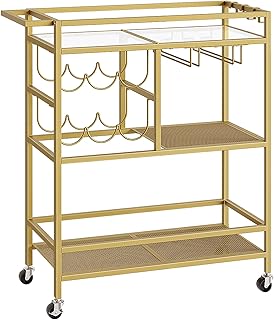
If drinks service is your primary purpose, the MAHANCRIS Bar Cart for Home is the most purpose-designed option in this guide, and its 499 reviews at 4.3 out of 5 stars on Amazon UK reflect how consistently it performs for that specific use case. The three-tier rolling design incorporates a wine rack for proper bottle storage and dedicated glass holders for stemware — making this a drinks cart rather than a repurposed utility trolley.
The wine rack slots hold bottles horizontally, which is the correct orientation for cork-sealed wines during both storage and transport. The glass holders suspend stems so they do not topple when the cart is in motion. If you have ever watched a good glass shatter on kitchen tiles because a flat shelf gave it nothing to grip, you will understand precisely why these fixtures matter. The cart also features a handle — absent from most utility trolleys — that gives you a proper steering grip when fully loaded, which is an ergonomic improvement you notice immediately when navigating around furniture with a full cocktail service on board.
The visual design is more considered than a utilitarian stainless trolley. It is built to sit in a dining room or lounge between uses without looking out of place. The three tiers create a natural hierarchy for a drinks setup: spirits and mixers on the top shelf, stemware secured in the holders, wines racked below. Between entertaining occasions it functions as a proper drinks storage unit rather than something to conceal in the kitchen. That dual role — organised storage station and mobile service cart — is what separates a purpose-built bar cart from an adapted utility trolley.
The tradeoff for this specialisation is straightforward: the wine rack displaces what would otherwise be a full flat shelf, reducing overall carrying capacity for plates and serving dishes. If you need a cart that handles food transport and drinks service with equal efficiency, the VASAGLE or the TUKAILAi will give you more flexibility. The glass holders are sized for standard-stemmed wine glasses; unusually large or deeply curved bowl shapes may not seat securely. For pure drinks hosting, this is the most logical choice in this guide.
MAHANCRIS also offers a closely related model under a separate listing. If the finish or configuration of the featured model does not suit your space, compare both — they belong to the same product family and the choice between them typically comes down to colour preference and current stock availability.
Best for Catering and Heavy-Duty Use
The HLC 3 Tier Stainless Steel Serving Catering Trolley is the most durably built option in this selection, rated 4.5 out of 5 stars from 192 reviewers on Amazon UK, and designed explicitly for professional catering and hospitality environments where a trolley needs to perform daily without degrading in quality or appearance.
The all-stainless-steel construction is the defining characteristic. Every component — shelves, frame tubes, and caster housings — is stainless, which means the cart handles wet conditions, commercial cleaning products, and repeated daily use without the surface degradation that eventually affects powder-coated or wood-finish alternatives. A painted finish develops chips and rust patches after a year or two of frequent kitchen use; a fully stainless trolley does not. For anyone running a small catering operation, organising large-scale events regularly, or working in a hospitality context, the long-term logic of buying once and buying correctly is compelling rather than extravagant.
Three substantial shelves provide ample capacity for a full catering setup — chafing equipment, stacked crockery, trays of glassware, and serving hardware. The locking casters hold the trolley stable on commercial kitchen flooring as well as domestic tile, and frame joints do not flex under significant loads. Assembly is manageable: the components are heavier than those of a domestic cart, but the configuration follows a logical sequence with no ambiguous steps.
The honest limitation is about matching the product to the actual use case. For occasional domestic hosting — dinner parties a handful of times per year — the HLC’s build specification is considerably more than the situation requires, and the price reflects that. The VASAGLE delivers excellent results for domestic use without the additional outlay. The stainless finish also reads as clinical in home environments: well-suited to a kitchen or catering context, but in a dining room with warm furniture and soft furnishings it will look unmistakably utilitarian. That is entirely appropriate for a commercial product — it is simply worth considering if the cart needs to serve a decorative as well as functional role in your home.
Best Mid-Range Stainless Trolley
The Nisorpa 3 Tier Stainless Steel Catering Trolley occupies the space between budget stainless utility carts and the higher-investment commercial options, offering solid stainless steel construction with locking wheels at a price that sits comfortably below the HLC. Its 155 reviews at 4.4 out of 5 stars on Amazon UK represent a smaller but consistently positive body of buyer feedback.
Three stainless shelves mount on a tubular steel frame with four casters, two of which lock, and the whole assembly performs reliably on kitchen tile and sealed hardwood. At 75cm tall, the top shelf sits at a comfortable loading height for most adults — a practical ergonomic consideration that is easy to overlook until you have spent an evening crouching over a shorter trolley to retrieve serving dishes. The stainless shelves clean quickly, resist rust under normal kitchen humidity, and handle the weight of heavy crockery and serving equipment without noticeable flex.
The long-term value case is straightforward: stainless steel does not chip, peel, or rust the way powder-coated or wood-effect finishes eventually do, particularly in environments with heat, steam, and cooking residue nearby. If you want a serving trolley that looks the same in five years as it does on day one, the material choice matters considerably more than the initial price difference between this and a painted alternative. The Nisorpa offers that durability at a more accessible price than the HLC, without giving up anything material in terms of construction integrity.
The tradeoff is aesthetic. Like the HLC, the Nisorpa is purposefully utilitarian in appearance — clean, functional, and easy to maintain, but not decorative. In a dining room with warm furniture and soft furnishings, it will look like a working tool rather than a design object. If the cart needs to live in a lounge or dining room between uses and blend into a domestic interior, the VASAGLE’s rustic finish or the MAHANCRIS’s bar-cart profile will suit the environment more naturally. The Nisorpa belongs in a kitchen, a utility area, or a catering context where performance matters more than presentation.
Nisorpa also offers this trolley in a taller configuration under a separate listing. If you regularly work with large lidded dishes or tall bottles, that additional height clearance may suit your workflow better than the 75cm version — compare both before you commit to a size.
What to Look for in a Serving Cart
Before you filter by price or appearance, work through these criteria to match the cart to your actual situation.
- Wheel quality and braking mechanism. This is the most important functional consideration. Casters should roll smoothly on both tile and hardwood without snagging on floor transitions or leaving marks. Look for a foot-brake system on at least two wheels — toe-operated brakes tend to be more reliable than side-press mechanisms under repeated daily use. A single locking wheel is rarely sufficient; you want two braking casters positioned for balanced stability.
- Shelf material and finish longevity. Stainless steel resists moisture, rust, and heavy kitchen use significantly better than powder-coated or wood-effect finishes over time. If the cart will be used frequently in a kitchen environment, stainless steel is worth the extra investment. For a dining room or lounge setting, powder-coated or wood-finish designs integrate more naturally into domestic décor — just accept that the surface will show wear sooner with regular use.
- Actual usable shelf dimensions. Listed measurements typically refer to the overall cart footprint, not the clear working area on each shelf. Support rails, frame edges, and shelf lips reduce the space available for plates and dishes. Seek out reviews that describe real-world shelf depth, or look for secondary product images showing items actually loaded onto the shelves rather than an empty cart in a staged setting.
- Frame rigidity under load. A cart that wobbles when fully loaded is an inconvenience and a potential hazard. Look for buyer reviews that describe how the cart behaves with weight across all three shelves — whether joints flex or the frame leans to one side. Triangular or cross-braced frame designs tend to be meaningfully more rigid than simple vertical-post configurations at the same price point.
- Assembly complexity. Some carts are foldable and ready to use immediately; others require significant assembly and benefit from having a rubber mallet and extra time available. Check reviews specifically for assembly feedback — particularly whether listed dimensions match the assembled product — before purchasing if ease of setup matters to your situation.
- Height and ergonomics. Most serving carts sit between 70cm and 90cm tall. A cart at the lower end of that range requires more bending when loading and unloading. If you are taller than average or have concerns about your back, a cart at the higher end of the height range will make a noticeable difference over the course of a long hosting evening.
- Use-case clarity. A general utility trolley with flat shelves carries more total volume than a bar cart with a wine rack and glass holders, but the bar cart serves drinks more safely and efficiently. Be clear about whether food transport, drinks service, kitchen storage, or a combination is your primary use before you filter on price or appearance — choosing based on aesthetics alone often leads to a cart that looks right but works poorly.
Our Verdict
For most UK households — a reasonably sized kitchen, dinner parties several times a year, and a general need to move food and drinks between rooms without making multiple trips — the VASAGLE Kitchen Serving Cart is the pick to make. It is the most-reviewed option in this guide for good reason: the combination of a reliable foot-brake wheel system, a removable top tray, levelling feet, and a design that fits naturally into a domestic interior makes it the most versatile and practical choice for the widest range of buyers. The three-tier layout keeps food, drinks, and tableware organised in transit, and the industrial-rustic finish suits the majority of UK kitchen-dining aesthetics without demanding attention.
If you specifically host drinks evenings and cocktail parties more than dinner parties, the MAHANCRIS Bar Cart for Home offers a meaningfully better experience for drinks service specifically — the wine rack and glass holders justify the trade in flat shelf space. For anyone who wants long-term stainless steel durability at a budget price, the TUKAILAi is the right starting point. And for professional or semi-professional catering where the trolley needs to perform daily without compromise, the HLC is built to outlast everything else in this list.
Whatever your situation, any of these five carts is a substantial improvement over carrying everything by hand.
We were not paid to feature any specific product in this guide. All opinions are independent and based on publicly available specifications, verified buyer feedback patterns, and category research.
Quick Comparison Table




FAQ
What weight capacity should I look for in a serving cart?
For domestic use — dinner party dishes, drinks bottles, and crockery — a cart rated for a substantial combined load across all shelves will comfortably exceed what most home-hosting situations require. Focus more on per-shelf ratings than the combined total, since weight distributes across tiers rather than concentrating on one. For catering or professional use, prioritise carts with commercial-grade frame construction designed specifically for sustained heavy loads over extended daily use.
Can a serving cart be used outdoors?
Most serving carts are designed for indoor use only. Powder-coated steel frames will rust if left in wet outdoor conditions, and wood-effect finishes can warp or delaminate with prolonged moisture exposure. Stainless steel models are more weather-resistant, but their casters are typically designed for hard flooring rather than garden surfaces or patios. If outdoor use is a genuine priority, look for a product specifically marketed for outdoor or garden environments rather than adapting an indoor trolley.
What is the difference between a serving cart and a bar cart?
A serving cart is a general-purpose wheeled trolley designed to carry food and tableware between rooms, typically offering flat shelves that maximise carrying capacity. A bar cart is a specialised design that incorporates a wine rack, glass holders, and often a steering handle — features that optimise it for drinks service specifically. Some carts combine both functions, but purpose-built bar carts prioritise drinks organisation over flat shelf space.
How do I stop my serving cart from rolling when I’m loading it?
Look for a cart with locking casters on at least two wheels, ideally positioned on opposite corners of the cart for balanced stability. Foot-operated toe brakes tend to be more reliable than side-press mechanisms under repeated use. Many quality carts also include levelling feet that stabilise the cart independently of the wheels, which is particularly useful on slightly uneven kitchen flooring where a wheeled cart might shift under load.
Are stainless steel serving carts better than powder-coated ones?
For kitchen environments and frequent use, stainless steel outperforms powder-coated finishes significantly over time. Powder-coated steel eventually chips and can rust, particularly around the base and wheel housings where moisture accumulates with regular use. Stainless steel resists this reliably under normal kitchen conditions. The tradeoff is aesthetic: stainless reads as utilitarian, while powder-coated and wood-finish carts integrate more naturally into domestic dining room and lounge settings.
What size serving cart suits most UK kitchens?
A footprint of roughly 35–45cm wide and 55–65cm long suits most UK kitchen and dining room layouts and fits through standard doorways without special manoeuvring. Carts in this size range typically offer three usable tiers at a working height of 70–90cm. If your doorways are narrower than standard or your kitchen is particularly compact, check the assembled width carefully before ordering — a few centimetres in either direction makes a real practical difference in tight spaces.