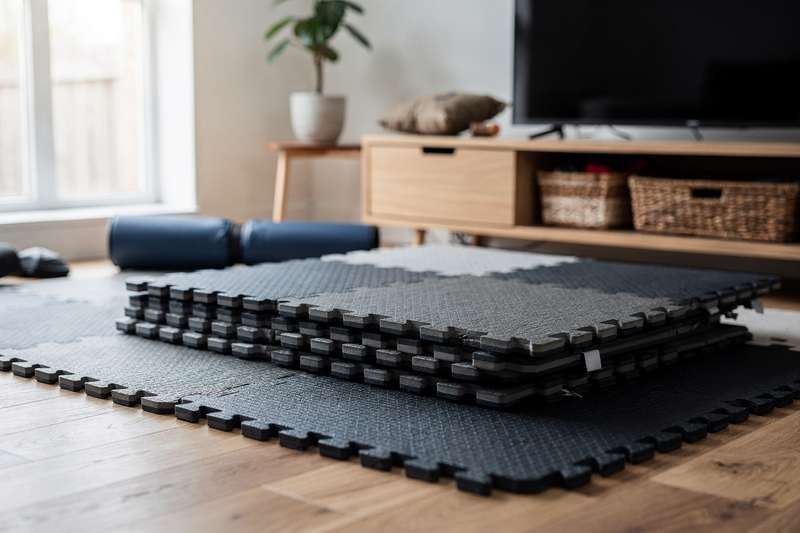
You’ve cleared out the garage floor, pushed the lawnmower into one corner, and marked out a rough boundary in masking tape on bare concrete. Your first attempt at a home grappling setup used those interlocking foam tiles sold for children’s play areas — the kind that separate the moment anyone shoots a single-leg. Then came the yoga mat experiment: workable for solo positional drilling, but a sliding hazard once sweat gets involved and movement becomes dynamic. You’ve trained on carpet, on bare floorboards, and on a borrowed gymnastics crash mat that was two sizes too small. After every session your knees ache, your back protests the hard floor beneath thin foam, and takedown practice feels like calculated risk management rather than committed drilling.
Finding a proper wrestling or grappling mat in the UK is harder than it should be. Search Amazon and you’ll wade through yoga mats, nursery floor tiles, inflatable gymnastics tracks, and general-purpose exercise mats — all loosely tagged with terms like “martial arts” or “wrestling” without much evidence to back them up. Without knowing what separates a genuinely grappling-appropriate surface from a repurposed gym mat, it’s easy to spend money on something that looks right on the product page but fails in training: padded but slippery, grippy on top but skating across your floor underneath, or well-built but far too small to be useful.
This guide addresses that gap. Whether you’re training wrestling, Brazilian jiu-jitsu, judo, or MMA at home — in a garage, spare bedroom, or garden outbuilding — the picks below are the most suitable products currently available on Amazon UK. Every tradeoff is named honestly, because the wrong mat wastes money and the right one changes how consistently and safely you train.
How These Mats Were Evaluated
Selecting a wrestling mat involves more than comparing headline thickness figures. For this guide, each product available on Amazon UK was assessed against criteria that directly affect combat sports training: foam density and thickness relative to impact absorption, surface texture and traction for both standing work and groundwork, cover material quality and longevity under sustained friction, the storage and portability format, and the patterns visible in verified buyer reviews where these existed in meaningful numbers.
Worth being direct about the data available here. The live product catalogue on Amazon UK for wrestling and grappling mats at the time of writing is limited. Two of the three picks in this guide are backed by meaningful verified buyer review volumes — 752 and 65 respectively — and the assessments draw on those feedback patterns. The third pick is a newer listing with no published buyer reviews on Amazon UK; that section is clearly flagged, and the assessment is based on product specifications and comparison with similar products in the category. Where a pick lacks buyer feedback, purchase risk is higher, and checking back for emerging reviews before committing is advisable.
Best Folding Mat for Home Wrestling and Grappling
The PROIRON Gymnastics Tumble Folding Exercise Mat is the standout choice for home wrestling and grappling drilling, with 752 verified buyer reviews averaging 4.6 out of 5 — the strongest evidence base of any product in this guide. Available in both 6 ft and 8 ft lengths, it gives a meaningful size choice depending on available floor space and training ambitions.
The foam core is 4 cm thick — roughly 1.6 inches — and this is the specification to focus on. Four centimetres of high-density foam hits a useful middle ground: firm enough to give stable footing during stance-and-motion drilling, guard recovery, and standing technique work, but cushioned enough to absorb a controlled throw, a sprawl, or a drop-step without jarring joints. Buyer reviews confirm this balance repeatedly. The most consistent praise is that the mat absorbs impact without feeling like landing on the floor, but also without the instability of an overly soft surface. That middle ground is exactly what wrestling training requires, where you need to trust the floor beneath you when driving off your feet.
The PU (polyurethane) leather surface deserves attention because it directly shapes the session experience. PU leather handles the lateral friction of groundwork more effectively than standard vinyl: it resists moisture without becoming slick, holds its surface texture over time rather than cracking under repeated use, and wipes down quickly after training — an important hygiene consideration for daily or near-daily use. The textured finish provides reliable traction for drilling, keeping feet planted during movement without gripping so aggressively that groundwork transitions feel sticky or jerky.
From a practical standpoint, the fold-out design works well for the reality of UK home training. Most people don’t have a dedicated room they can leave permanently equipped — packing down after sessions and reclaiming the floor for daily life is part of the routine. The mat folds to a compact rectangle, and the carry handles allow one person to move it without awkward bundling. The 6 ft version stores readily under a bed or standing in a narrow cupboard; the 8 ft version is heavier and bulkier when folded but still manageable for most adults working alone.
The tradeoffs are clear and worth naming before you buy. A single 6 ft mat is a workable surface for solo drilling — shrimping, bridging, hip escapes, guard recovery movement, and controlled positional work — but it’s too narrow for live wrestling with a partner moving at real pace. You’ll need to lay two mats side by side to create a practical live grappling space, which means a second purchase and a potential seam between mats that can catch a foot during dynamic movement. The 8 ft version gives more room but the same principle applies: committed partner drilling needs a minimum 10 ft × 10 ft area to be safe and effective.
Buyer review patterns are consistent: strength in cushioning, surface quality, and durability; frustration with size limitations for live sparring. Those frustrations are entirely predictable from the product’s dimensions rather than any construction flaw, which is a healthy indicator — the mat does what it claims. For solo drilling, technique refinement, and paired groundwork at controlled pace, the PROIRON is the most reliable and well-documented choice on Amazon UK right now.
Best Inflatable Mat for BJJ, MMA, and Wrestling Training
The FBSPORT Inflatable Wrestling Mat is the most explicitly wrestling- and grappling-specific product in this guide, and the right choice for anyone who trains with real regularity and wants a surface built for the demands of combat sports rather than adapted from gymnastics or general fitness use. It carries 65 verified reviews at 4.6 stars — a strong rating for a specialist product in a category with limited competition on Amazon UK.
The format is fundamentally different from a foam-panel mat. This is an inflatable PVC air mat — available in 5 ft, 10 ft, and 13 ft length options — that inflates to create a large, consistent, and level training surface. The “inflatable” label might suggest instability, but the double-layer PVC construction changes that significantly. When inflated to the correct pressure, the surface is notably firm: buyer accounts describe the feel as closer to a sprung wooden floor than to a bouncy castle, and that firmness is what makes it suitable for wrestling and BJJ rather than just gymnastics. You can plant your foot and drive without the surface deforming unpredictably, which is essential for takedown drilling and live sparring at pace.
The double-layer PVC construction is the engineering feature worth understanding before purchase. Single-skin inflatables have a real limitation: they feel unsteady under dynamic loading and are vulnerable to puncture damage from the friction and impact of regular grappling. The double-layer design addresses both. The structural integrity under load is significantly better, and the outer layer provides a more durable defence against the friction-wear of repeated groundwork and drilling sessions. This is the difference between a mat that lasts six months and one that lasts several years with proper care.
The PVC surface texture is designed to balance non-slip grip with smooth transitions for groundwork. From buyer accounts, it performs well for BJJ drilling, MMA sparring practice, and wrestling takedown repetitions. The mat stays put on hard flooring during use rather than migrating across the room under training load, and the size options let you match the surface area to your actual training needs rather than compromising. A pump is included in the kit, which removes the practical inconvenience of sourcing compatible inflation equipment separately.
Storage is the inflatable format’s most compelling advantage for UK home users. When deflated and folded, even the 13 ft version packs down to a fraction of its inflated footprint — manageable in a car boot, a corner of a garage, or a large holdall. If your training space serves other purposes between sessions, or if you want to transport the mat between locations, this storage efficiency is a practical advantage no foam mat in this guide can match.
The tradeoffs are concrete and worth considering honestly before committing. Inflation time is real overhead: getting a large inflatable to correct firmness takes several minutes even with a pump, and deflating and folding at the end of a session adds further time and effort. If you want to train for thirty minutes at short notice, a folding foam mat is faster to deploy. There’s also a meaningfully higher initial investment compared to the foam alternatives. At 65 reviews, the long-term durability data over twelve or more months of intensive training is less well documented than for the PROIRON. Both factors are worth weighing. For someone committed to regular, high-frequency training in wrestling, BJJ, or MMA, the size options, the double-layer construction, and the wrestling-specific design make the FBSPORT the most capable home training mat on Amazon UK right now.
Best Budget Tri-Fold Mat for Compact Spaces
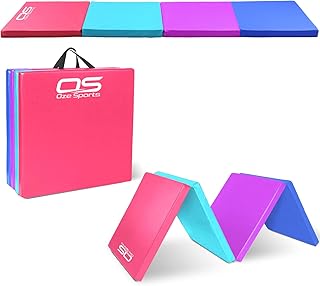
The Gymnastic Tumble Exercise Mat, available in a 6 ft tri-fold configuration with a PU leather surface and high-density polyether foam core, is the most compact and entry-level option in this guide. A direct disclosure upfront: this product has no published verified buyer reviews on Amazon UK at the time of writing. The 4.7 rating visible on the listing reflects very early or limited data rather than an established buyer consensus. If verified review history is central to your purchasing confidence — which is a reasonable position — this pick carries meaningfully higher uncertainty than the other two, and checking back for emerging reviews before committing is strongly advisable.
With that clearly stated, the specifications follow a well-established pattern in the gymnastics and crash mat category. The tri-fold design divides the mat into three equal panels, folding down to roughly one-third of its full training length for storage. Combined with carry handles, this makes it the most portable option in this guide — straightforward to move between rooms, load into a car, or store standing in a narrow cupboard. For anyone training in a flat, a shared house, or any space where floor area is at a premium, the compact folded footprint is a practical advantage over both other picks.
The PU leather surface is consistent in specification with the PROIRON above: moisture-resistant, wipeable, and providing reasonable traction for drilling and light grappling. The high-density polyether foam core is widely used across gymnastics crash mats and entry-level martial arts surfaces, and provides adequate cushioning for technique drilling, breakfall practice, and solo positional work. For a beginner working on movement foundations — shrimping, bridging, guard recovery, and basic positional transitions — the specification on paper is sufficient for building a consistent training habit.
The 6 ft length is an honest constraint, consistent with the limitations of the PROIRON 6 ft version. This surface accommodates one person drilling alone or two people working in close proximity at controlled pace. Any technique involving dynamic full-speed movement, committed takedowns, or a heavier training partner will require two mats placed side by side. The tri-fold panel joins can create slight ridges at the fold lines if the mat hasn’t been fully laid flat and allowed to settle — worth checking before beginning a drilling session to avoid an uneven surface underfoot.
This mat makes most sense as a starting point: a low-commitment entry for someone building a drilling habit and assessing whether a more significant home training investment is warranted before spending further. If you find yourself training consistently, wanting live partner work, and outgrowing the 6 ft surface within a few months, that’s the natural moment to step up to the PROIRON 8 ft version or the FBSPORT inflatable. Treat this as a first mat rather than a permanent training surface, and the expectations are likely to match the reality.
What to Look for When Buying a Wrestling Mat
With a relatively thin product catalogue for wrestling mats on Amazon UK, understanding the buying criteria well enough to evaluate any listing — not just the three picks above — is worth the time.
- Foam thickness and density: Thickness figures quoted in cm or inches are only half the story. A thick layer of low-density foam is softer and less stable than a thinner layer of high-density foam, and for wrestling, stability under load matters as much as cushioning. Look for high-density foam in the 3–5 cm (roughly 1.25–2 inch) range. Below 3 cm, hard landings begin to transmit shock to joints. Above 5 cm in soft foam, standing technique feels unstable because the surface deforms unpredictably underfoot. Competition-grade mats typically use closed-cell polyethylene foam for consistent density and resistance to moisture absorption over time.
- Surface material and texture: PU leather and vinyl are the two main cover options. PU leather handles the lateral friction of groundwork better over time and is less likely to crack or peel with regular intensive use. Vinyl is cheaper to produce and adequate for lighter training loads, but lower-quality vinyl covers can deteriorate noticeably within a year of regular use. Both materials should have a textured rather than smooth finish — grip during footwork is not optional for safe drilling, and a glossy smooth-finish cover is a genuine warning sign on any mat marketed for grappling.
- Stitching and seam construction: The seams, particularly at fold points, are the most common failure location on folding mats. Double-stitched or reinforced seams hold up significantly better than single-pass stitching under the repeated stress of folding and unfolding over months of use. If seam construction is visible in product images, examine it; if the listing shows only shots of the opened mat, check buyer-uploaded photos for evidence of stitching quality before purchasing.
- Format and deployment time: Folding panel mats are the most practical for most UK home setups — quick to open, compact when stored, manageable for one person. Roll-up mats have no panel joins and no surface ridges, but are heavier and require more floor space to unroll. Inflatable mats offer the largest training surfaces in the most compact storage form, at the cost of inflation time per session. Choose the format that matches your actual daily training workflow, not the theoretical ideal.
- Size and expandability: A single 6 ft mat is a starting point rather than a training space. For paired live wrestling or BJJ sparring, aim for a minimum 10 ft × 10 ft area. Check whether the mat uses a hook-and-loop or velcro edge system to connect to other mats from the same range — this makes expanding your surface area much more manageable than attempting to keep separate unconnected mats aligned during live training.
- Non-slip base: A mat that slides across your floor is an active hazard. Look for a rubber-backed or textured underside. On sealed concrete, polished wood, or other smooth hard floors, even a mat with a decent non-slip backing may benefit from a rubberised underlay placed beneath it — the type sold for keeping rugs in place works well and adds minimal bulk to the overall setup.
- Hygiene and cleanability: Wrestling and grappling mats accumulate sweat with regular use and must be cleaned consistently to stay safe. The cover surface needs to be wipeable with a damp cloth and a basic disinfectant spray after every session. Fabric-surface mats absorb moisture, dry slowly, and are significantly harder to keep hygienic — avoid them for any regular grappling use. PU leather and vinyl surfaces clean in seconds, which is one reason they dominate the category across every price bracket.
Verdict
For the majority of UK home wrestlers and grapplers — someone setting up a training space in a garage or spare bedroom, drilling alone or with one regular training partner — the PROIRON Gymnastics Tumble Folding Exercise Mat is the most confident recommendation from this guide. The 752-strong review base at 4.6 stars is the most reliable evidence available in this product category on Amazon UK right now, and the consistent buyer feedback — strong on cushioning, surface quality, and durability — confirms the mat delivers what it claims. The fold-out format suits UK home storage constraints, the PU leather surface handles grappling demands better than general-purpose alternatives, and the 4 cm foam density hits the right balance for solo drilling and controlled partner work. If space allows, buy the 8 ft version and pair two mats side by side for a practical live grappling area.
If you’re training seriously and frequently — multiple sessions per week, live sparring, a committed programme in wrestling, BJJ, or MMA — the FBSPORT Inflatable Wrestling Mat is the better match for that level of commitment. The larger size options (up to 13 ft), the double-layer PVC construction, and the wrestling-specific design make it more suitable for the demands of intensive regular training than any folding foam mat can be. Factor inflation time into your session structure from the start and it becomes a capable, storable daily training surface.
The Gymnastic Tumble Exercise Mat is a reasonable first-step option for someone new to home training who wants a low-commitment, compact starting point. The absence of verified buyer reviews at the time of writing makes it harder to recommend with confidence — check the listing for emerging reviews before purchasing, and treat it as an entry point rather than a long-term training surface.
We were not paid to feature any specific product in this guide. All opinions are independent and based on publicly available specifications, verified buyer feedback patterns, and category research.
Quick Comparison Table




FAQ
What thickness wrestling mat is best for home training?
For most home wrestlers and grapplers, a mat in the 3–5 cm (roughly 1.25–2 inch) range works well. This provides enough cushioning for controlled throws and sprawls without creating an unstable surface for footwork and standwork. If your training involves heavier throws or larger training partners, lean toward the upper end. Below 3 cm, hard landings start to transmit shock to joints; above 5 cm in low-density foam, standing technique can feel unsteady because the surface deforms underfoot.
Can I use a gymnastics mat for wrestling training?
Yes, in most cases a quality gymnastics tumbling mat works well for wrestling and grappling drilling, provided it has sufficient high-density foam (at least 3–4 cm), a non-slip textured PU leather or vinyl surface, and a stable non-sliding base. The crossover between gymnastics, wrestling, and BJJ mats is significant at the home training level. Where gymnastics mats fall short for wrestling is typically in size — a single 6 ft panel is adequate for solo drilling but insufficient for live partner work at real pace.
How much space do I need for a home wrestling mat setup?
For solo drilling and technique practice, a 6 ft × 4 ft surface is a functional minimum. For live wrestling or BJJ sparring with one training partner, aim for at least 10 ft × 10 ft. Most home setups reach this by laying two or three folding mats side by side. If you’re drilling full takedown sequences or practising throws with real follow-through, a 13–16 ft length gives more breathing room and reduces the risk of landing off the edge of the mat.
What is the difference between vinyl and PU leather surfaces on wrestling mats?
Both are wipeable, moisture-resistant cover materials, but they perform differently under sustained grappling use. PU leather handles the repeated lateral friction of groundwork better than standard vinyl, resists cracking and peeling over time, and tends to maintain its surface texture longer under intensive training. Standard vinyl is adequate for lighter use, but lower-quality vinyl covers can show significant wear within a year of regular training. For either material, a textured rather than smooth finish is important — grip during footwork is non-negotiable for safe drilling.
How do I stop my wrestling mat from sliding on a hard floor?
First check that the mat’s underside has a rubber or textured backing designed to grip hard flooring — most dedicated wrestling and grappling mats include this. If the mat still shifts during training, place a rubberised non-slip underlay between the mat and the floor (the type sold for keeping rugs in place works well and adds minimal bulk). On sealed concrete or polished wood floors, this step is often necessary regardless of the mat’s own backing material.
Are inflatable wrestling mats worth it for home training?
Inflatable mats work well for home training when you need a large training surface but have limited permanent space — they pack down dramatically when deflated, making them far more storable than an equivalent foam mat. Quality double-layer PVC inflatables deliver a firm, stable surface suitable for live rolling and not just drilling. The main practical tradeoff is setup time: several minutes to inflate before training and similar effort to deflate and fold after. For casual solo drilling, a folding foam mat is more convenient day-to-day; for regular high-frequency partner training, the larger surface area often justifies the overhead.