Picture this: you’ve been playing squash for a few months, using a pair of general-purpose cross-trainers you picked up at a sports superstore. They feel comfortable, they’re broken in, and your feet don’t hurt — so why change? Then one Tuesday evening you go for a wide shot in the back corner, your trailing foot slides on the polished court floor, and you land awkwardly on your outside ankle. Not a sprain, but close. Your training partner glances at your shoes and says nothing. You both know.
Or perhaps you’re coming at this from the other direction: you’ve been playing seriously for years, wearing the same dedicated court shoes until they’ve finally given up. The outsole has gone smooth, the heel cushioning has compressed to nothing, and the upper has started to separate along the toe — classic signs of a shoe that has done its job and given up. Now you need a replacement, and searching online returns a muddled mix of running shoes, gym trainers, and generic court shoes that may or may not be suitable for a squash court.
Squash punishes footwear in specific, unforgiving ways. The continuous lateral lunges, the grinding toe drag when you push off from the back corners, the sudden stops after a hard sprint to the front of the court — all of it happens on a slick hardwood or synthetic surface that demands proper grip and sideways stability. Running shoes have the wrong tread pattern, too much heel lift, and almost no lateral reinforcement. Generic trainers leave you sliding. This guide cuts through the confusion and gives you six picks you can buy right now on Amazon.co.uk, from budget-friendly club shoes to performance-grade options built for the court.
How These Picks Were Chosen
Selecting squash shoes requires a specific set of criteria, and the picks below were assessed against all of them: non-marking gum-rubber outsoles (required on almost every squash court in the UK), lateral stability and reinforced side walls to protect ankles during sharp direction changes, sole profile and court feel, upper breathability for hot court sessions, durability based on construction quality and brand track record, and fit range — including options for players with wider feet.
Three of the six picks have substantial verified buyer feedback on Amazon.co.uk, and those are identified clearly with their review counts. The remaining three are newer or less-reviewed listings where assessment draws on design specifications, intended use category, and brand history in indoor court footwear — each is flagged individually in its section. Every shoe selected is designed for indoor court sports; no running shoes or general gym trainers made the cut.
Best Overall: adidas Ligra 8 Indoor Shoes
If you play squash two to four times a week and want one shoe that handles everything competently without requiring a significant outlay, the adidas Ligra 8 Indoor Shoes is the place to start. With 752 verified ratings on Amazon.co.uk averaging 4.5 out of 5 stars, it has earned consistent praise across squash, badminton, and volleyball — and that breadth across court disciplines is a mark in its favour. Shoes that perform reliably across multiple court sports tend to offer solid all-round capability rather than something optimised for one narrow edge case.
The Ligra series has been one of adidas’s workhorse indoor court ranges for years, and the Ligra 8 refines a formula that already worked. The upper is lightweight and breathable — court sessions get warm fast, and trapped heat leads to foot fatigue faster than people realise. The non-marking rubber outsole uses a herringbone-style grip pattern designed for the rapid direction changes that squash demands. You will not find yourself skating across the court the way you might in cross-trainers with worn-down treads.
Lateral support is where this shoe does its most important work. The reinforced sidewalls help contain the foot during hard lateral lunges — those moments when you’re diving wide for a ball in the front corner and placing serious sideways stress through your foot and ankle. It won’t replace ankle strapping if you’ve had a previous injury, but for most recreational and club-level players it provides solid stability where it counts.
The cushioning sits in a useful mid-range: enough to absorb the repetitive impact of a hard match, but the sole is not so thick that you lose court feel. Some players prefer a minimal sole for maximum feedback from the surface; others want more cushioning for joint protection over longer sessions. The Ligra 8 sits between those two poles, which is exactly why it suits the widest range of players.
One consistent note from buyers: like many adidas court shoes, the Ligra 8 can run slightly narrow for players with medium-to-wide feet. If your feet tend towards the wider side, consider sizing up half a size, or look at the FitVille option described below. For most players of standard width, though, this is the shoe that works — reliable grip, adequate cushioning, good stability, and a track record backed by over 750 real-world buyers.
Best Budget Pick: Hi-Tec Men’s Squash Shoes
Not everyone wants to spend on performance-tier footwear, particularly if you’re still figuring out whether squash will become a regular habit or you only play once a week for social reasons. The Hi-Tec Men’s Squash Shoes addresses that segment directly, and with 498 reviews averaging 4.5 out of 5 stars, the feedback pattern is genuinely strong for an entry-level court shoe.
Hi-Tec is a British brand — founded in 1974 and long associated with accessible, practical sports footwear in the UK market. They’ve been making dedicated squash shoes for decades, and that heritage shows in a design that doesn’t try to be clever or fashionable but simply does what a squash shoe needs to do: non-marking rubber outsole, adequate grip for court surfaces, and a reasonably supportive upper that keeps the foot from rolling during lateral movement. The classic white and green colourway is very much old-school squash — if you’ve been playing since the 1990s, these will feel familiar.
The tradeoffs are real and worth knowing before you buy. The midsole cushioning is minimal compared to something like the ASICS Gel-Rocket 12 or the adidas Ligra 8. For a 40-minute lunchtime session, that’s fine. For an hour and a half of hard match play, you may feel more impact through your knees and heels by the end. The build quality is also honestly entry-level: stitched rather than fused in places, which means durability depends quite a bit on how aggressively you drag your toes during play. Heavy toe draggers will likely wear through the toe area faster than with a more premium option.
Sizing tends to run fairly true to size, and the standard-width fit suits most players. Buyer reviews frequently mention the shoe breaking in quickly and feeling comfortable from the first session — useful for anyone who doesn’t want a week of blisters while a new shoe moulds to their foot.
For a beginner who isn’t sure how committed to the sport they’ll become, or a player who just needs a reliable backup pair to keep in the kit bag, this is a sensible starting point. Don’t expect two years of heavy use from it, but for lighter play it represents honest value from a brand that has been making squash shoes for longer than most alternatives in this guide have existed.
Best Cushioned Pick: ASICS Men’s Gel-Rocket 12
The ASICS Men’s Gel-Rocket 12 is the pick if cushioning and shock absorption matter most to you — whether because of joint concerns, a heavier build, or because you play long sessions and your knees feel it the following morning. With 355 reviews averaging 4.4 out of 5 stars, it has a solid evidence base, and ASICS’s Gel-Rocket series has been one of the most consistently recommended court shoe lines in the squash community for years.
ASICS’s approach with the Gel-Rocket line is to pack in more cushioning than a typical lightweight court shoe without pushing so far into maximal-cushioning territory that you lose court responsiveness entirely. The Gel cushioning units in the heel absorb impact effectively — this matters when you’re stopping hard from a sprint to the back wall, and your joints notice the difference. The trade-off, as it always is with cushioning, is a slightly heavier and less nimble feel underfoot. If you’re a fast-moving player who prioritises agility over comfort, the adidas Ligra 8 or the Speedcourt option may suit you better.
The outsole is non-marking and uses a patterned rubber compound tuned for indoor court surfaces. Grip is confident in multiple directions — particularly important during the diagonal push-off when you’re recovering from a front-corner shot back to the T position. Lateral stability is solid; the upper holds the foot well during sideways stress without feeling restrictive. One consistent observation across ASICS court shoe models: the toe box runs slightly narrow. If you have wider feet or a squarer toe profile, check sizing carefully or consider the FitVille option instead.
Where the Gel-Rocket 12 earns particular praise in buyer feedback is durability. ASICS uses quality construction throughout — the bonding between upper and sole handles toe dragging well, and players report these lasting through a year or more of regular play. That longevity, combined with the cushioning package, makes this especially worthwhile for anyone playing three or more times a week who doesn’t want to replace their shoes every few months.
If you’re returning to squash after a knee or ankle injury, or if you simply want your joints to feel better during and after play, this should be near the top of your list. The cushioning won’t eliminate impact, but it reduces it meaningfully over the course of a long session — and over a full season, that adds up considerably.
Best for Wide Feet: FitVille Mens Wide Fit Tennis Badminton Squash Shoe
Wide feet are underserved by the court shoe market. Most brands default to a standard-width fit that leaves players with broader feet either cramped across the forefoot or forced to size up and deal with heel slippage. The FitVille Mens Wide Fit Tennis Badminton Squash Shoe is specifically built around this gap, with an explicitly wider last designed for feet that don’t fit conventional court shoe shapes comfortably.
One transparency note upfront: this listing had no verified buyer reviews on Amazon.co.uk at the time this guide was written. The assessment here is based on FitVille’s design specifications, the brand’s established positioning as a wide-fit specialist, and the product’s stated intended uses — which explicitly include squash, badminton, tennis, and volleyball. That’s less evidence than the three reviewed picks in this guide, so weigh that accordingly in your decision.
FitVille has built its reputation specifically around wide-fit footwear across sports and lifestyle categories. Their court shoe uses a wider toe box and expanded midfoot to accommodate feet that would otherwise feel pinched in a standard shoe. The non-slip rubber outsole is appropriate for indoor court surfaces, and the design reflects the lateral movement demands of racket sports. The upper appears to use a breathable mesh-and-synthetic combination that provides structure without being rigid — for wide-footed players, that sidewall structure matters because a too-soft upper can allow excessive lateral foot roll under heavy directional loads.
The cushioning is adequate rather than exceptional; this isn’t the pick for players prioritising maximal joint protection. But it is the right pick for players who have been getting blisters on their little toe, losing circulation in their foot during longer matches, or finding that pressure from a too-narrow shoe makes their feet ache before the session is even over. Dedicated wide-fit court options are rare enough that this belongs in the shortlist for anyone who regularly struggles with standard-width shoes.
If you’re uncertain about fit, check whether the retailer offers a return option on unworn items — that safety net matters more for an unreviewed product than it would for something backed by hundreds of verified buyers with clear sizing notes to guide you.
Best Lightweight Option: adidas Speedcourt Indoor Shoes
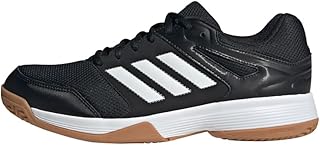
Speed-focused players — those who move quickly around the court and prioritise agility over cushioned comfort — tend to prefer a lower-profile, lighter shoe that keeps them feeling close to the ground. The adidas Speedcourt Indoor Shoes is designed for exactly that type of player, with a court-specific profile that prioritises responsiveness over padding.
Transparency note: this listing had no buyer reviews on Amazon.co.uk at the time of writing. The analysis draws on the product’s design category, the Speedcourt name’s explicit performance positioning, adidas’s consistent track record in indoor court footwear, and the known characteristics of speed-oriented court shoes as a category. Factor that in when deciding.
Compared to the adidas Ligra 8, expect a snappier, more reactive feel underfoot — less padding but more court feedback and typically a lighter overall weight. For a fast mover who is light on their feet and doesn’t rely heavily on the shoe to absorb impact, this is an appealing option. You feel more of the court under you, your footwork feels more immediate, and the overall experience is more like a sprint flat than a cushioned road shoe. For a heavier player or someone with joint concerns, the reduced cushioning will become noticeable and potentially uncomfortable over longer sessions.
The non-marking outsole and lateral support structure are both designed for indoor court use, so the core requirements for squash are met. adidas’s indoor court footwear has a solid reputation for durability — the outsole compounds used in this category tend to hold up to the lateral stress and surface friction that squash generates. Without buyer reviews to confirm this for the Speedcourt specifically, that reputation provides the basis for its inclusion here.
This is a pick for players who already know they prefer a minimal, fast feel underfoot and want something specifically designed for court sports. If you’re not sure which style suits you, start with the adidas Ligra 8 to experience the mid-range cushioning approach first. If you try it and find yourself wanting less underfoot and more agility, the Speedcourt is the natural next step in that direction.
Best Unisex Court Shoe: PUMA Unisex Varion II Indoor Court Shoe
Court shoes designed as unisex are practical for players who prefer a broader size range or for households where more than one person uses the same equipment. The PUMA Unisex Varion II Indoor Court Shoe offers a court-specific design across a full unisex size range — a useful option that the other picks in this guide, most of which are men’s-specific models, don’t cover.
Transparency note: this product had no buyer reviews on Amazon.co.uk at the time of writing. The pick is based on PUMA’s established presence in indoor court sports, the Varion II’s design as a purpose-built court shoe, and the practical value of having a unisex sizing option represented in this guide.
PUMA has made consistent progress in the indoor court sports market, competing in badminton, squash, and volleyball categories alongside ASICS and adidas. The Varion II positions itself as a mid-range performer with non-marking outsoles, lateral support, and an upper built for multi-directional movement. The second-generation designation suggests the brand incorporated real-world feedback from the original Varion and refined the areas where it fell short — typically a sign of incremental improvement rather than a wholesale redesign, meaning the original’s strengths are preserved.
The unisex sizing is worth thinking through practically. Unisex court shoes typically use men’s sizing — if you’re a woman using this guide, the general rule is to go approximately 1.5 sizes down from your standard UK women’s size. PUMA’s unisex fit profile tends to be slightly more accommodating than strictly men’s-specific designs, which can make these useful for players who find standard men’s shoes too narrow but don’t need the full wide-fit engineering of the FitVille option.
Based on PUMA’s court shoe range generally, cushioning is likely to be on the firmer side — which suits players who want more court feedback and a direct feel underfoot, but may disappoint those who rely on cushioning for joint protection over long sessions. The outsole durability track record for PUMA indoor court shoes is good. With no buyer reviews available yet, those are the terms on which this pick rests, and you should weigh them accordingly.
What to Look For in Squash Shoes
- Non-marking outsole — This is non-negotiable. The vast majority of squash clubs and leisure centres in the UK refuse court access to shoes that leave marks. Gum rubber soles — typically amber or translucent in appearance — provide good grip on hardwood and synthetic surfaces without transferring residue onto the floor. Any shoe marketed specifically as a squash or indoor court shoe should have a non-marking sole; if the product description doesn’t confirm this explicitly, don’t assume it does.
- Lateral stability — Squash is predominantly a sideways sport. You’re lunging wide, pushing off laterally, and stopping abruptly far more than in any straight-line discipline. Look for reinforced sidewalls, a relatively wide and flat sole profile that keeps your centre of gravity low, and a snug-but-not-constrictive heel cup. A running shoe, built for heel-to-toe forward motion, offers almost none of this protection — and its tread will typically mark the court as well.
- Sole thickness and court feel — Thinner soles keep you closer to the court surface and sharpen your ability to sense foot position and load in real time. This suits aggressive movers who benefit from quick, responsive footwork. Thicker, more cushioned soles absorb more impact, which is better for joint protection over long sessions or for heavier players. Neither is objectively superior; choose based on your movement style, build, and injury history.
- Toe reinforcement — A significant proportion of squash players drag their toe during the recovery step and when pushing off from the front corners. This wears through shoes quickly if the toe area isn’t reinforced. Fused construction — where the upper and sole are bonded rather than stitched — handles this abuse considerably better. If you know you drag your toes, look specifically for mentions of reinforced toe areas in product descriptions.
- Breathability — Court sessions generate heat fast. A breathable mesh upper reduces heat build-up and sweat accumulation, which matters both for comfort during play and for shoe longevity after. Cheaper shoes sometimes use more synthetic, less breathable uppers to reduce cost — worth checking if you play intensively or in a warm facility.
- Sizing and fit width — Court shoes often run narrower than casual trainers from the same brand. Many experienced court shoe buyers report needing to size up half a size from their usual measurement. If you have wider feet, most standard-width court shoes will feel cramped — a dedicated wide-fit option is a better starting point than simply sizing up in a narrow last, which creates heel instability without solving the forefoot problem.
- Weight — Lighter shoes feel faster. Heavier shoes — typically the more cushioned ones — feel more protective but more cumbersome underfoot. Most recreational players won’t notice a meaningful weight difference between otherwise similar models, but competitive players who prioritise foot speed may find it a worthwhile differentiator at the margins.
Verdict
For the majority of club-level squash players in the UK, the adidas Ligra 8 Indoor Shoes is the pick to go with. It carries the strongest combination of verified buyer feedback — 752 reviews averaging 4.5 stars — alongside all-round court performance that covers most players’ requirements. The non-marking outsole does what the court demands, the lateral support is solid for recreational to club-level play, and the cushioning sits in a useful middle ground without sacrificing court feel. It is the kind of shoe you lace up and stop thinking about, which is exactly what you want from footwear.
If your budget is tight or you’re in the early stages of the sport, the Hi-Tec Men’s Squash Shoes is a sensible starting point. The buyer feedback is strong for the price tier, and it’s a purpose-built squash shoe from a long-established UK brand — not a repurposed gym trainer with court suitability added to the listing.
For players with joint concerns or a history of knee or ankle problems, move directly to the ASICS Men’s Gel-Rocket 12. The cushioning is meaningful in practice, durability is excellent, and the Gel-Rocket line has a well-established track record in the squash community. If you play three or more times a week, the extra investment is worthwhile across a full season.
Wide-footed players should take the FitVille seriously, even with the absence of buyer reviews — because the alternative of squeezing into a standard-width shoe leads reliably to blisters, black toenails, and compromised lateral stability. A shoe that fits properly is more valuable than one with a long review history that leaves your feet in pain by the second game.
This guide was produced independently. We were not paid to feature any specific product in this guide. All opinions are independent and based on publicly available specifications, verified buyer feedback patterns on Amazon.co.uk, and category research in indoor court footwear.
Quick Comparison Table



FAQ
Can I wear running shoes for squash?
Running shoes are not suitable for squash. They are built for heel-to-toe forward motion rather than the rapid lateral movements squash demands, and most running shoe outsoles will leave marks on a squash court — which means many facilities won’t allow you on court in them. The lack of sidewall reinforcement also leaves your ankles exposed during side-to-side lunges. A dedicated court shoe is a safety consideration as much as a comfort one.
How long do squash shoes typically last?
This depends on how often you play and how aggressively you drag your feet. For a player hitting the courts twice a week, a well-made pair should last 12 to 18 months before the outsole or cushioning degrades noticeably. Heavier players or aggressive toe draggers may go through a pair in under a year. The toe area and heel cushioning are the first things to check — when the toe begins to separate from the upper or the heel feels flat, it is time to replace.
What is the difference between squash shoes and badminton shoes?
Functionally very similar — both require non-marking outsoles and prioritise lateral stability on indoor court surfaces. Squash shoes may have slightly more toe reinforcement due to the toe-dragging movements common in squash, while badminton shoes sometimes have a slimmer profile suited to quicker, shorter footsteps. In practice, many court shoes are marketed for both sports and perform well for either, which is why several picks in this guide appear across both squash and badminton product categories.
Do squash courts in the UK require non-marking soles?
Almost universally, yes. Squash courts in UK leisure centres and clubs require non-marking soles as a condition of court use. Shoes that leave rubber marks on the floor are typically refused because the marks affect other players’ footing and are difficult to remove. Any shoe sold specifically as a squash or indoor court shoe should have a non-marking sole, but check the product description explicitly if you’re considering a multi-sport option.
Do squash shoes run true to size?
Court shoes as a category tend to run slightly narrower than casual trainers from the same brand, and the toe box is often more snug. ASICS court shoes in particular have a notably narrow fit, and many buyers recommend going half a size up. The safest approach is to check sizing observations in buyer reviews for your specific model, measure both feet, and if in doubt, size up half a size from your usual measurement.
Are there squash shoes for women available on Amazon.co.uk?
The current Amazon.co.uk catalogue for squash-specific shoes skews heavily towards men’s sizing, which is reflected in this guide. Women players have two practical options: use a men’s or unisex shoe by going approximately 1.5 to 2 sizes down from a standard UK women’s size, or look at badminton shoe ranges that more often include women’s-specific sizing. The PUMA Varion II in this guide is listed as unisex and may offer a more accommodating fit across a wider range of foot profiles than most men’s-specific options.