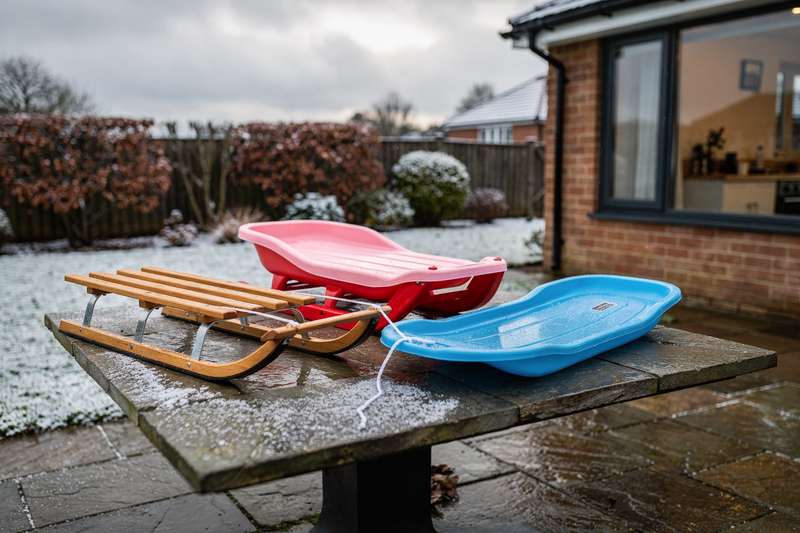
The weather forecast mentions snow overnight. By morning, there’s a proper covering on the local hill — the kind that actually sticks, the kind that turns the long slope behind the park into the most exciting place in the neighbourhood for the next few hours. Your children are dressed and at the door before you’ve finished breakfast. Then comes the question: where’s the sledge?
If you’ve spent more than a couple of winters in the UK, you know this situation intimately. Either the sledge vanished after last season — cracked, thrown away, lent to a neighbour who moved — or it never existed at all, and you’re about to spend twenty minutes fashioning something from a bin bag while every other family glides past on proper kit. Britain’s snow is infrequent, unpredictable, and often brief. When a good snowfall arrives, the window is real and it closes fast. A broken or absent sledge doesn’t just mean frustration — it means missing the whole thing.
This guide cuts through the noise. The UK Amazon market for snow sledges includes some genuinely solid heavy-duty plastic options — and a fair amount of thin, overpriced rubbish that looks identical in photos. After filtering out fitness training sleds, swimming equipment, and other obvious strays from the live product pool, four genuinely on-topic snow sledges with real buyer feedback remained. All four are covered here honestly: what they’re best for, where they fall short, and which one belongs in your garage before the next forecast appears.
How the Picks Were Evaluated
Four criteria drove the assessment of each product. First, build quality and material rigidity: UK snow is rarely the dry powder found on Alpine ski runs — it’s more often a wet, compacted mix that presses hard against the base of a sledge and tests the structural integrity of the plastic on every run. Thick-walled, rigid construction performs meaningfully better than thin, flexible plastic, which flexes under load, slows down, and eventually cracks at stress points around the rope attachment and front curve. Second, practical features: whether a tow rope is included and how robustly it’s attached, the presence of side handles or grip points, and how rider weight is accommodated across the body of the sledge.
Third, size and age range versatility: a sledge that only genuinely works for one age group is a more limited purchase than one that can be shared across a family over multiple seasons. Fourth, buyer feedback patterns on Amazon UK — not simply the star average, but what reviewers specifically described about real-world performance in varied snow conditions. It’s worth acknowledging upfront that only four clearly on-topic snow sledge products with verified buyer reviews were available in the current Amazon UK catalogue once off-topic listings were removed. This guide covers all four with equal honesty.
Best Twin Pack for Families with Multiple Children
The Blue Plastic Heavy Duty Snow Sledge Toboggan Sleigh Bobsleigh 2pc addresses the most common snow day logistics problem directly: more than one child, one sledge, and an argument before anyone has even reached the hill. Rated 4.8 out of 5 stars from 15 UK buyers — the highest rating in this shortlist — it also delivers two complete, ready-to-use sledges in a single purchase, which makes the maths work for families in a way that a single unit simply cannot.
The heavy-duty plastic construction here is the real differentiator from cheaper alternatives. The walls are thick enough to maintain their shape under the weight of a child on varied snow surfaces, including the harder-packed, partially iced runs that form on popular UK sledging slopes after a day of heavy use. Thin-walled plastic flexes under load, which slows the sledge down, creates an uncomfortable sensation under the rider, and eventually leads to cracking at the stress points — most commonly at the front curve and around the rope anchor. A rigidly constructed base avoids all of this, maintaining a consistent profile that tracks predictably from run to run.
The bobsleigh-style body profile on this pair typically includes a moulded seat area with shaped sides that provide natural hand-grip positions for younger riders. A child who can hold the sides firmly has real control over their experience — they can lean to steer, brace for bumps, and feel secure in a way that isn’t possible on a flat sheet-style sledge with nowhere obvious to grab. That sense of control is particularly important for children who are new to sledging, or who are nervous about speed on steeper runs.
Storage is the honest tradeoff. Two stacked sledges take up more garage or shed space than one, though they do sit neatly together when stacked. Both sledges share the same blue colourway — which suits most households perfectly well, but may generate the kind of dispute that only contrasting colours avoids. If colour differentiation matters more in your household than the twin-pack convenience, the colour-choice option further down this guide is worth considering instead.
At 15 reviews, the evidence base is relatively compact. A 4.8-star average is impressive, but it’s built from a smaller pool of buyers than you’d ideally want before making a confident long-term assessment. The reviews that exist are consistent in praising both the durability and the convenience of the twin format, and there are no patterns of early structural failure in the feedback — which is reassuring even if the sample isn’t vast. For families with two children aged roughly five and older who both want to sledge at the same time, this is the strongest pick in the shortlist.
Best for Older Kids and Adults
If you need a single, substantial snow sledge that genuinely accommodates older children, teenagers, or adults who want to participate rather than just watch from the sideline, the Heavy duty large plastic sledge with rope winter outdoor snow kids toboggan sled is the right pick. It carries 4.7 out of 5 stars from 11 UK reviewers — the second-highest rating in this guide.
The “large” descriptor is the key characteristic that sets this apart. A surprising number of plastic sledges sold on Amazon UK are optimised for the five-to-ten age group: adequate for a seven-year-old, uncomfortable for a twelve-year-old, and borderline impractical for a parent who fancies a go. A large-format sledge offers a longer and typically wider seating area, which changes the experience significantly for taller riders. Older children can sit in a proper riding position without their knees bunched up at the sides. Adults can fit comfortably rather than perching precariously on something clearly designed for someone thirty kilograms lighter.
The included tow rope deserves more attention than it usually gets in product descriptions. On any slope, you go down once and then you walk back up — again and again, for as long as you’re there. Carrying a large plastic sledge up a slippery hill under your arm, wearing thick winter gloves, is genuinely awkward and tiring. It destabilises your footing and puts a lot of strain on your arms. A rope attached to the front nose of the sledge changes this completely: hold the end of the rope and pull the sledge behind you, both hands free to aid your balance on the ascent. After twenty runs on an icy afternoon, the presence of that rope becomes the difference between an enjoyable day and an exhausting one.
Heavy-duty plastic on a large-format base is particularly important because a bigger base flexes more noticeably if the walls are thin. A rigid construction across a longer and wider footprint maintains its shape throughout the run, tracks straight on compacted snow, and handles the transition between surface types — soft fresh snow, harder packed areas, the occasional frozen rut — without shuddering or losing direction. That predictability matters for older riders who are travelling faster and have less margin for sudden changes in the sledge’s behaviour.
The tradeoffs are storage footprint and manoeuvrability for very young children. A large sledge occupies more space in a garage or shed, and it’s slightly heavier and bulkier for a young child to carry or manage independently. If you’re buying for a younger child heading out with friends rather than parents, a more compact option may be easier for them to handle. But for parent-and-child outings, or for a teenager who wants a sledge that fits properly rather than something they’ll outgrow in a season, this is a well-reviewed and properly proportioned choice.
Best All-Rounder for Family Outings
The Heavy Duty Snow Sledge Durable Plastic Sled for Kids & Adults, Ideal for Family Bonding Sleigh with Sturdy Rope Snow Sledge Plastic Sledge holds 4.2 out of 5 stars from 16 reviewers — the second-highest review count in this guide — and the “family bonding” framing in its listing is more substantive than it sounds. This product is explicitly designed for a range of users across the same family outing, rather than being optimised narrowly for one age group.
The “kids & adults” positioning matters because it influences both the size of the sledge and the structural choices made in its construction. A sledge genuinely intended for adult use needs a larger seating area and a sturdier base than one designed purely for children. The body here is proportioned to accommodate a wide range of rider sizes — younger children won’t rattle around on something oversized, and adults can use it without pushing the plastic beyond what it was built to handle.
The “sturdy rope” callout in the product description points to one of the most practically significant features on any sledge: the quality of the rope and its attachment point. On cheaper plastic sledges, the tow rope anchors to a thin moulded loop at the front of the body. After a season or two — sometimes after just one vigorous afternoon — that loop cracks away from the body of the sledge, leaving you with a detached rope and a sledge that can only be carried. A reinforced anchor point and a thick, grippable rope make a real difference over the course of a winter, particularly if the sledge is being used multiple times through a heavy snowfall.
Buyer feedback patterns across 16 reviews indicate consistent performance in UK conditions. Reviewers specifically note the build quality and multi-user versatility as positives, and there are no recurring complaints about early structural failure — which is the most common failing of budget-tier plastic sledges when the material is too thin. A 4.2 rating across 16 reviews isn’t as striking as the 4.8 from the twin pack, but it represents a slightly wider body of evidence built across at least one or two UK winter seasons.
The honest tradeoffs: this isn’t the largest sledge in the shortlist, so very tall adults may find it slightly snug for a comfortable riding position; and it’s a single unit rather than a pair, so two children wanting to go simultaneously will still need to take turns. But as one versatile, robust plastic sledge for a household that wants a do-everything option without fuss, it’s a reliable and well-supported choice backed by the most reviewer feedback of any single-unit option here.
Best for Colour Choice
The Heavy Duty Colour Large Adults Kids Children Snow Sledges Toboggan Sledge Rope Sled Play Snow Ice carries 21 reviews with a 4.1-star average — the widest feedback base in this guide, suggesting it has been through more seasonal use cycles than the newer listings. The word “Colour” in the title isn’t decorative: it signals that this listing offers a choice of colour options at purchase, which affects the buying experience in ways that are easy to underestimate.
Colour choice is more practically significant than it first appears in the context of children’s outdoor equipment. When you’re buying a sledge for a specific child, a preferred colour can determine whether they’re immediately enthusiastic or quietly disappointed — and on a snow day when excitement is the whole point, that distinction matters. More practically, on a busy hill where a dozen similar-looking plastic sledges are scattered between runs, a distinctive colour makes yours easy to spot and retrieve quickly. If you’re buying for two children as separate purchases rather than going the twin-pack route, contrasting colours mean each child immediately knows which one is theirs.
The “Large” and “Adults Kids Children” descriptors confirm this is a full-size product rather than a junior-format one restricted to younger children. Full-size, adult-compatible construction means genuine longevity as the child it’s bought for grows through middle childhood and into their teens. A sledge that’s already too small by the following winter represents poor value; one that remains usable across multiple seasons is a meaningfully different proposition.
The rope inclusion is standard for this product tier and non-negotiable — there’s no sensible reason to buy a sledge without a tow rope. The “Snow Ice” reference at the end of the title indicates the base is designed to perform on both snow and harder icy surfaces, which is relevant in UK conditions. After a few days of freeze-thaw cycling on a popular local slope, the surface becomes more ice than snow, and a base that handles ice without becoming completely uncontrollable is both safer and more enjoyable to use.
Reviewer feedback across the 21 reviews is broadly positive, with buyers consistently noting the sturdiness and overall size as highlights. A small proportion mentioned the rope attachment point could be more robust — worth checking the current listing to see whether this has been addressed in more recent stock. As the most budget-conscious option in this shortlist, it won’t outperform the higher-rated picks on any individual specification, but its combination of genuine colour choice, full-size construction, and the widest feedback base makes it the straightforward recommendation when a specific child’s colour preference is a real factor in the decision.
What to Look For When Buying a Snow Sledge or Toboggan
- Plastic thickness and body rigidity: This is the single most important factor separating a sledge that performs well from one that disappoints. Thin plastic flexes under the rider’s weight, increasing drag on compacted snow and slowing the sledge, before eventually cracking at stress points around the front curve or rope anchor. Heavy-duty or thick-walled plastic maintains a consistent base profile that tracks straight and handles variable surface conditions. If a listing doesn’t specify “heavy duty” or similar, it’s often a sign the construction is lighter than you’d want for more than occasional use.
- Tow rope quality and anchor point: Every sledge should include a tow rope — walking back up a slippery hill while carrying a sledge under your arm is exhausting and unnecessary. But the attachment point matters as much as the rope itself. A properly integrated moulded anchor built into the body of the sledge is far more durable than a separately attached clip or a thin moulded loop. Look for listings that specifically describe the rope as sturdy or the anchor as reinforced, and check whether reviewers have mentioned the rope detaching after heavy use.
- Size relative to your riders: Manufacturers often list length, but width is equally important for comfort and stability. A wider, longer sledge is more stable for younger children still developing their balance, and more comfortable for older riders who’d otherwise feel cramped. If you’re buying one sledge to serve multiple age groups across several seasons, err toward a larger format. Always confirm whether a product described as suitable for adults is genuinely sized for adult riders or is simply rated to technically carry adult weight on a small body.
- Side handles and grip points: A sledge with moulded side handles or shaped grip zones gives the rider something solid to hold during the run, enabling weight-shifting to steer and a braced posture over bumps. A completely smooth surface with only a rope at the front is harder to control, particularly for younger children. Side handles are especially useful for nervous first-timers who need a sense of security during the initial acceleration phase of a run.
- Single unit versus twin pack: Two children and one sledge means someone is always waiting, and that wait gets old quickly on a cold hillside. A twin-pack purchase isn’t always proportionally more expensive than buying two units separately, and it resolves the queuing problem entirely. If you have two children within a few years of each other in age, a twin pack is almost always the more practical purchase — even if the upfront outlay is higher.
- Colour options and identification: On a busy hill with dozens of similar-looking plastic sledges scattered around between runs, colour is genuinely useful for identification and retrieval. If the listing offers colour choice, think about whether a specific colour matters to the child receiving it. If you’re buying multiple sledges separately, contrasting colours eliminate the constant question of whose sledge is whose.
- Storage dimensions: A full-size adult-capable sledge takes up meaningful storage space — more than most people anticipate when buying in the excitement of an approaching snowfall. Check the product’s listed dimensions against your available garage or shed space before purchasing. Some sledges can be stored vertically on a wall hook, which is a practical space-saving option if floor space is at a premium.
Verdict
For most families with more than one child, the Blue Plastic Heavy Duty Snow Sledge Toboggan Sleigh Bobsleigh 2pc is the pick to reach for first. A 4.8-star rating, heavy-duty plastic construction, and two complete sledges in a single purchase solve the most common snow day frustration — the one-sledge, two-children arithmetic that always ends badly — without requiring two separate orders or additional decision-making. It’s the most efficient single purchase for a family heading out to a snowy slope.
If you only need one sledge — or specifically need something large enough for older children and adults to use comfortably — the Heavy duty large plastic sledge with rope is the strongest single-unit option in this guide. Its 4.7-star rating reflects genuine satisfaction from buyers who’ve used it in real UK snow conditions, and the large format means it won’t be outgrown after one winter.
Whichever option fits your household: buy it before the forecast. A snow day arrives with almost no notice, lasts a matter of hours, and a sledge still sitting in your online basket when the first flakes fall is no use to anyone.
We were not paid to feature any specific product in this guide. All opinions are independent and based on publicly available specifications, verified buyer feedback patterns, and category research.
Quick Comparison Table




FAQ
What age are plastic snow sledges suitable for?
Most standard heavy-duty plastic sledges are appropriate for children aged five and above, who are large enough to sit stably and strong enough to hold on during a run. For toddlers under four, adult-sized plastic sledges are not appropriate — very young children need a smaller toboggan with a high backrest and a proper safety harness. Always check the manufacturer’s stated age and weight guidance before purchasing for a young child.
Can adults use plastic snow sledges?
A genuinely heavy-duty plastic sledge will accommodate most adults for occasional use on a family snow day. The key qualification is build quality: thin-walled plastic designed primarily for children will flex uncomfortably under adult weight and may crack at stress points after repeated use by heavier riders. If adults are likely to use the sledge regularly, prioritise the largest, most structurally rigid option available and sit centrally to distribute weight more evenly across the base.
Is a tow rope always included with a snow sledge?
Most plastic sledges sold on Amazon UK include a tow rope, but not all — and quality varies considerably. Some ropes are thick, easy to grip through winter gloves, and anchored to a properly reinforced attachment point; others use thin cord tied to a flimsy moulded loop that can break away after heavy use. Check the listing description to confirm a rope is included before purchasing, and look at reviewer feedback for any mention of the rope or its attachment point failing over time.
How should I store a plastic sledge between winters?
Before storing, rinse off any mud, grit, or road salt from the base — dried-in debris scratches the underside and affects glide next season. Store the sledge flat or propped vertically against a wall in a cool, dry space such as a shed or garage. Avoid leaving it outdoors year-round, as prolonged UV exposure degrades plastic and makes it more brittle over time. A single hook at head height is enough to store most sledges vertically and keep the floor clear.
What snow conditions are best for sledging in the UK?
Lightly compacted snow — the kind that forms after fresh snowfall plus a few hours of other sledges tracking the same line — offers a fast, consistent surface ideal for a plastic sledge. Very icy conditions are faster but much harder to control and more likely to result in unexpected direction changes. Deep, fresh powder is slower and forgiving, which suits younger children. UK snowfall typically produces a wet, partially compacted mix that sits between these extremes, and heavy-duty plastic sledges handle this well.
Can a plastic snow sledge be used on grass without snow?
Technically possible on a smooth grass slope, but plastic sledges are much slower on grass due to higher friction, and it accelerates wear on the underside surface. Most heavy-duty plastic bases cope with occasional grass use without permanent damage, but repeated use on grass makes the base rougher over time — which in turn slows future snow performance. Purpose-made grass sledges have specifically designed undersides suited to higher friction; a snow sledge on grass is a compromise that serves neither surface as well as it should.