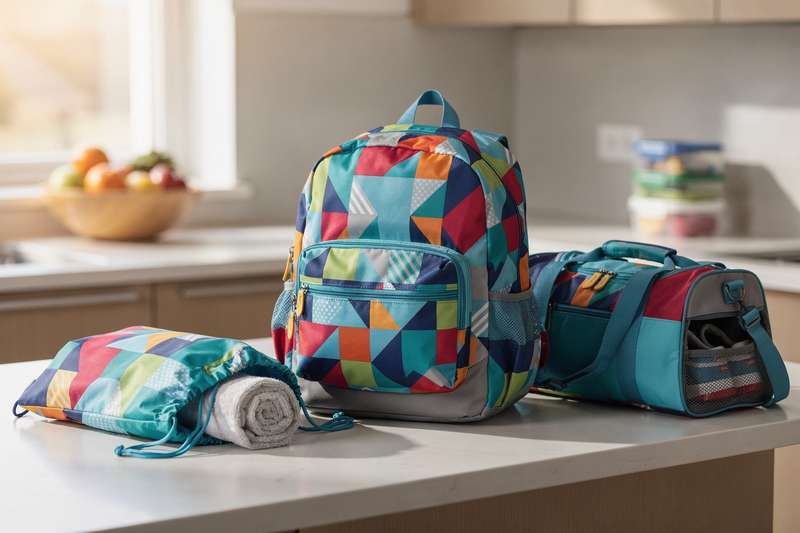
Your child has football training straight after school on Tuesday, swimming on Thursday, and PE kit to carry for the rest of the week. You’ve already tried the supermarket holdall that split at the seam by half term, the too-small drawstring bag where the water bottle and shin pads wouldn’t fit together, and the full-size adult rucksack that made your eight-year-old look like they were setting off on an expedition. Getting a sports bag right for a child is more involved than picking the cheapest option on the shelf.
The specific frustrations are familiar to any parent who has retrieved a soggy swimsuit from the bottom of a carrier bag: bags that are too heavy before anything goes in them, zips that jam under pressure, and designs so generic that the bag disappears into a pile of identical kit at the leisure centre. Then there’s the contamination problem — a damp towel wrapped around everything else, so clean clothes arrive home smelling of chlorine. This guide covers six picks across different styles, uses, and budget levels, all available on Amazon UK, to help you find the right bag for your child’s specific activities.
How We Chose These Bags
To put this list together, we assessed buyer feedback from hundreds of UK Amazon reviews, looking for patterns over time rather than just first impressions from the first few weeks of use. Our evaluation criteria focused on capacity relative to a child’s typical kit load — PE clothes, swimsuit, towel, water bottle, and a spare pair of shoes — plus how easy the bag is to open and close for younger children, strap comfort on small shoulders, material durability, and how water resistance performs in practice rather than just on the listing page. Organisation features such as separate shoe compartments, wet/dry separation, and side water-bottle pockets were weighed against the age group each bag suits best. One pick — the waterproof drawstring bag with shoe compartment — has very few reviews at the time of evaluation, so it is included on the strength of its specification but treated with appropriate caution throughout.
Best Budget All-Rounder
The WESTWOOD FOX Drawstring Gym Bag earns its place in the school-bag rotation by being reliably good at everything rather than exceptional at one thing. With 4.4 stars from 779 UK buyers, it is the most-reviewed option in this guide — a meaningful signal that it holds up beyond the initial excitement of a new purchase and through months of regular use.
This is a straightforward drawstring bag in the gym sack style, which means it is lightweight and quick to open. For children heading to PE class, after-school swim practice, or a sports club, that simplicity is a genuine advantage: they can pack and unpack it without fiddling with multiple zips or complicated pocket systems. The fabric is water-resistant, so a damp swimsuit or a wet towel won’t immediately soak through everything else in the bag, though it isn’t fully waterproof — sustained exposure to rain or prolonged contact with very wet items will eventually penetrate the material.
The colour options mean you can find something the child actually wants to carry, which matters more than it might seem at first. A child who’s attached to their bag is more likely to keep track of it and pack it properly. The bag is also light enough for younger children to carry comfortably alongside a school bag — a consideration often overlooked when adults choose bags for children.
Where it falls short is organisation. There’s a single main compartment with the drawstring closure, so everything goes in together. For older children who need to keep muddy boots away from clean kit, or swimmers who want a dry zone for their spare clothes, this becomes frustrating over time. It works best as a dedicated PE bag — the one that lives in a school locker or goes to Saturday morning sport — rather than a bag that needs to handle complex packing for overnight trips or multi-activity days.
The drawstring closure itself is worth considering: fast and convenient for younger children who struggle with stiff zips, but it doesn’t seal the bag as securely as a zip. Small items can work loose if the bag is inverted, which children will do. For children carrying a phone or anything else they can’t afford to lose, those items should be kept in a separate zip pouch inside.
Best for School PE and Uniform Colour Codes
The Listers Schoolwear Boys Girls Gym School PE Sports Swim Drawstring Bag does something the other bags in this guide don’t: it comes in over 20 colours matched to school uniform standards, including navy, maroon, bottle green, royal blue, and red. If your child’s school specifies a PE bag colour — and many UK primary and secondary schools do — this is often the most direct answer.
With 4.4 stars from 192 buyers, the review count is smaller than the WESTWOOD FOX option but the feedback is consistent. Reviewers mention durability through a full school term of weekly PE sessions and swimming lessons, and solid value relative to the budget outlay. For a bag that needs to survive the school year without falling apart, long-term impressions from buyers who return months later are more informative than a high volume of first-week enthusiasm.
The design is specifically school-oriented, sized to hold a standard PE kit: shorts, T-shirt, trainers, and a small towel. The reinforced drawstring cords hold up better than the thin cords that come apart on cheaper unbranded versions — a detail that sounds minor until you’re re-threading a cord at seven in the morning before the school run. The fabric is a smooth polyester that wipes clean after being dragged across a wet changing-room floor or stuffed under a bench at the leisure centre.
What Listers Schoolwear has understood is that a school PE bag has a very specific job: it needs to fit in a PE locker, survive being carried between lessons and activities, and return home intact. The bag doesn’t try to be anything it isn’t, and for that specific job it performs well.
The limitation is capacity. If your child needs to carry swimming goggles, a separate pair of shoes, a full-sized towel, and their kit simultaneously, it fills up quickly. This bag is best suited to children with a defined, consistent kit list rather than those who pack differently each session or who need to carry gear for more than one activity at a time.
Best Duffel for Active Young Athletes
The adidas Unisex Essentials Linear Duffel Bag is the only structured duffel on this list, and it comes from a brand that actually makes sports bags rather than simply printing them with sporty imagery. With 4.6 stars from 691 reviews, it has the highest combined rating and review volume of any product in this guide, and the feedback is consistent across that scale.
The small (S) size variant listed here is sized appropriately for children rather than adults — a duffel that isn’t so cavernous that a child can’t organise it or carry it comfortably. The bag has a main zip-access compartment, an external front pocket, and a mesh side pocket, giving enough separation to keep different types of kit accessible without making the bag overly complex to manage. The adidas branding is restrained — a simple logo stripe — which tends to appeal to older children who want something that looks purposeful rather than novelty-themed.
What a duffel offers over a drawstring bag is structure. The Essentials Linear holds its shape, which makes it easier to pack efficiently and find items without upending the whole bag. For children who play multiple sports and need to bring separate footwear, a change of clothes, and possibly small equipment to matches and training sessions, a structured duffel handles that combination more effectively than a simple drawstring sack.
The construction is durable: double-stitched handles, a robust main zip, and a material that wipes clean easily. The detachable shoulder strap means it can be carried across the body or over one shoulder, which older children tend to prefer. At secondary school level, this bag transitions naturally from sports use to overnight school trips, making it a longer-term investment than a basic PE sack.
The tradeoffs are worth knowing: there’s no dedicated wet/dry separation compartment, so swimmers still need a separate sealed pouch for a damp swimsuit. For very young children, the duffel format is less intuitive to pack and carry than a simple drawstring bag. But for children aged eight and upwards who are involved in regular, organised sport, this is the bag that scales with their activities as they develop.
Best Personalised Kids’ Sports Bag
The Personalised Monogram Initial & Script Name Drawstring Bag solves one of the more persistent problems in children’s sport: the bag that goes missing in a changing room full of identical bags. With 4.7 stars from 161 reviews, it is the highest-rated product in this guide by star rating, and buyer feedback consistently highlights the quality of the personalisation and how much children respond to having something that is clearly their own.
The personalisation is done properly here — not a generic label you apply at home, but a printed or embroidered initial and name in a neat script that arrives ready to use. The result looks considered and personal in a way that a supermarket name tape sewn inside a generic bag doesn’t. It arrives as a finished product, which also makes it a reliable choice as a gift when you want to avoid giving something that requires further work before it can be used.
As a functional sports bag, it works along similar lines to the other drawstring options in this guide: solid capacity for standard PE kit, swimsuit and towel, and a water bottle. The fabric handles damp kit without immediately soaking through, and the drawstring closure is straightforward for children to manage independently. It isn’t trying to replace a structured duffel for multi-sport use — it’s a day-to-day PE and after-school sports bag with a significant identification advantage built in.
The practical benefit of personalisation extends beyond aesthetics: a clearly named bag is much less likely to be picked up by mistake in a shared changing room, and if it is taken, it’s far easier to recover. For children who regularly use leisure centres, school swimming pools, or sports clubs where dozens of similar bags end up in a pile, that naming makes a meaningful difference to how often the bag comes home with the right child.
One practical consideration is lead time. Because the bag is made to order, dispatch takes longer than for a standard stock item — factor this in if you need the bag for an upcoming term start or competition. The personalisation is also permanent and specific to one child’s name, so unlike a plain bag, it can’t easily be passed on to a sibling. For a child settled into their sporting routine, that’s rarely a concern.
Best Character-Themed Bag
If your child is between roughly ages 4 and 10 and has a firm superhero allegiance, the Avengers Waterproof & Lightweight PE Drawstring Bag for Kids is worth considering. With 4.1 stars from 368 UK reviews, the review base is large enough to confirm this is a functional sports bag rather than just an attractive package.
The bag is officially licensed, which in the character merchandise category is a meaningful distinction. Official licensing typically means better print quality — the design is sharper, the colours more accurate, and the print more resistant to washing than unlicensed alternatives. Buyers report that after repeated machine washes the design holds up noticeably better than unbranded character bags, which tend to fade or crack within a few months of regular use.
On the functional side, the bag is lightweight and straightforward: adjustable drawstring straps, waterproof-treated outer fabric that handles the damp of a changing-room floor or a wet swimsuit inside, and a capacity suited to standard PE kit. Its lightness is particularly relevant for younger children who are already carrying a school bag — adding a heavy sports bag on top causes real discomfort over the course of a school day.
The honest limitation of any character-themed bag is that children’s preferences change. A six-year-old devoted to the Avengers may feel very differently about the same bag at eight. That isn’t a flaw in the product — it’s the reality of children’s tastes — but it’s a factor when deciding how much to invest. For the age group where the theme generates real enthusiasm, a child who’s excited about their kit bag is also more likely to keep track of it.
One practical note: the multicolour character design makes this bag unsuitable for schools with strict PE kit colour requirements. If your child’s school mandates a plain navy or black bag, the Listers Schoolwear option is the appropriate choice. For children who have freedom to choose their own sports bag, this is one of the more engaging options available at the budget end of the market.
Best for Swimmers and Wet Kit Separation
The Drawstring Gym Bag-Waterproof Sports Backpack with Shoe Compartment and Wet Dry Separation is the most feature-rich drawstring bag in this guide. Worth flagging upfront: it has very few reviews at the time of writing, so its practical credentials rest primarily on specification rather than an established pattern of buyer feedback — treat this pick with appropriate caution and check back as more reviews accumulate.
What sets this bag apart from the standard drawstring options is its built-in organisation. The dedicated shoe compartment keeps wet, muddy, or odorous footwear away from the rest of the kit — directly addressing one of the most common complaints about standard sports bags. The wet/dry separation is designed for exactly the swimming scenario: a damp swimsuit and towel stay contained and separate from the clean clothes packed alongside them, so nothing arrives home having been marinated in chlorine for two hours.
The mesh fabric panels improve ventilation, which matters when a bag is carrying kit that needs to air between sessions. Most basic drawstring bags trap moisture and amplify smells; the mesh construction allows air to circulate, reducing the mildew risk that develops in damp sports bags stored overnight in a locker or cupboard.
For children who swim regularly, or who play outdoor sport in all weathers and arrive back with muddy boots alongside a clean change of clothes, this bag’s specification addresses problems that simpler bags don’t. The drawstring format keeps carry weight down — important for younger children managing their own kit — while the added compartments provide the organisation that multi-activity days require.
The caveat remains the review count. With very few buyers having weighed in at this stage, the stated performance hasn’t been tested at a scale that would give real confidence. If the specification holds up in practice — and nothing in the listing suggests otherwise — this is a strong choice for regular swimmers. If you want certainty backed by substantial buyer experience, pairing the WESTWOOD FOX bag with a separate waterproof wet bag inside is the more proven route to the same outcome.
What to Look for When Buying a Kids’ Sports Bag
- Capacity matched to age and activity: Younger children heading to one after-school activity need roughly 10 to 15 litres — enough for kit, a water bottle, and a small towel. Older children managing multiple kit types in a day may need 20 to 30 litres. A bag that’s too large for a child’s frame is harder to carry and tends to become disorganised inside, with items migrating to the bottom where they’re impossible to find quickly.
- Closure type for the child’s age: Drawstring bags are faster and easier for younger children who struggle with stiff zips. Zipped duffels offer better security and organisation for older children carrying more varied kit. The key question is who’s actually packing and unpacking the bag, and how much time they have between activities.
- Water resistance versus proper waterproofing: Most bags marketed as waterproof are water-resistant in practice — they handle a damp changing-room floor or a light shower, but not sustained rain or a wet swimsuit left inside for several hours. For swimming specifically, look for bags with wet/dry separation compartments or plan to use a sealed wet bag as a liner.
- Separate shoe compartment: One of the most practical features for children who play outdoor sport or use activity-specific footwear. Keeping muddy boots or chlorine-smelling trainers away from clean clothes makes unpacking significantly less unpleasant, and extends the usable life of both the bag and the kit inside it.
- Strap comfort for small shoulders: Padded or wide shoulder straps make a real difference when a child is carrying a full kit over any distance. For drawstring bags, look for cords wide enough not to cut into small shoulders under load. Check that the bag sits at a sensible height for your child’s frame — a bag that hangs to knee height is harder to carry and more likely to be dragged along the ground.
- Ease of cleaning: Sports bags for children get consistently dirty. Look for materials that wipe clean easily and ideally that can be machine-washed on a cool, gentle cycle. Avoid bags with dense foam inserts or complex inner linings that trap moisture and are difficult to dry fully between uses.
- Identification: In shared sports facilities, bags get confused. A personalised bag, a distinctive colour, or at minimum a name written clearly inside reduces the risk of the wrong child going home with your bag. This matters particularly in primary school settings, where dozens of children may have very similar-looking bags in the same changing room.
Verdict
For the typical UK parent buying a first or everyday sports bag for a school-age child, the WESTWOOD FOX Drawstring Gym Bag is the recommendation we’d return to first. It has the largest review base in this guide, handles the daily rotation of PE kit and swim gear reliably, and the water-resistant fabric covers most scenarios without requiring additional inserts or accessories to make it work.
If your child’s school requires a specific uniform colour for PE bags, the Listers Schoolwear PE Drawstring Bag is the more targeted choice — over 20 colour options matched to UK school standards, with a track record of holding up through a full term. For children aged eight and above in regular, organised sport, the adidas Essentials Linear Duffel Bag is worth the step up: structured, durable, and versatile enough to serve for several years as activities and kit requirements develop.
If you’re buying as a gift, the Personalised Monogram Initial & Script Name Drawstring Bag is the option that removes the missing-bag problem and gives a child genuine ownership of their kit. Its 4.7-star rating is the highest in this guide, and the personalisation is done properly rather than being an afterthought — just allow extra time for dispatch given it’s made to order.
We were not paid to feature any specific product in this guide. All opinions are independent and based on publicly available specifications, verified buyer feedback patterns, and category research.
Quick Comparison Table


FAQ
What size sports bag does a child actually need?
For most primary school children aged 5 to 11, a capacity of 10 to 20 litres covers standard PE kit, a small towel, and a water bottle comfortably. Older children playing competitive sport who need to carry separate footwear and a full change of clothes may need 20 to 30 litres. The most useful check is whether the bag sits at a sensible height on the child’s frame — a bag that’s too large or hangs too low becomes difficult to carry and tends to end up being dragged rather than carried.
Are drawstring bags better than duffels for children?
It depends on age and how the bag is being used. Drawstring bags are lighter and simpler for younger children, who can open and close them without help and pack quickly between activities. Duffels provide more structure and organisation, which suits older children managing varied kit across multiple sports. For basic PE use and swim practice, a drawstring bag is usually the more practical choice; for regular competitive training with a complex kit load, a structured duffel is worth the step up.
How do I stop a kids’ sports bag from smelling?
Air the bag out after every use rather than sealing it directly in a cupboard while still damp. Use a sealed waterproof pouch inside for wet swimsuits or towels rather than letting damp items sit against the lining. Most polyester drawstring bags can be wiped down with a damp cloth after use, and many are machine-washable on a cool, gentle cycle — check the care label first. Leaving the bag open overnight lets residual moisture escape and makes a significant difference over the course of a term.
Can I put a child’s sports bag in the washing machine?
Many polyester drawstring bags are machine-washable on a cool, delicate cycle, but always check the care label before washing. Remove any inserts, empty all compartments, and place the bag in a mesh laundry bag to protect drawstring cords and any zips during the cycle. Air dry completely before the next use — tumble-drying can damage waterproof coatings and distort the shape of more structured bags.
Is a personalised sports bag worth the extra cost?
If your child uses shared facilities — school changing rooms, leisure centres, sports clubs — where similar bags regularly end up in a pile together, personalisation is a practical investment rather than just an aesthetic one. A clearly named bag is less likely to be picked up by mistake and easier to recover if it is. Children also tend to take better care of belongings that feel distinctly theirs, which has its own practical value over the course of a sports season.
What age do children need their own sports bag?
Most children start needing a dedicated sports bag around ages 4 to 5, when school PE and after-school activities begin. Lightweight drawstring bags are the most practical option at this stage. Structured duffels tend to become useful from around age 8 to 10, when children are managing more varied kit and often packing independently. Beyond that, the choice of bag should scale with the range and intensity of their activities rather than age alone.