You know the feeling. You’re coaching your junior cricket team, or running a pitching session at a local baseball club, and someone pulls out a cheap speed radar bought from a sports shop. It gives a reading, everyone nods — then the next throw comes back two miles per hour faster and nothing obviously changed. You start wondering whether the radar is measuring speed at all, or just generating plausible-looking numbers. Or perhaps you’re a golfer trying to track whether your swing changes are genuinely translating into more distance, and the device keeps producing different readings from the same spot without any explanation. Sport radars are useful training tools when they deliver data you can trust — but the gap between a unit that gives you a reliable number and one dressed up in science-looking packaging is enormous. The right radar turns practice sessions into trackable development. The wrong one gives you noise dressed as data, and you make worse decisions because of it. This guide gives you a clear path to the right choice for your sport and your setup.
How We Chose These Picks
Narrowing down sport radars for UK buyers on Amazon required more than sorting by star rating. The category spans professional handheld radar guns, sport-specific sensor nets, Bluetooth-connected coaching systems, and swing speed monitors — all described as speed measurement tools but functioning quite differently and suited to very different users. Evaluation criteria included stated accuracy tolerance (the ±MPH figure), maximum measurement distance and speed range, connectivity and app support, battery life and charging method, build quality and weather resistance, and the patterns within verified buyer reviews rather than individual outliers. Products with no verified reviews were excluded from this shortlist because sufficient reviewed alternatives exist across the category. The result covers a range of sports, use cases, and budgets — from the serious pitching coach who needs verified professional-grade accuracy through to the casual tennis player wanting a first look at their serve speed.
Best Overall Sport Radar
The Pocket Radar sits at the top of this guide for a straightforward reason: it has earned the trust of professional sports organisations worldwide, and its 4.6-star average from 864 Amazon UK reviews confirms that real-world buyers — coaches, scouts, and committed athletes — agree. When you’re investing in a speed measurement tool, that depth of verified feedback matters more than almost any other specification on the box.
What sets it apart from budget alternatives isn’t one headline feature but the combination of accuracy, build quality, and cross-sport versatility in a device compact enough to slip into a jacket pocket. Professional-grade units like this one deliver ±1 mph accuracy at distances of 120 feet or more — which is what you need to measure a bowling run-up, a pitch from a mound, or a tennis serve from a realistic position behind the baseline. Budget radars often give you numbers, but those numbers drift based on angle, distance, and atmospheric conditions. That’s exactly the problem you’re trying to solve, not reproduce.
Multi-sport versatility is one of the Pocket Radar’s genuine strengths. Cricket bowlers, baseball pitchers, softball players, and tennis coaches tracking serve velocity all get useful data from the same unit with no reconfiguration needed. The form factor matters in practice: it turns on quickly, passes easily from hand to hand during a coaching session, and doesn’t require a tripod or complex alignment to produce an accurate reading. For a coach who moves between players and positions throughout training, that responsiveness is worth a lot.
The main practical note is that the base unit runs on replaceable AAA batteries rather than a built-in rechargeable cell. For most training contexts this isn’t a problem — battery life is strong and keeping a spare set in your bag becomes routine. The base unit also doesn’t include Bluetooth or app connectivity; if session logging and velocity trend tracking are priorities, a Smart Coach variant exists as a separate listing with those features added. For coaches who already track data manually, or who use the radar primarily for immediate in-session feedback, the base unit gives you everything you need.
The honest limitation is cost. The Pocket Radar sits in the premium tier, and if you’re buying it out of casual curiosity rather than as a core training tool used weekly, the spend is hard to justify against the alternatives below. But if you’re coaching athletes regularly, tracking development over a season, or operating in any context where accuracy genuinely affects the decisions you make, nothing else in this guide gives you the same depth of proven, long-term reliability.
Best for Baseball and Softball Development
The TAG ONE Sports Radar Gun with 6-Hour Battery for Baseball, Softball & Golf addresses the two most common frustrations with traditional radar guns — battery anxiety and the inability to build a session history over time — by combining Bluetooth app connectivity with a built-in rechargeable battery that delivers six or more hours of continuous use per charge.
The core performance specification is strong: ±1 MPH accuracy and a measurement range of up to 130 feet puts it in the same accuracy bracket as professional-grade units. For baseball and softball development work — tracking pitch velocity, exit velocity off the bat, or ball speed during fielding drills — that precision is what makes data actionable rather than decorative. The TAG Sports app connects via Bluetooth and logs each reading, allowing you to build separate player profiles and review velocity trends across a season. An AI coaching feature analyses patterns and surfaces observations over time, which coaches working with multiple players at once may find genuinely useful for spotting fatigue patterns or velocity plateaus.
The hands-free capability deserves particular attention. The included mini tripod and bracket let you position the unit behind a target and step away, meaning a pitcher can run a solo bullpen session and receive speed feedback on every throw without needing a second person present. For parents working with young players in the back garden, or individuals doing solo pitching work, this changes the kind of training sessions that are realistically possible.
At 4.5 stars from 25 reviews, it’s an encouraging early signal — but a relatively modest sample. You don’t yet have the multi-season buyer experience that 864 reviews provide, and you can’t be fully confident about long-term hardware durability or how the app behaves through iOS and Android updates over years of use. The 2-year warranty and waterproof, dustproof construction suggest durability has been taken seriously in the design, but early-adopter risk is real and worth acknowledging honestly. That said, it comes as a complete kit from the box — tripod, bracket, USB-C cable, and carry case all included — so there’s nothing extra to source before your first session. For baseball and softball coaches who want app-based development tracking and the convenience of charging via cable rather than buying batteries, this is the strongest option in this guide.
Best Training Net with Integrated Speed Display
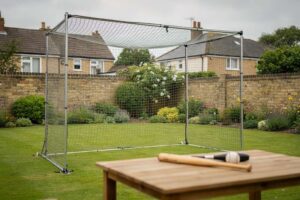
The Net Playz takes a fundamentally different approach to speed tracking: rather than a handheld or tripod-mounted radar gun, it integrates a speed display directly into the back panel of a training net. You kick, throw, or hit into the net and a display shows the impact speed immediately, without any separate device to operate.
The practical appeal of this format is real, particularly for youth coaching and home garden setups. If you’re already using a training net for football shooting practice, cricket throwdowns, or pitching drills, having the speed readout built into the same piece of equipment means one fewer gadget to position, power, and synchronise. Setup is simpler than configuring a separate radar unit, and for younger athletes the immediacy of seeing a number directly on the net after each strike tends to drive engagement and competition between players better than waiting for a coach to read out a figure from a separate device.
With 444 reviews and a 3.7-star average, the Net Playz has accumulated substantial buyer feedback — and that rating communicates something honest. Buyers consistently describe it as useful for ballpark speed awareness: knowing whether you’re generating impact in the 50s, 70s, or 90s MPH range is motivating and gives relative progress signals over time. But the unit measures impact speed at the net rather than true in-flight ball velocity, which introduces inconsistencies that a dedicated radar gun avoids. Reviewers note that readings are not suitable for serious athlete development or talent identification, and that accuracy can vary with where exactly the ball contacts the net. Treat the numbers as motivational feedback rather than precision data, and you’ll get good value from it.
Net durability comes up regularly in reviews — the frame joints and net material are designed for moderate use rather than heavy daily training in all weathers. For families running occasional garden sessions or coaches using it for fun speed competitions during warm-ups, it holds up well. For high-frequency or high-intensity outdoor use, a standalone radar gun paired with a more robust training net would be a more durable long-term investment. What the Net Playz does well — making speed measurement accessible, immediate, and engaging for younger players — it does with genuine effectiveness.
Best for Lacrosse Training
The Lacrosse Speed Radar is a sport-specific device designed to measure shooting power and trigger speed for lacrosse players, with a 4.4-star average from 7 early reviews confirming it delivers on its stated core function.
Measuring shot and pass speed has real tactical value in lacrosse. Understanding your shooting velocity helps players judge whether they’re close enough to test a goalkeeper, and tracking improvement across a training block gives coaches and players concrete feedback to work with rather than vague impressions. Most general-purpose radar guns will measure lacrosse shots without difficulty, but a lacrosse-specific unit is optimised for the speed ranges and distances typical of the sport. The trigger speed detection sensor approach noted in the product description suggests it activates on the movement of a shot, which makes it more practical for standalone training drills where you’re not relying on a second person to operate the radar for you.
Seven reviews is a thin sample from which to draw firm conclusions about long-term durability or accuracy benchmarked against a professional standard. The 4.4-star average is encouraging, and the product listing positions it both as a training tool and a gift option — which gives you a useful sense of the intended audience: enthusiast players, gifts for lacrosse-playing teenagers, coaches setting up a training station on a sensible budget. It’s not positioned as a direct replacement for the Pocket Radar in terms of verified professional-grade performance across multiple sports, but for lacrosse-specific training it fills a genuine gap in this product category.
If you’re invested in the lacrosse community and want a purpose-built speed tool rather than adapting a baseball radar gun to your sport, this is worth considering as an early-adopter purchase. Go in knowing you’re buying ahead of a deep review pool, and read the current product listing carefully to confirm measurement range and positioning method suit your training context before committing.
Best Entry-Level Option for Tennis
The Tennis Speed Radar Tennis Gift Sports Speed Tester Hands-Free Speed Gun for Tennis Baseball Golf Pitching Catching Speed Sensor is a hands-free speed sensor positioned at the accessible end of the market, aimed at tennis players who want occasional serve speed feedback without investing in a professional radar unit.
The hands-free design is its most practically useful characteristic. Tennis serve practice is frequently a solo activity — you’re serving from the baseline, collecting balls, and repeating, without a second person watching. Being able to set up the sensor independently means you can incorporate speed feedback into solo sessions without interrupting their flow. For recreational players who want to know roughly how hard they’re hitting, the concept is sound and the setup is straightforward.
Honesty is required here, though. With 3.5 stars from 3 reviews, this has the smallest and most mixed buyer feedback of any pick in this guide. Three reviews isn’t enough to draw reliable conclusions about whether the accuracy issues noted are isolated incidents or representative of the product’s general performance. The product title reads more like keyword optimisation than a focused brand identity, which doesn’t disqualify the unit but does suggest it may not have the same engineering rigour behind it as purpose-built options from dedicated sports technology manufacturers.
The appropriate use case is a casual player who wants a rough serve speed figure — something that can tell you whether you’re serving at 70 mph or 90 mph — rather than the precision needed for meaningful week-to-week development comparisons. If the precision of the reading matters to how you train, the Pocket Radar or TAG ONE Sports Radar Gun are far more dependable choices. But if you’re buying your first speed sensor, are curious rather than data-dependent, or want something as a gift for a tennis-playing friend who’d enjoy knowing their serve speed, this is the most accessible entry point in this guide.
Best for Golf and Bat Swing Speed
Achieve More Distance is a swing speed radar that measures golf club and bat swing speeds across a stated range of 20 to 200 mph, delivering instant readings to help golfers and batters understand the speed component of their stroke or swing.
Swing speed measurement is a distinct training tool from ball speed tracking. A ball speed radar tells you how fast the ball is moving after impact — which is a product of swing speed, strike quality, and equipment characteristics combined. A swing speed radar isolates just the movement of the club head or bat, which is useful if your training focus is specifically on generating more power through improved mechanics rather than analysing the full impact event. For a golfer working on increasing driver distance, or a batter trying to develop more speed through the hitting zone, that specific measurement can be more directly applicable than a ball speed figure.
With 3.7 stars from 6 reviews, you’re firmly in early-adopter territory here. The buyers who have reviewed it are broadly positive about the fundamental speed measurement function, but 6 reviews can’t tell you reliably how the unit performs across different swing types, weather conditions, or after sustained regular use over months. The product name — “Achieve More Distance” — reads as a marketing tagline rather than a brand or model identifier, which makes it harder to verify the manufacturer’s broader track record or locate supplementary documentation such as user guides or technical support resources.
Before purchasing, check the current product listing carefully to understand exactly how the device is positioned during use — whether it requires attachment to the club or bat, stands independently nearby, or uses a different arrangement. If you’re a golfer seriously investing in swing speed development, established golf technology brands offering launch monitor integration provide much deeper data on ball flight, spin, and carry distance. This option suits the golfer or cricketer who wants swing speed feedback without a significant financial commitment, and is comfortable treating a limited early review base as a tentative rather than definitive signal of quality.
What to Look For When Buying a Sport Radar
- Accuracy tolerance — The ±MPH figure tells you how much the reading can vary from true speed. Professional-grade units state ±1 mph explicitly; budget units often omit this figure entirely, which is itself informative. If you’re using speed data to make real training decisions, this single number deserves more attention than any other specification on the listing.
- Speed and measurement range — Different sports operate across different velocity ranges, and the distance at which you can stand and still get a reliable reading matters as much as the speed ceiling. For cricket and baseball, look for a unit that reads accurately from at least 60 feet away; anything requiring you to stand within 20 feet of the action is impractical in live training.
- Handheld vs. hands-free operation — If you’re coaching multiple players, a handheld unit operated by a second person is efficient. If you’re training alone, hands-free tripod mounting or net integration changes what’s possible in a solo session. Think about who will actually be operating the device during your typical training setup before committing to a form factor.
- Battery type and life — Replaceable batteries (often AAA) mean you’re never stranded if you forget to charge overnight, but you’ll need to keep spares in your kit bag. Built-in rechargeable batteries charged via USB-C are more convenient for regular training use but require charging discipline. Six or more hours of stated battery life is adequate for most training contexts.
- App connectivity and session logging — A radar that displays a number gives you immediate feedback. A Bluetooth-connected unit that logs readings to an app lets you track velocity trends across a season, which is significantly more valuable for long-term athlete development. If progress tracking matters to you, check whether the app is free or requires a subscription before purchasing.
- Weather resistance — Outdoor training in the UK means regular exposure to drizzle, damp grass, and unpredictable conditions. Look for units described as waterproof or at minimum water-resistant, and read reviews specifically for comments about durability in outdoor use. A radar gun that stops working reliably after getting wet is useless for a significant portion of the sporting calendar here.
- Sport specificity vs. versatility — Some radars are built and optimised for one sport; others work across baseball, softball, cricket, tennis, and golf from a single unit. If you coach multiple disciplines or want one device that works for a family of athletes playing different games, a versatile multi-sport unit is more practical. Sport-specific devices can offer interface design better suited to their context, but at the cost of flexibility.
Verdict
For the majority of UK readers — coaches, committed amateur athletes, or parents tracking a young player’s development — the Pocket Radar is the strongest overall choice. Its 4.6-star rating from 864 verified reviews represents genuine long-term confidence from buyers using it in real training environments, not novelty purchases gathering dust after a fortnight. The accuracy is verifiable, the form factor works across cricket, baseball, softball, tennis, and more without reconfiguration, and it requires no setup beyond pointing and triggering. That simplicity is the point.
If you want Bluetooth app integration and USB-C charging from the outset, the TAG ONE Sports Radar Gun is the next pick to consider seriously — particularly for baseball and softball coaches who want session-by-session velocity logging as part of their development workflow. It’s a newer product with a smaller review base, but the specifications are strong and early buyer response is positive. Just be aware you’re buying earlier in its review lifecycle than the Pocket Radar.
The Net Playz earns its place only if you specifically want a training net with a built-in speed display rather than a standalone radar — the speed measurement is a motivating addition to its primary function as a target net, not a replacement for dedicated measurement equipment. The sport-specific picks — the Lacrosse Speed Radar, Tennis Speed Radar, and Achieve More Distance — fill genuine niches, but with limited review histories you take on more uncertainty than with the two lead picks. For speed data you can actually rely on across multiple sports and multiple seasons, the Pocket Radar is where to start.
We were not paid to feature any specific product in this guide. All opinions are independent and based on publicly available specifications, verified buyer feedback patterns, and category research.
Quick Comparison Table


FAQ
How accurate are sport radar guns?
Professional-grade sport radar guns typically deliver ±1 mph accuracy, which is the benchmark used by MLB scouts and professional coaching organisations around the world. Budget units often don’t publish an accuracy tolerance figure at all — if a product listing omits this specification, treat the readings as approximate rather than precise. For training decisions that genuinely matter to athlete development, stick to units that explicitly state their accuracy tolerance.
Can I use a sport radar gun for cricket?
Yes — most baseball-spec radar guns work equally well for cricket bowling speed measurement. The physics of measuring a moving ball don’t change between sports, and units covering the relevant speed range for cricket will give you reliable readings. The key practical consideration is measurement distance: you want a unit that reads accurately from at least 60 feet to avoid standing directly at the stumps during live bowling. Check the maximum operating distance before buying.
What is the difference between ball speed and swing speed measurement?
Ball speed radars measure how fast the ball is moving after it leaves the bowler’s hand, pitcher’s grip, or racquet face — this is the figure most commonly used by coaches for pitching, bowling, and serving assessment. Swing speed radars measure how fast the club head or bat is moving at the point of contact, independently of what happens to the ball. Swing speed is most directly useful for golfers and batters focused on building power through improved mechanics, while ball speed is the standard metric for bowling, pitching, and serving evaluation.
Do sport radars work for solo training without a partner?
Some do and some don’t, and this distinction is worth checking carefully before you buy. Traditional handheld radar guns are typically operated by a second person positioned behind the thrower or server, so they don’t lend themselves to solo use. Hands-free units with tripod mounts — such as the TAG ONE Sports Radar Gun — can be set up independently and left to record speeds throughout a solo session. Net-integrated units like Net Playz also work without a partner by design. If solo training is your primary use case, confirm the product you’re considering explicitly supports hands-free positioning.
What speed range do I need for measuring tennis serves?
A recreational tennis serve typically falls between 50 and 90 mph; club-level competitive serves often reach 90 to 110 mph, and strong players can exceed this. For most amateur players, any radar that covers roughly 40 to 130 mph will give you useful readings across the full range of realistic serve speeds. Check the lower limit too — some radars designed primarily for baseball don’t register reliably below 25 mph, which can cause issues for junior players or slower serves at the recreational level.
Are sport radar guns legal to use in the UK?
Sport radar guns designed for measuring ball and swing speed in training contexts operate on different frequency characteristics and power levels than traffic enforcement equipment, and their use in sporting environments for private training and coaching is not restricted for individuals or clubs. The key point is that these devices are designed and intended for sporting measurement only — using them to monitor road traffic or in any way that could be interpreted as traffic speed enforcement is a separate matter entirely. Use them for the sporting purpose they’re built for, and there is no issue.