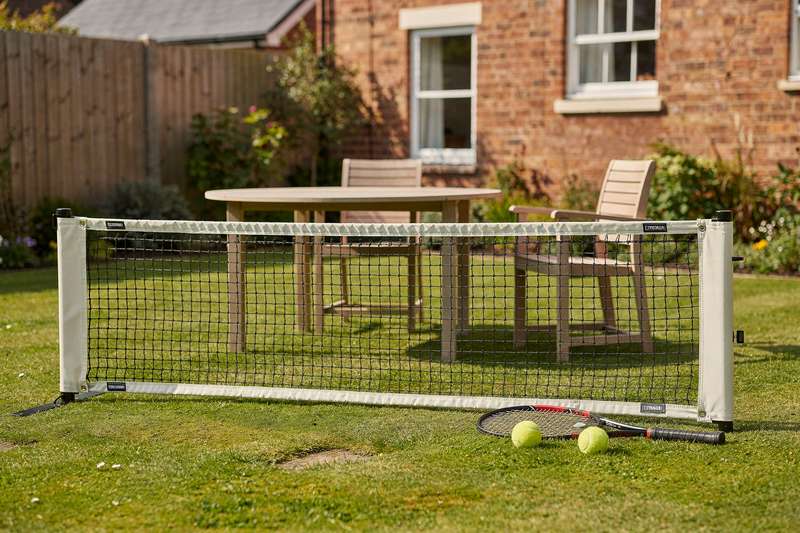
Picture this: the garden tennis net from last summer has finally given up. The white vinyl headband has cracked along the top, one pole cap has snapped off, and no matter how you adjust the guy ropes, the centre sags by several inches before the first game is done. You’ve tried doubling the tension, pegging the centre to the ground with a spare tent peg, and simply accepting a droopy barrier — until one windy evening the whole thing buckled and left you staring at a pile of poles and tangled netting. Or perhaps you’re starting from scratch: your children have caught the tennis bug after a school session, you want something to set up on the driveway for summer evenings, or you need a portable net for groundstroke practice at the local park. Whatever brought you here, the tennis net market on UK Amazon is confusing. Multi-sport nets, badminton systems marketed as tennis nets, and mini-game toys all appear in the same search results, often with the same confident claims. This guide cuts through that noise and focuses on what’s actually worth buying, for what kind of tennis, in the UK.
How These Picks Were Chosen
This guide covers portable and garden tennis nets available on UK Amazon — products designed for casual, garden, junior, or practice play rather than permanent court replacements that require fixed post infrastructure. Five criteria drove the selection: genuine tennis usability (not just listed as a keyword), net dimensions and height against what tennis actually needs, frame or pole system integrity for real garden conditions, portability and realistic setup time for recreational use, and where available, patterns in verified buyer reviews from UK customers. Products that were purely badminton-sized with no meaningful tennis application were excluded, as were items that don’t belong in a tennis net guide. Where a product had very few or no UK reviews, that’s noted plainly rather than glossed over. The result is a shorter list than the market implies exists — but each pick is honest about what it is and what it isn’t.
Best Portable Freestanding Tennis Net
The 10FT Tennis Net Portable Foldable with Carry Bag Backyard Indoor Outdoor is the most straightforwardly tennis-specific product in this guide. At 10 feet (around 3 metres) wide, it’s clearly a mini-court or compact practice net rather than a regulation full-court setup — but that’s an honest positioning. It’s sized and priced for driveway and smaller garden use, and it does that job well without overclaiming.
The defining feature is the foldable frame design, which sets this apart from pole-and-rope systems. With a traditional multi-pole net, setup typically involves slotting pole sections together, threading them through net sleeves, staking guy ropes into the ground, and tensioning everything before a single ball is hit. The folding frame removes most of those steps: it collapses flat, slides into the included carry bag, and sets up again without tools. A net that deploys in two minutes gets used; one that takes twenty minutes to erect tends to stay in the garage. The carry bag also means this can travel to the park, live in a car boot between sessions, or tuck behind a door without claiming the storage space that a set of separate poles would.
With 9 reviews averaging 4.2 out of 5 stars, the feedback base is modest. You’re not drawing on hundreds of long-term owner reports here, so treat the rating as directional rather than definitive. What reviews do consistently confirm is ease of setup and suitability for backyard sessions, particularly with younger children. Buyers note that players of junior age find it a manageable scale for keeping rallies going without having to chase the ball to either side of a much wider net.
The 10ft width is the main practical limit. Standard singles court nets span 33 feet, so even informal garden rallies with adults benefit from a considerably wider barrier. For proper cross-court play or adult groundstroke drills, 10ft will feel narrow. Think of this as a focused practice tool or compact game net for tighter spaces — a driveway, a smaller patio, a garage — rather than a garden court replica. The folding frame also means height is fixed rather than adjustable, so if you want one net to serve tennis, badminton, and volleyball across different height requirements, you’ll need a pole-based system instead.
Who is this pick for? Primarily parents with younger children who want a casual tennis-style game in the garden without investing in full court infrastructure, and players who need a net for a covered space where width is a constraint. For adults working on shot accuracy, a 10ft net can serve as a target-training tool — focus on placement rather than distance, and the compact size makes that possible in most home environments. Before buying, measure your available space with some margin: the base frame extends beyond each end of the net width to anchor the structure, so plan for slightly more than 10ft of clear width to avoid the base clipping your playing area. The listing mentions both indoor and outdoor suitability, which broadens the use case to covered playgrounds, sports halls, or garage practice spaces — a useful bonus for year-round use in a British climate.
Best Budget Net for Garden Training
With over 600 reviews at a 4.1 out of 5 average, the Foldable Badminton Net Portable Adjustable Volleyball Tennis Net is far and away the most widely purchased product in this guide, and that volume of real buyer feedback is informative. Start with honest framing: this is a multi-sport training net that includes tennis in its remit, not a purpose-built regulation tennis net. Understand that going in, and it becomes a practical, low-cost entry point for garden and schoolyard play.
The dimensions on the listing are 6.1 metres wide by 0.76 metres in net mesh height. That height figure is worth examining. A standard tennis net sits at 91.4cm at the centre — so this net runs noticeably lower than regulation. For adults drilling match-standard groundstrokes, that gap matters: balls that would clip the top of a real net may clear this one comfortably, which reduces the feedback you get on net-height clearance. For children learning to rally, for family games where keeping the ball in play matters more than exact height, or for casual knockabouts, the difference is entirely workable and not a reason to reject the product.
The 6.1 metre width is a genuine strength for a budget net. That’s considerably better than 3-metre mini-nets and wide enough to practise cross-court groundstrokes and diagonal angles in a garden setting. For a product at this price point, that width is well chosen — it gives enough of a real court feel to make sessions purposeful rather than feeling like a toy setup squeezed into the driveway.
What the 600-plus reviews reveal consistently about the tradeoffs: pole rigidity and net tension are the most common discussion points. Several buyers note that the net sags with extended use and benefits from periodic re-tensioning. On grass, the base loops accept standard tent pegs — a tip that surfaces repeatedly in positive reviews as the single most useful piece of setup advice and dramatically improves stability. On patio or hard surfaces, weighting the base or anchoring to a fence post is the practical workaround. None of this is unusual for a budget portable net; it’s the inherent tradeoff at this price tier. Avoid leaving the net under trees where falling debris can accelerate netting degradation; a dry, sheltered storage spot between sessions goes a long way towards keeping it serviceable.
Materials are functional rather than premium. Plan to bring the net in when it’s not in use rather than leaving it erected through British summer rain or autumn storms. As a put-up, use, pack-away net it will hold up well across a season or two. As a semi-permanent installation left out in all weather, expect the materials to age faster than the listing implies. For buyers who want maximum real-world evidence before spending, this product offers it: over 600 UK reviews cover a wide spread of scenarios, surface types, and user ages. The 4.1 rating is honest — it’s not a five-star product at the budget price, but it does the job it describes, and the breadth of feedback is far more reassuring than a product with five reviews and a five-star average that tells you almost nothing about real-world performance.
Best Adjustable Multi-Sport Net for Tennis Practice
For UK readers who want one portable net that works properly for garden tennis, handles a family badminton session, and doesn’t compromise too heavily on either, the 17ft Portable Badminton Net, Volleyball Net, Tennis Net – Indoor Outdoor Adjustable Height Sports Net with Poles, 3 in 1 Combo Net Set is the most balanced option in this guide. At 17 feet (roughly 5.2 metres) wide with height-adjustable poles and a carry set, it combines the most useful tennis width available here with multi-sport flexibility that makes a single purchase work harder. Of all the products in this guide with meaningful buyer feedback, it carries the strongest average rating: 4.5 out of 5 across 22 reviews.
The adjustable height is what genuinely separates this from cheaper fixed-height alternatives. Each sport has a specific net height requirement, and a pole system that locks at real intermediate positions — rather than vaguely claiming adjustability between two impractical extremes — is worth the extra outlay. If children in your household want badminton on Saturday and tennis drills on Sunday, you’re not buying or storing two separate nets. The height adjustment is a core feature of the pole design rather than a workaround afterthought, and that’s apparent in how buyers describe using it across different sessions.
At 17 feet, this net gives you a rally area that’s realistically useful for tennis practice. You can mark out a short-court layout in the garden and hit proper directional shots — cross-court forehands, down-the-line backhands — rather than just hitting the ball straight ahead over a narrow target. The difference between 10ft and 17ft in a practice session is significant: 17ft starts to feel like tennis; 10ft feels more like a drilling target. For players aged 10 and up who want to work on actual shot patterns and court angles, the extra width is the feature that matters most in day-to-day use.
The listing describes the product as suitable for both indoor and outdoor use, and for UK buyers that’s more practically valuable than it might first appear. British summers are unreliable, and a net that can move from the garden on a dry day to a sports hall or large garage when rain sets in keeps your tennis practice going without losing sessions to the weather. If you have access to a club hall or covered outdoor space, this net goes in a sports bag alongside a racket and balls without any difficulty.
Twenty-two reviews at 4.5 stars is a promising rather than conclusive sample. What buyer feedback indicates is consistent satisfaction with setup ease, pole quality relative to cheaper alternatives, and the net’s ability to hold tension across a session without constant readjustment. One thing to confirm before checkout: the description can vary in what’s actually included between product versions. Check that poles, net, and any carry accessories are all present in the current UK listing rather than sold separately. The strong reviews suggest buyers have been happy with what arrived, but confirming the box contents before payment is sensible with any combo-packaged product.
Best for Junior Tennis and Family Multi-Sport Play
The SONGMICS 3m/4m/5m Badminton Net, Volleyball Net with Height Adjustable Poles, Portable Net for Junior Tennis, Beach Volleyball, Pickleball has one particularly useful distinction in a category where most portable nets come in a single fixed width: it’s available in three sizes — 3 metres, 4 metres, and 5 metres — letting you choose the width that suits your space, your child’s developmental stage, and the game being played. That kind of sizing flexibility is uncommon at this price tier.
Junior tennis coaching increasingly uses progressively sized courts as a learning pathway to the full game. A 3-metre net suits very young beginners developing basic hand-eye coordination on a compact court; 4 metres gives more room as the game develops; 5 metres approaches a useful practice width for older juniors moving towards a standard court setup. Having one product that covers that progression — with the same poles and carry bag across all three widths — is more practical than buying separate equipment for each stage. The explicit mention of junior tennis in the product title suggests this use case was considered in the design rather than listed purely as a keyword.
SONGMICS produces a wide range of garden and sports accessories for European markets and has a reasonably consistent reputation for functional rather than premium build quality. Products in this category tend to use proper pole materials rather than thin plastic tubing and netting that handles garden conditions with appropriate storage. That’s the reasonable expectation going in: well-built garden-sport equipment from a brand with a European track record, not a specialist tennis manufacturer. The height-adjustable poles bring the same multi-sport flexibility as the 17ft option in this guide — set the net for tennis, raise it for volleyball, position it for badminton — without needing separate equipment for each activity.
The pickleball mention in the product title is worth a brief note for UK buyers. Pickleball is a growing sport in the UK — a racket game played on a compact court with a net similar in height to a tennis net. If your household wants to try pickleball alongside tennis, the SONGMICS’ sizing flexibility and height adjustment make it a sensible starting point before committing to dedicated pickleball equipment. It’s a case where the multi-sport design reflects growing real-world use patterns rather than just padding the description with sport names.
The honest caveat here is significant: both UK Amazon listings for this SONGMICS product currently show no UK buyer reviews, despite a stated rating of 4.6. That rating likely reflects data from equivalent listings in other European markets. Until UK buyers contribute verified feedback, you’re purchasing on specification and brand reputation rather than confirmed UK real-world experience. For a buyer who needs a strong evidence base before spending, the 17ft multi-sport option in this guide has a much more verifiable track record right now. If the three-width sizing is the specific feature your situation needs, consider checking back on the listing over the next few months as UK feedback accumulates — the specification is well conceived for the junior tennis and family multi-sport use case it targets.
What to Look For in a Tennis Net
- Width and height for your use case — A regulation singles court net spans 33 feet (10 metres); a doubles court net stretches to 42 feet (12.8 metres). Portable and garden nets are considerably smaller, so decide up front whether you need a mini-court net for junior play, a practice barrier for drills, or something for casual family games. The right width depends on your answer. For net height, aim for close to 90cm at the centre — this is where technique feedback becomes meaningful and where groundstroke mechanics begin to transfer to a real court.
- Pole system and stability — Freestanding folding frames set up faster and pack down smaller, but offer no height adjustment. Pole-based systems let you adjust height for different sports but take longer to erect and need proper anchoring. On grass, tent pegs through base loops make a significant difference to how stable the net feels and how long it stays taut during play. On hard surfaces, look for weighted base plates, sandbag compatibility, or a design that can be anchored to a fence post.
- Netting material and UV resistance — PE (polyethylene) and polyester netting last longer in outdoor conditions than plain nylon, which degrades noticeably under sustained UV exposure. The headband — the reinforced tape running along the top of the net — should be vinyl-coated or double-stitched, as it takes the most strain during play and is typically the first component to crack or split on cheaper products. Reinforced side edges and knotted mesh connections also slow down fraying compared to heat-sealed alternatives.
- Tension system — A good portable net stays taut through a session without constant readjustment. Look for independently adjustable tension cords at each pole and, ideally, a centre strap attachment point that keeps the net at the correct lower height in the middle. Systems with only a single central cord tend to sag more than those with independent adjustment on each side. If the product listing doesn’t mention a centre strap, check whether the net has any provision for one — without it, maintaining regulation height at the centre is noticeably harder.
- Portability and what comes in the box — A carry bag is a practical detail that changes how often a net actually gets used. Nets that pack into a manageable bag make it to the park and into car boots; nets that are a loose pile of poles and fabric tend to stay in the garage. Also count the number of separate components — more pieces mean more opportunities to lose something essential before a session starts, and more time spent hunting for that one missing anchor peg before you can play.
- Weather resistance and realistic storage expectations — Most portable nets are designed for use-and-store cycles, not permanent outdoor installation. Leaving a portable net erected through a British autumn shortens its lifespan significantly. For anything semi-permanent, look for galvanised or powder-coated steel poles, UV-stabilised netting, and a sealed or reinforced headband. Proper weather resistance costs more than the entry-level options, so budget accordingly if you want the net to survive without being packed away after every session.
- Actual versus claimed sport compatibility — Some products list tennis alongside several other sports primarily for search visibility, while the actual dimensions only suit one or two of them properly. Check the exact height range in centimetres and the net width in metres rather than trusting the sport logos in product images. A net that tops out at 76cm and is 3 metres wide is a badminton or volleyball product regardless of what it says about tennis compatibility, and you’ll feel that gap the moment you set it up for a proper rally.
Verdict
For most UK readers setting up a garden tennis net for casual play, groundstroke practice, and family sessions, the 17ft Portable Badminton Net, Volleyball Net, Tennis Net is the pick worth choosing. Its 17-foot width gives you a meaningful rally space, the adjustable height poles let you set an appropriate tennis net height, and the 4.5 out of 5 average across 22 reviews is the strongest verified score in this guide. The multi-sport flexibility is a practical bonus — this net has a genuine case for use across the garden season, not just tennis sessions.
If your space is tighter and you want a compact net that sets up in two minutes without any assembly fuss, the 10FT Tennis Net Portable Foldable is the practical choice for driveways and smaller garden setups. And if budget is the priority and maximum real-world buyer evidence matters most, the Foldable Badminton Net Portable Adjustable Volleyball Tennis Net has over 600 reviews to draw on — just go in knowing the net height is lower than regulation standard and that it works best as a casual training net rather than a match-conditions replica.
We were not paid to feature any specific product in this guide. All opinions are independent and based on publicly available specifications, verified buyer feedback patterns, and category research.
Quick Comparison Table


FAQ
What width tennis net do I need for a garden court?
For a regulation singles court, the net needs to span at least 33 feet (around 10 metres) between the posts. For a doubles court, that rises to 42 feet (12.8 metres). The portable and garden nets in this guide are considerably smaller — typically between 3 and 5.2 metres wide — which suits practice courts, junior play, and casual garden setups where replicating a full-size court isn’t the goal.
What height should a tennis net be?
A regulation tennis net sits at 91.4cm (36 inches) at the centre, held down by a centre strap, and rises to 107cm (42 inches) at the posts. For garden or junior play you don’t need to be exact, but getting close to 91cm at the centre helps develop realistic stroke mechanics. Many portable nets allow height adjustment — check the maximum height range listed before buying if this matters to your practice goals.
Can I use a badminton net for casual tennis?
You can, for casual garden and family play. Most badminton nets are shorter than a standard tennis net and only 6.1 metres wide, sized to the badminton court rather than a tennis layout. For junior practice, family knockabouts, and informal rallying, that’s workable. For anything aiming at realistic tennis conditions, look for a product that reaches the correct height range and offers enough width for a proper rally area.
What is the difference between a portable net and a permanent court net?
A portable net uses a foldable frame or lightweight poles that you erect for each session and pack away afterwards. A permanent court net is tensioned between fixed posts set into the ground and designed to stay installed year-round. Portable nets suit gardens, driveways, and parks where there are no fixed posts. Permanent replacement nets are for established courts with proper post infrastructure and are a different product category entirely.
How do I stop a portable tennis net from sagging?
A centre strap is the key piece of hardware — a short cord or strap running from the midpoint of the net to the ground that keeps the centre at the correct lower height. Make sure the poles are fully extended and any tension cords on each side are pulled firm before play. On soft ground, pegging the base loops firmly into the earth makes a significant difference to overall stability and how long the net stays taut between readjustments.
How do I make a portable tennis net last longer?
Store the net in its carry bag when not in use rather than leaving it erected between sessions. Prolonged outdoor exposure — particularly through a British winter — degrades netting and corrodes pole fixings faster than most portable nets are designed to handle. UV-stabilised PE or polyester netting and powder-coated poles resist the elements considerably better than bare alternatives. Bringing the net in before heavy rain and letting it dry thoroughly before storage will extend its useful life across multiple seasons.