You are back from a dive trip, SD card in hand, genuinely excited about what you captured — and then you transfer the files, hit play, and your heart sinks. Everything looks flat and greenish. The coral that appeared vivid orange at depth looks grey-brown on your monitor. The fish you tracked for thirty seconds appears as a murky silhouette against a colourless backdrop. All that planning, all that kit, and the result looks like footage from a poorly maintained aquarium.
Or perhaps you are a UK angler who has spent years wondering exactly what happens to your bait once it sinks below the surface. You have watched underwater fishing content online and thought: that looks achievable. You just need to know which products to trust, and where to start without wasting money on kit that does not deliver in real conditions.
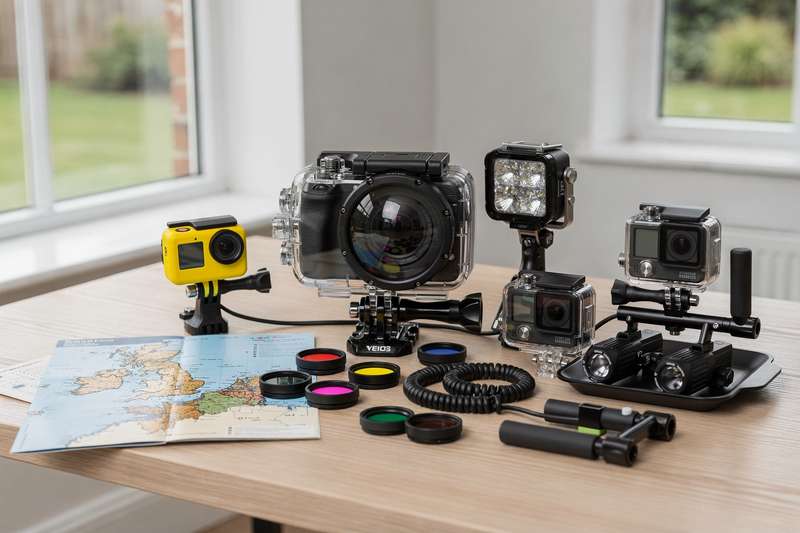
Getting good underwater video and photography requires more than pointing a camera into the water. Seawater and freshwater alike absorb red and warm-toned wavelengths within the first few metres, which means anything shot below about three metres looks cold and drained of colour without artificial light. The camera body matters, the housing matters, your technique matters — but lighting is consistently the most transformative improvement you can make to your underwater results, and yet it is what most newcomers buy last. This guide focuses on products currently available on Amazon UK that address the most common gaps: dedicated video lights, a purpose-built underwater fishing camera, and reference books that help you develop the skills to use your kit to its actual potential.
How These Picks Were Selected
These recommendations draw on verified buyer review patterns on Amazon UK, an honest assessment of manufacturer-stated specs and depth ratings, and a close reading of real-world experience reports from actual buyers rather than specification-sheet comparisons alone. For video lights, the key criteria were rated waterproof depth (taken from product titles and listings directly, not just marketing copy), beam angle, colour rendering index, battery life, and how well the light performs after extended use rather than straight out of the box. For the underwater fishing camera, the focus was on the intended deployment scenario — inline fishing use in UK freshwater and saltwater conditions — and whether the product performs consistently across that range. Books were assessed on reviewer sentiment, the practical applicability of the content to real shooting conditions, and how well the material covers digital workflows that remain relevant to a modern photographer. Products with zero verified reviews were excluded where reviewed alternatives existed, and high headline star ratings were not taken at face value without examining the underlying review content for recurring issues.
Best for Underwater Fishing Video: Water Wolf 2.0 Underwater Fishing Camera
The Water Wolf 2.0 Underwater Fishing Camera is the most extensively reviewed product in this guide, with 317 Amazon UK buyers giving it 3.9 out of 5 stars — a volume of feedback that produces a far more reliable picture of real-world performance than a product with a handful of early ratings can provide.
The concept is straightforward and well-suited to its intended purpose: the camera runs inline on your fishing line, positioning itself above the lure or bait as you cast or troll, and records full HD 1080p footage of the underwater environment and fish interactions around your presentation. For UK anglers targeting pike, perch, zander, or coastal species such as sea bass and pollock, the visibility into how fish are actually reacting to your bait is something that neither a sonar unit nor a depth finder can offer. You can see whether fish are following and turning away at the last moment, hovering without committing, or ignoring your presentation entirely — and adjust your approach with actual visual evidence rather than guesswork.
The design is compact and streamlined to reduce drag during casting, so it does not significantly affect rig action or sink rate. It is rated for both freshwater and saltwater environments, which broadens its useful range across UK fishing contexts — from still-water gravel pit sessions and canal fishing through to sea fishing from a boat or pier. Setup is not complicated, and you do not need a specialist housing or any additional accessories to start using it.
The tradeoffs come through clearly in the review patterns. The 3.9-star average reflects consistent feedback about low-light performance in murky or stained water — which describes a significant proportion of UK freshwater conditions, particularly through autumn and winter. Without supplemental lighting, footage in heavily coloured water can be dark and difficult to interpret. Some buyers have noted that battery life, while workable for standard sessions, can feel limited on longer days, and that cold temperatures reduce battery performance noticeably during winter fishing.
It is also worth being clear about the ceiling on image quality. The Water Wolf 2.0 produces footage that is useful and informative — you can see fish behaviour around your bait, which is the whole point — but the output is functional rather than cinematic. If your goal is producing polished underwater video content for a YouTube channel or social media following, you would need additional lighting and a more capable camera system to achieve that standard. For fishing-specific applications, however, this is a purpose-built tool that does exactly what it claims, and the 317-review base suggests it holds up to regular use in demanding conditions. Approach it as a serious fishing accessory rather than a general underwater photography system, and it is a well-chosen addition to your kit.
Best All-Round Dive Video Light: Sealion Dive Video Light (L24-1)
The Sealion Dive Video Light (L24-1) is one of the more capable mid-range options currently available on Amazon UK for divers who want a proper video light without stretching to the cost of a professional rig. It has accumulated 84 reviews at 4.1 stars — a solid level of feedback for a product in this category, and enough to draw reliable conclusions about real-world performance.
The specifications are well-matched to recreational diving. The L24-1 carries a 100m depth rating, which covers the vast majority of sport diving in the UK and on international trips — most recreational divers operate between 18 and 40 metres, so that depth certification provides a comfortable margin without overpaying for technical-dive depth ratings you will never use. The 120° beam angle is wide enough to fill the frame when shooting with a wide-angle lens or action camera, avoiding the harsh spotlight effect that plagues narrower alternatives and creates uneven, unflattering illumination across your subject. The 90 CRI rating is where this light makes its most meaningful contribution: CRI (Colour Rendering Index) measures how accurately a light source renders colours compared to natural daylight on a scale of 0–100, and a 90 CRI rating means the colours captured on your sensor under this light are close to what your eyes actually see. For photographers who work in post-processing, accurate colour at the point of capture is dramatically easier to work with than footage shot under low-CRI lighting that requires heavy correction.
Buyer reviews back up the spec sheet in a meaningful way. The light output is consistently described as effective and practically useful — it has the brightness to restore warm colours at recreational depths, which is the fundamental job of a video light, and the 90 CRI means those restored colours look natural rather than garish or inaccurate. Build quality comes up positively across reviews, with buyers noting the unit feels solid and handles repeated diving without issues arising over time.
Where it has limitations worth acknowledging honestly: the 100m depth rating places it short of the technical diving range if your diving eventually heads in that direction. A single light on a wide-angle shot can also produce one-sided shadows if your subject is not centred in the frame, and serious videographers producing professional-standard wide-angle work typically run two lights on arms for even coverage. Occasional lower-rated reviews in the 4.1-star mix tend to reflect battery life concerns on extended dives rather than fundamental reliability problems.
It is worth noting that Sealion also produces the B15-8, a smaller model in the same range with a lower output level — useful if you are packing light for air travel or using a very compact camera setup. For most divers who want a primary video light that covers recreational depths and delivers accurate colour rendering, the L24-1 is the more capable option and carries the higher review count to support that recommendation.
Paired with a compact mirrorless, action camera, or compact diving camera setup, a light with these specifications transforms the quality of your underwater footage in a way that no amount of colour grading can replicate after the fact. Getting colours right in-camera at depth is the foundation of compelling underwater photography, and the L24-1 is a practical way to achieve that at a mid-range investment level.
Best High-Power Torch for Deep-Water Illumination: LetonPower TS S Pro
For divers who need serious output rather than a modest fill light, the LetonPower TS S Pro underwater video light brings a claimed 13,000-lumen output into the mid-range price bracket, with 75 Amazon UK reviews at 4.0 stars — enough feedback to draw reasonable conclusions about performance and reliability.
The depth rating stated in the product listing is 120m, placing the LetonPower well beyond recreational limits and into technical diving territory. For wreck divers, cave divers, or technical divers who regularly operate in environments where ambient light is minimal or entirely absent, the combination of that depth rating and high raw output makes this a more credible tool than a light that would already be at its absolute limits before you reach the bottom of a deeper recreational dive. The Type-C charging port is a practical convenience that becomes meaningful on a liveaboard or multi-day trip where you may be managing several devices simultaneously — USB-C chargers are far easier to source internationally than proprietary formats, which matters when you are travelling.
The 4.0-star average from 75 reviewers reflects a broadly positive ownership experience. The light output is consistently described as impressive in practice, and the build quality is noted as substantial and capable. Some buyers flag that the output modes could benefit from finer gradations — the jump between brightness levels can be pronounced, which is worth knowing if you want precise control over exposure in shallower conditions where full output would overwhelm the sensor.
There is an important distinction to draw between a high-power torch and a dedicated video light, and the LetonPower sits closer to the torch end of that spectrum. A dedicated video light is optimised for wide, even coverage with accurate colour rendering — typically a beam angle of 100°–120° and a high CRI rating — which is what you want when filming or photographing marine life across a scene. A high-lumen torch prioritises raw output and often has a more concentrated beam designed to penetrate distance and darkness. Where the LetonPower works particularly well is in genuinely dark environments: inside wrecks, within caverns, or in conditions where a lower-output light simply cannot push through the water effectively. In those situations, the output advantage is tangible.
For recreational divers operating at modest depths on well-lit tropical reefs or in typical UK coastal visibility, the Sealion L24-1 with its 90 CRI and wide beam angle will produce better-looking footage for photography purposes despite a lower lumen figure. The LetonPower is the right choice when your diving is taking you somewhere genuinely dark and you need the light to do serious work. The 120m depth rating also means it has room to grow with you as your diving progresses beyond recreational limits — and for a diver who knows they are heading in that direction, that headroom is worth building into your kit now rather than replacing an adequate light sooner than necessary.
Best Visual Learning Resource for Underwater Photographers
Underwater Photography is the highest-rated book in this guide, carrying 4.6 out of 5 stars from 21 Amazon UK reviewers — the strongest endorsement from verified buyers in the current shortlist, and an encouraging signal for a reference title in a niche where the selection is relatively limited on the platform.
The appeal of this title comes through clearly in reviewer comments: it addresses underwater photography in a way that goes beyond technical instructions and engages with the visual thinking that separates good underwater images from average ones. Composition, how to approach marine subjects without disturbing them, understanding the behaviour of light at different depths, and the considerations that shape post-processing decisions — these are the elements that determine whether your photographs communicate what you actually saw and felt during a dive, not simply whether the exposure was technically correct.
A camera with strong autofocus, a housing that seals reliably, and a capable video light will still produce disappointing images if you have not developed a clear sense of what makes a compelling underwater photograph and how to achieve it deliberately. This is the gap that a well-regarded book addresses: the thinking and seeing that happens before you even enter the water.
The 4.6-star rating suggests most buyers find it applicable in practice rather than just theoretically interesting. For photographers who have invested in their first underwater camera setup and want to develop more rapidly without working through inconsistent online tutorials, a structured resource like this covers the fundamentals cohesively in a single reference you can return to between dives as your experience builds.
The honest context is that 21 reviews is a relatively modest sample size. The score is consistently positive rather than being distorted by outliers, but it is worth acknowledging that the underwater photography book market on Amazon UK is not large. If you prefer to learn through structured reading alongside practical application in the water, this title has the most enthusiastic buyer endorsement in the current shortlist. Pairing it with a solid lighting setup gives you both the technique and the tools to make consistent progress rather than hoping things improve automatically with more dives.
Best Technical Reference for Serious Underwater Photographers
The Master Guide For Underwater Digital Photography takes a more comprehensive and technically detailed approach than an introductory title, and while its review count is modest at 11 verified ratings, those reviewers give it 4.1 out of 5 stars and consistently describe the depth of content as its primary strength.
The title’s ambition is reflected in what it covers: camera settings and exposure theory as applied to underwater conditions, strobe and light positioning principles, the optics of water and how they affect angle of view and image sharpness, housing selection considerations, colour temperature correction techniques, and the specific challenges of different underwater environments — open ocean, coral reefs, kelp forests, and wrecks. For a photographer who has already taken underwater images and wants to understand why they are coming out the way they are, rather than simply following surface-level rules to “get closer and avoid direct flash,” that level of technical depth is where meaningful progress actually happens.
The reviewers who have left substantive comments are largely positive about the book’s thoroughness and practical value, noting that it reads as the work of someone with extensive field experience rather than a compiled overview. The 4.1-star average reflects genuine satisfaction among those who came to it looking for serious technical content rather than a beginner walkthrough.
The caveat on this title is the review count. With 11 ratings, the feedback represents a narrower range of buyer experience than a title with hundreds of reviews. The principles of underwater photography — strobe positioning, backscatter reduction, the physics of light in water, compositional approaches to marine life — are largely timeless and do not date in the way that specific gear recommendations might. Any equipment references from older editions should be treated as illustrative rather than current buying guidance, but the underlying technique remains directly applicable to modern digital systems.
The ideal reader is a diver who already has some experience shooting underwater, knows they want to improve, and is looking for a resource that engages seriously with the technical side of the craft rather than staying at introductory level. If you are the type of photographer who wants to understand why your images look the way they do and make deliberate decisions in the water rather than hoping for the best, this guide is built for that mindset. The 4.1-star average from its relatively small but consistent reviewer base suggests it delivers on that expectation for photographers who approach it with realistic expectations of what a technical reference offers.
What to Look For When Buying Underwater Photography and Video Gear
- Depth rating: This is the most fundamental spec to verify before purchasing any piece of underwater equipment. A depth rating of 50m covers recreational diving; 100m suits advanced recreational and some technical scenarios; 120m and beyond is relevant for technical divers operating beyond recreational limits. Check that the depth rating appears explicitly in the product title or listing documentation — a spec buried only in marketing copy is a weaker guarantee than one stated prominently in the product name itself.
- CRI (Colour Rendering Index) for video lights: CRI measures how accurately a light source renders colours compared to natural daylight on a scale of 0–100. For underwater photography and video, aim for a CRI of 90 or above. A lower-CRI light can appear bright but renders colours inaccurately, making coral, fish markings, and skin tones look unnatural on camera in ways that are genuinely difficult to correct in post-processing.
- Beam angle: Wider beams (typically 100°–120°) produce even, diffused illumination suited to video and general photography. Narrower beams concentrate output for longer-range penetration and are more appropriate for cave or wreck navigation. Identify which type of shooting you primarily intend to do — the two types serve different purposes and neither substitutes for the other.
- Battery life and charging format: Battery capacity matters considerably on multi-dive days or liveaboard trips. Check buyer reviews for honest accounts of real-world run time at typical brightness settings rather than relying on the maximum figure quoted by manufacturers. Lights with USB-C charging are more convenient for travel. Some lights use replaceable 18650 cells, which allows you to carry spares — a practical option for back-to-back diving days.
- Build quality and O-ring maintenance: The waterproof seal on any dive light or housing depends on O-rings. Check whether the O-rings are accessible for inspection and lubrication before dives, and whether replacement seals are readily available. Buyer reviews that mention issues arising after extended use are more informative than early ratings from buyers who have only used the product a handful of times.
- Use case match: Underwater photography and video equipment is highly specific to use case. A fishing action camera is not a substitute for a scuba diving system; a wide-angle video light optimised for photography is not the same as a torch designed for maximum penetration at depth. Match the product to the specific scenario you are actually shooting — the right tool for your use case will outperform a more expensive product designed for something different.
- Mounting compatibility: If you are adding a video light to an existing camera rig, confirm that the mounting interface is compatible with your current arm and tray system. Most dive lights use a standard 1-inch ball-head mount, but confirming this before purchase saves you discovering an incompatibility on the dive deck when it is too late to do anything about it.
Verdict
For most UK divers who want to make a meaningful improvement to the quality of their underwater video and photography, the Sealion Dive Video Light (L24-1) represents the most impactful single purchase available on Amazon UK right now. A 90 CRI light with a 120° beam and a 100m depth rating covers the vast majority of recreational diving scenarios, and the difference it makes to footage colour accuracy is dramatic compared to relying on natural light alone. The 84 verified reviews at 4.1 stars indicate a consistent ownership experience — not a product that looks good on paper but disappoints underwater.
If your underwater ambitions are specifically about fishing video rather than diving photography, the Water Wolf 2.0 is the natural starting point — purpose-built for inline fishing camera use and backed by 317 reviews that confirm its reliability in freshwater and saltwater conditions. And if you know your diving regularly takes you into genuinely dark environments such as wrecks, caverns, or technical depths, the LetonPower TS S Pro’s 120m depth rating and high lumen output give you meaningful headroom as your diving progresses.
Whatever hardware you buy, pair it with at least one solid learning resource. Understanding the principles of underwater photography before and between dives accelerates your development far more effectively than simply logging more bottom time with the same bad habits. The two books in this guide approach the subject from different angles — one more visual and conceptual, one more technically detailed — and each rewards a different type of learner.
We were not paid to feature any specific product in this guide. All opinions are independent and based on publicly available specifications, verified buyer feedback patterns, and category research.
Quick Comparison Table


FAQ
Do I need a dedicated underwater housing to use a regular camera for diving photography?
Yes — almost all standard cameras, including mirrorless, DSLR, and compact models, require a purpose-built underwater housing to be submerged safely beyond very shallow depths. Housings are waterproof enclosures with external controls that let you operate the camera’s buttons and dials underwater. The notable exceptions are waterproof compact cameras rated to 15 metres without a housing, though a dedicated housing extends that depth considerably and typically adds port options for wide-angle and macro wet lenses.
What is CRI, and why does it matter for dive video lights?
CRI stands for Colour Rendering Index and measures how accurately a light source renders colours compared to natural daylight on a scale of 0 to 100. Underwater, water itself absorbs warm wavelengths within a few metres, and a low-CRI light compounds that problem rather than correcting it. For underwater photography and video, a CRI of 90 or above is the standard to look for — lights below 80 CRI can make coral, fish markings, and skin tones look inaccurate and difficult to fix during post-processing, even when the footage appears adequately bright.
What depth rating should I look for in a dive video light?
Match the depth rating to your actual diving rather than the most extreme scenario you might theoretically consider. Recreational sport divers typically operate to 30–40 metres, so a light rated to 100m provides a comfortable margin. Technical divers operating beyond recreational limits should look for lights rated to 100m or deeper. Check that the depth rating is stated clearly in the product title or documentation, and pay attention to buyer reviews that mention flooding well within the stated limit — a single credible flooding report is a more useful data point than a headline rating alone.
What causes backscatter in underwater photos, and how do I reduce it?
Backscatter is the bright speckled effect caused by particles in the water — sediment, plankton, small debris — reflecting artificial light directly back into the camera lens. The most effective way to reduce it is to position your light source away from the lens axis using a strobe arm, so the light strikes your subject from an angle rather than straight on. Getting closer to your subject also helps by reducing the water column between you and it. No amount of post-processing fully removes heavy backscatter, so getting light positioning right in the water is far more effective than attempting to correct it afterwards.
Is the Water Wolf 2.0 suitable for scuba diving photography, or is it designed specifically for fishing?
The Water Wolf 2.0 is designed specifically as an inline fishing camera — it attaches to your fishing line above the lure or bait and records what happens around your presentation as you fish. It is not designed for mounting on a scuba rig, for wide-area photography of marine life, or for the kind of creative underwater shooting a diver would want. If you want underwater video footage from scuba diving, you need a camera and lighting setup built for that purpose. The Water Wolf is a fishing accessory first and foremost, and it performs that specific role well.
Is a high-lumen dive torch the same thing as a dedicated video light for underwater photography?
Not exactly — they are related but distinct tools. A dedicated video light is optimised for wide, even coverage with a high CRI rating, producing accurate colour across a broad scene, which is what underwater photographers and videographers need for their subjects. A high-power torch prioritises raw lumen output and often uses a more concentrated beam designed to penetrate distance and darkness, which is more useful for navigation and illuminating the interior of wrecks or caverns. For photography and video work, a high-CRI wide-angle video light typically produces better-looking results than a high-lumen torch with a narrower beam — even if the lumen figure looks lower on paper.