You bought your first katana six months ago — or perhaps you’ve been practising Iaido for a few years and the collection has crept up quietly to three or four blades. Whatever the situation, the chances are they’re not displayed in a way that does them justice. One is propped against a wardrobe. Another is flat on a shelf, taking up the entire surface. A third is still in the box under the bed because there’s no safe place to put it. You’ve probably tried leaning one against the wall at an angle, only for it to slide down and leave a mark on the skirting board. Searching online turns up a bewildering range of options — wall hooks, freestanding racks, wooden cradles, four-tier brackets — and each listing describes itself as suitable for everything from a child’s foam sword to a full-length tachi.
What you need isn’t more options; it’s clarity about which type of stand suits your specific situation. This guide cuts through the weapon stands available on Amazon UK right now and gives you concrete recommendations for seven different scenarios: from a single display piece on a bedroom wall to a freestanding five-tier rack that can hold a growing collection without requiring a single wall plug.
How These Picks Were Chosen
Eight sword stands and weapon mounts currently listed on Amazon UK were assessed for this guide. The primary selection criterion was real buyer feedback: products with strong review counts carried the most weight, and common complaint patterns — poor padding that marks lacquered scabbards, loose hook fixings, misleading capacity claims, and instructions that require deciphering — were used to flag weaknesses worth naming. Alongside review data, each product was assessed on mounting type (wall-fixed versus freestanding), how well it protects blade and scabbard finishes, capacity relative to a typical UK collector’s needs, adjustability for different sword lengths and handle shapes, and ease of installation on standard UK wall types.
Two products in this guide have very few reviews: the petour five-tier stand and the wooden single-layer rack designed for shorter blades. Both are flagged clearly in their sections so you can weigh the limited evidence yourself. One product with a 1.0-star rating from a single reviewer was excluded entirely. Every pick covers a distinct mounting type or use case, so reading through all seven gives you a clear picture of which category fits your situation.
Best Overall: Sword Wall Mount 2-Tier Hook Katana Holder
The Sword Wall Mount 2-Tier Hook Katana Holder has the strongest evidence base of any product in this guide — 753 reviews at 4.4 out of 5 — and it shows in how consistently buyers report it working across different sword types and wall configurations. When a product in a niche category accumulates that kind of review depth, the broad patterns become reliable: this mount works for the large majority of buyers who try it, and the complaints that do appear are specific and predictable rather than random.
The design is a two-tier horizontal wall mount: two sets of padded hooks positioned at different heights on the wall, with the sword resting horizontally across both. The padding on each hook matters more than it might initially seem — direct, unpadded contact with a lacquered saya or a polished habaki will eventually leave pressure marks, and this design prevents that from day one. The adjustability is one of the more practical features: the horizontal spacing between hooks on each tier can be altered to suit different blade lengths and handle positions, meaning a full-length katana and a shorter wakizashi can both be displayed using the same mount without either sitting awkwardly.
Installation is where this mount holds up to scrutiny. Most buyers report it takes under fifteen minutes from opening the box to having a sword on the wall — the hardware is included, the fixing points are straightforward, and you don’t need specialist tools. The hooks themselves have a satisfying rigidity once mounted, with no noticeable flex when a full-length blade rests across them. One real friction point that appears consistently in reviews: getting both tiers level on a wall with any irregularity requires care. A spirit level is worth using rather than relying on eye judgement, especially if your wall surface isn’t perfectly flat.
The aesthetic is functional rather than decorative. The matte finish blends into most painted walls without demanding attention — which lets the sword itself do the visual work. If you want something that looks like a crafted display piece in its own right, the wooden options elsewhere in this guide will serve better. But for a bedroom wall, a home gym corner, or a training room where the priority is accessible and safe display rather than interior styling, this mount delivers consistently.
It also handles weapons beyond traditional Japanese swords more capably than you might expect. Rapiers, decorative sabres, cosplay lightsabers, and film replica props all feature in the buyer reviews as things this mount has handled without trouble. The adjustable padded hooks are versatile enough to accommodate handle shapes and blade profiles that a katana-specific cradle wouldn’t suit. If you own one type of weapon now but expect your collection to diversify, that flexibility has real value from the start.
Best Multi-Pack Value: pmsanzay 4 Pack Mini Adjustable Sword Wall Mount Hook Display Hanger Rack
The pmsanzay 4 Pack Mini Adjustable Sword Wall Mount Hook Display Hanger Rack takes a fundamentally different approach from fixed multi-tier brackets — four individual adjustable hooks that you position independently on the wall, giving you complete control over your display layout. With 222 reviews at 4.5/5, it’s the second most-reviewed pick in this guide and the best choice for anyone who wants flexibility rather than a predetermined rack format.
The core benefit is modularity. Each hook mounts separately, so you decide the spacing, the height, and the configuration. You can create a tightly spaced vertical arrangement, a horizontal row at the same height, a diagonal spread for visual interest — none of that is locked in by the product design. If one wall in your home has a long narrow section above a doorframe, these hooks can fill it in a way that a standard multi-tier rack simply couldn’t. If you want hooks in two different rooms, you split the pack. If one hook eventually gets damaged, you have spares without having to buy the entire product again.
The adjustability on each individual hook is practical in a different sense: each hook’s width flexes to accommodate different handle thicknesses and blade widths, from slim tanto grips to the broader tsuka of a full katana. The padding on each hook is consistently mentioned in buyer reviews as effective — thick enough to prevent finish damage on lacquered scabbards, which is the test that matters most if you own anything with a delicate outer surface.
The tradeoff for modularity is that the planning work falls on you. A pre-assembled rack has its alignment built in; with four separate hooks, you’re responsible for measuring, marking, and drilling accurately. A spirit level and a pencil are your primary tools — invest the time in getting the first hook perfectly positioned and the rest follow more easily. Some buyers on harder walls or older UK plaster have found the included fixings less robust than they’d like and have sourced their own wall plugs. That’s worth knowing before you start, particularly in a period property.
For the price, four hooks represent strong value against buying four separate single-hook mounts. If your collection is growing and you want to spread weapons across your space without committing to a fixed rack layout, this pack gives you the material to build as you go. The 4.5/5 rating over 222 reviews suggests most buyers find them reliable once installed — which is what the category requires above all else.
Best for a Growing Collection: AUXPhome Four-Tier Sword Stand
The AUXPhome Four-Tier Sword Stand is built for collectors who have accumulated four or more swords and need a single wall installation that handles all of them, rather than drilling four separate sets of fixing points across the wall. With 187 reviews at 4.0/5, it’s well enough reviewed to trust — and understanding why the rating sits at 4.0 rather than 4.5 is useful to know before you buy.
The four-tier design spaces four horizontal display positions one above the other on a single bracket. This is efficient from a wall-space perspective: one set of anchor points accommodates what would otherwise require multiple separate mounts. The construction is metal rather than wood, which makes it lighter than a full timber rack and easier to ship flat — both relevant if you move house regularly. The metal hooks have padding on the contact surfaces, and the overall structure holds its load without noticeable flex once properly installed.
The 4.0 rating reflects a real friction point: installation precision. With four tiers on a single bracket, even a small angular error at the fixing points becomes amplified across the full height of the rack. Some buyers have found the assembly instructions sparse, and getting the bracket perfectly plumb on certain UK wall types — particularly older lath-and-plaster construction — requires more care than the listing implies. If you’ve mounted shelving units or picture rails before, you’ll manage it without difficulty. If this is your first wall-fixing project, budget more time than you expect and keep a proper spirit level to hand throughout.
One genuine limitation to check before ordering: the spacing between tiers is fixed, not adjustable. Standard katana fit without issue, but an exceptionally long decorative piece — a nodachi or an oversized prop — may not sit well within the tier spacing. Measure your longest blade before committing. Standard Japanese sword lengths and most decorative replica pieces fit correctly; this concern applies only at the extremes of blade length.
For the collector who has reached the point where a single-tier mount no longer covers their collection, the AUXPhome four-tier option is the most practical wall solution in this guide. It’s not the most elegant piece aesthetically — the metal bracket is functional rather than decorative — but in a dedicated training space, a games room, or on a wall where the display is the point rather than the backdrop, that pragmatism is an advantage rather than a shortcoming.
Best Freestanding Display: Helweet Sword Holder
The Helweet Sword Holder is the pick for anyone who can’t or won’t drill into their walls — a freestanding tabletop display with 140 reviews at 4.4/5, making it the best-evidenced no-drill option in this guide. It’s designed to sit on a surface and present a sword horizontally above it, which requires the stand to be stable enough not to tip and protective enough not to mark what’s resting on it. Based on the review patterns, it handles both requirements well.
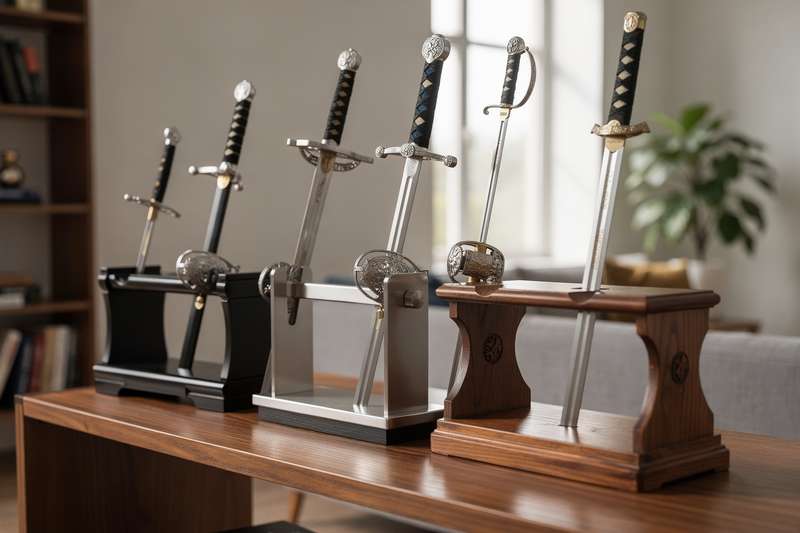
The wooden construction immediately sets this apart from the metal bracket options. This isn’t a flimsy plastic cradle — the material has weight and warmth to it, and the cradle sections that support the blade are shaped to distribute contact rather than creating pressure points. If you own a sword with a lacquered saya, a polished finish, or an elaborate wrapping on the handle, those contact surfaces determine whether your stand eventually damages what it’s holding. Wood with proper cradle shaping is generally kinder to delicate finishes than unpadded metal.
The practical benefits over wall mounting are real: you can reposition it without tools, take it to an event or demonstration, or move it to a different room in minutes. If you’re a practitioner who trains with your weapon and wants it accessible at a natural height rather than mounted overhead, a freestanding stand suits the workflow better. You pick it up, practise, put it back — no reaching up to a wall mount and lifting at an awkward angle each time.
The tradeoffs are equally clear. On a desk or a shelf, this takes up meaningful surface area — it’s not a compact piece. Check the dimensions against your available surface space before ordering. Stability is fine on a sturdy bookshelf or sideboard where it won’t be knocked regularly, but on a surface that gets regular traffic — a desk in a busy study, a shelf at child height — a freestanding stand needs more thought about positioning than a wall-fixed option. Some buyers have used the Helweet stand for decorative props and replica pieces beyond standard Japanese swords, and it handles a range of blade types without issue as long as the overall proportions aren’t far outside standard katana dimensions.
Best Aesthetic Wall Mount: Katana Wall Mount 1-Tier Wood Sword Display Stand with Padded Hooks
The Katana Wall Mount 1-Tier Wood Sword Display Stand with Padded Hooks takes a warmer approach than the metal bracket options in this guide — natural wood construction that reads as a considered display piece in its own right rather than a functional bracket that happens to hold a sword. At 4.8/5 from 8 reviews, the rating is the highest in this guide, though the low review count means you’re working with limited evidence. The early signal is positive; the caveat is that early is what it is.
The warmth of the wooden material is its primary appeal. In a study, a bedroom, or a living space where the display is integrated into the overall décor rather than isolated in a training room, wood reads as intentional in a way that a powder-coated metal hook bracket doesn’t. If the sword you’re displaying is a centrepiece piece — a first katana, a gift from a teacher, a commemorative item — the mount surrounding it should feel proportionate to that significance, and this one does.
The single-tier format means it holds one sword horizontally, displayed at a consistent height across the full length of the blade. Padded hooks are built into the design, protecting the scabbard or blade from direct hard contact. Single-sword mounting also removes the concern present in multi-tier racks where adjacent blades can knock against each other if spacing is tight or if the swords have unusually wide guards or handles.
The limitation is clear: one tier, one sword. If your collection has already grown to two or three pieces, this mount covers only one of them, and you’ll either need multiple units or a different product altogether. It’s the right scale for a single centrepiece sword in a room where the display matters — not for the collector who’s accumulating volume and needs to accommodate it efficiently. If you want wood aesthetics but would prefer a stronger evidence base, the Helweet freestanding stand covered earlier in this guide has substantially more reviews to draw on.
Best for a Large Freestanding Collection: petour Sword Stand Holder 5 Tiers
The petour Sword Stand Holder 5 Tiers is the most ambitious freestanding option in this guide: five display tiers, no wall fixings required, in a footprint measuring 31 × 11.5 × 37cm. The honest disclaimer comes first — only two buyers have reviewed this product, giving it a 5.0/5 score that’s encouraging but not statistically meaningful. Treat it as an early-stage product and factor that into your decision.
The five-tier design is what makes this clearly distinct from everything else in the guide. No drilling, no wall plugs, no commitment to a fixed wall location — you assemble the rack, place it on a flat surface, and load it up. Assembly on freestanding samurai sword racks of this type typically involves a peg-and-slot construction that requires no specialist tools. The compact overall dimensions mean it can sit on a wide shelf, a sideboard, or on the floor in a corner depending on your preference and blade lengths.
For collectors who move frequently, rent their home, or simply don’t want permanent wall fixtures, the no-drill advantage is real. Five tiers means up to five swords can be displayed simultaneously — enough to accommodate a daisho pairing, a couple of training blades, and a display piece without any of them being stored away or competing for the same shelf space.
Where the limited review count creates real uncertainty is long-term structural stability. A five-tier rack carrying multiple blades needs to maintain its integrity over months of loading and unloading, and two buyers can’t confirm that in the way that 200 can. If you specifically need a no-drill five-tier solution and can’t find a better-reviewed alternative on Amazon UK right now, this is the pick — but go in knowing you’re among the first buyers rather than buying into a proven product. Check the 37cm height against your blade storage requirements carefully: longer blades may overhang the tiers in ways that affect stability.
Best for Tanto and Wakizashi: Sword Holder Wooden Swords Rack Single Samurai Display Rack
The Sword Holder Wooden Swords Rack Single Samurai Display Rack fills a gap that most options in this category overlook: it’s specifically proportioned for wakizashi and tanto rather than assuming every sword in your collection is a full-length katana. With 2 reviews at 4.5/5, it shares the same early-stage caveat as the petour five-tier stand — limited evidence, promising signal, apply caution before committing.
Shorter Japanese blades have different display requirements from a katana. A stand sized for 100–110cm overall length leaves a 50cm tanto sitting awkwardly: too much unsupported blade overhang, the handle end not resting at the right angle, the scabbard tip failing to reach the lower cradle correctly. A stand sized for shorter blades addresses all of this by design rather than as an afterthought, and labelling that specifically mentions wakizashi and tanto is the right signal to look for when shopping in this category.
The wooden construction and black finish give this a clean, simple look that suits both traditional and more contemporary interiors. It’s a tabletop freestanding piece — one sword, one layer, positioned horizontally on a surface. The simplicity of the design means there’s less to go wrong with it than a complex multi-tier assembly, which is a small but real point in favour of a product that doesn’t have many reviews to fall back on for reassurance.
If you own a daisho set — the traditional matched pairing of a katana and a wakizashi — you’d need this for the wakizashi and a separate full-length stand for the katana. That’s not a design flaw; it’s a practical consideration for paired collections. This stand is a focused solution for a specific blade length range, and it’s a better fit for that scenario than adapting a full-length katana stand to shorter blades. Just factor in the thin evidence base, and if you try it, a review would help future buyers considerably.
What to Look For in a Weapon Stand
Before adding anything to your basket, run through each of these criteria against your specific situation:
- Wall mount versus freestanding: Wall mounts fix permanently and free up surface space, but require drilling and are not suitable for renters without landlord permission. Freestanding stands need no tools and can be repositioned freely, but occupy a surface and can tip if knocked. If you’re in rented accommodation, a freestanding stand or a no-drill adhesive-strip solution is worth prioritising.
- Capacity: Single-tier stands suit a centrepiece piece elegantly; multi-tier racks handle volume more efficiently but require more precise installation. Think about where your collection will be in two years — buying a single-tier mount when you already own three swords means buying again soon.
- Padding on every contact point: Any stand that puts hard, unpadded material in direct contact with a lacquered saya, a polished blade surface, or a fabric-wrapped handle risks leaving permanent marks over time. Look for foam, felt, or rubber padding wherever the stand touches the sword — and if the padding feels inadequate on arrival, self-adhesive felt strips from any hardware shop are an easy fix.
- Adjustability: Fixed-width hooks and cradles can’t accommodate the full range of handle thicknesses across different sword types. If your collection includes pieces with varying proportions — a tanto alongside a katana, or a European rapier alongside a Japanese blade — adjustable hooks are worth the marginal extra consideration.
- Blade length compatibility: Check the stand’s dimensions against your sword’s actual overall length. This matters most at the extremes: short blades in large stands and long blades in tight multi-tier racks are both common sources of frustration. Most product listings include a useful measurement range; don’t skip that check.
- Material and aesthetic: Wooden stands tend to look warmer and more traditional, suiting living spaces and studies. Metal brackets are lighter, more compact, and often easier to integrate into a modern space or dedicated training room. Neither is objectively better — it depends on the wall, the room, and what surrounds the display.
- Installation complexity: A four-tier wall rack that requires precise measurement and the right wall plugs for your specific wall type is a very different afternoon from a single hook that takes five minutes. Be honest about your DIY confidence, particularly on older UK walls where plaster depth and stud positions can be unpredictable.
Verdict
For most UK buyers — someone with one to three swords who wants a reliable, proven wall display that handles different blade sizes without fuss — the Sword Wall Mount 2-Tier Hook Katana Holder is the right starting point. It has the most substantial evidence base in this guide, works for a range of sword types and sizes, and the adjustable padded hooks mean you’re not locked into a specific blade length or handle shape. Installation is manageable for most people, and the functional finish suits a broad range of spaces without clashing with existing décor.
If you’re building a larger display and need to cover four swords from a single installation, the AUXPhome four-tier bracket handles that capacity more efficiently. If drilling is off the table, the Helweet freestanding stand is the best-reviewed no-drill option. If you want to configure your own wall layout across unconventional spaces, the pmsanzay four-pack of individual hooks gives you the flexibility to do it exactly as you need. And if you own specifically shorter blades — tanto, wakizashi, or similar — the purpose-built wooden single-layer stand suits those dimensions better than adapting a katana-sized rack.
Start with the two-tier adjustable mount if you’re unsure: it’s the safest default for the broadest range of collections, and most buyers find it covers their needs without anything further.
This guide was produced independently. We were not paid to feature any specific product. All opinions are based on publicly available specifications, verified buyer feedback patterns, and category research.
Quick Comparison Table


FAQ
What is the difference between a wall mount and a freestanding sword stand?
A wall mount fixes directly to the wall using screws and holds your sword horizontally against the surface, keeping it off shelves and freeing up floor or surface space. A freestanding stand sits on a table, shelf, or the floor and holds the sword above it. Wall mounts are more secure and take no surface space but require drilling; freestanding stands are portable and need no fixings but occupy a surface and can be knocked over.
Will a standard sword stand fit a full-length katana?
Most stands in this guide are designed for standard katana dimensions — roughly 100 to 110cm overall length. If your blade is particularly long, such as a nodachi, or unusually short, always check the product’s listed dimensions against your sword’s actual length before ordering. Stands specifically designed for wakizashi or tanto are sized for shorter blades and will not suit a full-length katana comfortably.
How do I stop a sword stand from scratching my scabbard or blade finish?
Look for padded hooks or cushioned cradle points on any stand you buy. Hard, unpadded metal or wood in direct contact with a lacquered saya will eventually leave pressure marks, especially if the sword is placed and removed regularly. If the padding on a stand feels thin after it arrives, self-adhesive felt strips — available in any hardware shop — can be added to contact points without affecting the stand’s function.
Can I use a weapon stand for a cosplay prop or replica sword?
Yes — most of the mounts in this guide work well for cosplay props, decorative replicas, and film or TV-inspired pieces. The adjustable hook options are particularly useful for non-standard blade shapes and wider handles typical of fantasy props. If your replica is unusually heavy — some resin or high-density foam pieces weigh more than a comparable steel blade — check the weight capacity stated in the product listing before mounting it.
How many wall fixings does a typical sword wall mount require?
Single-tier mounts typically need two fixing points; multi-tier racks and wider brackets may need four or more anchor points depending on the design. Hardware is usually included in the box, but whether the supplied screws and plugs suit your wall type is not guaranteed. In UK homes — particularly older properties with solid brick or lath-and-plaster walls — having a selection of appropriate wall plugs to hand before you start makes a practical difference to the result.
Is it safe to display a real sword on a wall mount in a home with children?
A correctly installed wall mount is generally more secure than a freestanding stand that can be knocked over, but any live blade on display warrants careful positioning. Place wall mounts high enough to be out of reach, keep the sword sheathed in its scabbard wherever possible, and consider a display case with a lockable front if the weapon will be in a shared family space.