You’ve gone through the paper calendar stuck with Blu Tack, the whiteboard that kept sliding off the kitchen wall, and the shared family app that somehow nobody ever opens. You know the cycle: you buy a new planning system with good intentions, use it for a week, and then watch it quietly become part of the background until it ends up in the recycling during the next clear-out. The problem usually isn’t your planning habits — it’s that the tool you chose wasn’t in the right place, in the right format, or easy enough to update without thinking about it.
What actually works for most households is a dry-erase planning board mounted where people already look: the fridge door, a wall beside the kettle, or the edge of a home office desk. Visible, low-friction, and updatable in thirty seconds — no charging required, no app to open, no password to remember. You scribble the week’s meals, the school run times, and the dentist appointment, then wipe it clean when Sunday rolls around again.
The UK market offers a solid range of these boards now — magnetic fridge planners, self-adhesive wall boards, desktop double-siders, and multi-board sets that cover everything from daily tasks to monthly overviews. The variety is useful, but picking the right format, size, and quality level for your specific situation is trickier in practice than it looks. This guide works through seven strong options currently available on Amazon UK, covering who each one suits, where it performs well, and where it falls short.
How These Picks Were Evaluated
Seven planning boards from the live Amazon UK catalogue were assessed for this guide. One product with no verified reviews was excluded. The evaluation focused on practical performance: dry-erase surface quality and resistance to ghosting; reliability of magnetic or self-adhesive fixings in real domestic and office conditions; board size relative to usable writing space per day; and how well the format — daily, weekly, monthly, or multi-board — fits typical UK household and small-office planning needs.
Reviewer feedback across hundreds of verified purchases was analysed, with particular attention to recurring patterns around marker performance, ghosting over time, adhesion longevity, and build quality after extended use. Where a product’s star rating rests on a very small number of reviews, that is flagged clearly in the relevant section. A 5.0 average from two buyers tells you far less than a 4.2 average from 360, and this guide treats those data points accordingly.
Best Overall Weekly Fridge Planner
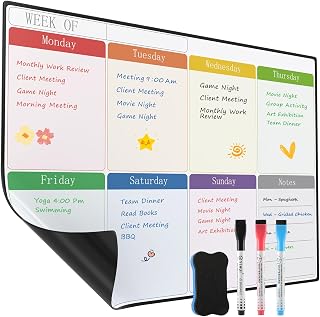
The TMS A4 Magnetic Weekly Planner Whiteboard for Fridge is the most battle-tested board in this guide. Backed by over 360 verified reviews averaging 4.2 stars, it has the kind of track record that reflects months of daily use across dozens of real households — not just an initial burst of enthusiasm from early buyers. If you want a reliable, no-nonsense weekly fridge planner that simply does what it’s supposed to without requiring much thought, this is the natural starting point.
At A4 size, it’s compact and unobtrusive. It fits on almost any standard domestic fridge door without blocking other magnets or children’s artwork, and the weekly layout — labelled day sections with a notes or to-do column alongside — covers the most common family planning scenario: tracking meals, school activities, work commitments, and weekly appointments in a single visible reference. The layout is pre-printed but leaves sufficient white space within each day section that you’re not constrained to tiny handwriting.
The dry-erase surface performs reliably with standard whiteboard markers. The clearest pattern across reviews is that the board wipes cleanly provided you use proper dry-erase markers and erase fully at the end of each week rather than just overwriting entries. Reviewers who leave writing in place for two or three weeks before erasing occasionally report faint ghosting, but those who maintain a weekly wipe-down habit report clean performance over many months. The magnetic backing grips securely on standard steel fridge doors; even with the door opening and closing repeatedly throughout the day, the board holds without sliding.
The main limitations are straightforward. Magnetic backing only works on steel fridge surfaces — test with a regular fridge magnet first, because many modern stainless steel and American-style models are non-magnetic. The A4 format is compact by design, which suits a couple or small family tracking key reminders but feels tight for a household of five tracking individual schedules. And the format is fixed as a weekly planner — no monthly view, no meal-planning template, no option to reconfigure the layout. If those constraints don’t apply to your situation, they’re not concerns.
The TMS boards are made in the UK, a detail that several long-term reviewers reference when explaining why build quality holds up better than budget imports they’ve tried previously. At budget pricing, the TMS A4 is the lowest-risk way to start with a dry-erase fridge planner, and the high review volume means you can read dozens of real-household accounts before committing — a credibility advantage that newer products with thin review bases simply can’t match yet.
Best Self-Adhesive Wall Planner
If your fridge surface isn’t magnetic, or you’d prefer your planning board somewhere other than the kitchen — a home office wall, a hallway door, a utility room cupboard — the MCCORL Dry Wipe Weekly Planner Whiteboard for Wall is the strongest candidate in the self-adhesive category. With 252 reviews averaging 4.3 stars, it has the review depth to confirm that its self-adhesive fixing performs as described in real domestic environments — the single most important thing to verify for this board type.
The self-adhesive backing bonds to smooth surfaces: painted walls, glass, tiles, laminate doors, and wooden cupboards all work well. The step most reviews emphasise is surface preparation. Clean the mounting area thoroughly, allow it to dry completely, then press the board firmly across its full face for at least 30 to 60 seconds. Leave it undisturbed for 24 hours before writing on it. Follow that sequence and the board holds reliably; skip it and you’ll likely find the corners lifting within a fortnight. Unlike a magnetic fridge board, this can go in any room of the house, which opens up placement options that fridge-specific boards can’t offer.
The weekly layout is practical and readable, with labelled day columns and space for reminders, household chores, or shared priorities alongside. The board is larger than a typical A4 fridge planner, so the day columns have more room — an advantage if multiple family members need their own entries, or if you write out detailed plans rather than shorthand. At wall-mounting size, it’s visible from across the room, which is important for a shared household board. Dry-erase performance is consistently praised: proper fine-tip whiteboard markers wipe off cleanly, and reviewers report minimal ghosting after months of regular use.
One tradeoff worth acknowledging: removal. Self-adhesive boards on older or lower-quality emulsion paintwork can pull paint when peeled off. The MCCORL’s adhesive is designed to be repositionable, but “repositionable” in practice depends heavily on the age and quality of the underlying paint. If you’re renting, or if your walls have a delicate finish, mount this board on glass, tiles, or a glazed cupboard door rather than directly on painted plaster. On suitable smooth surfaces, it performs well over time and is significantly easier to install than anything requiring drilling or wall fixings.
For households that want wall visibility rather than fridge placement — and particularly where the fridge surface doesn’t hold magnets — the MCCORL is a well-reviewed, mid-range choice that handles the weekly planning brief reliably. The 252-review base gives it a credibility that newer self-adhesive boards in this category can’t yet match.
Best Multi-Format Board Set
Sometimes a single board isn’t enough. A weekly grid handles the immediate — this week’s meals and commitments — but doesn’t show you the school term at a glance. A monthly overview misses daily task detail. Neither replaces a dedicated to-do list for items that don’t belong to a specific day. The 4-Pack Non-Magnetic Whiteboard Calendar Set addresses all of this at once: four boards in a single purchase — monthly planner, weekly planner, daily schedule board, and to-do or notes board — covering every planning horizon in one coherent system.
With 255 reviews averaging 4.4 stars, this is among the most highly rated options in this guide by review volume, and the feedback reflects sustained satisfaction with the multi-board concept rather than just enthusiasm for a novelty purchase. Reviewers who use all four boards consistently describe having built a structured planning hierarchy: the monthly board tracks term dates and fixed commitments, the weekly board gets updated every Sunday, the daily board handles that morning’s task list, and the notes board catches everything that doesn’t belong to a specific day or week.
The non-magnetic design means these boards attach to virtually any smooth surface using the included mounting strips — painted walls, glass, tiles, laminate, and wooden surfaces all work. They’re not tied to the fridge, which suits buyers who want their planning boards in a home office, study, or kitchen alcove. The boards benefit from a brief break-in period: write on and fully erase two or three times before settling into regular use, as the factory coating can cause slight initial ghosting that clears after the first few uses. After that, the surface cleans consistently with standard dry-erase markers and a soft cloth.
Versatility is where this set scores most strongly across reviews. Rather than a single board covering one time horizon, you get a complete planning system — something that genuinely shifts how a household or small office coordinates tasks and commitments across days, weeks, and months simultaneously. The included markers are functional as a starter set, but investing in quality fine-tip dry-erase markers improves the writing experience across all four boards noticeably.
The practical limitation is space. Four boards need four mounting spots, and the system works best when all four are visible in the same area — a planning wall in a home office or kitchen alcove, rather than scattered across different rooms. If you have a dedicated wall surface available, this set becomes a powerful planning tool. If you’re working with limited space or want to keep things minimal, a single well-chosen board from elsewhere in this guide will serve you better.
Best Self-Adhesive Monthly and Weekly Combo
The POPRUN 2 Pack A3 Whiteboard Calendar combines a monthly planner and a weekly chore chart in a pair of self-adhesive A3 boards — a noticeably larger format than the A4 fridge planners common in this category, and a two-in-one structure that suits households wanting both a monthly overview and a weekly task breakdown without committing to a full four-board set. With 23 reviews averaging 4.6 stars, the sample is smaller than the TMS or MCCORL, but the high average suggests early buyers have been clearly pleased with what they received.
At A3, the boards offer real writing space. Each day cell on the monthly planner is large enough for two or three distinct entries — not just a single event but a full day’s commitments written out properly. The weekly chore chart works well for families distributing household tasks across members, or for home-office users assigning work items across the week. Mount both boards side by side and you get a combined monthly-plus-weekly planning wall that covers the two time horizons most households actually use.
Self-adhesive performance follows the familiar pattern: clean and dry the mounting surface thoroughly, apply with firm pressure across the full board, allow 24 hours before writing. The POPRUN boards adhere to glass, tiles, smooth painted walls, and wooden surfaces — the operative word is smooth. Textured plaster, rough brick, or embossed wallpaper won’t hold the adhesive reliably. On suitable surfaces, reviewers report solid adhesion with no curling or corner lift over months of use.
The dry-erase surface receives consistent praise in early reviews: the coating feels smooth under a marker tip, ink wipes off cleanly with a cloth, and buyers report minimal ghosting with correct dry-erase markers over several months. The set includes markers, though those with strong preferences tend to switch to their preferred brand fairly quickly.
The caveat worth keeping front of mind is the limited review base. Twenty-three reviews — however positive — can’t tell you what 250 reveal about long-term adhesive durability, surface performance in humid kitchen environments, or how the boards hold up after 12 to 18 months of use. If you’re drawn to the A3 format and the monthly-plus-weekly combination, this two-board set is a strong option. If long-term track record matters more to you than format breadth, the TMS A3 Monthly board or the MCCORL offer deeper evidence to draw on.
Best Magnetic Monthly Overview Board
Where the TMS A4 Weekly Planner focuses on the immediate week ahead, the TMS A3 Monthly Planner Whiteboard takes the longer view. At A3 — roughly two A4 sheets side by side — and formatted as a full monthly calendar, it suits households that need to track school term dates, recurring appointments, work travel, or project milestones at a glance rather than day by day. With 131 reviews averaging 4.4 stars, it has the review depth to confirm real-world performance over time.
The magnetic backing adheres to standard steel fridge doors, where the A3 size makes it a more prominent fixture than the compact A4 alternatives. Day cells are spacious enough for genuine notes — two or three lines per day without crowding — and the monthly grid is pre-printed clearly so there’s no formatting work to do yourself. The board holds securely without sliding even on a heavily used fridge, and the magnets are strong enough for the larger footprint. Reviewers who open their fridge dozens of times daily report no issues with the board shifting position.
The “Made in the UK” detail carries weight here. Long-term reviewers consistently mention that the laminated dry-erase surface feels more substantial than the thin-film alternatives they’ve previously tried, and that this translates directly into better erasing performance over time. Standard whiteboard markers clean off fully with a cloth, and users who have maintained the board for six months or more report a clean surface throughout — as long as they wipe completely at the end of each month and use proper dry-erase markers rather than washable or permanent alternatives.
The limitation is format scope. A monthly grid gives you an overview, not granular daily scheduling. If you need hour-by-hour task tracking alongside the monthly reference, you’d want to pair this board with a smaller weekly or daily board — or consider the 4-Pack set if you want the complete hierarchy in one purchase. As a standalone monthly command centre on the kitchen fridge, it does the job reliably and durably. This board suits a buyer with an established planning habit who knows a monthly format is what they need, and who wants something that will last several years rather than a cheap board they’ll replace annually.
Best Double-Sided Desk and Wall Planner
The Double-Sided Whiteboard Calendar, Weekly and Monthly Planner for Desk and Wall takes a different physical form from every other board in this guide. One face shows a weekly planner, the other a monthly overview, and at 40x30cm it’s sized to stand upright on a desk as well as hang on a wall. That physical flexibility suits home workers and students who want a planning surface at their workspace without permanently mounting anything — you prop it up while planning, flip to the view you need, and move it when the desk space is needed for something else.
The double-sided format addresses a practical problem: you often need both a monthly calendar for deadlines and a weekly breakdown for daily tasks, but two separate boards take up twice the space. With this board you flip between views depending on what you’re working on. During a weekly planning session the weekly face is towards you; during a project deadline review you flip to the monthly view. The 40x30cm dimensions sit comfortably on a desk without crowding it, and at that size the board is readable at arm’s length — well suited to one person, though without the across-the-room visibility of a full wall-mounted board.
The chores board element in the product description adds a household task-tracking dimension alongside the planning grids, which is useful for a user managing both work deadlines and domestic logistics on a single surface. The board also suits classroom or tutoring settings — weekly lesson planning on one side, term overview on the other — where a shared visible reference is helpful without requiring permanent wall installation.
The honest caveat is the review base: five verified reviews at 4.5 stars. Five positive buyers confirm the product arrived as described and worked initially, but they can’t tell you about surface longevity, how the standing mechanism holds up after repeated repositioning, or whether dry-erase quality degrades over a year of use. What the early feedback does confirm is that the writing surface is smooth and the dual-format concept functions as described. This is a lower-certainty recommendation than the TMS or MCCORL picks, but the use case it addresses — a personal desk planning tool that requires no permanent wall mounting — is one that no other board in this guide covers.
Best Compact Fridge Planner for Small Households
The KTRIO Weekly Planner Whiteboard A4 Magnetic Whiteboard for Fridge is the newest entry in this guide, and its current rating of 5.0 stars from two verified reviews needs immediate context: two buyers, however positive, cannot tell you what 360 buyers reveal about long-term surface quality, magnetic grip longevity, or marker compatibility. This is stated plainly so you can weight the pick accordingly — it’s included because the format is legitimate and the price keeps the risk low, not because the review data is robust.
What the KTRIO offers is a clean, simple A4 weekly layout designed specifically for fridge use, at a budget price point that makes trying the concept low-risk if you’re not yet convinced a dry-erase fridge planner fits your household. At A4, it sits unobtrusively on almost any standard domestic fridge door — compact enough not to dominate the space or displace other magnets. The weekly layout provides labelled day sections and a notes or priority column alongside, in an uncluttered format that suits users who want a blank canvas rather than a board with lots of built-in structure or colour coding.
Because the review base is so thin, there’s limited user-experience data on dry-erase performance or ghosting resistance. What’s assessable from the specification is that an A4 magnetic dry-erase fridge planner is a well-understood product format — the basic engineering of magnetic backing plus a dry-erase coating is consistent across established products in this category. The two reviewers who have purchased and used the board report clean writing and easy erasing with no complaints about magnetic grip. That’s a start, but it isn’t the depth of evidence available from the more established alternatives.
This board suits a genuinely specific situation: a single person or couple who want the smallest, least intrusive fridge planner available, are comfortable being early adopters of a newer product, and want to try the fridge-planner concept at minimal financial risk before committing to something more substantial. For a household of more than two or three, the A4 day columns will feel tight. For anyone who wants structured templates for meals, chores, or priorities built in, the TMS A4 Weekly Planner is the better-proven choice at a comparable price point. Treat the KTRIO as a considered option for a specific scenario — compact, simple, fridge-magnetic — rather than a confident first choice for most buyers.
What to Look for in a Planning Board
The following criteria separate a planning board you’ll use daily from one that ends up at the back of a cupboard after a fortnight.
- Mounting method: Magnetic boards need a steel fridge surface — test with a standard fridge magnet before buying, because many modern stainless steel and American-style fridge doors are non-magnetic. Self-adhesive boards work on smooth painted walls, glass, tiles, and laminate but fail on textured plaster, rough brick, or embossed wallpaper. If you’re renting or have delicate emulsion, mount on glass or tiles rather than directly on painted plaster.
- Board size: A4 is compact and unobtrusive but gives narrow day columns — adequate for a couple tracking key reminders, tight for a family of four or five with multiple individual schedules. A3 roughly doubles the writing space. Larger isn’t always better if the board needs to fit a specific fridge panel or blend into the room without overwhelming it.
- Dry-erase surface quality: Laminated or premium-coated surfaces outperform thin plastic film for ghosting resistance over time. Ghosting worsens when writing is left on the board for extended periods before erasing, when incompatible markers are used, or when the surface is never fully cleaned of accumulated residue. Look for long-term reviewers who specifically mention clean erasing after six months or more of regular use.
- Marker compatibility: Use only proper dry-erase whiteboard markers on these boards. Permanent markers stain irreversibly; washable children’s markers and chalk markers leave residue that accumulates over time. Most boards include a starter marker — treat it as temporary and consider upgrading to quality fine-tip dry-erase markers for everyday use, which will noticeably improve both writing and erasing.
- Format vs actual habits: Choose the format that matches how you actually plan today, not how you intend to plan. A weekly board sees daily interaction and gets updated frequently; a monthly board gets updated less often but provides a wider reference window. Multi-board sets offer both, but only if you build the habit of maintaining all the boards consistently.
- Review volume and recency: A 4.2-star average from 350 reviews tells you far more than a 5.0 average from five. Scan recent reviews for consistent patterns around ghosting, adhesion failure, or marker compatibility — these tend to emerge after several months of use and are often absent from feedback posted in the first week after delivery.
- Single vs multi-board: A single board is simpler and needs less space, but may not cover every planning horizon you need. A multi-board set creates a more complete planning system but requires dedicated wall space and more consistent habits to use effectively. Start with one board if you’re new to the format; add more once you’ve confirmed the habit sticks.
Verdict
For the majority of UK households reading this — a family or couple wanting a visible, low-maintenance planning board in the kitchen — the TMS A4 Magnetic Weekly Planner Whiteboard for Fridge is the place to start. The largest verified review base in this guide, consistent real-world performance across hundreds of domestic households, budget pricing, and UK manufacture combine to make it the safest, most confident first planning board to try. If it works for your habits, you’ve spent very little to confirm it. If you outgrow it, you’ll know exactly what upgrade you need.
If your fridge surface isn’t magnetic or you want the board on a wall rather than in the kitchen, the MCCORL Dry Wipe Weekly Planner Whiteboard for Wall is the natural next choice — well-reviewed, reliably adhesive on smooth surfaces, and large enough to be useful as a shared household board visible from across the room.
For households that want to build a proper planning system rather than a single reminder board, the 4-Pack Non-Magnetic Whiteboard Calendar Set gives you the full hierarchy — monthly, weekly, daily, and to-do — in one purchase, with enough review depth to confirm the multi-board concept works in practice. Whatever board you choose, put it where people in your household already look — that placement decision matters more than which specific board sits on the shelf.
We were not paid to feature any specific product in this guide. All opinions are independent and based on publicly available specifications, verified buyer feedback patterns, and category research.
Quick Comparison Table


![TMS A4 Magnetic Weekly Planner Whiteboard for Fridge | Dry Wipe Meal Planner, Calendar or Memo Board | Plan Family or Business Tasks | Dry Erase to Do List Magnet | with 4 Dry Erase Pens [30 x 21cm]](https://m.media-amazon.com/images/I/61+ymFmVm0L._AC_UL320_.jpg)


![TMS A3 Monthly Planner Whiteboard | Magnetic Fridge Calendar for Meal Prep, Work or Family Planning | Made in the UK | use for To-Do Lists, Notes or Reminders | for Home and Office [42 x 30cm]](https://m.media-amazon.com/images/I/61iPH1w9KpL._AC_UL320_.jpg)
FAQ
What is the difference between a magnetic and a self-adhesive planning board?
A magnetic planning board uses a magnetic backing to attach directly to steel surfaces such as standard fridge doors. A self-adhesive board uses a peel-and-stick adhesive layer that bonds to smooth surfaces including painted walls, glass, tiles, and laminate. Magnetic boards can be repositioned freely and removed without surface damage; self-adhesive boards are more permanent and may lift paint from delicate emulsion walls when removed. The right choice depends primarily on where you want to mount the board and whether that surface is magnetic.
Will a magnetic planning board stick to my stainless steel fridge?
It depends on the alloy used. Many modern stainless steel fridge doors — particularly American-style double-door models and premium European appliances — use a non-magnetic steel alloy, which means standard fridge magnets and magnetic planning boards won’t adhere to them. Test with a regular fridge magnet before ordering. If the magnet holds, a magnetic planning board will too. If it doesn’t, opt for a self-adhesive wall board instead.
How do I prevent ghosting on a dry-erase planning board?
Ghosting — the faint ink residue left after erasing — is most commonly caused by leaving writing on the board for extended periods before erasing, using incompatible markers such as permanent markers or washable children’s markers, or never fully wiping the surface clean. To prevent it, erase the board completely at the end of each planning cycle, use only proper dry-erase whiteboard markers, and clean the surface with a damp cloth or specialist whiteboard spray once a month to clear any accumulated residue before it becomes permanent.
Can I use any type of marker on a dry-erase planning board?
No — only purpose-made dry-erase whiteboard markers work reliably. Permanent markers stain the surface irreversibly. Washable children’s markers and chalk markers leave residue that builds up with repeated use, eventually preventing clean erasing. Most planning boards include a starter marker in the set; these are functional initially, but a quality set of fine-tip dry-erase markers from a stationery brand will noticeably improve both the writing experience and the ease of erasing.
Is a weekly or monthly planning board more useful for a family?
Both serve different purposes and complement each other well. A weekly board handles the immediate — meals, school pickups, activities — and benefits from daily updates. A monthly board provides the wider view for fixed appointments, term dates, and longer-term commitments. If you can only have one, a weekly board tends to see more consistent use because the time horizon feels immediately relevant every day. If wall space allows, using both formats together gives you the most complete planning picture.
How do I safely remove a self-adhesive planning board without damaging the wall?
Warm the adhesive gently with a hairdryer on a low heat setting to soften the glue bond, then peel the board slowly at a shallow angle rather than pulling sharply. Any residue left on the wall can usually be removed with a small amount of isopropyl alcohol on a clean cloth, wiped gently. If your walls have older or lower-quality emulsion paint, test on a hidden corner first, or consider mounting the board on glass, tiles, or a smooth wooden surface where paint damage isn’t a concern.