The Rental Kitchen Problem Nobody Talks About
Picture the scene: you’ve just moved into a rented flat with a kitchen the size of a large wardrobe. The worktops are already crowded with a kettle, a toaster, and a chopping board you can’t bear to put away. There’s a roll of kitchen paper balanced on the windowsill, which means every time you open the window to let out steam from the hob, it rolls behind the radiator. You’ve tried a freestanding holder on the worktop — it wobbled every time you tore a sheet, and your letting agent spotted the round mark it left on the laminate and docked your deposit accordingly. You’ve looked at wall-mounted holders, then immediately remembered the clause in your tenancy agreement about drilling holes. So the roll ends up back on the windowsill.
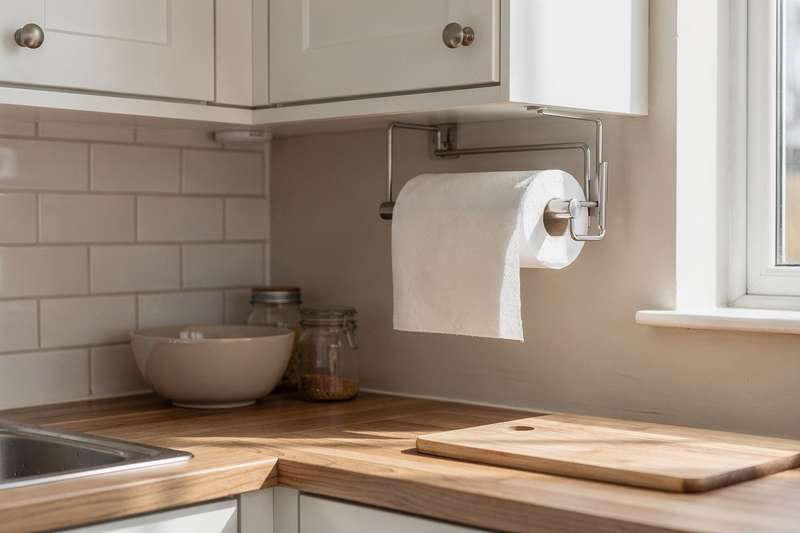
This guide is for you. Specifically, it’s about under-cabinet paper towel holders — the category that solves the rental kitchen problem by mounting out of the way, underneath your wall-hung cabinets, where they free up worktop space and (if you choose the right one) leave zero permanent marks when you move out. The catch is that not all of them are created equal, and the wrong choice can mean adhesive that fails after a week, a roll that unravels every time you tear a sheet, or a holder so cheaply made it bends the first time you load a jumbo roll onto it.
How We Evaluated These Picks
To narrow down the options in this category, we focused on five criteria that matter specifically to rental situations. First, mounting method: adhesive-only options were assessed on how strong and removable the tape is, while screw-mount options were assessed on whether they leave manageable marks that can be filled. Second, build quality and material: stainless steel (particularly SUS304 grade), aluminium, and the quality of plastic components. Third, roll compatibility: UK kitchen rolls vary enormously in core diameter and roll width — a holder that only fits a standard roll is frustrating. Fourth, one-handed tearability: the ability to tear a sheet cleanly with one hand without the roll spinning freely. Fifth, real reviewer patterns: we read through hundreds of verified buyer reviews on amazon.co.uk, specifically looking for patterns in failure modes — adhesive falling off, rust appearing within months, screws stripping — rather than relying on headline star ratings alone.
The six picks below cover the main use-cases: no-drill adhesive mounting, heavy-duty screw-mount, anti-unravelling design, generous roll clearance, easy cleaning, and budget-friendly options under £15.
Best No-Drill Option for Rentals — Adhesive Strip Mount
If your tenancy agreement includes the words “no fixings” or your landlord has a habit of turning up unannounced to inspect every wall, an adhesive-strip under-cabinet holder is the obvious starting point. The design concept here is simple: a strong, double-sided foam tape strip adheres to the underside of a cabinet, and the holder itself clips or slides onto a bracket. The best versions of this style use an industrial-grade adhesive foam that grips smooth surfaces — melamine-faced cabinets, gloss-painted MDF, tile, or glass — with a pull strength well above what a full kitchen roll will ever exert on it.
When shopping for this type, look for a holder that specifies the surface types it will and won’t bond to. This is not small print to ignore. Adhesive-strip holders categorically do not work on painted plaster, wallpaper, bare brick, or rough concrete. They work best on the factory-finished undersides of modern flat-pack kitchen cabinets, which are almost universally smooth and non-porous. If you’re in an older property with solid-wood cabinets that have been repainted over the years, the adhesive is bonding to the top layer of paint, not the wood — and that layer can lift away when you remove the holder. Test the surface first by pressing a strip of regular packing tape firmly and peeling it back; if paint comes with it, use a different mounting method.
In practice, the install process for a well-designed adhesive holder takes under two minutes. You clean the surface with alcohol wipe (usually included), peel the backing, press firmly for thirty seconds, and then wait the recommended curing time — usually 24 hours — before loading the roll. The biggest error people make is skipping that curing time and immediately hanging a heavy jumbo roll. The adhesive hasn’t reached full strength yet and the holder drops overnight, sometimes taking a strip of cabinet surface with it.
The main tradeoff with adhesive-only mounting is weight limit. Most adhesive holders are rated for rolls up to around 500 g, which covers standard UK kitchen rolls comfortably but will strain under the very large, thick-sheet variety. If you buy the value multipack rolls from a warehouse store, measure the roll diameter first. Look for holders with a maximum roll diameter specification of at least 13 cm to cover most UK sizes. One further tradeoff: once the tape is fully cured and has been in place for months, removal can be trickier than the packaging suggests. Slow, patient peeling at an acute angle minimises damage; sharp-angle yanking is how you damage cabinet surfaces.
Best Heavy-Duty Build — High-Grade Aluminium, Screw Mount
If you’re willing to use the two or three small pilot holes that a screw-mount holder requires — and you’re confident you can fill and touch up the holes when you leave, or that your landlord won’t object to tidy fixings that are standard practice — then a screw-mounted aluminium holder is the most reliable long-term solution. Aluminium is lighter than steel but resists corrosion just as well in normal kitchen conditions, and a quality aluminium casting will simply outlast any adhesive product.
What distinguishes a well-built aluminium under-cabinet holder from a cheap one is the interior roller design. Budget versions often have a fixed rod with nothing to hold the roll in place — it spins freely and the entire roll feeds out when you pull a sheet. Better aluminium holders use an interior wire roller that sits inside the cardboard core of the roll, with just enough outward tension to grip the core and create resistance when you pull. This is the detail that makes one-handed tearing possible.
Another feature to look for is whether the holder allows you to load a new roll without removing any mounting hardware. The best designs use a spring-loaded end cap or a simple swing-arm that you can open and close with one hand, drop the roll onto the roller, and close again. This sounds trivial until you’ve spent ten seconds wrestling a new roll onto a holder with both hands while your other hand — theoretically — holds a frying pan. In a small kitchen, every second of friction in the workflow matters.
The one genuine tradeoff with high-grade aluminium screw-mount holders is installation commitment. You’ll need a drill, the correct drill bit for your cabinet material (MDF needs a different bit than solid wood or chipboard), and ideally a spirit level to ensure the holder runs straight. The screws provided with many holders in this category are the weakest component — they’re often short, thin, and made from low-grade steel that strips easily. It’s worth buying two or three matching screws from a hardware shop that are 2–3 mm longer than the originals and have a slightly wider thread for better bite in MDF. This ten-minute investment means the holder stays solid for years rather than gradually working loose.
Best for Preventing Roll Unravelling — Tension Rod with Spring Resistance
The single most common complaint about under-cabinet paper towel holders — across hundreds of UK Amazon reviews — is not poor adhesion or rust. It’s the roll unravelling. You grab one sheet, and instead of tearing cleanly, the roll spins three or four times and you’re holding a two-foot streamer of kitchen paper while the loose end flaps against the cabinet. It’s a minor irritation that becomes genuinely maddening when you’re mid-cook and just need to blot a spill quickly.
The solution is a holder designed specifically around controlled resistance. The best approach uses an oversized-diameter rod — physically wider than a standard holder rod — combined with a ring spring or internal tensioner that grips the inside of the roll’s cardboard core. The wider the rod, the more contact area it has with the core, and the more friction it can generate without the roll feeling stiff or difficult to unroll intentionally. Some designs achieve a similar result with an external spring clip that presses against the outside of the roll rather than the inside of the core.
When this technology is well-implemented, you can grip the hanging sheet, pull sharply against the perforation, and the roll stays completely still — absorbing the tear force without spinning. The ideal resistance level is enough to hold the roll stationary during a single-sheet tear but light enough that a full unroll (to get to a new sheet after a tear gone wrong) doesn’t require two hands. Finding that balance is harder than it sounds, which is why this feature commands a higher price point than standard holders. Expect to spend between £25 and £35 for a genuinely well-engineered tension system, roughly twice what basic holders cost.
A secondary benefit of the tension-rod design is that these holders typically use a quick-release knob or push-button end cap for roll changes. You press a button, the rod slides out, you swap the roll in three seconds, and you’re done. This is a notable quality-of-life improvement over designs where you have to unscrew an end cap — or worse, flex the entire bracket to free the rod — every time you change a roll. For a household that gets through kitchen rolls quickly, that convenience compounds.
One honest caveat: the spring mechanism in these holders can develop a squeak over time, particularly if the kitchen is steamy. A tiny drop of food-safe silicone lubricant on the contact points resolves this immediately, but it’s worth knowing before you buy.
Best for Damp Kitchens — SUS304 Stainless Steel with Internal Resistance
UK kitchens — especially in older Victorian terraces and converted flats — often have inadequate extraction. Steam from boiling, condensation from poorly insulated windows, and splash from the sink all contribute to a damp microclimate right where your under-cabinet holder lives. In these conditions, any holder with steel components that aren’t properly graded will show rust within six to twelve months. You’ll see it first on the rod, then on the bracket arms, and eventually the rust staining transfers to the cabinet surface and to the paper itself.
SUS304 stainless steel is the material specification to look for. It’s an austenitic stainless containing at least 18% chromium and 8% nickel, which gives it genuine corrosion resistance in both wet and moderately acidic environments. It won’t rust from kitchen steam, and it won’t corrode from the occasional cleaning spray that drifts onto it. Importantly, it also maintains its structural integrity at the low temperatures you might encounter if your kitchen is unheated in winter — some cheaper steel alloys can become brittle and crack at the joints.
Beyond the material spec, a well-designed stainless holder for damp kitchens should have a smooth, continuous surface with minimal crevices where moisture can pool and eventually cause staining even in stainless steel. Spot-welded joins are fine; overlapping metal edges that create a capillary gap are not. Look at the bracket arms where they join the main body — this is the most common failure point in cheaper stainless holders.
The internal resistance bar found in some stainless holders — a tensioned bar inside the roller tube — serves the same anti-unravelling function as the spring-tension designs above, but at a lower price point. It won’t be as finely tuned, but it provides enough friction for clean single-sheet tearing most of the time. The tradeoff is that the resistance is fixed; you can’t adjust it. If you prefer a looser roll or a tighter roll depending on which brand of kitchen towel you’re using, a fixed tensioner can feel either too stiff or too loose depending on the roll’s core diameter.
Best Scratch-Resistant Adhesive Option — Solid SUS304 with Tape Mount
Some rental kitchens have cabinet undersides that look pristine — white or grey melamine with no marks, presumably renewed between tenancies. If you’re worried about leaving any impression at all when you move out, the combination of a solid stainless steel body (which won’t flex and create stress marks on the cabinet surface) with a high-quality double-sided foam tape is the safest bet. The rigidity of the body means the mounting forces are distributed evenly across the full tape footprint rather than concentrated at stress points, which is what causes the tape to eventually peel and sometimes take surface material with it.
In this subcategory, the key specification is the quality and dimensions of the tape itself. Look for tape that’s at least 20 mm wide and covers the full length of the mounting plate. Narrow tape strips — even very strong ones — concentrate the load onto a small area and are more likely to fail under the repetitive micro-vibrations of daily tearing. The total tape area matters more than the tape’s quoted pull strength per unit area.
The SUS304 body also brings an anti-scratch benefit that the name implies: the steel surface resists scratching from everyday contact — knuckles, pans being moved nearby, cleaning cloths — in a way that powder-coated or painted holders don’t. A painted holder will show chips and scratches within months; SUS304 will look essentially the same after three years. In a rental context, this means the holder maintains its appearance even as you inevitably reuse it across multiple flats.
One honest limitation: this type of holder generally requires two hands to tear a sheet. The body is rigid but the mounting tape, however strong, doesn’t provide the same tear resistance as a bracket bolted to a cabinet. When you pull, there’s a tiny give in the tape’s flex layer, which means your tearing force goes partly into pulling the holder rather than solely into tearing the perforation. The solution is to brace the holder with one hand while you tear with the other, which works fine but is less convenient than a proper tension-rod design. For occasional kitchen paper use, this is a non-issue. If you tear through multiple sheets several times a day, it becomes a mild but persistent annoyance.
Best Easy-Clean Option — Brushed Stainless, High Load Capacity
Kitchens get greasy. The underside of your cabinets, where an under-cabinet holder lives, is directly in the path of cooking vapours rising from the hob. Over weeks and months, a fine film of oil and cooking residue coats everything up there, including your paper towel holder. On a holder with a textured, rough, or powder-coated surface, this film is nearly impossible to remove completely — it grips in every microscopic surface irregularity and turns yellow-brown over time.
Brushed stainless steel surfaces clean up in seconds with a damp cloth or a spray of kitchen degreaser. The brushed texture is smooth enough to release grease without absorbing it, and the steel’s chemical resistance means it won’t be damaged by the mildly acidic cleaners most people use. This is a practical quality-of-life benefit that’s easy to underestimate when you’re buying, and very hard to ignore six months into living with a greasy, discoloured holder.
The load-capacity figure — some holders in this category quote a 5 kg limit — sounds excessive for a paper towel roll (which weighs perhaps 300–500 g), but it matters because it tells you about the structural integrity of the bracket arms and the mounting hardware. A holder rated for 5 kg is built with overengineered brackets and adequately sized screws; the paper towel roll is never going to stress it. This means the holder won’t flex, won’t work loose over time, and won’t develop the creaking noise that many cheap holders exhibit after a few months of use.
Look for models in this category that come with a 12-month manufacturer’s warranty at minimum. The warranty on its own tells you relatively little — enforcing it internationally on a low-cost product is impractical — but sellers that offer it tend to make products with better quality control, because warranty claims hurt their ratings and profitability. It’s a weak but not entirely meaningless signal. Pair it with a good review pattern (4.3 stars or above from more than 200 reviews) and you have reasonable confidence.
What to Look For When Buying an Under-Cabinet Paper Towel Holder
- Mounting method vs. tenancy terms: Adhesive strip holders are safer for strict no-drill tenancies, but only work on smooth, non-porous surfaces. Check your cabinet undersides before buying. Screw-mount holders are more secure and longer-lasting but require small holes that should be filled on departure.
- Roll compatibility: UK kitchen rolls range from about 11 cm to 15 cm in diameter and have cardboard cores of roughly 4–5 cm diameter. Check the holder’s maximum roll diameter specification — anything under 13 cm will exclude some standard rolls. Also check the arm spacing (the width between the two bracket arms) to ensure it accommodates your preferred roll brand’s width, typically 24–27 cm.
- Material and rust resistance: SUS304 stainless steel or high-grade aluminium are the two reliable choices. Avoid chrome-plated steel — the plating eventually chips or cracks, and the underlying steel rusts quickly in a damp kitchen. Brushed stainless is easier to clean than polished stainless but both are suitable.
- Anti-unravelling mechanism: Spring-tension rods, internal resistance bars, and oversized-diameter rods all achieve the same goal of letting you tear one sheet without the roll spinning. This feature is worth paying extra for if you use kitchen paper frequently.
- Installation hardware quality: The screws supplied with many holders are underspecified for MDF cabinet bases. Consider buying longer, wider-thread versions from a hardware shop. For adhesive holders, check that the tape covers the full mounting plate area and that the manufacturer recommends a 24-hour curing period.
- Dimensions and clearance: Measure the gap between your cabinet underside and your worktop (or the top of any appliances sitting on the worktop below). You need enough clearance to load a new roll onto the holder without having to remove it from the cabinet. Generally, 15–20 cm of vertical clearance is sufficient, but check the holder’s depth specification before buying.
- Finish durability: In a cooking environment, a finish that resists grease and discolouration is a genuine practical benefit. Brushed stainless and bare aluminium both resist kitchen grease well. Avoid glossy or painted finishes for under-cabinet use — they show every mark and are difficult to clean around fittings.
Verdict
For most rental kitchen situations in the UK, the right answer depends on one question: will you ever drill into the cabinet, even with the intention of filling the holes on departure?
If the answer is no, go for a well-specified adhesive strip holder — specifically one using a full-length wide tape strip rather than a pair of small adhesive pads, and only if your cabinet underside is smooth and factory-finished. Check the surface first. These holders solve the problem neatly and leave virtually no trace when removed carefully after a proper 24-hour cure.
If you’re comfortable making two or three small holes and filling them when you leave — which takes ten minutes and costs under £2 in filler — then the screw-mounted aluminium or brushed stainless option with a wire roller or internal resistance bar is the better long-term investment. It will be more stable, accommodate a wider range of roll sizes, and actually stay on the cabinet the first time a small child yanks a sheet rather than tearing it cleanly.
For households that get genuinely frustrated by unravelling rolls, the tension-rod design with an oversized rod and ring spring is worth the extra spend. It’s the one holder type that makes single-handed tearing genuinely reliable, and in a busy kitchen, that functional difference earns its price premium fairly quickly.
Editorial note: This guide was produced independently. We were not paid to feature any specific product. All opinions are based on publicly available specifications, verified buyer feedback patterns, and category research. Prices shown are approximate and were accurate at the time of writing — they may have changed.
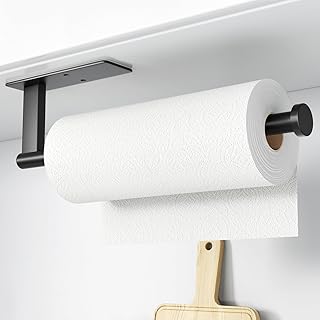
Quick Comparison Table



FAQ
Can I use an adhesive under-cabinet paper towel holder in a rented flat without risking my deposit?
Yes, in most cases — but only if your cabinet undersides are smooth and factory-finished (typically melamine-faced MDF in modern kitchens). Adhesive-strip holders generally leave no trace when removed slowly at an acute angle after a 24-hour cure. On painted, wallpapered, or previously repainted surfaces, the tape can lift the top layer, which would be chargeable damage. Test a small area with packing tape first before committing to the holder.
What is the difference between SUS304 and regular stainless steel in a kitchen towel holder?
SUS304 is a specific grade of austenitic stainless steel containing at least 18% chromium and 8% nickel, giving it genuine corrosion and rust resistance in wet, steamy kitchen environments. Generic “stainless steel” or chrome-plated steel products often use lower grades that can rust at welded joints or where the surface is scratched. For a holder living directly above a hob and sink, SUS304 is worth specifying.
Why does my under-cabinet paper towel holder keep falling off?
The two most common causes are inadequate curing time (adhesive holders need at least 24 hours before you load a roll) and surface incompatibility (adhesive tape will not bond reliably to painted plaster, wallpaper, or rough surfaces). A third cause is overloading — large, heavy premium kitchen rolls can exceed the rated weight for some adhesive holders. If your surface is compatible and the curing time was respected, try a holder with a larger tape footprint or switch to a screw-mount option.
How do I stop the kitchen roll unravelling every time I pull a sheet?
The underlying issue is lack of resistance between the rod and the cardboard core of the roll. Look for holders that specifically advertise an internal tensioner, a spring-resistance mechanism, or an oversized rod diameter — these all create friction that holds the roll stationary during tearing. Alternatively, if you already own a basic holder, placing a folded piece of kitchen paper between the rod and the core adds temporary friction, though it’s not a lasting fix.
Do under-cabinet paper towel holders fit all UK kitchen roll sizes?
Not all of them. UK kitchen rolls vary from approximately 11 cm to 15 cm in diameter, and roll widths vary between brands from about 24 cm to 28 cm. Check the holder’s maximum roll diameter and arm-span (the width between the two mounting arms) before buying. Holders with arm spans of at least 27 cm and a maximum roll diameter of 14 cm will accommodate the vast majority of UK rolls, including most value multipacks.
Is it worth spending more than £25 on an under-cabinet paper towel holder?
For a household that uses kitchen paper frequently and values reliable single-handed tearing, yes. The main thing you’re paying for above the £20 mark is a well-engineered tension or spring mechanism, a quick-release roll-change system, and sturdier mounting hardware. If you only use a roll every week or two and aren’t bothered by occasionally steadying the holder while you tear, a well-built holder in the £10–£16 range does the job perfectly well.