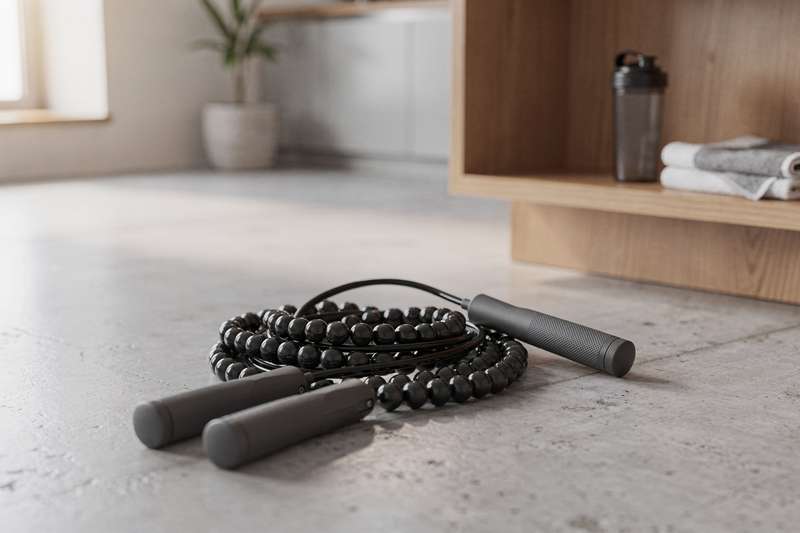
The Scenario: Why Concrete Destroys Most Jump Ropes
You’ve cleared a corner of the garage, shoved the car onto the drive, and laid down a half-hearted rubber mat from a discount shop. The first set of double-unders feels fine — until the rope clips the edge of the mat and whips back at your calf. By rep twenty, you notice the beads leaving white scuff marks on the exposed concrete. By the end of the session, two plastic beads have cracked clean off. You’re not doing anything wrong. The problem is that most jump ropes — including plenty of those marketed as “durable” — were tested in a carpeted studio or on a sprung gym floor, not on bare concrete that grinds through plastic like coarse sandpaper.
If that sounds familiar, this guide is for you. You want double-unders: fast, consistent, with good rhythm feedback. You want a rope that survives a concrete garage floor or outdoor driveway without turning into a pile of broken beads after a fortnight. And you want to know what to actually buy, without wading through vague descriptions that could apply to any piece of plastic cord.
How We Evaluated These Picks
The picks in this guide were assessed against five criteria that matter specifically for beaded ropes used on hard floors. First, bead durability — how the bead material (polypropylene, nylon, or PVC) holds up against repeated concrete contact. Second, rotation quality — whether the handle system (ball bearing vs. swivel) delivers the consistent, smooth spin you need for double-unders. Third, adjustability — because the wrong rope length on a concrete surface doesn’t just cost you a double-under; it can flick a bead directly into your shin. Fourth, handle ergonomics — grip security during sweaty sessions matters more on concrete because you can’t afford any wobble mid-rotation. Fifth, floor impact pattern — how the beaded sections actually strike concrete at speed, and whether a mat is absolutely necessary or merely helpful. Verified buyer feedback patterns on UK retail listings were reviewed alongside category specifications to identify consistent strengths and weaknesses.
Best Overall for Double-Unders on Concrete
If you only buy one rope for double-unders on a concrete surface, look for a beaded jump rope that sits in the £18–£28 bracket, uses weighted nylon or high-density polypropylene beads, and includes ball-bearing handles. That combination solves the three most common concrete-floor problems at once: bead wear, inconsistent rotation, and hand fatigue.
The weighted bead construction is the key differentiator here. Heavier beads maintain their arc on the downswing even when you’re mid-double-under and your timing is slightly off — the rope continues its path rather than collapsing and tangling. On a concrete floor, that arc is particularly important because the contact point with the ground is harder and less forgiving than a sprung floor; any rope that hesitates or drags on the strike loses momentum fast. Look for beads that are at least 7–8mm in diameter with a solid (not hollow) core, which gives you both the weight and the structural integrity to survive thousands of concrete contacts before showing significant wear.
Ball-bearing handles are non-negotiable for double-unders. A simple plastic swivel might be fine for basic skipping, but when you’re spinning the rope twice per jump at speed, even a fractional drag in the bearing becomes noticeable as inconsistency in your rhythm. Quality ball-bearing handles typically state “360° rotation” or “sealed bearings” in the product description — if neither phrase appears, assume the handle uses a basic swivel. Adjustable length is also worth prioritising: for double-unders, the standard setup guide (rope reaches armpits when standing on the centre) is a starting point, but many athletes prefer the rope 10–15cm shorter than that to tighten the loop. Buy a rope you can shorten.
One honest tradeoff: heavier beaded ropes are slightly slower than ultra-light wire ropes, so if you’re competing in timed CrossFit workouts where fractions of a second per rep matter, a speed cable is technically faster. But for most athletes — especially those training in a home garage where consistency and durability over weeks of sessions trumps marginal speed gains — the beaded version on concrete is the smarter long-term choice.
Best Budget Pick (Under £15)
There’s a category of classic segmented beaded ropes — the kind that has existed in PE cupboards for decades — that genuinely holds up on concrete when you choose the right one. Under £15, you won’t get ball bearings, but you can find a rope with a polypropylene bead construction, a basic but functional swivel, and enough length adjustment via knotting or a crimping mechanism to get the sizing right.
What to look for at this price point: beads made from polypropylene rather than brittle ABS plastic. Polypropylene is tougher, has a slight flex to it, and resists the kind of shattering impact that ABS beads show when they repeatedly strike a rough concrete surface. You can usually tell the difference by feel — polypropylene beads have a slight waxy texture and don’t feel hollow when tapped together, whereas cheaper ABS beads produce a higher-pitched click and feel more rigid.
The handles at this price are typically solid plastic rather than foam-gripped, which is fine as long as your sessions stay under 20–25 minutes. For longer HIIT blocks, bare plastic handles become uncomfortable when wet with sweat, so either wear thin training gloves or look for a budget rope that includes a basic rubber overmould on the grip section. Some do, and they’re usually only £1–2 more than the bare-plastic versions.
Where the budget pick struggles: double-unders specifically require a consistent arc, and the basic swivel on a sub-£15 rope can develop a slight judder after extended use on concrete. For learning double-unders or practicing timing, this rope is solid value. For programming 5×50 double-unders three times a week on a garage floor, you’ll likely replace it every 8–12 weeks. Factor that into the value calculation — two budget ropes a year costs less than one mid-range rope only if the budget rope actually delivers the training quality you need.
Best for CrossFit and High-Volume Training
CrossFit-style programming puts a beaded rope through a different kind of stress than casual skipping. You’re looking at sets of 50–100 double-unders in a metcon, multiple times a week, on whatever floor surface your box or garage happens to have. On concrete, that means the rope’s contact point is taking hundreds of hard strikes per session. At this training volume, you need a rope in the £22–£35 range that is specifically built for repetitive high-impact use.
The construction feature that matters most here is reinforced bead-to-cord connectivity. On cheaper beaded ropes, the cord passes through the centre of each bead and the beads are held in place by nothing more than the cord’s thickness. Under high-volume use, the cord at each end gradually frays at the point where it exits the last bead before the handle. Look for ropes where the manufacturer lists “reinforced end connections” or “heat-sealed cord entry” — this protects the highest-stress point on the rope.
Ergonomic foam handles with a contoured grip make a genuine difference in a workout like Diane or Annie, where you’re putting the rope down and picking it back up under fatigue. Handles that are 14–16cm long give you room to adjust your grip during a set without losing control. Handles shorter than 12cm force a fixed grip position, which becomes uncomfortable after high rep counts. Look for handles that taper slightly toward the end cap — this makes re-gripping between sets faster.
Many high-volume ropes at this price tier include spare bead sets. On concrete, this is a practical benefit rather than a marketing bonus. Beads at the lowest point of the arc — the section that strikes the floor most frequently — wear faster than the rest of the rope. Being able to replace the central 30–40 beads without buying an entirely new rope extends the lifespan significantly. Check whether the spare beads included are the same diameter and material as the originals; mismatched beads create subtle weight imbalances that affect your double-under timing.
Best for Beginners Learning Double-Unders
Learning double-unders is a specific skill challenge, and a beaded rope is arguably the best teaching tool available because the audible “click” as beads pass each other gives you timing feedback that a silent wire rope simply can’t provide. If you’re at the stage of converting from singles to doubles — that awkward phase of occasional doubles mixed with desperate singles — the right beginner-friendly beaded rope can shorten your learning curve meaningfully.
For this use case, prioritise the audio feedback quality above everything else. The bead sound should be crisp and consistent: each rotation should produce a clear click pattern, not a dull thud or a rattle. That click is your metronome. Ropes with smaller, lighter beads tend to produce sharper sounds; heavier beads are slightly more muted. In the £12–£20 range, look for ropes described as “rhythm” or “training” ropes, as these are typically optimised for the clicking feedback rather than raw speed.
Weight matters differently for beginners than for experienced athletes. A slightly heavier rope (due to its beads and cord weight combined) is actually helpful when you’re learning, because the extra momentum carries the rope through even when your timing is off. Ultra-light ropes are unforgiving — the rope collapses the instant your timing wavers. The extra forgiveness of a medium-weight beaded rope means you can complete a double-under even with slightly imperfect form, which is how skill patterns consolidate in the early stages.
On concrete specifically, beginners hit the floor more often with the rope during the learning process — mistime a jump and the rope slaps hard. A beaded rope absorbs this better than a wire cable (which can kink and permanently damage the cable on a hard concrete strike). Polypropylene beads on concrete produce minimal damage to the rope at the energy levels of a mistimed jump, whereas a wire rope hitting concrete at the wrong angle can develop a permanent bend in the cable that ruins the rotation arc. For anyone still dialling in the skill, beaded is the more forgiving choice on hard floors.
Best for Outdoor Concrete and Tarmac
Training outdoors on a driveway, patio, or car park surface adds UV exposure and moisture to the usual concrete-wear problem. Beads that are fine indoors can become brittle after weeks of direct sunlight; handles that grip well in a dry garage can become slippery in damp conditions. The outdoor-specific pick in the £20–£30 range addresses these variables with UV-resistant bead material and textured or rubberised handle surfaces.
UV resistance in beads is rarely listed explicitly in product descriptions, but you can infer it from the material. Nylon and high-density polyethylene (HDPE) beads have inherently better UV resistance than standard polypropylene; if the listing mentions either material, that’s a good sign. Avoid ropes with bright, thin-coloured beads at this use case — heavily dyed thin-walled beads fade and become brittle faster than thicker, more lightly coloured beads when exposed to consistent sunlight.
Tarmac is actually harder on beads than smooth concrete because the aggregate surface texture is rougher and more irregular. On tarmac, the rope strikes at slightly different angles with each rotation, meaning beads wear unevenly. Reinforced end caps — the small metal or hard plastic fittings at the point where the cord enters the handle — are worth checking before buying, because tarmac also places more lateral stress on the cord entry point than indoor surfaces. Caps that are metal rather than plastic will outlast plastic equivalents by a significant margin on rough outdoor surfaces.
One practical note for outdoor training: concrete and tarmac surfaces vary enormously in texture. A freshly laid smooth concrete floor wears beads far less quickly than exposed aggregate concrete or brushed concrete. If your outdoor surface is particularly rough, consider a short non-slip rubber mat under the rope’s primary contact zone — even a 50×50cm square of 6mm rubber matting protects your rope’s central bead section and extends its life by several months at high training volumes.
Best Paired with a Protective Mat
This pick is specifically for athletes who want to extend the life of a good beaded rope and protect their joints at the same time. The combination of a well-chosen beaded rope with a proper jump rope mat changes the dynamic of training on concrete — the rope strikes rubber or high-density foam instead of bare concrete, bead wear slows dramatically, and the surface returns energy more gently to your ankles and knees.
For the mat itself, the dimension that matters most for double-unders is length, not width. When you’re performing double-unders, the rope contacts the floor in a narrow zone directly beneath your jump point — but that zone moves slightly with each rep as your body position shifts. A mat that is at least 150cm (ideally 170–180cm) long ensures the rope always lands on rubber regardless of minor positional drift. Width of around 60–70cm is sufficient for straight-line jumping. Thickness should be 6–7mm — below that and the cushioning benefit diminishes; above 8mm and some athletes find the soft surface disrupts their rhythm.
Non-slip backing is essential on concrete. A mat that slides even slightly during an intense set will eventually put the rope on bare floor mid-workout, defeating the purpose entirely. Check that the mat lists a textured or suction-cup back specifically rated for smooth concrete or hard floors — not all non-slip backings work equally well on concrete versus carpet.
The beaded rope to pair with a mat in this configuration can be a step down in ruggedness from the outdoor pick, since the mat is absorbing the wear. At £25–£45 for rope plus mat combined, you can afford a mid-weight rope with good ball-bearing handles and reserve most of your budget for a quality mat. The mat is doing the durability work here; the rope just needs to be consistent and well-balanced for double-under rhythm.
What to Look For When Buying a Beaded Jump Rope for Concrete
- Bead material and wall thickness: Polypropylene and nylon beads outlast ABS on concrete. Look for solid (not hollow) beads with a wall thickness you can assess by feel — beads that produce a dull click rather than a sharp crack when knocked together tend to be more durable under impact.
- Handle bearing type: Ball bearings (sealed, ideally) are required for smooth double-under rotation. A basic plastic swivel introduces drag and inconsistency at high speeds. The listing should state “ball bearing” clearly — if it doesn’t, assume a swivel.
- Adjustable length with a secure locking mechanism: For double-unders, rope length is critical and personal. Avoid ropes that adjust only by knotting the cord inside the handle — knots degrade the cord over time. Look for a crimping collar or a screw-based adjustment system.
- Cord-to-bead connection quality: The cord should pass cleanly through each bead without visible fraying at entry or exit points. If a product image shows bare cord visible between beads, the beads are too widely spaced and will develop rattling and inconsistency as the cord stretches.
- Handle length and grip surface: 14–16cm handles work for most adults. Foam or rubber overmould grips outperform bare plastic in sweaty conditions. Some handles include a knurled texture on the grip zone — this works well but can cause palm abrasion during very long sessions.
- Weight distribution: A rope where most of the weight sits in the beads (rather than in weighted handles) gives more consistent arc feedback during double-unders. Weighted handles shift the centre of rotation and can make timing harder to internalise.
- Floor mat compatibility: If you’re not using a mat, buy the most bead-durable rope you can afford. If you are using a mat, you have more flexibility on bead material and can prioritise rotation quality and handle comfort instead.
Verdict
For the majority of UK athletes training on concrete — whether that’s a home garage, a driveway, or a CrossFit box with bare floors — the best overall pick is a beaded jump rope in the £18–£28 bracket with sealed ball-bearing handles, solid nylon or HD polypropylene beads, and a secure length-adjustment collar. This combination balances the three things that matter most for double-unders on hard floors: consistent rotation arc, bead durability under repeated concrete contact, and the grip security to maintain control through fatigue.
If your budget is tight, the polypropylene budget pick under £15 is a genuinely serviceable choice for building the skill — just expect to replace it more frequently. If you’re programming high-volume CrossFit-style workouts three or more days a week, step up to the reinforced CrossFit pick and pair it with a 6–7mm non-slip mat: the combination dramatically extends the rope’s lifespan and your joints will thank you by week eight. Either way, stop buying wire speed ropes for concrete garage work — they kink, they wear, and they don’t give you the rhythm feedback that makes double-unders click into place.
We were not paid to feature any specific product in this guide. All opinions are independent and based on publicly available specifications, verified buyer feedback patterns, and category research. Prices shown were accurate at time of writing and may change.
Quick Comparison Table



FAQ
Can you use a beaded jump rope on concrete without a mat?
Yes, but the beads will wear faster than on a softer surface. On smooth concrete, high-density polypropylene or nylon beads can last several months of regular use before showing significant degradation. On rough or exposed-aggregate concrete, bead wear accelerates noticeably — a mat under the central contact zone is worth adding if you train on this type of surface more than three times per week.
Are beaded jump ropes good for double-unders or are speed ropes better?
Beaded ropes are excellent for learning double-unders and for consistent training on hard floors. The audible click gives you timing feedback that silent wire ropes don’t provide, and the arc stays more stable when your timing is slightly off. Wire speed ropes are faster in raw RPM terms but are more susceptible to damage from concrete contact — a single hard kink in a wire cable can ruin the rope’s arc permanently. For most non-competitive athletes, a beaded rope on concrete is the more practical choice.
What length jump rope should I use for double-unders?
The standard starting point is to stand on the centre of the rope and check that the handles reach your armpits. For double-unders specifically, many athletes prefer the rope 10–15cm shorter than this to tighten the rotation arc. Start at armpit height, practice a few sets, and shorten the rope incrementally until the arc feels efficient without the rope clipping your feet on the second pass.
How thick should jump rope mat be for concrete floors?
For double-under training on concrete, a mat between 6mm and 8mm thick hits the right balance. Below 6mm, the cushioning benefit for joints is minimal and bead protection is limited. Above 8mm, the soft surface can subtly alter the rope’s rebound behaviour on landing, which some athletes find disrupts rhythm. A 6–7mm high-density foam or rubber mat with a non-slip concrete-rated backing is the practical choice for most home gym setups.
How do I know if a jump rope has ball bearings or just a swivel?
Check the product description for phrases like “ball bearing handles”, “360° sealed bearings”, or “precision bearings”. If none of those phrases appear, the handle most likely uses a basic swivel mechanism. You can also test it at point of purchase: spin the handle freely — ball-bearing handles spin smoothly and coast for several rotations after a flick; swivel handles stop almost immediately. For double-unders, always choose ball bearings.
Can children use a beaded jump rope on concrete?
Yes — beaded ropes are actually one of the safer options for children on concrete because the beads absorb some of the impact energy when the rope strikes the floor, reducing the chance of dangerous snap-back compared to a taut wire rope. Ensure the rope is correctly sized for the child’s height (handles to armpit level when standing on the centre), and consider a thin rubber mat to protect both the floor surface and the rope’s lifespan under energetic use.