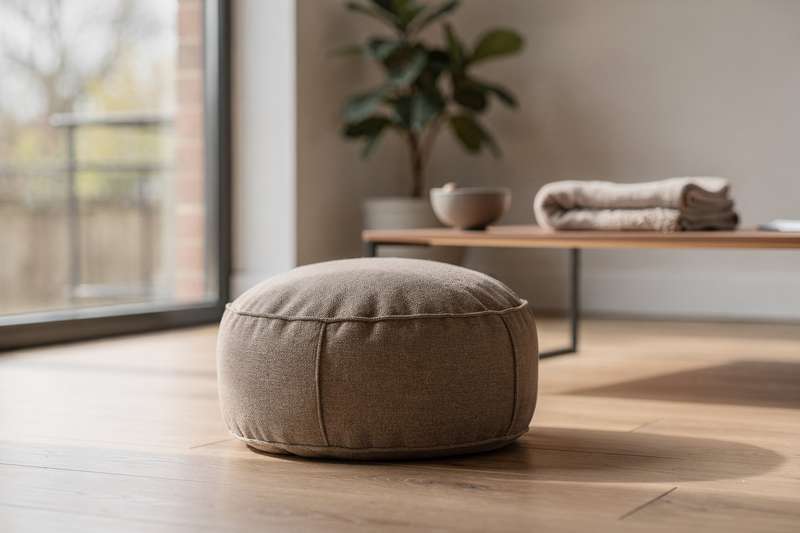
You’re 6’1″, maybe 6’3″. You’ve tried meditating on a standard zafu and spent the whole session fighting your own hips. Your pelvis tips backward, your lower back rounds, and within ten minutes you’re shifting position and giving up on any kind of stillness. You bought a cheaper foam cushion from a high street sports shop — it felt fine in the shop but went flat within a fortnight. You’ve propped yourself on folded blankets, on yoga blocks, on a stack of books. Nothing holds its height, and nothing gives you the firm, stable base that makes sitting for twenty minutes feel possible rather than punishing.
This is an anatomy problem, not a motivation problem. Long femurs — the thigh bones of taller people — need more elevation to allow the pelvis to tilt forward naturally. Standard zafus are typically 5–6 inches tall, designed around average sitting geometry. If you’re above 6 feet, that’s rarely enough. What you need is a cushion that sits at 7–8 inches fully packed, holds that height session after session, and doesn’t shift under you when you settle in. Buckwheat hulls are the filling that actually delivers this — they’re dense, they don’t compress the way kapok or foam does, and they pack together under your weight rather than collapsing.
This guide focuses specifically on that gap in the market: buckwheat-filled cushions sized and shaped to work for tall practitioners in the UK.
How We Evaluated These Picks
The criteria for this category are specific. A cushion that works brilliantly for a 5’6″ sitter may be entirely wrong for someone six inches taller. With that in mind, every pick was assessed against five factors: sitting height under load (how tall the cushion actually sits when a person is on it, not just at rest), diameter or base footprint (wider bases give more stability for longer legs), fill density and quality (not all buckwheat hulls are equal — fresh, properly dried hulls hold their shape far longer than bargain alternatives), cover durability and washability (you’re going to use this daily; the cover needs to survive it), and adjustability (some cushions have zippered inner shells that let you fine-tune the firmness and height).
Research drew on manufacturer specifications, verified buyer feedback patterns across UK retailers, ergonomic guidance from yoga and meditation practitioners, and comparative category knowledge across over a dozen cushion types. No products were provided free of charge for this guide.
Best for Very Tall Sitters (6’1″+): Maximum-Height Buckwheat Zafu
If you’re 6’1″ or taller, height under load is the single number that matters most. A standard 5-inch zafu loses an inch or more once you’re sitting on it; a cushion marketed as “tall” but filled loosely will do the same. What you’re looking for is a round buckwheat zafu with a packed (unstuffed) height of at least 7.5 to 8 inches and a diameter of 14 to 15 inches. The wider diameter isn’t just about space — it distributes your weight across a larger area, which reduces the sinking effect that narrows the effective sitting height.
The key specification to seek out here is fill weight. Cushions in this tier typically weigh 7–9 lbs (roughly 3.2–4 kg) when fully packed. That weight is almost entirely buckwheat hulls, and it tells you there’s genuine fill volume inside rather than a loosely packed bag. When you see a cushion described as “jumbo” or “XL” or “built for tall frames”, check whether the listing gives a fill weight alongside the physical dimensions — those that do are usually the ones that actually deliver the height they claim.
Buckwheat hulls at this fill density do have one honest drawback: they rustle audibly when you shift position. For practitioners who value silence in their sitting environment, this takes a few sessions to stop noticing. The hulls also make the cushion heavier than kapok alternatives — carrying it to a class or a retreat takes more effort. But in a home practice setting, neither of these is a genuine problem. What you get in return is a cushion that holds its shape for years rather than months. Dense buckwheat doesn’t compress the way kapok or foam does; the height you feel on your first sit is within a few millimetres of what you’ll feel eighteen months later.
Avoid listings that describe themselves as tall but don’t give a packed height, or that list a diameter under 13 inches. A narrow base with high fill will rock under a tall sitter rather than stabilise. Also avoid cushions that use “buckwheat blend” as a euphemism for a mix of buckwheat and synthetic fill — you want pure hulls for the consistent density that makes this category work.
Best Adjustable Buckwheat Cushion for Tall Sitters
Not every tall sitter needs the same height. If you’re 6’2″ but relatively flexible, or if your practice involves different sitting styles — cross-legged on some days, kneeling in seiza on others — a cushion with a zippered inner pouch gives you a significant advantage. You can pack it fully for maximum lift or remove a handful of hulls to soften the firmness slightly for longer, gentler sessions. This adjustability also means the cushion can grow with your practice: many beginners need more height early on and find they can reduce it slightly as hip flexibility improves over months.
Look for cushions in the £35–£55 range that list two zips: an outer cover zip (for washing) and a separate inner pouch zip (for adjusting fill). These are distinct features and not all listings make the distinction clearly. If a product only mentions one zip and calls it “adjustable”, confirm whether that zip accesses the fill directly or simply removes the cover — washing access is useful, but it’s not the same as fill adjustment.
The tradeoff with adjustable cushions is structural: the inner pouch needs to be robust enough that it doesn’t sag or deform when you remove hulls. Cheaper versions use thin cotton for the inner shell, and it starts to bunch under repeated adjustment. Look for listings that specify a reinforced inner pouch, or read buyer reviews specifically mentioning how the cushion performs after several months of use — early reviews rarely flag this, but reviews from buyers who’ve had the cushion for six months or more will mention it if it’s a problem.
One practical tip: if you buy an adjustable cushion and find it doesn’t quite reach the height you need at maximum fill, you can purchase additional loose buckwheat hulls separately (available from several UK suppliers online) and top it up. Most inner pouches have enough physical capacity for an extra 200–300g of fill beyond what comes in the box. This makes an adjustable cushion a flexible long-term investment rather than a one-size assessment.
Best Budget Pick for Tall Sitters (Under £40)
A lower price doesn’t have to mean a shorter cushion, but it does mean accepting some compromises. In the under-£40 bracket, the most common tradeoff is fill quality: budget buckwheat cushions frequently use hulls that are slightly smaller, less uniform, or less thoroughly dried than premium alternatives. This affects long-term longevity more than initial performance — the cushion feels fine for the first few months, then starts losing perceptible height as the hulls settle and compact more than they should.
That said, there are genuinely useful budget options if you know what to look for. Prioritise cushions that list a packed height of at least 6.5 inches (not just diameter), have a removable and washable cotton cover, and use a zip closure rather than a tie or button — ties work loose under daily use. At this price point, 14 inches is a realistic diameter target; the full 15-inch jumbo-size cushions tend to sit above £45 once you factor in the extra fill needed.
For tall sitters on a budget, a useful strategy is to buy a standard 13–14 inch round buckwheat zafu and immediately assess the height. If it’s slightly lower than you need, buy a thin cotton zabuton (floor mat) to place under it — not for cushioning the floor, but to add a stable inch or so of height beneath the zafu. This combination often outperforms a single pricier cushion that was only marginally taller to begin with.
Where budget cushions genuinely struggle is in stitching quality around the handle and the base seam. Under the weight of a tall sitter, a loosely stitched base will start to show stress within a few months. Run a quick check on recent buyer reviews for any mentions of seam splitting or the handle pulling loose — these are the failure points that distinguish a £30 cushion worth buying from one that will need replacing within a year.
Best for Tall Sitters Who Travel or Attend Classes
The challenge with buckwheat cushions and travel is straightforward: buckwheat is heavy. A fully packed jumbo zafu can weigh close to 4 kg, which is impractical in a yoga bag or on public transport. If you want a cushion that works for classes, retreats, or regular travel, you need to balance portability against the height requirements that make buckwheat worthwhile for tall sitters in the first place.
The sweet spot here is a medium round zafu (13–14 inches diameter) with a carry handle and a partially adjustable fill. Removing roughly 15–20% of the hulls brings the weight down to around 2.5–3 kg while keeping a functional sitting height of 6–7 inches. For tall sitters in the 6’0″–6’2″ range, that’s often sufficient. If you’re closer to 6’4″, you’ll feel the compromise — a travel-oriented cushion genuinely isn’t going to replace a home-based jumbo zafu for very tall practitioners.
A built-in carry handle is more useful than it sounds. Buckwheat cushions are awkward shapes to carry tucked under your arm, and a handle loop lets you hook it onto a bag or carry it alongside a rolled yoga mat without it constantly shifting. Look for handles stitched into the side seam rather than attached with a single stitch point — the side-seam integration distributes load across several inches of reinforced stitching and is far more durable under regular use.
Cover material matters more for travel cushions than for home use. A woven cotton twill cover handles compression in a bag better than a loose-weave linen, and it’s more resistant to the scuffs and friction that come from being carried regularly. Machine-washable covers are a practical requirement if the cushion is moving between environments — studio floors are not always clean.
Best Crescent-Shape Buckwheat Cushion for Tall Sitters with Hip or Knee Sensitivity
The crescent (or “zafkorn”) shape is less common than the standard round zafu, but for tall sitters with hip impingement, tight IT bands, or knee discomfort in cross-legged positions, it’s worth understanding. A crescent cushion cups around your sitting bones and provides a raised platform under each thigh rather than under the centre of the pelvis. This allows the knees to drop lower and the pelvis to tilt forward, which reduces the compressive load on the hip flexors that causes the burning sensation many tall sitters feel in prolonged cross-legged positions.
For standard cross-legged sitting (sukhasana), a round zafu is usually adequate if it’s tall enough. But for tall practitioners attempting half-lotus or full-lotus, the crescent shape provides a different kind of support — your legs have somewhere to rest rather than just hanging off the sides of a round cushion. Many experienced practitioners keep both shapes and choose based on the session length and the sitting style they’re using.
Buckwheat-filled crescent cushions are slightly harder to find in the UK than their round equivalents, but they do exist in the £40–£65 range. The specification to check is the inner curvature depth — a shallower crescent provides less knee support, while a deeper curve (more pronounced crescent shape) gives more targeted support but works best with specific sitting positions. If you’re unsure which shape suits you, a round zafu is the safer starting point; the crescent is a considered upgrade once you know your sitting style.
One honest limitation: crescent buckwheat cushions are even harder to reposition mid-sit than round ones, because their weight isn’t symmetrically distributed. If you tend to shift position frequently during a session, a crescent can feel fiddly. Round zafus are more forgiving of repositioning for this reason.
Best Premium Long-Term Buckwheat Cushion for Tall Sitters
If you’re committed to a daily practice and want a cushion that will serve you for five to ten years without needing replacement, the investment in a premium option makes practical sense. In the £65–£100 range, you should expect organic cotton covers (which are both softer and more breathable than standard cotton twill), extra fill volume (some premium cushions list fill weights of 9–10 lbs, ensuring maximum height that holds over years), reinforced double-stitched seams throughout, and in many cases an option to purchase replacement hulls directly from the manufacturer.
The organic cotton specification matters beyond ethics. Organic cotton covers tend to use tighter weaves that resist hull dust migration more effectively — over time, fine buckwheat dust works through looser weave covers and settles on your floor. Tighter weave covers slow this down significantly. They’re also more comfortable against bare skin if you sit in shorts or lightweight clothing.
At this price point, look for cushions made in small production runs by specialist suppliers rather than generic volume imports. These products typically come with better documentation of their fill sourcing, more accurate packed-height specifications (often independently tested), and customer service that will actually help if the seam develops a problem two years in. In the UK market, several independent wellness and yoga equipment suppliers sell cushions in this tier — they’re less visible than Amazon bestsellers but well-reviewed within the meditation community.
The honest tradeoff is price versus immediate utility: a £70 premium buckwheat zafu and a £40 mid-range buckwheat zafu may feel nearly indistinguishable on day one. The difference shows over one to three years in how well the cushion holds its packed height, how the cover wears, and whether the stitching stays intact under daily use. If you’re not certain whether a daily practice will stick, start with the mid-range option. If you’ve been practising consistently for six months or more and intend to continue, the premium tier is a reasonable long-term choice.
What to Look For When Buying a Buckwheat Cushion for Tall Sitters
- Packed height under load: The most important single specification. Look for cushions with a packed height of at least 7 inches (ideally 7.5–8 inches) for sitters over 6 feet. Be sceptical of listings that only give unstuffed dimensions — some cushions measure taller flat than they actually sit under a person’s weight.
- Fill weight and density: A fully packed buckwheat zafu for tall sitters should weigh 7–9 lbs (3.2–4 kg). Lower fill weights indicate less hull volume and mean the cushion will lose height faster over time as the hulls compact. Fill weight is a more reliable quality indicator than price alone.
- Diameter: For tall sitters, 14–15 inches is the target. Wider diameters distribute weight more evenly, reduce hull displacement to the edges under load, and provide a more stable base for longer legs.
- Adjustability: A zippered inner pouch lets you customise height and firmness. This is especially useful if you’re unsure exactly how much elevation you need, or if your practice includes multiple sitting styles with different support requirements.
- Cover material and washability: Cotton twill or organic cotton are the practical choices — durable, washable, and breathable. Avoid synthetic covers, which trap heat and tend to slip on wooden floors. Confirm the outer cover is machine washable; hand-wash-only covers are inconvenient for daily use.
- Seam quality: For tall sitters (who tend to be heavier than the average user these products are designed for), the base seam and the handle attachment are the most common failure points. Look for mentions of double-stitching or reinforced seams in the product description, and check recent reviews for seam or handle issues.
- Hull quality: Fresh, properly dried buckwheat hulls hold their shape and resist compacting far better than cheaper alternatives. Terms like “premium grade”, “cleaned and dried”, or “organically grown hulls” in a product description are meaningful indicators. Vague descriptors like “natural fill” or “eco-friendly stuffing” without hull-specific detail are less reliable.
Verdict
For most tall sitters — anyone 6’0″ and above who has struggled with standard zafus — the maximum-height round buckwheat zafu in the £55–£75 range is the clearest answer. A packed height of 7.5–8 inches, a 14–15 inch diameter, and dense buckwheat fill that holds its shape over years addresses the core problem directly and without fuss. It’s not portable, it’s not adjustable, and it’s heavier than alternatives — but for a home practice, none of those things matter as much as simply having a cushion that keeps your hips where they need to be from the first session onward.
If adjustability matters to you — because your flexibility is changing, because you sit in multiple styles, or because you share the cushion with a partner of a different height — step to the adjustable-fill option in the £35–£55 range. The ability to add or remove hulls gives you a cushion that can work correctly across a range of users and preferences, and it’s a sensible choice if you’re still finding the height that works best for your body.
The budget and travel options are honest compromises, not replacements. If cost is a genuine constraint, a well-filled budget zafu paired with a thin zabuton beneath it will outperform a premium cushion that’s too short for your anatomy. But if budget allows, start where your body actually needs you to start: at the height end of the market.
Editorial Note
We were not paid to feature any specific product in this guide. All opinions are independent and based on publicly available specifications, verified buyer feedback patterns, and category research. Prices shown were accurate at time of writing and may change.
FAQ
How tall should a meditation cushion be for a tall person?
For sitters above 6 feet, look for a buckwheat zafu with a packed height of at least 7 inches — ideally 7.5 to 8 inches. The goal is to have your hips clearly above your knees when seated, which allows the pelvis to tilt forward and the lumbar spine to sit in its natural curve. Standard zafus at 5–6 inches are designed around average anatomy and frequently fall short for tall practitioners.
Why is buckwheat better than foam or kapok for tall sitters?
Buckwheat hulls hold their shape under load rather than compressing. Foam and kapok both lose height over time — kapok noticeably within months of daily use, foam even faster. For tall sitters who need a specific height to sit comfortably, a filling that maintains consistent lift session after session is far more useful than one that starts at the right height and gradually sinks. Buckwheat hulls also provide a stable, non-springy base that doesn’t shift under you mid-sit.
Can I add more buckwheat hulls to increase the height of my cushion?
Yes, provided your cushion has a zippered inner pouch. Loose buckwheat hulls are available from several UK suppliers online and can be added in small increments until you find the height that works for you. If your cushion has a fixed (sewn-shut) fill, adding hulls isn’t straightforward — this is one reason adjustable-fill cushions are worth considering for tall sitters who are still dialling in their ideal sitting height.
Is a crescent or round cushion better for tall sitters?
For most tall sitters, a round zafu is the better starting point. It’s more versatile across sitting styles and easier to reposition mid-session. A crescent cushion becomes useful if you regularly sit in half-lotus or full-lotus and experience knee or hip strain — the crescent shape supports the thighs and allows the knees to drop further. If you’re new to meditation cushions, start round; the crescent is a considered second purchase once you know your practice style.
How long does a buckwheat meditation cushion last?
A well-made buckwheat zafu with quality hulls should hold its functional height for three to five years of daily use, and many last considerably longer. The hulls gradually compact over time, slowly reducing height — this happens faster with lower-quality hulls or if the cushion is stored compressed. Most specialist suppliers offer replacement hull top-ups, which can restore a cushion’s height without buying a new one.
Do buckwheat cushions make noise during meditation?
They do rustle when you move. This is an intrinsic property of the fill — buckwheat hulls shift against each other audibly when the cushion is compressed or repositioned. Most practitioners stop noticing after a few sessions, and during still sitting the cushion is completely silent. If you find the initial rustling distracting, give it two weeks of regular use before drawing conclusions; the vast majority of buckwheat cushion users report the sound ceases to register once it becomes familiar.