When Your Flat Has No Room for a Rack of Kettlebells
You live in a one-bed or studio flat. There is no spare room, no garage, no loft. Your workout space is the gap between the sofa and the TV cabinet — roughly two metres of laminate flooring if you move the coffee table. You have tried resistance bands, and they are fine for some things, but they will not give you the weighted swing pattern that builds real hip power. You looked at fixed-weight kettlebells, but even two or three bells take up visible floor space, cost over £100 total, and your landlord would not thank you for the scuff marks. So you typed something like “adjustable kettlebell small flat” into Google, and here you are.
The frustration is real: most adjustable kettlebell guides are written for people with garden sheds or basement gyms. They recommend options that weigh 32 kg at the top end, sit on a bulky cradle dock, and cost £200 before you have even looked at a mat. That is not your situation. You need something that goes from a light warm-up weight to a challenging working weight, stores flat or in a bag, does not shake or rattle mid-set, and comes in under £100. This guide is written for exactly that scenario.
How We Evaluated These Picks
The picks in this guide were assessed against five criteria that matter specifically to flat-dwelling, budget-conscious UK buyers. First, storage footprint: does the bell disassemble, collapse, or sit in a compact form when not in use? Second, weight range: is the spread wide enough to cover both beginner swings and more demanding presses without buying a second bell? Third, adjustment mechanism: how quickly and reliably can you change the weight mid-session, and is there any wobble or loose-plate noise during use? Fourth, floor friendliness: does the coating protect your floors and dampen noise — relevant when you have downstairs neighbours? Fifth, value: does the price hold up against buying two or three fixed bells covering the same range? Verified buyer feedback patterns from UK Amazon listings informed tradeoff notes throughout.
Best Overall — Dial-Adjust Mechanism (4–20 kg)
If you can only buy one adjustable kettlebell for your flat, the dial-adjust style in the 4–20 kg bracket is the one to beat. You turn a dial on the handle or base and the mechanism locks in the selected weight plates — the whole process takes under ten seconds. There is no loose collar to strip, no pin to lose, and no fumbling between sets when you want to drop from 16 kg to 12 kg for a finisher. That speed matters in a real session when your rest periods are timed.
What you are looking for in this category: a weight range of at least 4–20 kg in steps of no more than 4 kg (2 kg steps are better), a handle diameter between 33 mm and 35 mm so your grip can actually close around it, and a locking mechanism that stays silent during dynamic movements like swings and cleans. The cradle dock adds about 30 cm × 20 cm to your storage footprint — roughly the size of a hardback book lying flat — which is acceptable for most flats when tucked under a bed or in a wardrobe.
The tradeoff with dial-adjust designs is that the mechanism is the first thing to wear out if you drop the bell repeatedly onto hard floors. These are designed for controlled lowering, not CrossFit-style drops. If you train with a lot of ballistic movements and know you release the bell from overhead, this mechanism will degrade faster than a simple screw collar. For swings, presses, goblet squats, and Turkish get-ups — the bread-and-butter flat-workout movements — it holds up well under normal use.
Budget guidance: expect to pay £70–£90 for a quality dial-adjust model in this range from a UK-dispatched Amazon listing. Anything noticeably cheaper than £65 tends to use a cheaper plastic dial that reviewers report slipping after a few months. Pay a little more and check that the listing specifies steel internal components.
Best for Beginners — Simple Pin-Lock Design (4–12 kg)
If you are new to kettlebell training, a 4–12 kg adjustable bell with a pin-lock or bolt-through plate system is the most sensible starting point. The upper limit of 12 kg might sound low, but the reality is that most beginners — regardless of gym history — need several weeks of technique work at 8–12 kg before swings feel controlled rather than chaotic. Buying a 24 kg bell and never touching the top weight range is a common and expensive mistake.
Pin-lock designs in this weight class tend to be simpler and cheaper than dial mechanisms. A central handle sits atop a stack of disc weights, and a pin or bolt locks the selected plates in place. Look for a design where the pin runs through the handle collar rather than just resting on the outside of the plates — the latter wobbles during movements and the noise travels through flat floors to the room below. Models with a rubber or neoprene skirt around the plate stack also reduce rattling significantly.
Storage is where this category earns its place. Many pin-lock designs at the 4–12 kg range disassemble to a handle and a set of flat plates that stack together and slide under a bed or into a cupboard shelf. When assembled, the footprint at the base is typically under 20 cm in diameter. That is genuinely small by any measure.
The honest limitation: you will outgrow 12 kg within three to six months of consistent training if you are doing swings and deadlifts. That is not a reason to avoid this tier — it is just a reason to think of it as a six-to-twelve-month tool rather than a permanent fixture. Resale value on simple adjustable bells is reasonable on Facebook Marketplace or Gumtree. Budget around £40–£60 for a well-reviewed model; steer clear of anything under £35 as quality control on the pin mechanism becomes inconsistent below that price point.
Best for Pressing and Overhead Work (8–20 kg)
Not all adjustable kettlebells are shaped the same, and that matters more for pressing movements than for swings. When you clean a bell to the rack position for a press or a Turkish get-up, the bell should sit naturally against your forearm without digging in. Competition-style bells have a flat base and a handle that sits in a fixed geometric relationship to the bell body — your arm is in the same position regardless of the weight loaded. Adjustable bells that mimic this geometry feel noticeably more controlled in the rack than standard adjustable designs with a spherical body that shifts as you change weight.
Look for adjustable bells in the 8–20 kg range with a flat base (so they stand stable on the floor between sets), a handle height that clears your knuckles by at least 35 mm when the bell is set on the ground, and a handle width of around 110–130 mm so you can get a two-hand goblet squat grip without your fingers cramping. The 8 kg floor is intentional: press-focused training rarely benefits from going below 8 kg because the bell is too light to provide meaningful shoulder loading, and the technique cues for Turkish get-ups work better with some real weight in your hand.
This style tends to be slightly more expensive than basic pin-lock designs, sitting in the £70–£95 range for a UK-dispatched model. Some use a twist-collar adjustment — you rotate the handle relative to the body to engage or disengage weight rings. This mechanism is reliable but slower than a dial, so if you want to make rapid weight changes mid-circuit it requires a ten-to-fifteen second pause. For straight-set pressing work that is rarely a problem. What to avoid: adjustable bells marketed as “competition style” that actually have a variable body diameter as plates are added — this changes the rack position and defeats the purpose.
A practical note for flat use: pressing movements have a lower impact signature than swings and drops, so this is a good category if noise is a genuine concern. You are not putting the bell down hard; you are lowering it under control. That makes these bells relatively considerate of downstairs neighbours when used sensibly.
Best for Floor Protection and Quiet Use (4–16 kg)
Rented flats, downstairs neighbours, and laminate or hardwood floors are a specific combination that shapes equipment choices more than most guides acknowledge. A neoprene-coated or fully rubber-encased adjustable kettlebell dramatically reduces the consequence of an imperfect set-down — not because you should be dropping kettlebells (you should not), but because fatigue happens, grip slips, and a 14 kg bell meeting a hard floor at speed is a noise and damage event you want to minimise.
What distinguishes truly floor-friendly adjustable bells from ones that just have a thin coating: look for a full-body neoprene or rubber covering at least 5 mm thick, a base that is flat and wide enough to remain stable when set down quickly, and a mechanism that does not expose bare metal plates on the lower surface of the bell. Some adjustable designs leave the underside of the weight stack partially exposed — fine for gym rubber flooring, but a problem on laminate. The weight plates themselves should not shift or clatter when the bell is set down, which means the locking mechanism must stay engaged even under the brief stress of a set-down impact.
One tradeoff worth flagging honestly: neoprene coating adds cost and slightly increases the overall diameter of the bell at any given weight. A 16 kg neoprene-coated adjustable bell will be slightly larger in the hand than a bare-iron equivalent. For most movements this makes no practical difference, but if you have smaller hands and are working in the 12–16 kg range overhead, the extra diameter of the handle area can feel less secure. Check that the handle itself is bare metal or lightly textured — coating the handle is a design choice that reduces grip security significantly.
The weight range for neoprene adjustable bells tends to top out around 16–20 kg, and that is fine for this use case. If quiet, floor-friendly training in a flat is your primary constraint, you are very unlikely to be swinging 24 kg in a living room anyway. Budget roughly £55–£80 for a well-coated model. Anything cheaper tends to have a thinner coating that chips at the adjustment seams within a few months of regular use.
Best for Maximum Weight Range Under £100 (4–24 kg)
If you are an intermediate trainee — comfortable with swings, cleans, and presses at 16 kg already — and you want one bell that will not need replacing for at least two years, look for a model in the 4–24 kg adjustable range. This is the top of what is genuinely achievable under £100 on the UK market; 32 kg adjustable bells exist but they reliably push past that budget with any decent build quality.
The 4–24 kg range in 2 kg increments gives you twelve distinct weight settings. That level of granularity is useful for progressive overload — moving from 20 kg to 22 kg is a more manageable jump than 20 kg to 24 kg, and being able to fine-tune the load is one of the main justifications for choosing adjustable over fixed. Look for a locking collar mechanism rather than a dial for this weight range, because dial mechanisms at 20–24 kg face higher stress loads and are more vulnerable to wear. A steel or reinforced polymer collar that you twist and lock is the more durable option at the heavier end.
Handle geometry becomes more important as the weight increases. At 24 kg you want a handle that is 35–38 mm in diameter — closer to the lower end of that range is better for most hands — and at least 130 mm wide internally so a two-handed swing grip is comfortable. Check that the listing confirms the handle is a fixed component, not adjustable itself, because handle-adjust designs introduce a wobble point under high-load ballistic use.
Storage: a 4–24 kg adjustable bell will typically sit in a cradle or dock that is around 35 cm × 25 cm when fully assembled. That is noticeably larger than a basic 4–12 kg model but still fits under most beds or in a corner. When you consider that a set of fixed kettlebells covering 8, 12, 16, 20, and 24 kg would cost well over £150 and take up a shelf’s worth of space, the compact dock makes a strong practical argument. Budget £80–£100 for a reliable model at this weight range; this is where you genuinely get what you pay for, so do not try to save £15 by going with an unknown listing with very few reviews.
What to Look for When Buying an Adjustable Kettlebell for a Flat
- Weight range and increments: Match the range to your current ability, not your aspirational maximum. A 4–16 kg bell will serve most beginners and intermediates well; only buy to 24 kg if you are already training at 16–18 kg regularly. Increments of 2 kg allow better progressive overload than 4 kg jumps.
- Adjustment mechanism type: Dial-adjust is fastest and most convenient. Twist-collar is more durable under heavier loads. Pin-lock is the simplest and cheapest but slowest to change. Match the mechanism to how you train — if you do drop sets or circuits with rapid weight changes, prioritise speed of adjustment.
- Handle geometry: Handle diameter (aim for 33–38 mm) and internal width (110–135 mm) directly affect comfort and safety. A handle that is too wide forces an awkward elbow position in the rack; too narrow and you cannot swing two-handed comfortably.
- Coating and floor impact: Neoprene or rubber coating protects floors and reduces noise but can add bulk. Bare iron with a flat base is fine if you use a rubber mat, which you should anyway. Avoid thin vinyl coatings — they crack and peel at the adjustment seams.
- Storage footprint: Measure the space you have. A compact cradle dock is typically 20–35 cm long. Some designs disassemble to a flat plate stack that fits in a bag or shelf — useful if storage is very tight, though reassembly takes longer.
- Locking security: The mechanism must stay locked during dynamic movements. Read reviews specifically for comments about rattling or slipping during swings — this is the most common failure point across budget adjustable bells. Any mention of plates shifting mid-set is a red flag.
- Warranty and dispatch location: UK-dispatched stock means faster delivery and easier returns. Look for at least a one-year warranty; some brands offer two years. Avoid grey-import listings with no clear UK return address — returns on heavy items are costly and slow if the warehouse is overseas.
Verdict
For the majority of people reading this — training in a flat, working within a £100 budget, and wanting one piece of kit that covers swings, presses, squats, and Turkish get-ups — the dial-adjust model in the 4–20 kg range is the clearest recommendation. It adjusts quickly enough to use mid-session, the 4–20 kg span covers genuinely beginner through solid-intermediate territory, and the cradle dock is compact enough for under-bed storage. It costs more than the basic pin-lock starter bell, but the speed of adjustment and the durability of a good dial mechanism justify the extra spend for anyone planning to train consistently.
The one exception: if you are already training at 18–20 kg on fixed bells and want to continue progressing, the 4–24 kg locking-collar model is worth the extra £10–£15 over the dial-adjust option. The collar mechanism handles the heavier loads more reliably over time, and the additional weight range means you genuinely do not need to buy a second bell for two to three years of structured training.
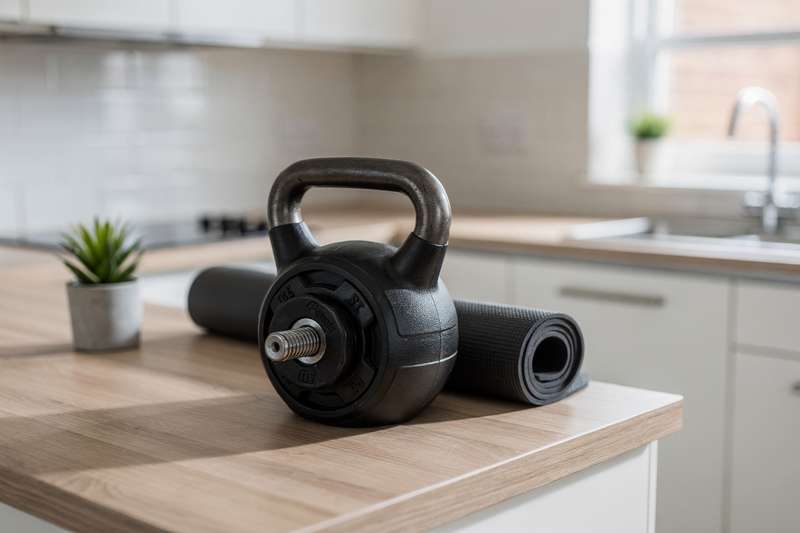
Whatever you choose, pair it with a folding rubber mat (around £15–£20) to protect your floor and reduce noise transmission. It is the single most practical upgrade you can make for flat-based training, and it extends the life of any kettlebell coating significantly.
We were not paid to feature any specific product in this guide. All opinions are independent and based on publicly available specifications, verified buyer feedback patterns, and category research. Prices shown were accurate at time of writing and may change.
FAQ
Are adjustable kettlebells safe to use on laminate or wooden floors?
Yes, provided you use a rubber mat underneath and lower the bell under control rather than dropping it. A mat of at least 6 mm thickness absorbs impact and prevents scratching. Neoprene-coated bells add an extra layer of floor protection, but no coating fully compensates for a hard drop — controlled set-downs are the real answer.
How much weight do I actually need as a beginner?
Most beginners benefit from starting in the 8–12 kg range for swings and deadlifts, and 4–8 kg for overhead pressing movements. A 4–16 kg adjustable bell covers this entire range with room to progress. Resist the urge to buy to 24 kg until you are consistently training at 16 kg — it wastes budget and adds unnecessary weight to store.
Do adjustable kettlebells rattle during swings?
A well-made adjustable bell with a secure locking mechanism should not rattle during normal use. The most common cause of rattling is a worn dial or collar that no longer holds the plates firmly — this tends to appear after several months on lower-quality models. Before buying, look for reviews that specifically comment on sound during ballistic movements. Any mention of clanking or shifting plates mid-swing is a sign to choose a different model.
Can I do Turkish get-ups with an adjustable kettlebell?
Yes, but handle geometry matters. You need a bell that sits stably in the rack position with the handle at a comfortable angle to your forearm. Flat-base designs with a fixed handle-to-body geometry work best for Turkish get-ups. Avoid designs where the body diameter changes significantly as you add weight — this shifts the rack position and makes the movement feel inconsistent.
Is one adjustable kettlebell enough for a complete workout programme?
For most flat-based training programmes — swings, deadlifts, presses, squats, carries, and core work — one adjustable bell covering 4–20 kg is sufficient. You can increase difficulty through volume, tempo, and movement complexity as well as weight. The limitation appears when you want to do double-bell work (two bells simultaneously), which requires a second bell. For single-bell training, one good adjustable is a complete solution.
What is the difference between a dial-adjust and a locking-collar adjustable kettlebell?
A dial-adjust bell uses a rotary selector to engage specific weight increments — quick to change (under ten seconds) but the dial mechanism is the most vulnerable component under heavy or repeated-drop use. A locking collar requires you to manually remove and replace weight plates before twisting a collar to lock them in place — slower to adjust but generally more durable under heavier loads (18–24 kg). For weights under 20 kg and controlled training, dial-adjust is more convenient. For heavier training or high-volume use, a collar mechanism tends to last longer.