You’ve just booked a court for Saturday, dusted off the old racket from the back of the wardrobe, and realised the strings are sagging like a hammock. Or perhaps you’ve been playing for a year on a £10 leisure frame and you’re starting to wonder why your clears keep landing short. Maybe you want to kit out two people for casual garden or leisure-centre play without spending a fortune. Whatever your situation, the badminton equipment market in 2026 is both richer and more confusing than ever — there are lightweight graphite sets aimed at beginners, pre-strung Yonex frames, shuttlecock tubes that range from featherlight to tournament-grade, and two-player bundles that try to do everything at once. Finding what actually suits your level, your court, and your budget without wading through pages of manufacturer jargon is genuinely difficult. This guide cuts through all of that.
How We Evaluated These Picks
Every product recommended here is drawn from the live Amazon UK catalogue. Evaluation covered five main criteria: construction material (graphite, carbon fibre, or aluminium), weight and balance (head-heavy vs head-light vs even balance), inclusion of accessories (shuttlecocks, carry bags, overgrips), real-world reviewer feedback patterns across hundreds of verified UK purchases, and overall value relative to category tier. Where products carry zero review counts, they are assessed on specification and brand heritage alone. The goal was to cover the full spectrum — from a solo club-level shuttlecock purchase right up to a ready-to-play graphite set — so that regardless of where you are on the playing journey, at least one recommendation maps directly to your situation.
Best Entry-Level Carbon Racket for Solo Buyers
The WHiZZ Carbon Graphite Badminton Racket is the pick if you need a single lightweight frame for training, school sport, or casual leisure-centre sessions without committing to a full two-player bundle. It earns an impressive 4.7 out of 5 stars from 90 reviewers, which is the highest rating in the category at this tier — a strong signal that real buyers are happy with what lands in their hands.
The carbon graphite construction keeps the frame noticeably lighter than aluminium alternatives, which matters more than many beginners expect. A lighter frame lets you react faster at the net, generates swing speed more easily, and reduces arm fatigue during longer sessions. For someone stepping up from a plastic leisure set, the difference in feel is immediate. The racket arrives with a shuttlecock and grip tape included, so you can genuinely pick it up and start playing without any additional purchases.
Where it falls short is in the finer points of intermediate play. The shaft flex and string tension are tuned for accessibility rather than performance — advanced players who want to dial in tension for smash power or drop-shot precision will find it limiting. Likewise, the bundle shuttlecock is a starter piece, not something you’d use for a serious club match. Think of this as an excellent first proper racket rather than a racket you’ll still be playing competitively with in three years.
It’s also worth noting that the listing description gets cut off in the product title, which can feel slightly uncertain when browsing. In practice, though, the verified buyer feedback is consistent and positive, with players specifically calling out the lightweight feel and clean build quality. For solo buyers at beginner-to-improver level, this is genuinely hard to beat at its price point.
Best Two-Player Set for Casual Play
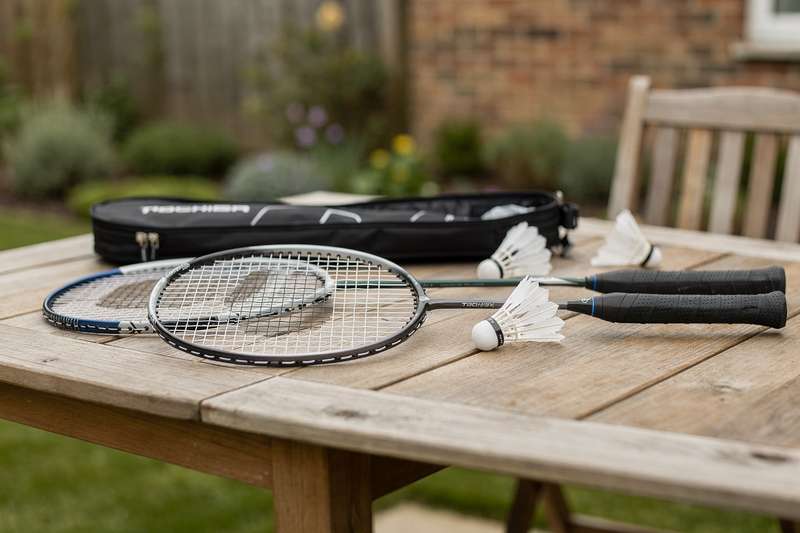
The Nalax Badminton Set — 2 Player Carbon Fiber Racquet with 3 Shuttlecocks and Carrying Bag is the go-to option for garden sessions, holidays, or couples who want to pick up badminton together without buying two separate rackets. With 463 reviews and a 4.3-star rating, it has one of the largest verified buyer bases in this category, which gives you a meaningful picture of real-world performance.
The carbon fibre frame claim is accurate enough for this tier — these rackets are noticeably stiffer than pure aluminium frames and hold up better during regular outdoor use. The inclusion of three shuttlecocks is a practical touch: you typically lose one or two to trees or hedges during a garden session, so having spares matters. The carry bag means you can toss the whole kit in the car boot without worrying about the frames getting scratched or bent.
The tradeoff is that both rackets in the set are identical spec — there’s no differentiation for a stronger versus weaker player. If one of you is significantly more experienced, you might prefer to buy one higher-spec individual racket and pair it with one from this set. The shuttlecocks in the bundle are also suitable for outdoor, casual play rather than club-standard matches on an indoor court. They’ll perform fine in a garden but may feel slightly unpredictable in an air-conditioned sports hall.
For what it is — a complete, ready-to-play two-person kit at a budget-friendly price — the Nalax set delivers reliably. Reviewers consistently praise the lightweight feel and the sensible packaging. If you’re buying badminton gear for a family, a holiday cottage kit, or a first attempt at the sport with a friend, this is a practical, well-rated starting point.
Best Full Carbon Set with Carry Case — Mid-Range
The Senston Badminton Set S300 Graphite Full-Carbon Badminton Rackets With Carry Case, 2 Badminton Rackets 1 Tube Shuttlecocks and 2 Overgrips is the benchmark pick for players who want a proper graphite set with a carry case and don’t want to compromise on build quality. Its 4.6-star rating from 654 reviews makes it the most reviewed and one of the highest-rated full sets in this guide — that volume of feedback provides genuine confidence.
The full-carbon construction here is a step above entry-level blends. Full-carbon frames are stiffer, more responsive, and more durable under repeated hard play. The S300 designation suggests a performance-oriented tuning: the rackets feel taut and controlled rather than soft and forgiving, which suits players who have some technique behind their shots. The inclusion of two overgrips is a thoughtful detail — overgrips wear out quickly, and having replacements from the start means you’re not hunting for them separately after two months of play.
The carry case is a meaningful upgrade over basic bags. It’s structured enough to protect the frames during transport and has enough room for the accessories without becoming unwieldy. For club players who travel to leisure centres regularly, this is a real practical benefit. The tube of shuttlecocks included is serviceable, though serious club players will want to supplement with dedicated training or tournament shuttles depending on how frequently they play.
The one honest caveat is that this is still a set rather than two individually spec’d rackets. If you’re at different playing levels, both rackets being the same spec may not be ideal. But for two players at a similar recreational or developing club stage, the Senston S300 is a sensible, well-rounded choice that punches above its tier. It’s the kind of set that sits in the boot of the car ready to go rather than gathering dust in the hallway.
Best Lightweight Graphite Set for Developing Club Players
The Badminton Racket Professional Graphite Badminton Set of 2 Lightweight Racquet for Sports, Training & Entertainment with 3 Badminton Shuttlecocks sits in the mid-tier graphite bracket and is aimed at players who have moved past complete beginner status and want something that will hold up in both training drills and proper match play. Its 4.5-star rating from 107 reviews reflects a smaller but clearly satisfied user base.
The emphasis on lightweight construction in the product’s own description is meaningful here. Lighter graphite rackets (typically in the 85–90g range before stringing) are well-suited to players developing their footwork and swing mechanics, because the reduced mass means less compensation for technique errors. At this stage of the game, a racket that amplifies your good shots without punishing your bad ones is more useful than a stiff, head-heavy power frame that demands perfect timing on every smash.
The three-shuttlecock inclusion gives you enough to run a proper practice session or a few games without stopping. As with the other sets in this guide, the bundled shuttles are best treated as practice aids rather than match shuttles — for serious league or club nights, you’ll want to supplement with dedicated shuttlecocks designed for the court temperature and altitude of your venue.
Where this set distinguishes itself from the Nalax set reviewed above is in the frame construction quality. The professional graphite claim holds up based on reviewer feedback, with players noting a noticeably more solid feel compared to aluminium or blended frames. If you’re playing twice a week and starting to think seriously about your technique, this set provides the right platform without requiring a jump to premium single-racket territory. It’s also a sensible buy for someone who wants a backup pair of rackets without spending significantly on each individual frame.
Best Head-Heavy Power Racket for Intermediate Players
The YONEX Astrox Smash Badminton Racket in black/red is the pick for players who want the Yonex Astrox attacking DNA — head-heavy balance and smash-focused geometry — in a pre-strung, ready-to-play format. Yonex is the most widely respected badminton brand in the world, and the Astrox line is specifically engineered for steep, powerful smashes with fast recovery through the swing.
The head-heavy balance of the Astrox series means the frame carries more weight toward the top of the stringbed. In practice, this gives you additional momentum when swinging through a jump smash or a flat drive, translating directly into shuttle speed. If you’ve been playing with an even-balanced recreational frame and want to feel the difference a proper attacking profile makes, this is where to start. The black/red colourway is clean and understated — it looks like a serious piece of kit without being garish.
The honest tradeoff with any head-heavy frame is manoeuvrability. At the net, for tight net kills and fast defensive reactions, head-heavy rackets require more wrist work than head-light or even-balanced frames. Players who rely heavily on net play or fast doubles defence may find the transition demands some adjustment. That said, for players building an attacking baseline game in singles or mixed doubles, the smash advantage is worth it.
It’s worth noting that this listing carries zero reviews in the current data, which means you’re relying on Yonex brand quality and the Astrox specification heritage rather than a large body of verified buyer feedback. Yonex’s manufacturing consistency is well-regarded across the industry, so this is less of a concern than it would be with an unknown brand. But if you want the reassurance of volume reviews before purchasing, the Senston or the WHiZZ options above both carry substantial verified feedback. For players who trust the Yonex name and want a proper power frame, this is the right choice.
Best Budget Pre-Strung Racket for Beginners
The YONEX Nanoray 10F Hi-Flex Pre-Strung Badminton Racquet is a factory-strung Yonex entry designed for beginners and casual players who want the Yonex build quality without the complexity of choosing string and tension separately. The Hi-Flex shaft designation is Yonex’s approach to making shots feel springy and forgiving — the shaft bends on impact and then rebounds, helping less-experienced players generate shuttle speed even when their technique isn’t fully developed yet.
For beginners, this is genuinely useful. One of the most common frustrations early on is clears that consistently land too short or smashes that lack pace. A high-flex shaft compensates somewhat by adding a whip-action that supplements your swing speed. The Nanoray frame shape also reduces aerodynamic drag, which means faster swing-through compared to older isometric or round frame profiles. Coming pre-strung means you can pull it out of the packaging and go directly to court — no strings, no stringing machine, no tension decisions required.
The tradeoff is clear: as your technique improves and you start generating your own swing speed consistently, the hi-flex shaft will begin to feel imprecise. At higher swing speeds, a flexible shaft deflects further before rebounding, which introduces a slight unpredictability in shot direction that advanced players find frustrating. This is a racket you’ll likely grow out of within 12–18 months of regular play, at which point something with a medium or stiff shaft becomes a better fit. Think of it as an excellent first proper Yonex rather than a long-term companion.
It’s also worth noting this listing currently shows zero verified reviews in the live data. Yonex’s quality control at this tier is consistently reliable based on the brand’s broader reputation, so the absence of reviews is more likely a listing timing issue than a product concern. If you’re set on Yonex but want to stay at the accessible end of the budget, this is a sensible choice. If you want verified buyer reassurance, the WHiZZ solo racket earlier in this guide carries 90 positive reviews at a comparable tier.
Best Shuttlecock Tube for Club Training
The Carlton Badminton Shuttle Tournament T800 for Juniors and Club Players (1×6 Tube) is the right call when you need shuttles that perform consistently on an indoor court without the cost of full feather shuttlecocks. Carlton is a well-established UK badminton brand with decades of heritage, and the T800 sits at the tournament/club end of their synthetic shuttle range. At 4.4 stars from 447 reviews, there’s a substantial body of verified club-level feedback behind this product.
The T800 designation indicates a shuttle tuned for medium-speed indoor play — appropriate for most UK leisure centres and club sessions where court temperature sits in the typical indoor range. Shuttlecock speed selection matters more than many casual players realise: a shuttle that’s too fast will consistently fly long, while one that’s too slow will drop short before reaching the baseline. Getting this match right for your specific court can transform the quality of your rallies. The T800 is a versatile middle-ground speed that works well across a range of standard UK indoor venues.
Nylon or synthetic shuttles like the T800 are considerably more durable than feather alternatives. A good synthetic shuttle will survive dozens of sessions; a feather shuttle might need replacing after a single hard match. For clubs running junior sessions or for players who don’t want to budget for feathers every week, the durability-to-performance ratio of the T800 is genuinely hard to argue with. The flight arc is slightly different from feather — synthetic shuttles tend to drop a fraction more steeply — but at club recreational level, most players adapt quickly and the consistency of flight more than makes up for the minor arc difference.
One tube of six is enough for a singles session or a light doubles practice. For a full club night with multiple courts, you’d want two or three tubes to hand. The Carlton T800 is the kind of shuttle you buy in multiples, keep in your kit bag, and replenish regularly — a genuine workhorse for anyone playing indoors more than once a week.
Best Tournament-Grade Synthetic Shuttle
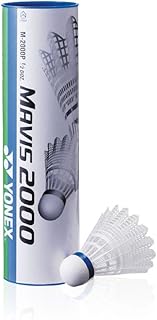
The YONEX Mavis 2000 Badminton Shuttlecocks ‘tube of 6’, 78-Medium-Blue is the premium nylon shuttle option from Yonex, widely regarded as the gold standard for synthetic shuttlecock performance. At 4.6 stars from 118 reviews, it outperforms nearly every other shuttle in the verified feedback category, and the Mavis 2000 has an international reputation across club and coaching circles that dates back many years.
The 78-Medium speed rating in the blue-cap variant is Yonex’s designation for medium-speed indoor play, which makes it suitable for the majority of UK indoor courts at typical room temperatures. Yonex offers the Mavis 2000 in multiple speed variants (slow, medium, fast), and selecting the right one for your court temperature is worth doing — Yonex provides a temperature-to-speed guide that’s easy to follow once you know your court’s average ambient temperature. Getting this right means the shuttle will consistently carry to the back tramlines on a clear shot without overshooting.
The nylon skirt construction of the Mavis 2000 is engineered to replicate feather shuttle flight characteristics more closely than most synthetic alternatives. The vane design produces a more natural, arcing trajectory rather than the flatter, faster flight of basic plastic shuttles. For players transitioning from feather play in competition to synthetic shuttles in training, the Mavis 2000 is the closest bridge available without the fragility and cost of feathers.
Durability is also excellent. The Mavis 2000 typically outlasts budget synthetic shuttles by a significant margin, with the nylon skirt resisting cracking and deformation even after extended hard play. Over the course of a season, a tube of six Mavis 2000s will typically represent better value than multiple tubes of cheaper alternatives, even if the individual per-tube cost feels higher upfront. For club players who take their game seriously and want reliable flight every session, this is the shuttle to have in the bag.
What to Look for When Buying Badminton Equipment
- Frame material: Aluminium frames are cheapest but flex unpredictably and add weight. Graphite and full-carbon frames are stiffer, lighter, and more responsive. For anyone playing regularly at a leisure centre or club, graphite is the minimum to look for. Full-carbon construction offers the best stiffness-to-weight ratio at the mid-range tier.
- Balance point: Head-heavy frames favour power and steep smashes — good for attacking singles players. Head-light frames suit fast doubles play, net reactions, and players who prioritise speed over raw power. Even-balanced frames are the versatile middle ground, covering both skill sets reasonably well. Match the balance to your playing style, not just your budget.
- Shaft flexibility: A flexible (hi-flex) shaft is forgiving for beginners and generates extra whip for slower swings. A medium-flex shaft is the sweet spot for club-level all-round play. A stiff shaft rewards precise technique and fast swing speeds, translating energy directly to the shuttle without lag. Moving to a stiffer shaft too soon is a common mistake — wait until your technique is consistent before upgrading.
- Pre-strung vs unstrung: Pre-strung rackets are ready to play immediately and are the right choice for beginners and casual players. Unstrung rackets (common in top-tier models) require professional stringing and give advanced players control over tension and string type, but add cost and lead time. For most UK buyers, pre-strung is the practical default.
- Shuttlecock speed rating: Shuttlecocks come in speed grades (typically indicated by a number or cap colour). The correct speed depends on your court’s air temperature and altitude. UK indoor courts typically fall in the medium-speed range. Using the wrong speed shuttle makes even perfect technique look flawed — clears that land short or overshoot are often a shuttle speed problem, not a technique problem.
- Bundle vs individual purchase: Two-player sets with bags and shuttlecocks offer strong value for casual and beginner play. But both rackets in a set are always the same spec, which doesn’t suit players at different levels. Once you’re playing regularly and have a sense of your preferred style, individual rackets matched to your game will serve you better than a bundle.
- Review volume vs rating: A 4.7-star rating from 30 reviews is less reliable than a 4.5-star rating from 600 reviews. Prioritise verified feedback volume when making decisions at an unfamiliar price point, especially for accessories like shuttlecocks where flight consistency varies significantly between brands.
Verdict
For most UK readers arriving at this guide — whether you’re returning to the sport after a break, setting up for regular leisure-centre sessions, or buying kit for two — the Senston S300 Graphite Full-Carbon Set is the most complete single purchase. It gives you two well-built full-carbon rackets, a structured carry case, overgrips, and a tube of shuttlecocks in one transaction. The 654-review, 4.6-star feedback profile is the strongest in the category, and the full-carbon construction will serve you well into serious club play rather than becoming redundant after a few months.
If you only need one racket, the WHiZZ Carbon Graphite Racket is the best individual frame pick at the accessible tier — the highest-rated solo product in this guide. And if shuttlecocks are your primary need, the YONEX Mavis 2000 is the shuttle to put in your bag and keep there.
We were not paid to feature any specific product in this guide. All opinions are independent and based on publicly available specifications, verified buyer feedback patterns, and category research.
Quick Comparison Table


FAQ
What is the best badminton racket for beginners in the UK?
For beginners, look for a lightweight graphite or carbon-blend frame with a flexible or medium-flex shaft, pre-strung and ready to play. The WHiZZ Carbon Graphite Racket and the Yonex Nanoray 10F Hi-Flex are both designed with beginners in mind — the flexible shaft helps generate shuttle speed before your technique is fully developed. Avoid stiff, head-heavy frames until your swing mechanics are consistent.
What shuttlecocks should I use for indoor club play?
For indoor club sessions, a durable synthetic shuttle at the correct speed rating for your court temperature is the practical choice. The YONEX Mavis 2000 (medium speed, blue cap) is the benchmark synthetic shuttle for UK indoor courts and delivers consistent, natural-feeling flight. The Carlton T800 is a more budget-friendly alternative that also performs well at club level. Match the speed rating to your court’s ambient temperature — most UK venues fall in the medium range.
Should I buy a two-player set or two individual rackets?
Two-player sets like the Nalax or Senston S300 offer strong value and convenience if both players are at a similar level, since both rackets in a bundle are identical spec. If you’re at noticeably different skill levels — or if one player has a strong preference for head-heavy attacking balance versus head-light speed play — individual rackets matched to each person’s style will serve you better in the long run.
What does head-heavy vs head-light mean on a badminton racket?
Head-heavy means the balance point sits closer to the top of the frame, adding momentum on smashes and powerful overhead shots — it suits attacking players who rely on steep drives and jump smashes. Head-light means the balance point sits closer to the handle, making the racket feel faster and easier to manoeuvre — better for net play, doubles defence, and players who prioritise reaction speed. Even-balanced sits in the middle and is a good default for beginners who haven’t yet identified a playing style preference.
How often should I replace my shuttlecocks?
Nylon or synthetic shuttlecocks last considerably longer than feather ones — a good quality synthetic shuttle like the YONEX Mavis 2000 can survive many sessions before the vane cracks or the flight becomes inconsistent. For feather shuttlecocks in competitive club play, replacement after each session or match is standard. For casual indoor play with synthetic shuttles, inspect the vane after each session and replace when you notice flight irregularity, cracking, or deformation at the skirt base.
Is full-carbon better than graphite for badminton rackets?
In product listings, “full-carbon” and “graphite” are often used interchangeably, but full-carbon construction typically refers to frames where the entire structure is made from carbon fibre, which produces a lighter, stiffer, and more responsive racket than aluminium-graphite blends. For regular players at club or improver level, full-carbon frames like the Senston S300 offer noticeably better feel and durability compared to budget blended frames. The practical difference is most obvious when you’re generating consistent swing speed and want the energy to transfer cleanly to the shuttle rather than being absorbed by a softer frame.