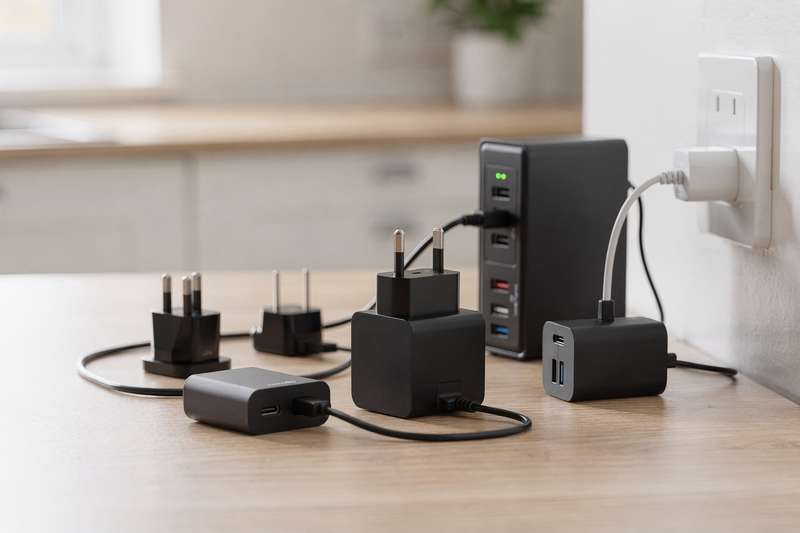
You’ve got a drawer full of tangled cables and a graveyard of chargers that almost — but not quite — fit your devices. Maybe you’ve just come back from a holiday abroad and realised your laptop brick won’t work without a bulky plug converter. Or perhaps you’ve spent twenty minutes rifling through Amazon listings trying to find a 12V DC supply for your LED strip, only to end up confused by conflicting specs and zero useful reviews. The world of AC adapters is a genuinely fragmented market: the same search query returns travel plugs, laptop chargers, Christmas light transformers, and industrial power supplies all jumbled together. That’s frustrating when you have a specific job to do and just need the right unit.
This guide cuts through the noise. Whether you need a compact travel plug adapter for a trip across multiple continents, a regulated 12V DC supply for your CCTV or LED driver, a low-voltage AC adaptor for seasonal decorative lighting, or a conversion cable to extend the usefulness of your grow-light controller, there’s a product here that genuinely fits your situation. Every pick below is sourced from live Amazon UK listings with real buyer reviews behind them — no phantom products, no inflated specs.
How We Chose These Picks
Evaluating AC adapters requires a different lens depending on what category of adapter you’re looking at — a travel plug adapter has entirely different success criteria to a 24V AC transformer for rope lights. For this guide, the evaluation framework covered five core dimensions: verified buyer review volume and rating patterns (looking for consistency rather than spikes), stated electrical specifications versus what buyers actually report in practice, build quality signals (connector fit, cable quality, UK plug compliance), compatibility range across devices or regions, and value for money relative to the alternatives in each subcategory.
Products were drawn from live Amazon UK search results and filtered for on-topic relevance, minimum review thresholds where possible, and genuine category fit. Where a product had very few reviews, that context is stated plainly. Zero-review products were excluded unless no reviewed alternative existed in that category. The goal throughout is to give you a shortlist you can act on immediately, not a theoretical ranking of specifications.
Best All-Round Travel Adapter for Frequent Flyers
The Anker Universal Travel Adapter 5-in-1 for UK/EU/US/AU, 20W USB-C + 4 USB Ports is the pick for anyone who travels across multiple regions and wants a single compact unit that handles plugs, USB-A charging, and USB-C Power Delivery in one. Anker’s build quality has a strong track record, and this 5-in-1 design covers UK, EU, US, and Australian socket types — which means one adapter genuinely replaces four separate converters in your bag.
The integrated 20W USB-C port is the headline feature here. Most budget travel adapters give you USB-A ports running at 5W or 12W, which is fine for a phone but useless for a modern iPad or compact laptop that expects USB-C PD. The 20W output on this unit is enough to fast-charge an iPhone at full speed, top up an iPad reasonably quickly, and keep smaller USB-C accessories ticking over. The four additional USB-A ports mean you can charge multiple devices simultaneously without a separate multi-port charger.
The tradeoff is that this adapter is primarily a plug converter with integrated USB charging — it isn’t a power bank, it doesn’t boost or regulate voltage, and it relies on the destination country’s mains supply being stable. The AC pass-through socket means you can plug a grounded laptop charger into it, but the adapter itself doesn’t add surge protection beyond what’s built into your device’s own charger. At the time of review, buyer feedback was still building (only 16 reviews), so it doesn’t yet have the large verified sample of some rival travel adapters — but Anker’s category reputation means this is a lower-risk early buy than an unknown brand with similar numbers.
This is best suited to travellers who visit a mix of regions across a year and want to simplify packing. It’s less ideal if you need a heavy-duty earthed connection for power-hungry equipment, or if you specifically need a Type-C outlet for a European kettle or shaver.
Best Budget Travel Plug Adapter for Occasional Trips
If you travel occasionally rather than constantly and don’t need USB-C PD, the Universal Travel Adapter Worldwide with 2 USB C and 2 USB A Ports hits a pragmatic midpoint between price and function. With 482 reviews and a 4.4/5 rating, it’s a well-validated option in the budget travel adapter space — more confidence-inspiring than a two-review listing from an unknown brand.
The spec sheet covers worldwide compatibility, which in practice means it handles the major regional socket types you’ll encounter in Europe, North America, Australia, and most of Asia. The four USB ports (two USB-C, two USB-A) give you flexibility for charging phones and tablets without hunting for a local plug adapter for each charger. The form factor is compact enough to fit into a jacket pocket or the side pouch of a carry-on without adding meaningful weight.
Where it lags behind the Anker above is in output wattage — the USB-C ports here are likely running at standard 5V rather than the higher wattage PD charging you’d need to fast-charge a modern laptop. If you’re travelling with a MacBook, Surface, or any USB-C laptop that expects 45W or more, you’ll want to carry your own laptop charger separately and use this adapter purely as a plug converter. For phones, small tablets, earbuds, and cameras, it’s genuinely sufficient and well-priced for the job.
Build quality at this price point is acceptable rather than exceptional — the socket grips are functional, the plug prongs retract cleanly, but the plastic housing doesn’t have the premium feel of Anker’s products. That’s a fair tradeoff for a product you might use a few times a year and stuff into a bag without much ceremony. Just avoid using it with high-wattage appliances like hair dryers or travel kettles that draw sustained current — those need a proper voltage converter, not a plug adapter.
Best 12V DC Power Supply for LED Strips, CCTV & Small Electronics
The 12V 2A DC Power Supply UK Plug AC Adapter with 8 DC Plug Tips is the practical choice when you need a regulated 12V DC output for a specific piece of equipment and your original adapter has died or gone missing. At 2A output (24W total), it handles the power requirements of most 12V LED drivers, CCTV cameras, routers, ADSL modems, and small desktop electronics without issue.
The inclusion of eight interchangeable DC plug tips is the feature that makes this genuinely useful rather than just adequate. Proprietary barrel connectors are one of the most frustrating compatibility problems in consumer electronics — you can have exactly the right voltage and current rating but the wrong physical tip, and the adapter is useless. Having eight tips covering the most common sizes (typically ranging from 2.5mm to 5.5mm in various inner/outer diameter combinations) means you have a reasonable chance of matching your device’s input socket straight out of the box. Buyers with 31 reviews and a 4.2/5 rating confirm that the tip range covers most common home and small-business scenarios.
The AC input range (100–240V) means the unit is technically usable abroad if you carry a separate plug converter, though it’s sold with a UK plug and that’s clearly its primary market. The regulation quality matters here — a poorly regulated supply can output voltage that spikes above 12V under light load, which can damage sensitive electronics. The buyer feedback on this unit doesn’t flag widespread damage reports, which is a reasonable indicator that the regulation is stable, but if you’re powering anything particularly sensitive or expensive, a dedicated regulated supply from a specialist electronics supplier will always be safer.
Where this adapter struggles is at the upper end of its rated current. Running it continuously at close to 2A output (powering a busy router and a CCTV camera simultaneously, for instance) may cause the unit to run warm. It’s fine for single-device use at moderate loads but isn’t a substitute for a purpose-built power supply with thermal management if you’re running equipment 24/7. For occasional or moderate-duty use, it’s a very capable budget replacement.
Best Low-Voltage AC Adaptor for Christmas Rope Lights and Decorations
Seasonal lighting transformers are a surprisingly specific product category, and the Christmas Concepts® 24v AC 250ma 6va AC Adaptor Without Lead is the most reviewed entry point in this niche, with 895 verified ratings at 4.4/5. It’s designed as a replacement or spare transformer for low-voltage Christmas and decorative lighting systems that run on 24V AC rather than the DC output that most other adapters produce — an important distinction that catches many buyers off-guard.
Most LED strips and decorative lights sold for home use run on DC (often 12V or 5V DC). However, certain older Christmas rope lights and some decorative garden lighting systems were designed around 24V AC transformers — and if your lights have a specific 24V AC input requirement, a DC adapter simply will not work correctly, and forcing it risks damaging the lights or creating a safety hazard. This adapter addresses that specific scenario directly. The 250mA / 6VA rating means it’s suited to lower-power decorative strings; it’s not designed for high-current loads.
The “without lead” aspect of the name means this unit ships without a mains cable attached — you connect it in-line within a lighting circuit rather than plugging it into a socket directly. That means it’s not a standard plug-in adapter and requires some basic electrical confidence to install correctly. If you’re replacing a dead transformer on a set of Christmas rope lights, you need to match the connector type and voltage output of the original unit to the new one, or the lights won’t function as expected. Read your existing lights’ documentation or check the label on the original adapter before purchasing.
The primary strength here is specificity — this does one thing (supply 24V AC at low current) and does it reliably, which is exactly what the buyer reviews confirm. It’s not versatile, it doesn’t charge phones, and it won’t help you power a router. But as a seasonal lighting replacement transformer sourced from a brand that clearly understands the Christmas lighting market, it earns its reputation in the 895 reviews behind it.
Best Higher-Current 24V AC Adaptor for Larger Lighting Installations
If your rope light setup is more extensive — covering a longer run of lights, a larger outdoor display, or multiple decorative zones — the Christmas Concepts® 24V 850MA AC Adaptor Without Lead steps up the current capacity significantly. At 850mA output (versus 250mA on the 6VA version above), this adaptor can power longer and more power-hungry rope light and decorative lighting installations without the risk of an undersized transformer struggling under load.
This is the same Christmas Concepts product family as the 6VA unit above, with the same “without lead” installation approach, the same 24V AC output, and the same general build philosophy — but rated for over three times the current draw. If you have a multi-strand decorative display or a longer run of rope lights, this is the unit to choose. The 197 reviews at 4.5/5 are a meaningful validation of reliability, even if the review count is lower than the entry-level model.
The key buying decision between this and the 6VA model is straightforward: check the wattage or mA rating of your lighting and match it to the transformer output. Buying a transformer rated too low for your load is a common mistake — the transformer overheats, and in the worst case becomes a safety risk. It’s better to have slightly more headroom (say, buying the 850mA unit for a load that only draws 500mA) than to run a smaller transformer at its absolute limit. This unit gives you that headroom for moderately large installations.
As with all adaptors in this family, it’s designed specifically for 24V AC loads. Don’t purchase it if your lights are rated for 12V DC or 5V DC — the mismatch will damage your lighting at best and create a hazard at worst. If you’re unsure, check the original transformer label or the product documentation for your lights before ordering.
Best for Higher-Wattage Christmas Rope Light Displays
Rounding out the seasonal lighting transformer category, the Christmas Concepts® 24v 450ma 10.8va AC Adaptor Without Lead sits between the 6VA and the 850mA unit in output terms — rated at 450mA and 10.8VA, it covers mid-sized decorative lighting installations that outgrow the entry-level 6VA transformer but don’t need the full 850mA headroom. With 695 reviews at 4.4/5, this is the most broadly validated unit in the Christmas Concepts adaptor range for mid-sized setups.
In practice, this adaptor is the sensible choice for a single continuous run of 24V AC rope lights at moderate length, or a small cluster of decorative lighting elements powered from one transformer. It’s not intended for multi-zone displays or extended outdoor installations where power draw is higher. Think of it as the middle of the product ladder: more capable than the 6VA entry model, more appropriately sized (and priced) than going straight to the 850mA unit if your needs are modest.
Installation follows the same pattern as the other units in this family — no mains lead included, in-line transformer design, requiring basic electrical competence to connect correctly. Always ensure any mains wiring connections are made safely and in accordance with UK electrical regulations; if you’re not comfortable with the installation, consult a qualified electrician. The transformer itself is not complex, but the in-line connection to a mains cable must be made safely.
The honest tradeoff with this unit is that the Christmas Concepts adaptor range covers a niche use case (24V AC decorative lighting) very well, but if you discover your lights run on a different voltage or current type, none of these three units will help you. Always confirm your lighting specification before choosing between the 6VA, 10.8VA, and 850mA options — the voltage is always 24V AC across the range, and the choice is purely about how much current your specific lighting draws.
Best for Grow Light Controller Compatibility and RJ11/12 Integration
The AC Infinity RJ11/12 to UIS Port Type-A Adapter Dongle is a different kind of “adapter” to everything else in this guide — it’s a signal and control conversion cable rather than a mains power adapter. It earns its place here because it solves a real connectivity problem for indoor growers who use AC Infinity grow lights with PWM or 0-10V dimming control but want to connect them using the RJ11 or RJ12 connector standard rather than the newer UIS port format.
With 654 reviews at 4.6/5, this is the most review-validated product in this guide, and the high rating reflects a product that does exactly what it promises without compatibility surprises. If you have AC Infinity grow lights with a UIS control port and want to integrate them with RJ11/RJ12-based controllers, timer modules, or automation systems, this dongle is the missing link. It’s a narrow use case — this won’t help you if you’re not in the grow light ecosystem — but for those who are, it’s a reliable and well-priced solution.
The inclusion of an extension cable is a practical detail that matters in real installations, where the controller and the light fixture aren’t always conveniently close to each other. The 0-10V and PWM dimming compatibility means you retain full light intensity control through the adapted connection, rather than just on/off switching. Buyers consistently note that the fit is secure, the signal integrity is maintained, and the build quality is solid for the price point.
Where this adapter falls short is in scope: it does one very specific job. If you’re looking for a general-purpose electrical adapter, a USB charger, or a travel plug solution, this is not that product. It’s included in this guide because it represents the adapter category accurately — sometimes the device you need is a signal or connector conversion adapter rather than a power transformer. If your grow light setup uses AC Infinity hardware and you’re struggling to connect a third-party controller, this is the product that resolves it without the need for custom wiring.
What to Look For When Buying an AC Adapter
- Voltage and current matching: The most important rule in adapter purchasing. Your device requires a specific voltage (e.g. 12V DC, 24V AC, 5V DC) and a maximum current draw (e.g. 2A, 850mA). The adapter’s output voltage must match exactly. The adapter’s current rating should be equal to or greater than your device’s requirement — an adapter rated too low will overheat; one rated too high is fine, as the device only draws what it needs.
- AC vs DC output: Many buyers confuse these. Most modern electronics (routers, phones, laptops) require DC (direct current). Some older or specialised devices (certain decorative lighting transformers, some audio equipment) require AC (alternating current). The adapter’s output type must match your device’s input. Check the original adapter label or your device’s power socket specification.
- Plug type and socket compatibility: For travel adapters, confirm which regions you’re visiting and which socket types are covered. For replacement adapters, confirm the barrel connector diameter (outer and inner dimensions), polarity (centre positive or negative), and connector locking mechanism if any.
- Safety certifications: UK-sold adapters should carry CE and UKCA markings as a minimum. Better units also carry energy efficiency labels. For mains-connected transformers (like the in-line decorative lighting adaptors), check that the unit meets relevant UK safety standards — this matters particularly for anything used in or near water, or left unattended.
- Regulated vs unregulated output: A regulated power supply maintains a stable output voltage across varying load conditions. An unregulated supply can drift, particularly under light load, outputting higher than rated voltage. Sensitive electronics (cameras, networking equipment, control boards) need a regulated supply. Simple resistive loads like basic LED strings are more tolerant.
- USB output wattage for charging adapters: USB-A ports typically deliver 5W to 18W depending on the charging standard. USB-C ports range from 5W up to 100W+ with Power Delivery. If you need to fast-charge a modern phone or power a laptop over USB-C, confirm the PD wattage on the spec sheet — not all “USB-C” ports support fast charging.
- Build quality and thermal management: Adapters that run hot are a warning sign. Well-designed units manage heat through efficient conversion electronics and adequate thermal mass. Read buyer reviews specifically for heat complaints — sustained high temperatures shorten adapter lifespan and, in poor designs, become a safety concern.
Verdict
The honest answer is that there’s no single “best AC adapter” — the right pick depends entirely on what you’re trying to power or connect. For most UK readers landing on this guide, the need usually falls into one of three buckets: travel, 12V DC replacement, or seasonal lighting.
For travel, the Anker Universal Travel Adapter 5-in-1 is the pick worth spending slightly more on — Anker’s build quality and the integrated 20W USB-C PD port make it genuinely future-proof for a year or two of travel, not just a stopgap. For occasional travel on a tighter budget, the Universal Travel Adapter Worldwide delivers reliable plug conversion with 482 reviews behind it at a lower entry cost.
For the modal reader who needs a 12V DC replacement for a router, CCTV camera, or LED driver, the 12V 2A DC Power Supply with 8 DC Plug Tips is the most practical starting point — the multi-tip kit solves the barrel connector lottery at a fair price. And for anyone replacing a dead transformer in a 24V AC decorative lighting system, the Christmas Concepts range (6VA for small setups, 10.8VA for mid-sized, 850mA for larger installations) is purpose-built, well-reviewed, and available in the exact spec your lights need.
We were not paid to feature any specific product in this guide. All opinions are independent and based on publicly available specifications, verified buyer feedback patterns, and category research.
Quick Comparison Table


FAQ
What is the difference between an AC adapter and a DC adapter?
An AC adapter converts mains electricity (alternating current) into a lower-voltage AC output — some decorative lighting transformers work this way. A DC adapter (more accurately called an AC-to-DC adapter or power supply) converts mains AC into a direct current output. Most modern electronics including phones, laptops, routers, and CCTV cameras run on DC. Always check your device’s power input specification to confirm which type you need.
Can I use a travel adapter to power high-wattage appliances like hair dryers?
No. A travel plug adapter converts the physical socket shape only — it doesn’t regulate voltage or boost current capacity. High-wattage appliances like hair dryers, travel kettles, and clothes steamers draw sustained high current and may also require voltage conversion (e.g. if you’re taking a 230V UK appliance to a 120V US supply). For these, you need a dedicated voltage converter or a dual-voltage appliance, not a plug adapter.
How do I know what voltage and current my replacement adapter needs to output?
Check the label on your original adapter — it will list output voltage (e.g. “12V DC”) and current (e.g. “2A” or “2000mA”). Your replacement must match the voltage exactly. The current rating on the replacement should be equal to or higher than the original — a higher-rated supply won’t damage your device, because the device only draws what it needs. Never use an adapter with a lower current rating than the original.
Why do some Christmas light adaptors say “without lead”?
“Without lead” means the adaptor doesn’t come with a mains power cable attached — it’s designed to be wired in-line within a lighting circuit rather than plugged directly into a wall socket. These are intended for users who are replacing a transformer within an existing wiring setup. If you need a plug-in transformer that connects directly to a mains socket, you need a different product configuration. When in doubt, check the product description carefully or consult an electrician.
Is a USB-C port on a travel adapter the same as USB-C Power Delivery?
No — having a USB-C socket doesn’t automatically mean the port supports Power Delivery fast charging. A basic USB-C port on a budget adapter may only deliver 5W (enough to slowly charge a phone), while a USB-C PD port can deliver 20W, 45W, 65W, or more. Always check the wattage spec on the USB-C port specifically, not just the total adapter output. If you need to fast-charge a modern iPhone, iPad, or laptop, confirm that the port is rated for PD charging at the wattage your device requires.
Can I use a 12V DC adapter rated at a higher current than my device needs?
Yes, this is safe and in fact common practice. A device draws only as much current as it needs — it won’t “pull” more than its design allows just because the adapter is rated higher. For example, if your router needs 1A at 12V, you can safely use a 2A adapter at 12V. What you must never do is use an adapter rated at a lower current than required, as this causes the adapter to overheat and may damage both the adapter and the connected device.