You’ve been putting off buying a smartwatch for months. Maybe you tried a cheap fitness band a few years back and it lasted three weeks before the strap cracked and the step counter started inventing numbers. Or perhaps you’ve been eyeing something more capable but every time you look, you’re confronted with a wall of near-identical rectangular screens, vague spec sheets, and review sections full of suspicious five-star ratings from accounts with zero purchase history. You just want something that reliably tells the time, nudges you about messages, tracks your walks or gym sessions, and doesn’t need charging every other night — ideally without spending a small fortune.
The good news is that the smartwatch market in 2026 has genuinely matured at the budget end. You no longer have to pay premium prices just to get accurate heart rate monitoring and usable call functionality. The tricky part is filtering the strong performers from the sea of near-identical white-label devices. That’s exactly what this guide does — so you can make a confident decision and actually enjoy wearing the thing.
How We Evaluated These Picks
Choosing smartwatches for this guide meant looking at the live Amazon UK catalogue and applying a set of practical criteria relevant to everyday UK buyers. The key factors were: display size and readability in daylight, health-monitoring accuracy (heart rate, SpO2, sleep tracking), call functionality (whether you can actually answer and make calls from the watch), battery life claims versus real-world patterns from buyer feedback, water resistance rating, sports mode breadth, and build quality signals like materials and strap design.
Where buyer reviews exist, patterns in that feedback — common complaints about sync issues, app reliability, or charging quirks — weighed heavily. Products with zero reviews were assessed on specifications and brand track record alone, and that uncertainty is flagged clearly in each relevant section. The goal throughout was to match each pick to a specific type of user, not to rank everything against one impossible ideal.
Best Established Brand Smartwatch: Amazfit Active 2 (44mm, NFC, GPS)
The Amazfit Active 2 Smart Watch for Men 44mm with NFC Payment, AI, GPS & Free Maps sits at the premium end of what this guide covers, and it genuinely earns that position. Amazfit has spent years refining its wearables — the Active 2 benefits from that experience in ways that unbranded rivals simply cannot match. You get onboard GPS with free maps and turn-by-turn direction support, which matters enormously if you run, cycle, or hike and want real route data rather than connected GPS that depends on your phone staying nearby.
The NFC payment functionality is a standout feature for a watch in this segment. Being able to tap your wrist to pay in shops — the way you would with a contactless card — is genuinely useful, and it’s something many budget watches promise but don’t deliver in the UK. Amazfit has worked to make this functional through compatible banks, though it’s worth verifying your bank is supported before buying. The AI integration, meanwhile, feeds into personalised training suggestions and health coaching within the Zepp app, which has a polished interface compared to most budget alternatives.
Battery life is rated at up to 10 days, which is credible for a watch running GPS regularly — though heavy GPS use will shorten that considerably. The 5 ATM water resistance means it can handle swimming, not just rain. With over 160 sports modes, nearly every activity you might track is covered, from padel to rowing. The 44mm case suits most wrists without feeling overwhelming.
The main tradeoff here is that this watch currently has no buyer reviews on Amazon UK, so you’re relying on Amazfit’s broader reputation (which is solid) and spec-sheet promises rather than verified real-world UK buyer experience. It is also the most expensive option in this guide, reflecting the GPS hardware and NFC capability. If those features matter to you and you’re comfortable buying a well-regarded brand without the reassurance of local reviews yet, it’s a strong choice. If you’d rather have the safety net of proven buyer feedback, one of the reviewed options below will suit you better.
Best Budget GPS Tracker: Amazfit Active 2 (44mm, Without NFC)
The Amazfit Active 2 Smart Watch 44mm with GPS Maps with Direction and 160+ Sport Modes is effectively the same hardware as the NFC version above, but stripped of contactless payment support — and that single omission drops it noticeably in price. For anyone who doesn’t use or want wrist payments, this is the smarter buy from the same family.
You still get onboard GPS with maps and directional guidance, the same 10-day battery claim, 5 ATM water resistance, sleep monitoring, and the full Zepp app ecosystem. The sports mode library is identical at 160-plus. In practice, the day-to-day experience will be indistinguishable from its NFC sibling for the vast majority of users. The only moment you’d notice the difference is standing at a contactless terminal wishing you’d bought the other one.
Like the NFC variant, this listing has no buyer reviews on Amazon UK at time of writing. That’s the persistent caveat with both Amazfit Active 2 versions — you’re trusting the brand rather than crowd-sourced feedback. Amazfit’s track record on GPS accuracy and app stability is generally well-regarded in the wearables community, but it’s fair to acknowledge the uncertainty. The rating of 4.2 stars exists at a product-family level rather than this specific UK listing.
Who is this for? Runners, cyclists, and walkers who want accurate route mapping without paying for NFC. It’s particularly well suited to people who already use a digital wallet on their phone and have no desire to replicate it on their wrist. If you’re buying your first proper GPS sports watch and want Amazfit quality at a mid-range price, this is worth serious consideration — just go in with open eyes about the current lack of UK buyer reviews.
Best Mid-Range Pick with Alexa: Smart Watch with Alexa Built-in and 1.8″ HD Display
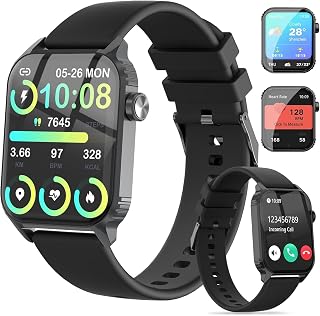
The Smart Watch for Men Women with Answer/Make Call, Alexa Built-in 1.8″ HD Fitness Watch targets a specific type of buyer: someone already embedded in the Amazon ecosystem who wants voice-assistant access on their wrist without committing to premium brand pricing. Having Alexa built in means you can set timers, check the weather, add items to a shopping list, and control compatible smart-home devices directly from the watch — something most watches in this price range simply don’t offer.
The 1.8-inch HD display is a genuine practical advantage. At that size, notifications are actually readable at a glance rather than requiring you to squint, and the watch face has enough room to display meaningful health data without everything feeling cramped. Heart rate monitoring runs continuously, SpO2 (blood oxygen) readings are available on demand, and sleep tracking covers the usual stages. Call support — both answering and making calls via Bluetooth — works with both iPhone and Android, which makes it one of the more versatile options for mixed households.
There are no Amazon UK buyer reviews for this listing, so the 4.3-star rating and the Alexa integration claims are taken on trust. Alexa integration quality can vary on third-party watches — sometimes it’s genuinely responsive, and sometimes it’s sluggish and disconnects frequently. Without a body of UK buyer feedback to draw on, that uncertainty is real. The watch is rated for compatibility with both iOS and Android, which is always worth double-checking for specific phone models before purchasing.
This is a reasonable pick for someone who wants a larger display, voice-assistant functionality, and solid health tracking at a mid-range price — as long as you’re buying without the safety net of established UK buyer reviews. If Alexa integration is a priority for you, this is the only option in this guide that offers it.
Best Everyday Value Pick: Smart Watch for Women Men with 120+ Sports Modes
The Smart Watch for Women Men with Answer/Make Call, Fitness Tracker for Android iPhone Compatible with Sleep Female Cycle and 120+ Sports Modes is the first option in this guide backed by a meaningful body of real UK buyer feedback — 68 reviews at 4.3 stars. That verification matters. It means the call functionality actually works as advertised, the app syncs reliably, and the build quality holds up beyond the first few days. That’s genuinely reassuring in a category full of products that look identical in photos but vary wildly in day-to-day reliability.
What distinguishes this watch for everyday users is its breadth of compatibility and thoughtful feature set for the price. Female cycle tracking is included alongside the standard health metrics, making it a better fit for women who want a single device that covers reproductive health alongside fitness and sleep. The 120-plus sports modes cover everything from yoga and swimming to cycling and football. IP68 water resistance means it’s genuinely submersible — you can leave it on in the shower or during a swim without worry.
Call functionality via Bluetooth works with both Android and iPhone, which keeps it accessible regardless of which phone you carry. Sleep tracking covers standard stages, and the companion app — while not as polished as Zepp or Samsung Health — is reportedly functional and not overly cluttered, based on buyer feedback patterns. Battery life claims sit in a range typical for this category, and real-world performance from buyers suggests decent longevity for the feature set.
The tradeoff is that this is an unbranded or lightly branded device, meaning long-term software support and app updates are less predictable than with Amazfit or a named brand. It also lacks GPS — connected GPS via your phone is the best you’ll get. But for someone who wants a reliable, affordable everyday smartwatch with call support, cycle tracking, and genuine buyer validation behind it, this is a well-rounded budget pick.
Best Budget Pick with Strong Buyer Ratings: Smart Watch with 1.85″ Display and 140+ Sports
The Smart Watch for Men Women Answer/Make Call with 1.85″ Smartwatch, Heart Rate Blood Pressure Sleep Monitor and 140+ Sports carries a perfect 5.0-star rating from 64 UK buyers — the highest rating of any reviewed product in this guide. That’s a small-but-not-negligible sample, and a 5.0 across 64 reviews is uncommon enough to take seriously. It suggests buyers are genuinely satisfied rather than simply not bothered enough to complain.
The 1.85-inch display is one of the larger screens in this guide, which translates to more comfortable notification reading and easier navigation through menus without constantly squinting. Blood pressure monitoring is listed alongside heart rate and SpO2 — though it’s worth understanding that blood pressure readings from optical wrist sensors are trend indicators rather than medical-grade measurements. Use them as a general wellness signal, not a replacement for a proper cuff-based monitor. Sleep monitoring and activity tracking round out the health feature set in the expected way for this category.
IP68 water resistance covers the full submersible standard, and call functionality is included for both Android and iOS. The 140-plus sports modes place it in the same practical territory as the competition — the meaningful question isn’t the number of modes but whether the core tracking (steps, heart rate during exercise, sleep stages) is accurate enough to be useful. Buyer feedback suggests this one performs consistently on those basics, which is ultimately what matters most.
The tradeoff is the same as with all unbranded budget watches: no GPS, no premium app ecosystem, and uncertain long-term support. But if you want a solidly reviewed, larger-screen smartwatch with call support at a genuinely entry-level price, this is the most buyer-validated affordable option in this guide. The 5.0 rating won’t hold forever as the review count grows, but the current signal is encouraging.
Best Ultra-Affordable Everyday Watch: Motast Smart Watch with 1.96″ HD Display
The Motast Smart Watch for Men Women with 1.96″ HD Fitness Watch, IP68 Waterproof Fitness Tracker with Heart Rate Sleep Monitor has the largest review count of any product in this guide — 106 UK buyers at 4.2 stars — and the largest display at 1.96 inches. That review count provides genuine confidence that the product behaves consistently across real users, not just one or two enthusiastic early adopters.
The 1.96-inch screen is noticeably larger than most smartwatch displays at this price point, and for users who struggle with small text or simply prefer a watch that feels substantial on the wrist, that’s a real advantage. Call support (both answering and making calls) works via Bluetooth, and IP68 waterproofing means it can handle submersion without a problem. Heart rate monitoring runs in the background, and sleep tracking covers the standard stages. The companion app is described as functional by buyers, without being particularly sophisticated.
Where the Motast sits apart from the competition is sheer accessibility. It’s the most affordable reviewed option in this guide, and with 106 reviews at 4.2 stars it has genuinely proven itself to a meaningful user base. That’s not common in the ultra-budget smartwatch segment, where many products disappear from sale shortly after launch. The Motast appears to have established some staying power.
The honest tradeoffs: no GPS, no NFC, no premium health algorithms. The app experience is functional rather than impressive. Long-term software support from a brand at this price point is always uncertain. But if your priority is a reliable, large-screen everyday watch that tracks your health basics, handles calls, and costs as little as possible while still having real buyer backing, the Motast delivers that promise. It’s the pick for someone who wants to try a smartwatch without a significant financial commitment.
Best Rugged Budget Smartwatch: Blackview Military Smart Watch with 100-Day Battery and Flashlight
The Blackview Military Smart Watch for Men with 1.45″ Fitness Tracker, 100-Day Battery, Flashlight, Compass, Heart Rate and SpO2 takes a very different approach to the rest of this guide’s picks. Where most budget smartwatches compete on display size and feature breadth, the Blackview prioritises durability and standby endurance above everything else.
The headline claim of a 100-day battery is extraordinary — and it’s worth being precise about what that means. In practice, that kind of longevity is achieved in a low-power standby mode, not during continuous active use with all sensors running. If you’re tracking workouts, checking notifications regularly, and using the compass and flashlight, real-world battery life will be substantially shorter. That said, even a fraction of that 100-day claim would make this an exceptional performer compared to the daily or every-other-day charging many smartwatches demand. For outdoor use, camping, or situations where charging is inconvenient, that matters enormously.
The military-style branding reflects a genuinely robust build. The 1.45-inch display is on the smaller side compared to other picks here, but the watch is designed for endurance rather than screen real estate. The built-in flashlight and compass are genuinely practical additions for outdoor use — not just marketing features. Heart rate and SpO2 monitoring are present alongside sleep tracking. Call functionality is listed for both answering and making calls via Bluetooth.
Blackview is an established brand with a history in rugged smartphones, which gives this watch somewhat more credibility than a fully generic listing. That said, the Amazon UK listing currently has no buyer reviews, so the claims around battery life and build durability remain unverified by local buyer experience. This is a pick for outdoors-oriented buyers who specifically need rugged design and exceptional battery longevity and are prepared to trust the brand’s track record while UK reviews build up.
What to Look For When Buying a Smartwatch
- Call functionality vs. notification mirroring: Many budget smartwatches display notifications from your phone but can’t actually handle calls from the watch itself. If two-way call support is important to you, check explicitly that the watch has a built-in speaker and microphone — not just notification alerts. The picks in this guide that include call support are flagged clearly.
- GPS type — onboard vs. connected: Onboard GPS (built into the watch) works independently of your phone, giving you accurate routes even when your phone isn’t nearby. Connected GPS uses your phone’s GPS signal via Bluetooth, which means you need to carry your phone on every run or ride. Onboard GPS adds significant cost; connected GPS is fine for most casual users but limiting for serious runners and cyclists.
- Water resistance rating: IP67 means the watch can handle brief submersion (up to about 1 metre for 30 minutes). IP68 means it’s rated for longer submersion at greater depth. 5 ATM (atmospheres) is the standard used by Amazfit and similar brands, and it’s generally considered suitable for swimming. None of these ratings are tested for high-velocity water (water sports, high-pressure showers), so don’t take any budget watch surfing.
- Health sensors — what’s real vs. what’s inflated: Heart rate and SpO2 monitoring are well-established in wrist wearables and generally accurate enough for wellness purposes. Blood pressure readings from optical wrist sensors are trend indicators, not clinical measurements. ECG (electrocardiogram) capability, which can detect irregular heart rhythms, is rare at budget price points and usually requires regulatory approval. Be sceptical of watches claiming medical-grade measurements.
- Battery life — claims vs. reality: Manufacturers always quote maximum battery life under optimal conditions (low brightness, minimal GPS, sensors off or polling infrequently). Assume real-world battery life is 30–50% shorter than the headline figure if you use GPS, always-on display, and continuous heart rate monitoring. A watch claiming 10 days will typically deliver 5–7 days in normal use — which is still far better than most premium flagship watches.
- App ecosystem and long-term support: A smartwatch is only as good as its companion app. Zepp (Amazfit) is one of the most mature apps in the non-Apple/Samsung segment — it stores historical data, offers meaningful health insights, and receives regular updates. Generic or unbranded watches often use white-label apps that receive minimal updates and may lose cloud functionality if the company pivots. Check whether the app is actively maintained before buying.
- Display size and always-on option: Display size directly affects readability — especially for notifications, which are almost useless on anything under 1.5 inches. Always-on display (where the watch face stays visible without a wrist raise) drains battery significantly but is useful in situations where wrist-raise detection is unreliable. Most budget watches don’t offer always-on display; check if it matters to you before ruling out a pick.
Verdict
For most UK buyers reading this guide, the Motast Smart Watch is where we’d start. It has the highest review count in this guide, a 4.2-star rating from over 100 verified buyers, a large 1.96-inch display, IP68 waterproofing, call support, and heart rate and sleep tracking — all the essentials, verified by a genuine user community. It’s the lowest-risk choice for a first smartwatch or for anyone who simply wants reliable basics without overcomplicating the decision.
If you’re a runner or cyclist who wants proper GPS route tracking, step up to the Amazfit Active 2 (non-NFC variant) — the onboard GPS and Zepp app ecosystem put it in a different league for sports use, and the brand’s track record justifies the higher price. Add NFC payment by choosing the NFC version if contactless payments from your wrist are useful to you. And if you’re heading outdoors and need maximum battery stamina in a rugged build, the Blackview Military watch is the outlier pick worth considering — just be patient while UK buyer reviews accumulate.
We were not paid to feature any specific product in this guide. All opinions are independent and based on publicly available specifications, verified buyer feedback patterns, and category research.
Quick Comparison Table



FAQ
Do budget smartwatches work with both iPhone and Android?
Most budget smartwatches are compatible with both Android and iOS via Bluetooth and a companion app. The level of integration varies — some features like notification mirroring and call support work well on both platforms, while others (like certain health sync functions) may work better on one than the other. Always check the product listing to confirm iPhone compatibility, as some cheaper watches only support Android fully.
Can I make and receive calls from a smartwatch without my phone nearby?
Most smartwatches in this guide use Bluetooth to relay calls through your phone — your phone still needs to be nearby (typically within about 10 metres) and connected via Bluetooth. Only smartwatches with their own SIM card or eSIM capability can operate calls independently of a paired phone, and those are generally more expensive devices not covered in this guide. All the call-capable picks here require your phone to remain within Bluetooth range.
Is GPS on a smartwatch worth the extra cost?
It depends on how you use it. If you run, cycle, or hike and want accurate pace, distance, and route data without carrying your phone, onboard GPS is worth the premium. If you primarily walk, go to the gym, or track daily activity, connected GPS (via your phone) is perfectly adequate and saves you money. For casual fitness tracking, the non-GPS picks in this guide will cover 95% of what most people actually need.
How accurate is blood pressure monitoring on smartwatches?
Optical wrist sensors used in most smartwatches cannot measure blood pressure the way a traditional cuff monitor does. They provide trend data based on pulse wave analysis — useful for spotting patterns over time, but not accurate enough for clinical decisions. If you have a health condition that requires reliable blood pressure readings, use a validated cuff monitor. Smartwatch readings are a wellness indicator, not a medical measurement.
What does IP67 or IP68 waterproofing mean for a smartwatch?
IP67 means the watch can withstand submersion in up to 1 metre of water for 30 minutes. IP68 offers a higher standard — typically deeper submersion for longer, though the exact specs vary by manufacturer. Both ratings mean the watch can handle rain, handwashing, and casual swimming. Neither rating covers high-pressure water jets, hot showers at high pressure, or saltwater immersion repeatedly over time, which can degrade seals. For swimming, IP68 or 5 ATM-rated watches are the safer choice.
How long do budget smartwatch batteries actually last in real use?
Manufacturer battery claims are measured under optimal conditions — low brightness, minimal GPS use, and sensors polling infrequently. In typical real-world use with call support active, continuous heart rate monitoring, and regular notification sync, expect roughly 50–70% of the advertised figure. A watch rated at 10 days will commonly deliver 5–7 days; a watch claiming 7 days might last 4–5. Watches with very long standby claims (like the Blackview’s 100-day figure) achieve that in a low-activity mode — active daily use will reduce it dramatically.