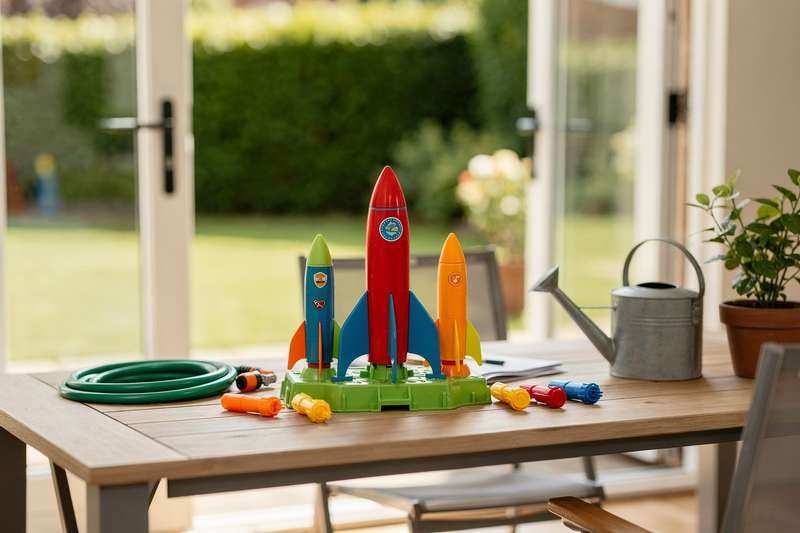
Picture this: it’s a dry Saturday afternoon, the garden is calling, and your child is restless. You’ve tried the frisbee, the football has gone over the fence again, and the bubble machine broke last summer. You want something that genuinely gets them outside and physically active — something that produces that wide-eyed, gasping reaction when it launches. Toy rockets promise exactly that. But the category is a mess. Search online and you’ll wade through products that snap on first use, foam tips that go missing within minutes, and launchers sized for toddlers that a seven-year-old will find boring after two launches. You want a toy rocket that actually flies high, stays intact, and keeps kids coming back to the garden rather than retreating to a screen. This guide cuts through the noise and tells you exactly which options are worth your money — and which ones you should walk past.
How We Evaluated These Picks
This guide focuses specifically on toy rocket launchers and foam rocket sets available to UK buyers on Amazon. To select picks, we assessed real buyer review patterns where available (noting the star rating and volume of feedback), examined product specifications carefully, considered age-suitability and safety for the target age ranges listed, and looked at design features like launch mechanism type, rocket count, and durability indicators. Where products had no published reviews, we evaluated them on category knowledge — comparing their specifications and stated design features against established norms for toy rockets. We discarded any products that didn’t genuinely belong to the toy-rocket or hobby-rocket category. The result is a shortlist of six distinct products, each suited to a slightly different scenario.
Best All-Round Outdoor Rocket: WOW! STUFF HYPR Rocket 500
If you want the one product that has demonstrated real-world performance through verified buyer feedback, the WOW! STUFF HYPR Rocket 500 is the strongest choice in this round-up. With 86 reviews averaging 4.4 out of 5 stars, it’s the only option in this category with enough buyer feedback to form a clear picture — and the picture is largely positive.
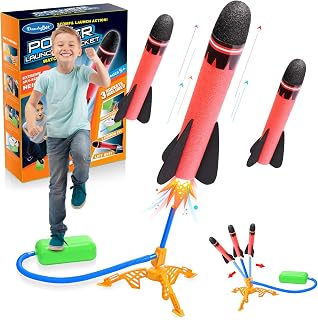
The HYPR Rocket 500 uses a stamp-to-launch mechanism: you press the rocket down onto a pad, which compresses air and fires it skyward — no batteries, no pumping, no complicated setup. The name refers to its claimed maximum altitude of around 500 feet, which puts it well above the typical garden fence and into territory where children will genuinely crane their necks to track it. The set includes three rockets, which matters because you’ll inevitably lose one in a hedge during the first session. Three gives you a working margin.
Reviewer feedback highlights that the launch height is genuinely impressive for a budget-tier product — several parents note their children had no idea a simple stamp mechanism could send something that far into the sky. The foam rockets are designed to be soft enough to be safe for garden use but robust enough to withstand repeated launches. A common positive note is that the launcher feels solidly constructed compared to cheaper alternatives, though a handful of reviewers mention that with very vigorous use, the launch pad can show wear over time.
The HYPR Rocket 500 works well for children aged around 5 and upward — younger children may lack the coordination and force needed to get the full launch height, but from about 6 years old, most kids can operate it independently. It’s an outdoor-only product by design: 500-foot flights indoors are obviously not viable, and the rockets need open space to be retrieved safely. If you have a reasonably sized garden or access to a park, this is the product you should default to. The main limitation is that you’re dependent on three rockets, and if you use it near trees or tall hedges, you will lose them. Spare rockets aren’t always easy to source.
On balance, the HYPR Rocket 500 earns its position as the top pick simply because it’s the only product in this set with a meaningful base of buyer evidence behind it. The 4.4-star average from 86 reviewers suggests consistent satisfaction rather than a lucky handful of positive experiences.
Best for Younger Kids: Stomp Rocket The Original Jr. Glow Rocket Launcher
The Stomp Rocket The Original Jr. Glow Rocket Launcher is one of the most recognisable names in the toy rocket category globally, and its Junior Glow version is specifically calibrated for younger children — the age range listed starts from 3 years old.
Stomp Rocket’s mechanism is exactly what the name suggests: a foot-stomp pad connected by a tube to the launch stand. Your child jumps on the pad, and the air pressure fires the foam rocket upward. This is an intuitive, physically satisfying action for young children who want immediate cause-and-effect feedback. Unlike the stamp mechanism of the HYPR Rocket 500 (which requires directed downward pressure), the stomp pad can be operated by a toddler jumping with both feet, making it genuinely accessible from the lower end of the age range.
The Junior Glow version includes four foam rockets and these glow in the dark — a feature that extends the play window into dusk, which is particularly useful in autumn and winter when daylight is short. The glow feature is a genuine differentiator for this age group: children who might normally be reluctant to head outside as the light fades will be drawn out by the novelty. The foam rockets are soft and rounded, specifically designed with safety in mind for the 3+ age group.
The tradeoff is that the Junior version doesn’t launch as high as products designed for older children. The stomp mechanism is sized and tuned for smaller children, which means older or heavier children can generate more force than the system is optimised for, and the launch height won’t be as dramatic as something like the HYPR Rocket 500. Think of this as a 30–50 foot launcher rather than a 500-foot one — appropriate and exciting for a four-year-old, underwhelming for an eight-year-old.
It’s also worth noting that this product carries 0 published reviews on the UK Amazon listing at the time of writing, so direct buyer evidence is absent. The product’s strong reputation in the toy rocket category is well-established in the broader market, and the 4.6-star displayed rating suggests positive reception, but do bear that context in mind when deciding. If you have a child under 6 and want something that prioritises safety and accessibility over maximum altitude, this remains a strong contender.
Best Budget Launcher: DejaNard Rocket Toy Launcher for Kids
The DejaNard Rocket Toy Launcher for Kids sits at the budget end of this category and positions itself as a solid garden starter kit for children aged 3 to 12.
DejaNard’s rocket launcher follows the foot-pump or air-pressure launch style typical in this price segment. The stated age range of 3 to 12 is broad, and in practice, the sweet spot is probably 4 to 8 years old — young enough to find the launch mechanism exciting, old enough to operate it with confidence. The product includes rockets and a launcher stand, giving you everything needed out of the box.
At its price tier, the DejaNard set is positioned for buyers who want to test whether their child will actually stay interested in a toy rocket before committing more spend. That’s a reasonable use case: children’s enthusiasm for any given outdoor toy is notoriously variable, and a budget entry point lets you gauge interest without significant financial risk. If your child turns out to be genuinely passionate about rocket play, you can then invest in a higher-specification product like the HYPR Rocket 500.
The limitation here is that budget construction often means lighter materials and less precise tolerances in the launch mechanism. Products at this price point can show wear more quickly with daily use, and the rockets may deform after heavy impacts with hard surfaces. DejaNard carries a 4.5-star displayed rating but has 0 published reviews on the UK listing, so the evidence base is thin. Treat this as a reasonable budget gamble rather than a proven performer. It’s suited to occasional garden sessions rather than intensive daily play.
For buyers who want to gift something rocket-related without spending a lot, or who are genuinely unsure whether their child will latch onto this type of toy, the DejaNard launcher is a sensible, low-risk starting point. Just calibrate your durability expectations accordingly.
Best for Boys Who Love Space Themes: Boy Toys for 4 5 6 Year Old Toy Rockets
The Boy Toys for 4 5 6 Year Old, Toy Rockets Boys Age 3-9 set is designed for the younger end of the toy rocket market, with a specific focus on children who are drawn to space exploration themes and imaginative play rather than pure altitude performance.
This product’s listing positions it firmly as a gift item — the packaging and presentation are geared toward birthday and Christmas gifting, which makes it a good option if you’re looking for something to wrap rather than just drop in the garden. The rocket design aesthetic is space-themed, which for the 4–6 age group is often as important as the actual play mechanics. A child who is into astronauts, planets, and the idea of space will engage with this more readily than with a generic foam tube.
The age range of 3–9 is wide, but this is better treated as a 3–6 product in terms of the engagement level it’s designed to produce. Older children in the upper range of that bracket will likely want more performance than a toy primarily designed around theme and giftability can offer. The product also notes autism-friendly play features, which is a useful signal for parents who prioritise sensory-safe materials and predictable play patterns.
Like several products in this round-up, the UK Amazon listing carries a 4.5-star displayed rating but 0 published reviews, so buyer evidence is absent. The product’s appeal rests on its thematic design and gift-friendly packaging rather than demonstrated performance data. If your primary goal is finding a visually appealing, space-themed gift for a young child who loves astronaut stories, this serves that purpose well. If you want a product your child will use repeatedly and intensively outdoors, the WOW! STUFF HYPR Rocket 500 remains the better choice for performance.
One practical note: check the exact play mechanics before buying, as some products in this segment are primarily display toys or simple throwing rockets rather than pressure-launched systems. Read the product description carefully to confirm what the launch mechanism actually involves.
Best for Mixed-Age Groups: Anginne Toys for 3-12 Years Old Boys
The Anginne Toys for 3-12 Years Old Boys, Outdoor Garden Toys launcher is designed as a versatile garden toy that can span a wider age range — from toddlers playing alongside older siblings to primary-school-aged children using it independently.
Anginne’s design philosophy here is inclusivity: the launcher and rocket set should work well enough to satisfy a 9-year-old without being too complex or forceful for a 3-year-old to participate in. In practice, that means the mechanism is accessible and the rockets are soft-tipped, prioritising broad usability over maximum altitude. It’s the kind of toy that works at a family gathering or a mixed-age birthday party, where children of different ages are playing together and you need something nobody gets left out of.
The product covers both boys and girls in terms of its practical appeal despite the listing’s boy-focused title, and the outdoor garden framing is appropriate — this is a product for open spaces, not living rooms. The birthday present positioning in the listing title suggests gift-friendly packaging, which is useful context if you’re shopping for a present rather than a personal purchase.
The substantive limitation is the same as several others in this round-up: 0 published reviews on the UK listing at time of evaluation, with a displayed 4.5-star rating that lacks a verified buyer base to support it. You’re making a decision based on product specification and category knowledge rather than crowd-sourced experience. That’s not necessarily a reason to avoid it — new or low-volume products can be perfectly good — but it does mean your tolerance for risk needs to be higher.
This is a good pick for a household that wants a single rocket launcher to serve multiple children of different ages simultaneously, or for a parent who needs a garden-party toy that can be handed around a group. It won’t give you the verified altitude performance of the HYPR Rocket 500, but the breadth of its appeal is a genuine strength.
Best for Girls and Unicorn-Themed Gifting: Anginne Rocket Kits for Kids Unicorn Gifts for Girls
The Anginne Rocket Kits for Kids Unicorn Gifts for Girls takes the same core outdoor rocket play concept and wraps it in a unicorn-themed aesthetic aimed squarely at girls aged 3 to 7.
This is a deliberately themed gift product. The unicorn design isn’t incidental — it’s the whole point for the target audience. A child who has strong preferences for specific colour palettes and fantasy themes (unicorns, rainbows, sparkle) will find a generic foam rocket launcher far less exciting than one that looks like it belongs in their existing world of interests. Toy manufacturers understand that the visual language of a product matters enormously at this age, and this product leans into that deliberately.
From a functional standpoint, the rocket kit operates on the same air-pressure or pump principle as similar products in this segment. The rockets are foam, the launcher is sized for small hands and younger children, and the play experience is the familiar launch-retrieve-relaunch cycle. The unicorn theming doesn’t compromise the actual mechanics — you still get the satisfying outdoor launch experience.
As with the other Anginne product in this guide (the boys’ version), these are from the same brand but are distinct enough in their theming and target audience to warrant separate consideration — you’d buy one or the other based on who you’re buying for, not both. The girls’ version sits at a slightly higher price tier than the boys’ version, reflecting the additional theming investment. Neither product has published UK reviews at the time of evaluation, so both carry the same caveat around buyer evidence.
For the specific gifting scenario — a birthday or Christmas present for a 4- to 6-year-old girl who loves unicorns and needs a reason to spend time outside — this product genuinely addresses that need. It’s a more thoughtful gift than a generic rocket set for this audience, and the outdoor play angle is a genuine bonus if screen time is a concern at your household.
What to Look For When Buying a Toy Rocket
- Launch mechanism type: The three main types are stomp pad (foot jumps on a connected air bladder), stamp launcher (press down on a pad), and manual pump. Stomp pads are the most accessible for toddlers and young children. Stamp mechanisms like the HYPR Rocket 500 tend to produce more consistent and impressive altitude. Manual pumps can require more adult involvement to prime. Match the mechanism to your child’s age and independence level.
- Maximum flight altitude: This is often stated on packaging but should be treated as a best-case figure under ideal conditions. A 500-foot claim like the HYPR Rocket 500 requires a strong, directed launch in calm conditions. In a real garden with wind and a child operating it, expect somewhat less — but still impressively high. For younger children, altitude is less important than launch accessibility.
- Rocket count: More rockets mean more resilience against loss. Foam rockets disappear into hedges, trees, and neighbouring gardens with remarkable speed. A set with 3–4 rockets gives you a working buffer. Check whether replacement rockets are available to purchase separately — some brands support this, others don’t.
- Age appropriateness and safety: Look for UK or EU safety markings where visible, and pay attention to the stated lower age limit. Products for under-3s must meet stricter safety standards around small parts. Foam-tipped rockets are safer than hard-nosed ones for garden play around younger children.
- Durability of the launcher: The rocket itself is disposable to some extent, but the launcher is the part you want to last. Look for descriptions mentioning sturdy construction, non-slip base, or reinforced launch pad. Budget products at the lower end of the price range can show wear quickly with intensive use.
- Space requirements: Most toy rocket launchers need open outdoor space. If your garden is small or surrounded by tall trees, you may find a significant proportion of your rockets end up lost. A park or sports field is ideal for products with very high launch altitudes. Be honest with yourself about your available space before buying a 500-foot launcher.
- Gifting presentation: If you’re buying as a gift, check whether the product comes in gift-ready packaging. Several products in this category are specifically positioned as birthday or Christmas presents and include presentable box packaging. Others are more utilitarian — fine for personal purchase, less impressive when unwrapped.
Verdict
For most families shopping in this category, the WOW! STUFF HYPR Rocket 500 is the clear recommendation. It’s the only product in this round-up with a meaningful base of verified buyer feedback (86 reviews at 4.4 stars), and the performance claims are backed by real-world user experience rather than just marketing copy. The stamp mechanism is accessible from around age 5 or 6 upward, the three-rocket set gives you a reasonable buffer against losses, and the claimed 500-foot altitude delivers genuine spectacle in a garden or park setting.
If you’re buying for a younger child (under 5), consider the Stomp Rocket Jr. Glow instead — the stomp mechanism is more physically intuitive for toddlers, and the glow-in-the-dark rockets extend playtime into dusk. And if you need a unicorn-themed gift for a young girl, the Anginne unicorn rocket kit solves that specific problem neatly. But for the broadest range of families who want a reliable, high-performing outdoor toy rocket, the HYPR Rocket 500 is where your money should go.
We were not paid to feature any specific product in this guide. All opinions are independent and based on publicly available specifications, verified buyer feedback patterns, and category research.
Quick Comparison Table


FAQ
What age is a toy rocket launcher suitable for?
Most toy rocket launchers state a minimum age of 3 years, but the realistic sweet spot for independent use is around 4 to 6 years old. Stomp-pad launchers are more accessible for younger children because they respond to a simple jumping action. Stamp and pump launchers may require more coordination and tend to suit children aged 5 and above. Always check the stated age range on the specific product you’re buying, and be aware that products with small parts may have higher minimum age requirements.
How high do toy rockets actually fly?
Altitude claims vary enormously — from around 30 feet for junior stomp launchers aimed at toddlers, up to 500 feet for higher-performance stamp-launch products like the HYPR Rocket 500. In practice, real-world launch height depends on how firmly and accurately the child operates the mechanism, wind conditions, and the condition of the launcher over time. The headline altitude figure is usually a best-case result; expect somewhat less in a typical garden setting.
Are toy rockets safe for garden use?
Foam-tipped toy rockets are generally safe for garden use — they’re designed to be lightweight and soft enough to avoid injury on landing. That said, you should always supervise younger children and ensure adequate open space so rockets don’t land on or near other people. Hard-surface areas like patios can deform foam rockets faster. Keep the rocket pointed skyward during launch and ensure bystanders aren’t standing directly over the launch pad.
What happens when you lose a foam rocket?
Foam rockets inevitably end up in hedges, on roofs, and over fences — it’s an occupational hazard of the toy. Buying a set with multiple rockets (3–4 is typical) gives you a buffer, but you will eventually run out. Some brands sell replacement rockets separately, which is well worth checking before you buy. Products like the Stomp Rocket range have a strong track record for spare-parts availability; newer or less established brands may offer no replacement option at all.
Can toy rockets be used indoors?
High-performance toy rockets — particularly those claiming altitudes of hundreds of feet — should only be used outdoors in open spaces. Even lower-power junior launchers are generally better suited to gardens or parks due to the unpredictability of launch direction and the need for retrieval space. Small, hand-launched foam rockets can work in a large indoor space, but most launcher-type products will cause breakage or injury risk indoors.
Is a stomp rocket or a stamp rocket better?
It depends primarily on the child’s age. Stomp rockets — where you jump on a connected pad — are more intuitive for toddlers and younger children because the action is a natural jumping motion. Stamp rockets, where you press down on a launch pad, tend to generate more consistent force and can achieve higher altitudes, making them better suited to older children from around age 5 or 6. If you’re buying for a mixed-age group, a stomp-style launcher is usually the safer choice for keeping younger children involved.