Picture this: you’ve been working through bodyweight exercises in your spare room for a few months — press-ups, bodyweight squats, lunges repeated until they feel more routine than challenging. Progress came quickly at first, which makes the current plateau all the more frustrating. You know you need more resistance to keep developing, but a full gym membership feels like an expensive answer to a logistics problem: the commute, the packed free-weights section, the session times that clash with your schedule. A proper barbell and squat rack would be ideal, but your training space is a corner of the living room that needs to look presentable the other 23 hours of the day.
So you’ve been browsing Amazon late in the evening, scrolling past kettlebells, resistance band kits, pedal trainers, and flat-pack contraptions that all claim to replace an entire gym. The variety is baffling, and nothing comes with a straightforward answer to the question you’re actually asking: what will genuinely make me stronger?
This guide answers that directly. It’s written for UK home trainers who want to build real, functional strength without converting their living space into a commercial gym. These picks cover resistance bands in several formats and a rubber-coated kettlebell set — each reviewed honestly, with limitations clearly stated, so you can match the right tool to your specific training goals.
How These Picks Were Evaluated
Each product was assessed against a consistent set of criteria: the range of resistance levels available for progressive overload, versatility across major muscle groups, construction quality markers such as material type and handle ergonomics, ease of use in a typical UK home with limited floor space, accessories included (door anchors, ankle straps, handles), and buyer feedback patterns from verified purchasers on Amazon UK. Products were drawn from the Amazon UK catalogue and shortlisted for genuine training value rather than novelty. Where review counts are low, that is flagged in the relevant section — a 5-star average from four buyers carries different evidential weight than the same score from 800. Products with zero verified reviews were excluded wherever five or more reviewed alternatives existed in the same category. Specific prices are not quoted here because they change frequently; the current price is best checked directly on Amazon.
Best Kettlebell Set for Home Workouts
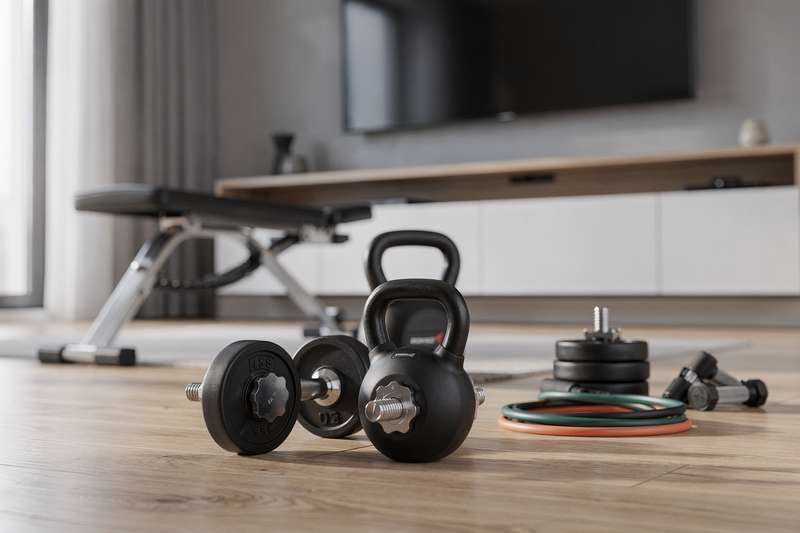
The Rubber Kettlebell Set is the only traditional weighted implement in this guide, and that distinction matters considerably. Resistance bands are versatile tools, but there are movement patterns that a fixed-weight kettlebell handles with a quality and feel that bands simply cannot replicate: the hip hinge of a kettlebell swing, the loaded carry, the Turkish get-up, and the goblet squat all rely on a fixed, ballistic load that moves through space in a way that an elastic resistance source doesn’t. If you want to build explosive power, hip strength, and genuine carry-over to functional movement, a kettlebell set belongs in your home gym.
Being sold as a set rather than a single weight is a practical advantage from day one. Lower-body exercises like swings and goblet squats typically handle considerably more weight than shoulder presses or arm work, so having multiple weights available lets you load appropriately for each movement pattern rather than compromising. The rubber coating on this set serves two real purposes: it protects your floor if a bell is set down with some force, and it reduces the impact noise that bare cast iron creates — both genuine considerations in a home setting with thin floors or close neighbours.
The ergonomic non-slip handle is worth specific attention. One of the most common frustrations with budget kettlebells is a handle that becomes slippery with sweat mid-set. When you’re swinging a weight through a ballistic arc, grip confidence is as much a safety concern as a performance one. A handle that maintains traction through the full range of a swing makes a material difference to how the session actually feels and whether you complete your sets with control.
Transparency about the review base is warranted here: at the time of writing, this product holds a 5.0-star rating but from only 4 verified purchasers. That’s a promising early signal, not a long-established track record. The rubber construction and ergonomic handle are legitimate quality markers — these are industry-standard features associated with durability and floor protection — but if you want the security of a large buyer pool, this product asks more patience than the others in this guide. Treat it as a considered early-adopter purchase with positive initial indicators rather than a market-proven favourite.
The right buyer for this set is someone who wants to move beyond band-only training and add weighted, ballistic movement to their routine. A kettlebell set’s footprint is small — a collection of bells occupies a corner of a room — and the exercise variety it unlocks is substantial. For beginners and early-intermediate trainers building a home gym incrementally, this is the kind of purchase that compounds in value over time as technique develops and loads increase.
Best for Physiotherapy and Flexibility Training
The Meglio Resistance Band Roll takes a different form from the tube bands and loop kits elsewhere in this guide, and that difference defines its best use case. Rather than pre-cut loops or lengths with handles, you receive a continuous roll of flat, wide resistance band material. It’s latex-free, and you can cut it to the length you need or use it directly from the roll depending on the exercise.
With 891 reviews at 4.2 stars, this is the most thoroughly tested product in this guide. Reading through the buyer feedback, a clear pattern emerges: physiotherapy patients using it for rehabilitation exercises on advice from their physios, Pilates practitioners incorporating it into controlled resistance movements, and general fitness users adding it to warm-up and cool-down routines alongside heavier training. The latex-free construction is a real differentiator — latex allergies and sensitivities are more widespread than many people realise, and a latex-free band removes that concern entirely while still delivering useful training resistance.
In terms of how the Meglio roll fits into a strength training programme, flat bands suit a specific category of exercises particularly well: banded glute bridges and squats (looping the band around the thighs to add lateral resistance), shoulder activation drills, assisted stretching, and physiotherapy-specific movements like clamshells, side-steps, and rotator cuff exercises. They’re also effective for structured warm-up protocols before heavier lifting — activating the glutes before deadlifts, or preparing the shoulder stabilisers before pressing sessions.
The honest tradeoff is specificity of application. If your primary goal is building significant upper or lower-body strength through progressive overload, a flat band roll functions as a supporting tool rather than a lead one. It doesn’t offer the handle-guided range of motion that tube bands provide, and the resistance profile differs from a tube band’s consistent tension. Think of this as the mobility and physiotherapy end of the resistance training spectrum — valuable, well-reviewed, and practically useful, but not a heavy-lifting solution.
For anyone returning to training after a lower-limb injury, working through shoulder or hip rehabilitation, or looking to build a structured warm-up routine around their main lifting sessions, the Meglio roll is a sound choice that earns consistent use rather than occasional use before gathering dust. Its latex-free composition makes it the clear pick for anyone who has experienced skin irritation from standard rubber bands in the past.
Best Loop Bands for Pull-Ups and Strength Assistance
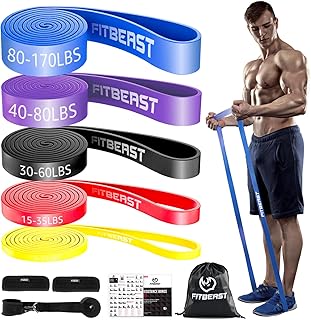
The FitBeast Resistance Bands Set is built for a training application that flat bands and tube sets handle less effectively: assisted pull-ups, barbell accommodating resistance, and banded variations of compound movements. At 795 reviews and 4.4 stars, it has the deepest buyer evidence base of any product in this guide, and buyer feedback consistently highlights durability under regular use and well-differentiated resistance levels across the five sizes.
Loop bands differ structurally from tube bands or flat band rolls. Each band is a complete closed loop — you loop it over a pull-up bar, anchor it under your feet, or wrap it around a barbell. This format is precisely what makes assisted pull-ups possible: the band creates elastic assistance at the bottom of the movement where you’re weakest, reducing the load you have to move through the hardest portion of each rep. As you build strength, you progress to a lighter band (less assistance) and eventually to unassisted reps. Five resistance levels give you a logical series of steps to follow across that progression.
Beyond pull-up assistance, loop bands suit band-resisted squats and deadlifts, face pulls with appropriate anchoring, glute work including banded hip thrusts and lateral walks, and a range of upper-body activation exercises. The door anchor included in the set extends the exercise options into cable-machine-style pulling movements from a home door frame, adding rows and lat-focused exercises to the loop band’s natural repertoire.
Where loop bands fall short is in exercises where a handle creates a more natural movement pattern — bicep curls with a stable grip, tricep pushdowns, or seated rows where handle placement matters. Loop bands wrapped around the wrists or hands for curl variations can work in a pinch, but the feel is different from a proper handle, and the band can dig in uncomfortably during high-rep sets. This is a product with a clear strength zone, not a universal solution, and knowing that going in helps you get the most from it.
Build quality for rubber loop bands can vary at this price point, so a regular inspection habit is worthwhile: before each session, scan the bands for cracking, thinning, or surface degradation. The buyer feedback for this FitBeast set suggests consistent quality control — seams are generally clean and thickness is uniform — but a rubber band under significant stretch load that fails mid-set delivers a sharp reminder to check your kit. For most home trainers, that basic care should keep this set in service through months of regular use.
Best for Core and Seated Strength Work
The WOQQW Multifunction Pedal Resistance Band is the most distinctive product in this guide and, for a specific user profile, one of the most practically useful. Rated 4.8 stars from 65 reviewers, this foot-pedal system works by placing a platform on the floor, stepping on it to anchor the resistance, and pulling the handles upward and outward against the tube tension. The result is a self-contained pulling system that requires no door anchor, no wall mount, and no external structure whatsoever.
That anchoring mechanism is the key differentiator. Most resistance band setups require you to fix one end to a door frame or anchor point. If you’re in a rented flat with thin internal doors, cautious about what you attach to door frames, or want to train somewhere a door anchor isn’t available — a bedroom without a suitable door, an outdoor space, a hotel room — the pedal mechanism solves that problem entirely by using your own bodyweight as the anchor. The training remains self-contained wherever you set it up.
The three-tube construction allows resistance variability: engaging one, two, or three tubes simultaneously changes the load you’re pulling against. This suits the varied demands of different exercises — lighter resistance for shoulder raises and lateral deltoid work where the target muscles are smaller, heavier for rowing and back movements that recruit larger muscle groups. Core exercises from a seated or floor position translate particularly naturally to this format: seated rotations, resistance-added sit-ups, and cable-style pulls all work without any attachment point beyond the floor beneath you.
The honest context on limitations: this is not a tool for heavy compound training or for pushing progressive overload into high resistance ranges. The load ceiling is lower than a dedicated heavy tube-band set or, obviously, a kettlebell. Where it performs best is as a targeted option for people who sit for long periods and want effective resistance work from a chair or the floor, those managing mobility-limiting conditions who need to train without extended standing, and regular travellers who want a portable, self-anchored system that fits into a bag.
The 4.8-star average is the highest of any reviewed product in this guide, and 65 reviewers represent a sufficient pool to identify consistent themes. Buyer feedback points to solid build quality, effective resistance for the exercises the product is designed for, and the convenience of its door-anchor-free setup. If those characteristics match your training scenario, this product addresses a gap that most other equipment in this category doesn’t cover.
Best Stackable Resistance Kit for Progressive Loading
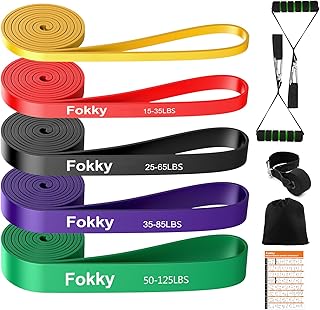
The Exercise Bands with Handles, Stackable up to 150lbs takes the tube-band concept as far as it can go at this end of the market: rather than committing to a single fixed resistance, you stack multiple bands onto the same handles to increase the combined load. This directly addresses the progressive overload requirement — adding resistance incrementally as exercises become easier — without needing to buy a completely new product at each stage of your training.
The kit includes five resistance bands at different levels, two handles, a door anchor, and ankle straps. That combination of accessories transforms a band set into a reasonably comprehensive home cable-machine substitute. Positioning the door anchor at different heights on a door frame allows you to set up pulling exercises from floor level (lower-body cable exercises), waist height (rows), and overhead (partial lat pulldown variations). The ankle straps extend the exercise range into leg work — kickbacks, straight-leg raises with resistance, and similar lower-body isolation exercises that standard handles alone don’t address.
The handle design is worth discussing specifically. Handles give tube bands a movement quality that loop bands and flat rolls cannot replicate as closely. You hold a firm, consistent grip through the full range of motion, which makes exercises feel closer to cable machine training. Bicep curls, tricep pushdowns, face pulls, lateral raises, and seated rows all translate well to this format. For building accessory muscle mass and targeting specific movement patterns with reliable, repeatable resistance, handles are the right tool.
With 20 reviews at 4.4 stars, the evidence base here is smaller than for the FitBeast or Meglio products, so temper your confidence in the rating accordingly. The pattern of feedback is positive, but individual quality consistency is harder to verify from a thinner buyer pool. If you’re particularly cautious about purchases with limited reviews, the FitBeast set offers a much more robust evidence base for comparison. That said, the stackable band concept is well-established across this product category, and the included accessories are comprehensive — the design is sound in principle.
A practical note on stacking: layering multiple bands onto a single handle means the combined resistance isn’t always perfectly linear in feel, and individual bands can wear at different rates if you always use the same combination. Rotating which bands you stack together and inspecting each one individually before sessions extends the kit’s service life and reduces the risk of one overworked band failing under load. For anyone wanting a single kit that covers pressing, pulling, rowing, and leg exercises while supporting incremental loading over months of training, this is the most complete all-round option in this guide.
What to Look For When Buying Strength Training Equipment
- Resistance range for progressive overload: The central driver of strength development is incrementally increasing the challenge over time. Look for products that offer multiple resistance levels — either a band set with clearly differentiated tensions or a kettlebell set spanning several weights. A product that maxes out at your current strength level after a few weeks isn’t a long-term training tool.
- Material quality and durability signals: Resistance bands are typically made from natural latex or synthetic alternatives. Latex generally offers reliable stretch and return characteristics; latex-free suits those with allergies or skin sensitivities. Look for consistent thickness throughout the band, clean seaming at joins, and handles that feel solid rather than hollow or brittle. For kettlebells, rubber or vinyl coatings protect floors and reduce impact noise — both practical considerations in a home environment.
- Format and exercise fit: Different resistance band formats serve different purposes. Loop bands suit pull-up assistance and banded compound lifts. Flat roll bands work best for mobility work and physiotherapy exercises. Tube bands with handles replicate cable machine movements more closely. Pedal-anchored systems provide self-contained pulling work without a door frame. Match the format to your primary exercises rather than defaulting to whichever format happens to be most popular.
- Included accessories: A door anchor, ankle straps, and handles significantly expand a band set’s exercise range. Before comparing two similarly priced kits, check what each actually includes — a bare set of loop bands and the same loops with a full accessories kit are not equivalent products at the same price point, even if they look similar at a glance.
- Latex vs latex-free: If you have a latex allergy or find that rubber bands cause skin irritation after prolonged contact, apply this filter before anything else. Latex-free options perform well for the majority of training applications — flag the sensitivity early in your research rather than discovering it after purchase and mid-programme.
- Space and storage: Resistance bands pack into a small bag and can live in a drawer. A kettlebell set takes up permanent floor space and adds meaningful weight to a room — relevant if you’re in a flat with weight restrictions or limited storage between sessions. Consider where equipment lives the other 23 hours of the day, not just during training.
- Review depth and credibility: A 5-star rating from 10 buyers tells you something; a 4.3 from 700 tells you considerably more about real-world durability and whether the product matches its description. For any product with fewer than 50 reviews, treat the rating as a preliminary signal rather than a definitive verdict on quality.
Verdict
For most home trainers starting or expanding a strength training setup, the FitBeast Resistance Bands Set is the strongest first purchase in this guide. With close to 800 verified reviews at 4.4 stars, it has the deepest evidence base of any product here, and the loop band format covers the broadest range of strength-focused exercises: pull-up assistance, banded squats and deadlifts, glute work, and upper-body activation. Five resistance levels provide genuine room to progress, and the included door anchor extends the exercise library without adding any floor space requirement.
To build a more complete home gym over time, the Rubber Kettlebell Set makes a natural second addition — it fills the gap that no band format addresses: weighted, ballistic training. Hip hinge patterns, loaded carries, and ballistic pressing work done with a kettlebell develop qualities that elastic resistance cannot replicate with the same effect or feel.
For cable-style, handle-guided exercises, the Exercise Bands with Handles offers the most complete accessory kit. For physiotherapy and mobility work, the Meglio Resistance Band Roll is the pick. For training without a door anchor, the WOQQW Multifunction Pedal Resistance Band covers that specific scenario neatly. Match the tool to your training context, and a sensible equipment budget goes a long way toward building an effective home gym.
We were not paid to feature any specific product in this guide. All opinions are independent and based on publicly available specifications, verified buyer feedback patterns, and category research.
Quick Comparison Table




FAQ
Can you build real strength with resistance bands rather than weights?
Yes — resistance bands build meaningful muscle and functional strength, particularly for beginners and intermediate trainers. The key is applying progressive overload: as exercises become easier, move to a heavier band or stack bands together to increase the combined resistance. For advanced strength athletes chasing maximum power output, bands alone have a ceiling that barbells don’t, but for most home trainers, a structured band programme produces real results in muscle development, strength, and joint stability.
What’s the difference between loop bands and tube bands with handles?
Loop bands are closed circular bands you loop over a bar, under your feet, or around your legs — ideal for pull-up assistance, banded compound lifts, and lower-body activation work. Tube bands with handles have a different structure: two handles connected by one or more elastic tubes, mimicking cable machine exercises like rows, curls, and tricep pushdowns where a stable grip is needed. Both are effective; the right choice depends on which exercise patterns you want to prioritise in your training.
Are resistance bands safe for regular strength training?
Resistance bands are safe when used correctly and inspected before each session. Check bands for cracking, thinning, or surface degradation before use — a band snapping under tension can cause a painful injury. Avoid overstretching beyond the recommended range, and replace any band showing visible wear. If you have a latex sensitivity, choose a latex-free option from the outset rather than discovering the problem after you’re already mid-programme.
How heavy should a kettlebell be for someone starting out?
The right starting weight depends on your current fitness level and the exercises you plan to focus on. As a general principle, lower-body movements like swings typically handle more load than pressing or arm exercises, so a set spanning two or more weights allows appropriate loading for different movement patterns from day one. Start lighter than you think you need — kettlebell technique, particularly for swings, takes time to develop safely, and practising good form at a manageable load builds a more reliable foundation than forcing heavier weights too early.
Can resistance bands be used for injury rehabilitation?
Resistance bands are commonly used in physiotherapy because they allow controlled, low-impact loading across a range of resistances. The flat roll band format is a standard physiotherapy tool for shoulder, hip, and knee rehabilitation exercises. Always work within the guidance of your physiotherapist or healthcare professional when training through injury — appropriate exercises vary significantly by condition and recovery stage, and this guide is not a substitute for professional rehabilitation advice.
How should I store resistance bands to make them last longer?
Store bands away from direct sunlight, heat sources, and sharp objects — UV exposure and sustained heat degrade both natural latex and synthetic rubber over time, reducing elasticity and increasing the risk of tearing. Use the carry bag included with most sets for storage as well as transport. Allow bands to dry naturally if used in damp conditions before putting them away. Avoid folding bands sharply at the same point repeatedly, as repeated stress at one spot creates weak points that can develop into tears during training.