Picture this: your toddler has just found their feet — properly, confidently, running-without-falling-over feet — and suddenly the window is open for their first real ride-on. You have spent forty minutes trawling Amazon, and the results are a mess. There are push-along trikes, balance bikes, convertible five-in-one designs, a premium folding model at a significantly higher price point, and about fifteen listings that appear to be the same moulded plastic trike under slightly different brand names. You bought a ride-on car eighteen months ago and the handle snapped off after three weeks. Now you want something that will actually last, will not tip over the moment your child leans to one side, and can be assembled without spending a Sunday afternoon on the floor with a hex key. The age ranges on the listings do not help either — one says “suitable from 10 months,” another says “2–5 years,” and you cannot tell whether your child will grow out of it in six months or use it until primary school. This guide cuts through the confusion with five honest picks, each for a different type of buyer, with the tradeoffs stated plainly.
How These Picks Were Chosen
Eight kids’ bike and trike products currently listed on Amazon UK were assessed for this guide, and the five picks below were selected from those with verified buyer reviews, giving real-world feedback beyond the product page copy. Evaluation focused on age and weight suitability, build quality and frame material, adjustability (seat height, handlebar height, parent push handle), safety features including steering angle limiters and enclosed wheel guards, folding and storage practicality, and assembly complexity. The pattern of buyer complaints was weighted as heavily as star averages — what consistently breaks, where products fall short of their marketing copy, and what parents say they would change. Picks cover a spread of budgets and child development stages, from first wheels at around ten months through to a confident four-year-old ready to pedal independently.
Best Budget Pick — Scuttlebug 3-Wheel Foldable Ride-On Tricycle
The Scuttlebug 3-Wheel Foldable Ride-On Tricycle is the most reviewed product in this guide, with 149 buyers rating it at 4.5 out of 5 stars. That volume of real-world feedback from parents makes it the most reliable choice at the budget end of the market. The Beetle Trike design has a deliberately cheerful, characterful look — complete with antennae-style handlebars — and that aesthetic matters more than it might first appear. A child who finds their bike exciting to look at will want to ride it regularly, and consistent riding is precisely how balance and coordination develop.
The three-wheel layout provides solid stability for toddlers aged one to three who are still working out the relationship between their body weight and steering. The wide wheelbase keeps tipping to a minimum on slightly uneven garden paths or patio edges, which is a meaningful concern on budget trikes where a narrow rear axle can allow the whole thing to rock sideways when a child shifts their weight. The Scuttlebug’s proportions address this problem at the price point, which is one reason it has held up well across a large buyer base.
The fold mechanism is where this product separates itself from similarly priced alternatives. It collapses quickly and compactly, small enough for a hallway cupboard, a hatchback boot, or taking on the bus to the park. Most budget trikes in this category are rigid plastic and stay exactly the size they arrive; the Scuttlebug’s fold is a genuine practical advantage for families in flats, terraced houses, or anywhere storage space is at a premium. Buyers consistently report the mechanism working reliably rather than stiffening up after a few months of use.
The tradeoffs are worth naming clearly. There is no parent push handle, which means your child steers and propels themselves from the start. That is fine for developing independence and motor skills, but if your toddler is at the very young end of the one-to-three range — closer to twelve months — they may not yet have the coordination to self-direct reliably. This is not a safety concern so much as a usability one: a ten-month-old will get more from a trike that includes parent guidance. There are also no pedals on the Scuttlebug; it is a scoot-and-push design where children move with their feet on the ground. That is the correct developmental approach for this age, but worth knowing upfront if you expected a traditional pedal trike.
For grandparents, aunties and uncles, or any gift-buyer looking for something parents will appreciate rather than quietly pass on, this is the most sensible choice in its bracket. It is well-sized for the age range, simple to use, and the fold means it will not become a permanent obstacle in the living room. The age ceiling of around three years means it will not last forever, but at this price point that is a fair and honest trade. If your child is already approaching two and a half, consider whether the multi-stage options later in this guide might offer better longevity for the money.
Best Dedicated Balance Bike — AIYAPLAY Kids Balance Bike
If you have decided on the balance-bike approach rather than a trike, the AIYAPLAY Kids Balance Bike is the clearest option in this guide. It carries the highest star rating of any reviewed product here — 4.6 out of 5 from 78 buyers — and the design philosophy is deliberately focused: teach children aged one to three to balance and steer before pedalling ever enters the picture. It is a case of doing one thing well rather than trying to be everything at once.
The design is intentionally spare. No parent handle, no canopy, no multiple conversion modes — just a lightweight frame, an adjustable seat, and silent wheels. The silence is worth calling out. Many budget balance bikes use hard plastic wheels that produce a loud rattling clatter on paved surfaces, which becomes wearing for adults supervising outdoor rides and can unsettle younger or more cautious riders. The AIYAPLAY’s quieter wheel choice reflects an understanding of how these bikes are actually used, in gardens, on pavements, on outdoor paths, rather than just how they look in a product photograph.
Seat height adjustability is not optional on a balance bike; it is central to the product’s usefulness. Children at the twelve-to-thirty-six-month stage grow quickly and unpredictably, and a seat that fits at eighteen months will not fit at two and a half. Look for quick-release adjustment mechanisms — needing a tool every time the seat height changes is an irritation that erodes real-world usability. Reviewers of the AIYAPLAY specifically mention the ease of adjustment as a practical positive, and the lightweight overall build means small children can manoeuvre the bike themselves without fighting the frame. A balance bike that is too heavy for a toddler to move around independently tends to stop being used.
The core tradeoff is straightforward: the AIYAPLAY is a single-purpose product. It does not convert to a trike, does not accept pedals later, and does not extend into a different configuration as the child grows beyond the stated age range. When your child is ready to move to a pedal bike — typically around age three or four — you will need to buy a pedal bike separately. Some parents see this as inefficient; others consider it entirely correct, because the balance-bike method has a strong track record of producing children who transition to pedal bikes quickly and confidently without needing training wheels. If you are committed to that developmental path, the AIYAPLAY supports it cleanly and at a sensible price.
One practical consideration before buying: if your child is already two years old and physically confident — already riding a scooter or another wheeled toy with ease — check the upper weight limit and the maximum seat height to ensure there is at least a year or two of comfortable use ahead. For children starting from around twelve to eighteen months, the AIYAPLAY is well positioned to deliver the full benefit of the balance-bike learning curve.
Best Premium Trike — DOONA Liki Baby Trike S5 Deluxe
The DOONA Liki Baby Trike S5 Deluxe Foldable Toddler Trike sits in a completely different price bracket from the other picks in this guide, and that gap reflects a genuine difference in engineering rather than simply a brand premium. With 139 reviews at 4.5 stars, it has a buyer validation level comparable to the Scuttlebug, and the pattern of those reviews is consistently positive about build quality, the fold mechanism, and long-term durability — not just about first impressions out of the box.
DOONA is known in the UK for its pushchair-car-seat hybrid, and the same practical engineering logic has been applied to this trike. The S5 folds in a single motion — not a two-handed wrestle with multiple clips and levers, but a one-fold mechanism that collapses the whole structure into a compact shape you can carry by its built-in handle. For parents who use public transport regularly, take the trike on holiday, or have a small car boot, this mechanism changes the practical experience of ownership. Trikes that are theoretically foldable but awkward to collapse in practice do not get folded, and a trike that is never folded never travels.
The parent push handle is fully height-adjustable and genuinely useful for the ten-to-eighteen-month window, when a child has neither the leg strength nor the coordination to self-direct reliably. Importantly, the handle is steerable rather than simply a push bar — you are guiding where the trike goes, not just pushing from behind — which is a meaningful difference for a child still developing steering control. The trike progresses through several configurations: a parent-controlled push mode for the youngest riders, an intermediate setup as the child’s legs develop, and an independent riding mode for confident three-year-olds. A storage bag is included and proves more useful on day trips than you might expect before owning one.
The tradeoffs are plain to state. This is expensive, and if your child will primarily ride it in the back garden and you have one child, the premium for the fold mechanism and travel-oriented engineering may not be fully recouped. The number of adjustable components means initial setup is more involved than simpler trikes — though the instructions are clear and most buyers report completing assembly without major difficulty. As a substantial piece of kit, even folded it takes up meaningful space in a compact car boot.
Where the higher cost makes clear sense is if you have multiple children, travel regularly as a family, or want a product you are confident passing down to a second child in full working order three or four years from now. The build quality is noticeably stronger than mid-range alternatives, and a DOONA Liki that has been actively used by one child remaining functional for a second is a realistic outcome — not something you could say of most budget or mid-range trikes. If buying the best option without compromise is the priority, this is the pick.
Best Multi-Stage All-Rounder — aiwo 7in1 Kids Tricycle
The aiwo 7in1 Kids Tricycle makes a strong case for the buy-once multi-stage approach, with seven configurable modes that take a child from a fully parent-controlled push trike at around ten months through to independent pedalling at three or older. Seven modes could sound like marketing overstatement, but the progression here maps sensibly onto how toddler riding ability actually develops, and with 49 reviews at 4.4 stars there is enough real-world feedback to assess whether the claims hold up in practice.
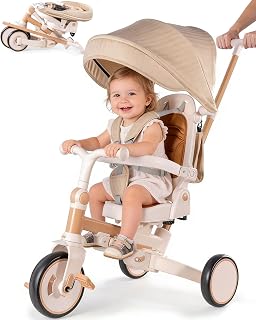
The foldable push-trike format provides transport practicality from the outset, and the steering push handle lets a parent guide direction before the child has developed the coordination to manage it themselves. The removable sun canopy is a feature that does not appear on most trikes in this category and deserves attention: if you live somewhere that outdoor time happens regardless of whether the sun cooperates — and that describes most of the UK, most of the year — a bit of overhead coverage for a young child is a practical addition rather than a novelty. The canopy detaches straightforwardly when the child does not want it, which matters because toddlers have strong opinions about accessories.
What distinguishes the aiwo from simpler multi-mode trikes is that the stage transitions feel purposeful rather than arbitrary. A push trike with a locking parent handle and a locked rear axle is the starting point for the youngest riders. As the child develops, components are reconfigured to progressively increase independence — footrests adjust, the pedal mode is enabled, the parent handle transfers control gradually to the child, and eventually detaches entirely for fully independent riding. Parents who are planning ahead and want to avoid buying a new ride-on every twelve to eighteen months will find this progression practical and well structured.
The tradeoffs are real and worth factoring in before purchasing. Seven modes means seven sets of adjustment points, and the initial assembly is considerably more involved than simpler products in this guide. Some buyers note that the instructions could be clearer, and transitioning between configurations for the first time may require a careful re-read of the manual. The canopy adds bulk to the stored size, which matters if your storage space is tight. The price sits in the mid-range — above the Scuttlebug and AIYAPLAY but below the DOONA — and if your child is already eighteen months and steady on their feet, some of the earliest push-trike configurations will be skipped quickly, reducing the full value of the seven-mode range.
This is the right choice if you are buying for a child of around ten to fourteen months and want a single product to carry them through to age three or beyond without returning to the shops. The versatility only pays off if you start using it early enough to benefit from the early-stage modes. Buy it for a first birthday or for a newborn sibling of an older child, and three or more years of active use becomes a realistic outcome.
Best for Girls Aged 1–5 — 5-in-1 Balance Bike for 1-5 Years Old Girls
The 5-in-1 Balance Bike for 1-5 Years Old Girls covers the widest stated age range of any product in this guide, and that extended span is its primary proposition: a single purchase that takes a child from first wheels at around twelve months through to confident pedalling at five. It has 11 reviews at 4.0 stars — a smaller sample than the other picks here. That rating is solid, but the smaller review base means buying with slightly less certainty than the higher-reviewed options, and parents who want maximum reassurance before spending may prefer to wait for the review count to build further.
The LED wheels are the design feature that catches immediate attention and, in practice, do more than simply look appealing. The lights activate through wheel spin without batteries — the mechanism is mechanical rather than electronic, removing one long-term maintenance concern — and for young children who are hesitant about getting onto a bike, the visual reward of colour-changing moving lights provides a motivational nudge that is more effective than it sounds on a spec sheet. A reluctant rider who sees something exciting happen every time the wheels move will try again, and that persistence is where real skill develops.
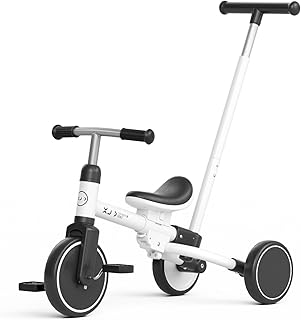
The five-in-one configuration spans tricycle mode with a parent push handle and a seatbelt for the youngest riders, through to a pure balance-bike mode without pedals, and on to a pedal-bike mode as the child approaches three or four. The removable pedals are central to this flexibility: the bike is not locked into one developmental approach. When your child is not yet ready to pedal, the pedals come off and the bike functions as a balance bike. When they are ready, the pedals go back on. The adjustable seat and handlebars grow with the child across the full 1–5 age range, which is a longer span than any other product in this guide.
The tradeoffs are worth stating clearly. Eleven reviews is a modest base, and a 4.0 star average from a small sample means the full picture of long-term durability and quality consistency may not yet be visible. The design and colour scheme are clearly targeted at girls rather than being gender neutral — if you have a second child of a different gender, or prefer a more adaptable aesthetic, other picks in this guide are more flexible in that respect. The seatbelt included for the tricycle mode is a thoughtful safety feature that most other products here do not offer, providing added security for very young riders who are not yet actively gripping the handlebars.
For parents buying for a daughter who will use the bike from her first birthday through to school age, the age span here is the key argument. It is the only product in this guide that claims and plausibly covers a 1–5 year range. Weigh that against the smaller review base and proceed with the understanding that you are buying into a product with less independently verified feedback than the top picks here — but with a broader potential use window if the quality holds up over time.
What to Look For When Buying a Kids’ Bike, Trike or Riding Toy
- Age and weight suitability: Check the manufacturer’s stated age range and the weight limit separately. Children of the same age can vary significantly in size, and a lightweight toddler trike may have a weight ceiling that a large two-year-old is already approaching. Matching the product to your child’s current height and weight — not just their birthday — is the most important decision in the whole buying process.
- Adjustability: Seat height and handlebar adjustability determine whether a product lasts one year or three. Look for tool-free mechanisms; quick-release levers make raising the seat after a growth spurt a five-second task rather than a ten-minute exercise with an Allen key. If a tool is required every time, adjustments happen less often than they should, and the child ends up hunched or stretched.
- Parent push handle: For children under about eighteen months, an adjustable parent push handle allows you to guide the trike’s direction before the child has developed independent steering control. Check that it is height-adjustable for an adult user — a fixed low handle causes back strain during longer outings and is one of the most common complaints about budget trikes in buyer reviews.
- Stability and safety features: A wider rear wheelbase resists tipping. Steering angle limiters — typically set to around 135 degrees — prevent the front wheel from turning sharply enough to topple the trike sideways, which is the most common cause of early falls. Enclosed wheel guards that keep fingers away from moving spokes are a meaningful safety improvement not found on all budget products.
- Folding and storage: If you live in a flat, have a small car, or plan to travel with the trike, a fold mechanism matters significantly. Not all products that describe themselves as foldable actually collapse into a useful size — read buyer reviews specifically for how the fold works in practice, and whether it remains easy to operate after several months of regular use.
- Frame material: Steel frames are more durable and carry higher weight limits; plastic frames are lighter and will not corrode. For outdoor use in UK conditions, consider whether the product’s materials suit occasional rain exposure and damp storage. Thin moulded plastic at joints and handle mounts is where budget products typically fail first, so check reviews for any pattern of cracking at those points.
- Convertible versus single-mode: Multi-stage convertible designs provide better long-term value only if you start using them at the earliest recommended age. If your child is already eighteen months or older, several early configurations on a seven-in-one will be redundant from day one. A well-built single-purpose balance bike or trike often gives better practical value for an older toddler than a convertible design with modes that will never be used.
Verdict
For most parents buying a first ride-on for a toddler between one and two years old, the Scuttlebug 3-Wheel Foldable Ride-On Tricycle is the most practical starting point. It has the largest verified buyer base of any product in this guide, it folds for storage and travel, and it gives a young child exactly what a first trike should provide: a stable, engaging platform to push around and build confidence on. It does not overcomplicate things with modes a fourteen-month-old will never access.
If you want to invest more and get a product with real engineering quality and a one-fold travel mechanism you will use on family outings, the DOONA Liki Baby Trike S5 Deluxe is the premium option with no significant weaknesses — particularly for families who travel regularly or plan to pass the trike down to a second child. For parents specifically committed to the balance-bike method, the AIYAPLAY Kids Balance Bike carries the highest rating in this group and does its single job with clarity and solid build quality. Whichever you choose, match the product to your child’s current size and developmental stage first, budget second — the best bike available will not get used if it does not fit.
We were not paid to feature any specific product in this guide. All opinions are independent and based on publicly available specifications, verified buyer feedback patterns, and category research.
Quick Comparison Table



FAQ
What is the difference between a balance bike and a tricycle?
A balance bike has no pedals — children scoot with their feet on the ground and focus on learning to balance and steer before pedalling is introduced. A tricycle has three wheels and pedals, providing lateral stability but requiring the child to coordinate steering and pedalling simultaneously. Children who start on balance bikes typically transition to two-wheel pedal bikes faster and with greater confidence, but trikes offer useful stability for very young children not yet ready to balance independently on two wheels.
At what age should my child start on a balance bike or trike?
Most parent-push trikes are suitable from around ten to twelve months, provided your child can sit upright independently and their feet can reach the footrests. For a dedicated balance bike, children generally need to be walking confidently first — usually around eighteen months, though some are ready slightly earlier. Always check the manufacturer’s minimum seat height as a practical guide: if your child’s feet cannot comfortably reach the ground while seated, the bike is not yet the right fit regardless of their age.
Are 5-in-1 or 7-in-1 convertible trikes worth the higher cost?
If you start using them at the earliest recommended age — typically around ten to twelve months — multi-stage convertible trikes can provide three or more years of use from a single purchase, which improves the value considerably. If your child is already eighteen months or older, several early-stage configurations will be skipped immediately, and a simpler, well-built product may represent better value for what you actually need. The deciding question is how much of the stated age range you will realistically use from the point of purchase.
Do I need a parent push handle on a trike?
For children under about eighteen months, a parent push handle makes a real practical difference — it allows you to guide the trike’s direction before your child has developed independent steering control. Once a child can self-direct with confidence, typically from eighteen to twenty-four months onwards, the handle becomes less necessary. Check that any push handle is height-adjustable for your own height; a fixed low handle causes back strain during longer outings and is one of the most common complaints about budget trikes.
Can kids use a balance bike or trike indoors?
Yes — most balance bikes and small trikes work on smooth indoor flooring as well as outdoor surfaces. Hard plastic wheels can scratch or mark hardwood and laminate flooring, so if indoor use is a priority, look for products with rubber or foam tyres. Carpet provides too much resistance for small children to push through comfortably, so a garage, conservatory, or smooth hard floor gives the best riding experience and encourages children to practise more frequently.
How long will a kids’ trike or balance bike last before they grow out of it?
This depends on the product’s stated age range and build quality. A simple trike designed for ages one to three typically provides around two years of comfortable use. A well-built multi-stage convertible designed for ages one to five can remain relevant for four or more years. Steel-framed models generally outlast plastic-framed ones and can often be passed down to a younger sibling in functional condition, significantly improving the cost-per-year of use compared to products that cannot be handed on.