You’ve killed another batch of herbs. Not from neglect — you watered them on schedule, gave them a sunny windowsill, even talked to them. But the roots are brown and soggy, the compost stinks, and the ceramic pot you bought from a garden centre is sitting in a puddle of standing water with nowhere to drain. Sound familiar? This is one of the most common and most preventable gardening problems in the UK, and the container is almost always to blame rather than your technique.
Maybe you’re on a balcony and the weight limits mean you can’t use heavy terracotta. Maybe you’ve got a patio where you need to move things around seasonally. Maybe you’re trying to grow tomatoes or courgettes in a small raised bed and you need something that breathes properly and won’t cost a fortune to replace each year. The problem isn’t your green thumb — it’s that the UK market for plant containers is genuinely confusing, with hundreds of near-identical listings and very little honest guidance on what actually works for whom.
This guide cuts through that. Whether you’re growing herbs on a kitchen windowsill, running a small vegetable patch on a flat roof, or simply trying to stop your succulents from drowning, there’s a container in this guide that will genuinely improve your results.
How We Evaluated These Picks
Each container was assessed against five criteria relevant to UK gardeners: drainage effectiveness (the single biggest factor in whether roots stay healthy or rot), material durability across damp British winters, practical capacity relative to what’s advertised, ease of handling and relocation, and real-world buyer feedback patterns from verified purchasers on Amazon UK. Where a product had a substantial number of reviews — dozens to hundreds — those patterns were weighted heavily. Where review counts were lower, we looked more carefully at objective specifications and relied on category knowledge about material performance. We filtered out products that were colour or size variants of the same model, keeping only the best-reviewed version in each family, and we discarded any listings that didn’t genuinely suit the plant container use case.
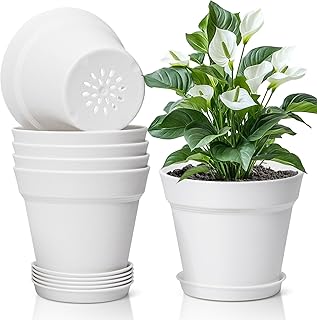
Best High-Rating Indoor Pot Set: 17cm Plant Pots Indoor, 5 Pack
The 17cm Plant Pots Indoor 5 Pack Plastic Planters with Drainage Holes and Saucer is the standout choice in this guide with a 4.7-star rating drawn from over 550 verified buyers — the highest-rated and most-reviewed plastic pot set in our live product block. That breadth of positive feedback across such a large sample is meaningful: it suggests real consistency in manufacturing quality rather than a handful of outlier reviews.
Each pot measures 17cm across and comes with its own matching saucer, which matters more than it sounds. A saucer that’s actually sized for the pot prevents the annoying puddle-on-shelf situation that ruins windowsills and worktops. The decorative stripe groove design gives these pots a tidier appearance than plain black nursery plastic, making them suitable for living rooms, kitchens, and home offices without looking like you raided a polytunnel. The drainage holes are pre-formed and adequately sized — not pinprick apertures that clog within a season.
For indoor use, the 17cm diameter suits a wide range of houseplants comfortably: devil’s ivy, spider plants, small peace lilies, herbs like rosemary or basil, and most succulents that have outgrown a starter pot. The plastic construction keeps the weight low, which matters when you’re moving pots to dust a shelf or rotate plants towards the light. It’s also genuinely frost-resistant in the sense that you’re not going to crack these on a cold garage floor the way you might terracotta.
The honest limitation here is that five pots at the same 17cm size means this set won’t cover your full range from seedling to mature specimen. If you need a graduated set where each pot is a different diameter, you’ll want to look elsewhere. These are also uniform in colour — the stripe detail is subtle rather than decorative in a bold sense — so if you’re after a statement pot for a feature plant, manage expectations. But for everyday indoor growing where you want something that looks neat, drains reliably, and comes with saucers already included, this is the pick that real buyers keep endorsing.
Best Fabric Grow Bags for Vegetables: LATERN 6Pcs 5 Gallons Plant Growing Bags
The LATERN 6Pcs 5 Gallons Plant Growing Bags Nonwoven Fabric Breathable Grow Bags is the most-reviewed fabric grow bag option in our selection, with over 900 ratings sitting at 4.6 stars — a genuinely strong signal for a product in this category where cheap alternatives flood the market. This is the set to reach for if you’re growing tomatoes, peppers, aubergines, or potatoes on a patio or in a small garden.
The key advantage of a well-made fabric grow bag over a rigid plastic pot is air pruning. When roots reach the breathable sidewall and encounter air, they self-prune and branch back into the soil, creating a denser, healthier root system than you get in a pot where roots circle the base indefinitely. This translates directly to better fruiting for tomatoes and better tuber development for potatoes. The nonwoven fabric on these LATERN bags is thickened for durability, and the handles are reinforced rather than single-stitched — a detail that matters enormously when you’re hauling a fully-loaded, soil-heavy bag across a patio.
Five gallons (roughly 19 litres) is a reasonable size for a single tomato plant, a large pepper, or a small courgette. For context, most growing guides suggest a minimum of around 10–12 litres for a productive tomato, so these 19-litre bags comfortably exceed that. The six-bag pack gives you enough for a modest vegetable set-up without over-committing if you’re trying fabric bags for the first time. They fold flat for storage over winter, which is a practical win for anyone with limited shed space.
Be aware that fabric bags do dry out faster than rigid pots in warm weather — the breathability that benefits roots also means you’ll need to water more frequently in July and August than you would with a plastic container. For UK summers this is rarely a dealbreaker, but if you’re heading away for two weeks in peak season, fabric bags need more planning around watering. The black colour also absorbs heat; in exposed south-facing spots this can warm the root zone, which isn’t always a negative for heat-loving crops but is worth monitoring in the hottest spells.
Best Multi-Size Indoor Set: Bamworld 5 Pack Indoor Plant Pots with Saucers
If you want a single purchase that covers your full range of houseplants in graduated sizes, the Bamworld 5 Pack Indoor Plant Pots with Saucers and Drainage Holes is the most sensible option. With 92 reviews at 4.5 stars, it’s well-enough tested to trust, and the multi-size configuration solves the problem that same-size sets create: you can pot on a small plant without jumping straight to a vessel three sizes too large (which causes overwatering problems because too much bare compost retains moisture the roots can’t use).
Each pot in the set comes with a matching saucer and drainage holes, so from the moment the parcel arrives you have everything you need to pot up five different plants at appropriately scaled sizes. This suits collectors who’ve accumulated a mix of small trailing plants, medium leafy specimens, and the occasional larger statement plant, and who want them all to look visually coherent. The plastic material is lightweight and easy to clean — a practical consideration if you’re repotting frequently.
The indoor and outdoor designation means these work on a covered porch or balcony as well as inside, giving you flexibility if you move plants out for summer. However, the aesthetic is fairly utilitarian — these are functional rather than decorative pots. If you want something that genuinely enhances a styled interior, the 17cm stripe-groove set above has the edge on looks. The Bamworld set earns its place for gardeners who prioritise practicality and variety of sizing over visual finish.
One thing to check when pots arrive in graduated sets: make sure the size increments are meaningful rather than token. A set where the largest pot is only marginally bigger than the smallest is much less useful than one with genuine steps between sizes. Based on the listing specifications, the Bamworld set does offer meaningful size progression, making it genuinely useful for potting on plants as they grow.
Best for Colourful Grow Bag Variety: LATERN 7Pcs 5 Gallons Plant Growing Bags in 7 Colors
The LATERN 7Pcs 5 Gallons Plant Growing Bags 7 Colors Nonwoven Fabric Breathable Grow Bags is the cheerful, practical choice for anyone who wants the horticultural benefits of fabric grow bags but finds an all-black patio visually dull. Seven bags in seven colours at 5 gallons each makes it easy to colour-code by crop — green for cucumbers, red for tomatoes, yellow for peppers — which is surprisingly useful when you’ve got a crowded growing space and can’t immediately tell what’s what.
The underlying construction follows the same nonwoven fabric and heavy-duty thickening as other quality grow bags, with root aeration and drainage as the core function. With 83 reviews at 4.5 stars, the feedback is consistent enough to suggest these aren’t just aesthetically novel but functionally reliable. The thickened material resists the tearing and fraying that cheaper fabric bags suffer after a single season, and the reinforced handles hold up to the weight of soil-filled bags.
Five-gallon (approximately 19 litres) capacity works for tomatoes, chillies, herbs grown large, or small root vegetables. Seven bags in one purchase is a good volume for a dedicated kitchen garden corner on a patio. The colour variety does raise one practical question: UV stability. Coloured fabric can fade in direct summer sunlight more noticeably than plain black, though this is a cosmetic rather than structural issue. Structurally, the thickened nonwoven fabric should perform comparably across colours.
This set is not the pick if you want a neat, uniform look — the whole point is variety. It’s also not the right choice for indoor use where the colours might clash with your decor. But for an outdoor kitchen garden where you want to inject some personality into an otherwise utilitarian growing space, this is a genuinely practical way to do it. The colour-coding benefit alone saves time and reduces the chance of accidentally harvesting or treating the wrong plant.
Best Self-Watering Option: LATERN 5Pcs Self Watering Plant Pots
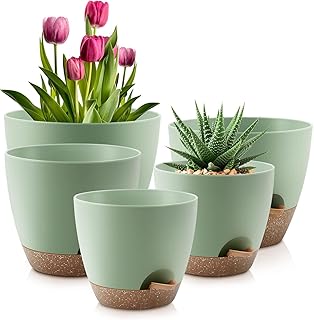
The LATERN 5Pcs Self Watering Plant Pots 18/16.5/15/13.5/12CM Plastic Flower Pot Garden Plant Container addresses a different problem from standard drainage pots: inconsistent watering. With a self-watering reservoir system, water is drawn up from below as the plant needs it rather than flooding from the top. This is particularly useful for plants that dislike both drought and waterlogging — African violets, peace lilies, herbs — and for anyone whose schedule means watering gets missed for days at a stretch.
The set provides five graduated sizes from 12cm to 18cm, which gives you a useful range for smaller plants. The large-capacity reservoir extends intervals between waterings, reducing the frequency with which you need to intervene. Each pot has a drainage hole as well, so the self-watering system doesn’t mean water sits stagnant — excess still exits properly. This dual mechanism (reservoir below, drainage above) is the feature that separates a well-designed self-watering pot from the kind where water just pools in a saucer and causes root rot.
With 14 reviews at 4.4 stars, the sample size here is smaller than ideal. The rating is encouraging but treat it with appropriate caution — 14 reviews is not yet a large enough base to be statistically robust. What we can say is that the design principles are sound, and the graduated sizing makes the set more versatile than a same-size collection. The plastic construction is lightweight and the aesthetic is clean enough for indoor display.
This set is best for indoor plants and countertop herb gardens where self-watering genuinely extends how long plants stay healthy between attention. If you’re a reliably attentive waterer, you won’t extract much extra benefit from the reservoir system — but if you travel for work, have a busy household, or simply find watering easy to forget, this solves a real problem. The 12–18cm size range means these suit smaller plants; if you need self-watering capability for large specimens, you’d need to look beyond this set.
Best Large Outdoor Planters: ORGANIZED Set of 2 Large Round Plastic Garden Planters
When you’re planting something substantial — a standard bay tree, a large ornamental grass, a dwarf fruit tree — you need real volume, and the ORGANIZED set of 2 large round plastic garden planters durable and lightweight with drainage holes is the option that fills that gap in this guide. Two large-format round planters with drainage holes, designed specifically for patio and outdoor use, at a price point that makes buying a pair feasible without breaking your garden budget.
The durable plastic construction hits the right balance for outdoor planters: light enough to move with some effort (important when you need to reposition for winter or during a patio redesign), resilient enough to handle frost and UV exposure without cracking or fading quickly. Drainage holes are present, which is the first thing to verify on any large outdoor planter — a pot this size without drainage turns into a waterlogged container that will kill almost anything you put in it within a wet British autumn.
With 15 reviews at 4.2 stars, the feedback pool is modest, and this is worth acknowledging honestly. The rating is decent but not yet backed by the volume of real-world experience that the highest-rated options in this guide can point to. If you’re cautious about relatively limited reviews, this is the trade-off: large round planters in this category don’t tend to accumulate reviews as rapidly as smaller, cheaper products that more people buy on impulse. The ORGANIZED listing offers the large-format functionality that nothing else in the current live product block provides.
The round format suits classic planting schemes — a single specimen tree underplanted with trailing ivy, or a bold agapanthus display for a front doorstep. The pair format means you can create symmetrical arrangements flanking a doorway or the ends of a path. For anyone whose primary need is a large, practical outdoor container rather than a grow bag or a windowsill pot, this is the appropriate pick.
What to Look For When Buying Plant Containers
- Drainage holes — non-negotiable: Every container needs at least one drainage hole, and for anything above about 15cm in diameter you want multiple holes to ensure water exits evenly rather than pooling in one corner. Self-watering pots are the one exception, but even these should have an overflow mechanism. Check the listing carefully — some decorative pots are sold without drainage and marketed with a “use as a cache pot” note in small print.
- Material and its consequences: Fabric bags offer superior root aeration and air pruning but dry out faster and have a shorter lifespan than rigid pots. Plastic is lightweight, frost-resistant, and inexpensive but can degrade with UV exposure over several years. Terracotta breathes well but is heavy and cracks in hard frosts. Ceramic is beautiful but heavy and cold-sensitive. Match the material to where the pot will live and what you’re growing, not just how it looks on the listing.
- Capacity versus stated size: Advertised volume (especially in gallons on fabric grow bags) can be misleading. A “5-gallon” bag filled to its functional rim with potting compost, leaving the recommended gap below the rim, may deliver around 15–17 litres of usable growing medium rather than the theoretical maximum. For vegetables, check whether the usable capacity matches what your crop actually needs — most tomatoes thrive with 15–20 litres of compost access, while herbs are content with 5–8 litres.
- Handle quality: On fabric grow bags especially, handles are where failures happen. Single-stitched fabric handles tear under the weight of wet, soil-filled bags. Look for reinforced handles with serger or double stitching. For large plastic planters, consider whether handles are present at all — a large pot without handles requires two people and creative lifting technique to move.
- Saucers and drip trays: Indoors, a pot without a saucer damages surfaces and creates mess. Buying pot and saucer separately sounds trivial but the sizes rarely match perfectly from different manufacturers. Sets that include matching saucers are worth a modest premium for indoor use. Outdoors, saucers are often a liability — they collect rainwater and keep roots sitting in standing water, so for outdoor pots, skip the saucer or remove it in wet months.
- Weather resistance for outdoor use: UV stabilisation determines how quickly plastic pots fade and become brittle. Cheaper plastic planters often lack meaningful UV inhibitors and start cracking within two or three seasons. Look for descriptions mentioning UV-resistant or UV-stabilised polypropylene if the pot will live in direct sun. Fabric bags generally tolerate UV well structurally but do fade cosmetically.
- Pack size and cost-per-pot: Buying in sets almost always reduces cost-per-container, but only if you’ll actually use every pot in the set. A 60-pack of small nursery pots is excellent value for propagation but pointless if you only need three pots for a windowsill herb garden. Assess whether the set format genuinely matches your planting plans before committing to volume.
Verdict
For the majority of UK gardeners — those managing a mix of indoor houseplants and an outdoor patio or small garden — the two picks that will genuinely improve results are the 17cm Plant Pots Indoor 5 Pack with Drainage and Saucer for indoor use, and the LATERN 6Pcs 5 Gallons Plant Growing Bags for outdoor vegetables.
The indoor pot set is the single strongest pick here on the basis of over 550 real buyer reviews and the highest rating in the group — that’s the most robust signal of consistent quality in the live data. The matching saucers, adequate drainage holes, and tidy aesthetic make it genuinely suitable for any room. For outdoor growing, the LATERN 6-pack fabric bags lead on review volume at over 900 ratings, and the air-pruning benefit of fabric construction is a real, measurable advantage for vegetable crops. If you’re growing tomatoes, peppers, or courgettes on a UK patio, fabric bags are simply better for root health than rigid plastic equivalents at the same price point.
If your primary problem is forgetting to water, the self-watering LATERN 5-pack is the practical upgrade worth considering alongside either of the above.
We were not paid to feature any specific product in this guide. All opinions are independent and based on publicly available specifications, verified buyer feedback patterns, and category research.
Quick Comparison Table



FAQ
What size container do tomatoes need?
Tomatoes need a generous root run to crop well. A single cordon tomato plant performs best with at least 15–20 litres of accessible compost — the 5-gallon fabric bags in this guide (approximately 19 litres) sit comfortably within that range. Bush varieties are slightly more forgiving and can manage in around 12 litres, but giving them more space always produces better results. Avoid going much smaller than 10 litres even for compact bush types, as restricted roots will limit cropping heavily.
Do fabric grow bags need saucers?
Outdoors, no — the whole point of fabric bags is that excess water drains freely through the base and sides, so standing them in a tray just defeats the drainage function and risks waterlogging. Indoors or on a wooden deck where drainage causes staining, you can use a wide shallow tray underneath, but empty it after watering so water doesn’t sit in contact with the bag base for hours. On a patio or concrete, simply allow the bag to drain freely.
How often do plastic plant pots need replacing?
Quality UV-stabilised plastic pots typically last five to ten years outdoors before brittleness and cracking become a problem. Budget pots without UV inhibitors may crack within two or three seasons in direct sun. Indoors, plastic pots essentially last indefinitely unless physically damaged. Fabric grow bags have a shorter lifespan — expect two to four seasons from a well-made bag with proper winter storage, or one to two seasons from a cheaper version used year-round without care.
Can I use indoor plant pots outside in the UK?
Most plastic indoor pots are not UV-stabilised or frost-rated to the same standard as outdoor planters, so they may become brittle and crack after a winter outside. If you’re moving plants outdoors for summer only and bringing them back in before hard frosts, the risk is low. For permanent outdoor placement through a UK winter, choose containers specifically described as frost-resistant or outdoor-rated, or opt for fabric bags that handle the temperature range more reliably.
What’s the difference between self-watering pots and standard pots with saucers?
A standard pot with a saucer relies on you emptying the saucer so water doesn’t sit stagnant — leaving water in a saucer for days causes root rot, which defeats the purpose. A genuine self-watering pot has a sealed reservoir separated from the root zone by a partition, with a wicking mechanism that draws moisture upward only as the plant consumes it. This maintains consistent moisture without waterlogging, and the reservoir genuinely extends the interval between waterings rather than just catching overflow.
Are fabric grow bags reusable?
Yes, with some care. At the end of the growing season, shake out the spent compost, shake or brush off any remaining soil from the fabric, and allow the bags to dry completely before folding and storing. Wet storage encourages mould and degrades the nonwoven fabric. Well-made, thickened bags from reputable sets can realistically be reused for two to four seasons. Check handles and seams for wear at the start of each new season before loading with heavy, wet compost.