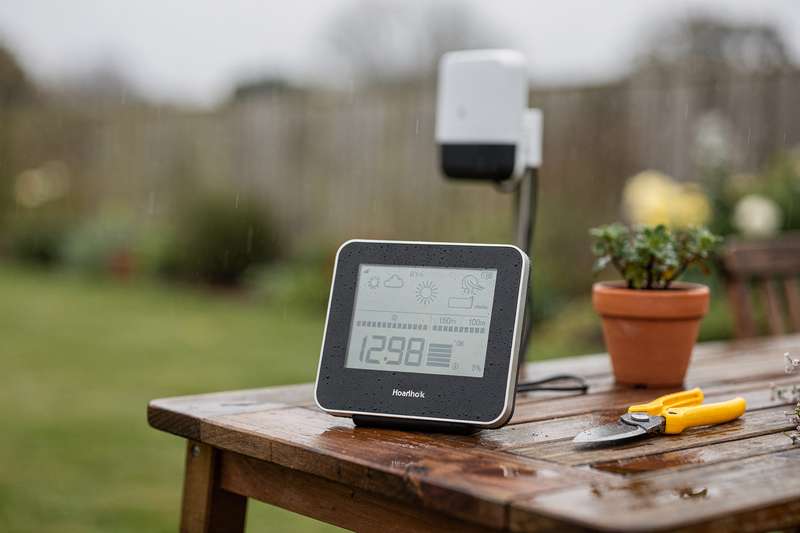
Picture this: it’s a damp Saturday in mid-September. You’ve been tracking the forecast all week, waiting for a dry window to harvest the last courgettes and re-seed bare patches on the lawn. The Met Office app on your phone shows 15°C, light cloud, no rain until evening. You pull on your boots and head out — and within twenty minutes the sky closes in, the temperature feels closer to 11°C, and a steady drizzle begins that lasts the rest of the day. The forecast wasn’t wrong exactly; it reflected conditions at the nearest official recording station, located on a school rooftop five miles away, in terrain quite unlike your garden.
This is the defining frustration that drives people towards personal weather stations. UK gardens, allotments, and smallholdings have extraordinarily variable microclimates: frost pockets at the bottom of slopes, sheltered south-facing walls that hold heat well into autumn, exposed hillsides where wind chill takes the effective temperature several degrees below what the regional forecast suggests. National weather data reflects broad patterns, not your specific outdoor space. A weather station puts real sensors in your garden, records exactly what’s happening there, and sends that data to a display inside your home — often alongside a smartphone app.
The range of products available on Amazon UK has expanded considerably. You can now find basic indoor-outdoor thermometers at the budget end, right through to professional-grade wireless systems with solar-powered sensors, data logging, and internet connectivity approaching what a commercial meteorological site might use. The challenge is knowing which level of station fits your actual needs — and which products are worth the money. This guide covers the most credible options currently available on Amazon UK, from entry-level to enthusiast-grade.
How These Picks Were Assessed
Eight weather stations available on Amazon UK were evaluated for this guide. Buyer review volume and consistency were weighted heavily — a 4.5-star rating from several hundred verified buyers carries more weight than a pristine score from a handful. Assessment criteria included: the range of measurements covered (temperature, humidity, wind, rainfall, UV, solar radiation, barometric pressure), ease of setup and sensor placement, display quality and readability at a glance, wireless connectivity and app integration, build quality suited to sustained UK conditions including prolonged rain and low winter temperatures, and overall long-term value. Where products used meaningfully different sensor technologies — such as solid-state versus mechanical wind measurement — that distinction was noted as relevant to long-term reliability. One product in the source block carried zero buyer reviews and was excluded in favour of stations with verified real-world feedback.
Best Overall Weather Station
The Ecowitt WS2910 is the most well-rounded home weather station on Amazon UK right now, with a 4.5-star rating from over 837 buyers. That volume of real-world feedback — substantially larger than any competing station in this guide — is meaningful in a category where sensor reliability and software consistency are difficult to assess from product listings alone.
The WS2910 centres on a 7-in-1 outdoor sensor array that simultaneously measures temperature, humidity, wind speed and direction, rainfall, UV index, and solar radiation. The outdoor unit is solar-powered with battery backup, removing the need to run cables outside or make regular battery changes through dark UK winters. The colour LCD console inside your home shows all readings at a glance, and WiFi connectivity opens two significant advantages: remote monitoring via the Ecowitt app on your phone, and the ability to contribute data to weather networks like Weather Underground, where your readings become part of a collaborative local picture.
Setup is more involved than plugging in a simple thermometer. You’ll need to mount the outdoor sensor on a pole in an open location away from buildings and obstructions, work through the WiFi configuration, and complete some initial calibration steps. UK buyers consistently note that the process takes a patient hour or two, and that the instructions benefit from supplementing with the Ecowitt online community or video walkthroughs. None of this is particularly technical, but setting aside proper time rather than expecting a ten-minute installation will save frustration.
Where the WS2910 clearly justifies its position as the best overall pick is data breadth. Most competing stations at this price measure only temperature and humidity — adding wind and rainfall transforms the device from a curiosity into a practical planning tool. Knowing wind speed before heading out to stake fragile seedlings, tracking the 24-hour rainfall total to guide irrigation decisions, or watching the barometric pressure trend before planning outdoor work are all concrete daily uses that a simpler station cannot support.
The display, while clear and colourful, may feel less premium than the consoles on significantly pricier stations. If you want a large, high-resolution screen with customisable brightness and dark or light mode, Ecowitt’s premium models provide that step up. But for the vast majority of UK home users who want comprehensive, accurate readings and proper app connectivity without spending at professional-grade levels, the WS2910 is the most sensible starting point in this category.
Best Budget Pick
If your goal is reliable indoor and outdoor readings without the complexity or cost of a full 7-in-1 system, the LIORQUE Weather Station gives you exactly that. With a 4.5-star rating from 579 reviews, it’s one of the most trusted options in the budget segment — that consistency of feedback from buyers who have used it through UK weather is reassuring at this price point.
The LIORQUE focuses on what most home users check most often: indoor and outdoor temperature, humidity in both environments, and barometric pressure. The inclusion of barometric pressure is a meaningful differentiator at this price — it’s one of the most reliable short-term indicators of weather change, and many cheaper stations omit it entirely. When pressure is falling, conditions are likely deteriorating; when rising, you can reasonably expect improvement over the next few hours. Having that information without paying for a full 7-in-1 station is a practical advantage for everyday use.
The wireless outdoor sensor connects reliably to the indoor console, and setup is refreshingly quick: insert batteries, pair the sensor, and you’re reading live data within minutes. There’s no WiFi configuration, no app account to create, and no ongoing software dependency. The display is clear and legible from across a room, showing current readings alongside the date, and some units include a basic forecast icon based on barometric trends — a useful prompt about direction of travel rather than a precision forecast.
Where the LIORQUE gives ground to pricier stations is measurement depth. There’s no wind speed or direction, no rainfall total, and no UV or solar radiation data. For gardeners or outdoor workers who need that fuller picture, this station will feel limited. But for someone who wants to know how cold it is outside before getting dressed, whether indoor humidity is at a comfortable level, or whether pressure suggests rain is approaching, the LIORQUE handles those questions cleanly and without fuss.
Battery operation on both the console and outdoor sensor means flexible placement without proximity to a power socket. The outdoor sensor is weatherproof enough for typical UK conditions based on the volume of positive buyer feedback, though some shelter from the worst direct exposure will extend battery life. For the price, this is a capable, low-hassle introduction to home weather monitoring — and the 579-review track record makes it the most evidenced budget option in this guide.
Best for Monitoring Multiple Outdoor Zones
The Weather Station Wireless with 3 Sensors UK addresses a problem that single-sensor stations cannot solve: monitoring conditions across more than one outdoor area simultaneously. It carries a 4.4-star rating from 436 buyers — a solid evidence base for a mid-range product.
The headline feature is the three included outdoor sensors. Where most stations at this price supply one outdoor unit, this package lets you position sensors in three separate locations and compare readings from each on the same indoor console. For a gardener with a greenhouse, this is practically useful: you can see at a glance how much warmer and more humid the greenhouse is compared to the open garden and a third area, and act accordingly. It also suits larger properties where a single sensor in one corner does not accurately represent the whole plot.
The indoor console features a large, colourful LCD screen that’s notably easy to read from across a room — a point UK buyers in kitchens and utility rooms raise consistently in positive reviews. Weather forecast icons sit alongside the current temperature and humidity readings for each zone, giving a quick visual cue about direction of travel without requiring you to interpret numbers. The overall display aesthetic is tidier than many competing options at this price, which tend to cram data into small monochrome screens.
The limitations on measurement depth are worth being direct about. Temperature and humidity are the primary outdoor measurements — there’s no wind speed, rainfall total, UV index, or dedicated pressure reading from the outdoor sensors. This station is built around understanding thermal and moisture differences between areas of your property, not providing full meteorological coverage. If you need wind data to decide whether to stake plants, or rainfall totals for irrigation scheduling, a 7-in-1 setup is the more appropriate choice.
Setup is straightforward: pair each sensor to the console, position them in their desired locations, and you’re reading data from all three zones within a short time. For anyone managing multiple growing areas, a combination of indoor and greenhouse spaces, or a larger garden where conditions vary significantly across the plot, the ability to compare three outdoor zones on one screen is a practical advantage that most competing stations at this price don’t offer.
Best for Low-Maintenance Long-Term Reliability
The ECOWITT GW3001 represents a notable step forward in outdoor sensor technology compared to most stations in this guide. Pairing the WS90 outdoor unit with the GW30 multi-protocol gateway, it holds an early 4.7-star rating from 34 reviews — a strong signal, though the relatively small review base is worth factoring into your decision.
The WS90 is a 7-in-1 sensor covering the full range of outdoor measurements — wind, temperature, humidity, rainfall, UV, and solar radiation — but uses solid-state technology for wind measurement rather than the traditional spinning cup anemometer found on most outdoor sensors. In practice, this eliminates moving mechanical parts that can wear out, seize in icy conditions, or gradually lose accuracy after several winters of exposure. For anyone planning to mount the sensor in a high or difficult-to-access location, this matters considerably: a conventional anemometer may need cleaning, lubricating, or eventually replacing; a solid-state sensor has no such maintenance requirements. The WS90 is also solar-powered, removing the need for regular battery changes once installed.
The GW30 hub connects via both WiFi and wired Ethernet. The wired option is useful if your property layout makes WiFi coverage unreliable in the area where the hub needs to sit — a fallback that most competing stations don’t offer. It integrates with the Ecowitt app, supports data sharing to services like Weather Underground, and is compatible with the wider Ecowitt sensor ecosystem should you want to expand monitoring later without replacing the core system.
The premium price over the WS2910 raises an honest question about whether the advantages justify the difference for your situation. If you’ll mount the sensor somewhere easily accessible and use the data casually, the WS2910 serves those needs at lower cost. The GW3001 makes more sense if you’re installing on a high roofline or somewhere genuinely inconvenient to maintain, if you’re already invested in the Ecowitt ecosystem, or if long-term wind measurement accuracy across multiple seasons is a specific priority.
With 34 reviews at time of writing, the full reliability picture is still developing. Ecowitt’s broader track record across their product range provides reasonable supporting confidence, and the early buyer responses are positive. If you prefer a product with an extensive review history before committing at a premium price, the WS2910 offers that reassurance more readily.
Best All-in-One Home Hub
The ECOWITT HP2564 sits at the top of the price range in this guide and brings a combination that’s unusual in the home weather station category: a full 7-in-1 wireless station paired with a built-in WiFi internet radio. It holds a 4.2-star rating from 95 reviews — enough to confirm real-world reliability across a range of UK setups.
On the weather monitoring side, the HP2564 covers the full outdoor measurement suite via a wireless sensor array, with WiFi connectivity for app integration and data sharing to weather networks. The large console is designed to sit permanently on a kitchen surface or sideboard, showing all weather readings alongside the radio interface. That dual function is the core proposition: one device on the worktop that handles both your weather station display and your daily radio listening, streaming from thousands of internet stations without requiring a separate smart speaker or DAB radio.
For some buyers, this combination fits naturally into the daily routine — particularly in a kitchen where a countertop radio is already part of the day and integrating weather data into the same device reduces clutter. The weather capability is comprehensive, and Ecowitt app integration works consistently based on buyer feedback. The station can also share readings to citizen science weather networks if that appeals to you.
The 4.2-star rating sits below the WS2910’s and GW3001’s scores, and a portion of critical reviews reference setup complexity and the learning curve of managing a device handling two distinct functions simultaneously. Getting radio presets, WiFi configuration, and weather calibration all sorted in one interface apparently requires patience. There’s also a direct cost consideration: if internet radio isn’t part of your daily routine, you’d be paying a premium over the WS2910 for weather capability that’s comparable rather than superior.
The HP2564 is a well-defined niche pick. If the combined use case fits your life — a kitchen hub for both radio listening and garden monitoring — it’s the only product in the Amazon UK catalogue offering this particular pairing. If weather monitoring is the sole priority, the WS2910 or GW3001 represent better value for that specific purpose.
Best Compact Bedside Weather Station
The Temtop Weather Station takes a different approach from the outdoor-sensor-focused stations in this guide. Designed primarily as an indoor device that sits on a bedside table or desk, it bundles alarm clock functionality, a moon phase display, and barometric pressure trending alongside indoor and outdoor temperature readings from a wireless outdoor sensor. It carries a 4.3-star rating from 25 reviews.
Temtop has an established reputation in the air quality monitor space, and the same attention to compact form factor and readable displays carries through here. The unit presents multiple data types — time, alarm, indoor temperature and humidity, outdoor temperature, barometric pressure, moon phase — without the display feeling overloaded. For gardeners who plan sowing or harvesting by lunar calendar, the moon phase display adds practical utility; it won’t drive most purchase decisions on its own, but it’s a thoughtful inclusion for that group of users.
The wireless outdoor sensor covers outdoor temperature readings, and the barometric pressure trend lets you make a reasonable call on likely weather direction. What the Temtop doesn’t measure is wind, rainfall, or UV — it sits firmly in the indoor comfort monitoring bracket rather than the full garden station category. If you want to know how cold it is before getting out of bed, whether indoor humidity is at a comfortable level, and whether pressure suggests the day is likely to hold fair, this answers those questions clearly.
With 25 reviews, the Temtop has the thinnest feedback base of any product in this guide. Buyers report straightforward setup and a display that reads well in low light — a practical requirement for a bedside station where a harsh screen at 6am is unpleasant in practice. The alarm function has received consistently positive comment for reliability, which matters for a device that also serves as your morning alarm.
This is unambiguously a niche pick — right for someone who wants a single bedside device combining a clock, indoor comfort monitoring, outdoor temperature, moon phase, and pressure trend. If your priority is comprehensive garden monitoring with wind and rainfall data, a 7-in-1 station like the WS2910 is the more appropriate choice. The Temtop isn’t competing in that space and doesn’t try to.
Best Mid-Range Wireless 7-in-1 Station
The SQECH 7-in-1 Weather Stations with Outdoor Sensor Wireless fills the space between simpler indoor-outdoor thermometers and the fully featured Ecowitt systems. With a 4.2-star rating from 31 reviews, it’s one of the newer entrants in the Amazon UK weather station market, and the review count reflects that newer status.
The 7-in-1 outdoor sensor format means a broader measurement range than basic stations — including wind data and additional parameters beyond temperature and humidity. That’s the appeal at this price: a meaningful step up in capability without committing to the full outlay of the established brands. SQECH is a relatively new name in UK weather station retail, which cuts both ways: no extended track record of documented reliability across multiple seasons, but also an opportunity to get capable hardware at a more accessible price point.
The 4.2-star score puts this station slightly below the leading picks in this guide, and 31 reviews don’t yet provide the depth to confirm reliability across multiple UK seasons. Buyers who have reviewed it are generally positive about measurement accuracy and setup, but the picture is still building. In a category where anemometer durability through winter and rain gauge accuracy only reveal themselves over time and through varied conditions, that thin review base is a consideration worth factoring in.
For buyers who know they want 7-in-1 capability but are hesitant to commit to the higher prices of the Ecowitt range, this is a lower-stakes entry point. If you’re uncertain how much you’ll use weather station data in your daily routine, starting at this price lets you find that out without significant financial risk. Should you discover you rely on it constantly, you can step up to the WS2910 later with a clear sense of which features matter to you.
The honest caution remains the limited track record. Established stations like the WS2910 have hundreds of UK buyers who have used them through multiple winters, confirming sensor accuracy and hardware survival in sustained British conditions. The SQECH may well prove equally durable — but you’re relying on considerably thinner evidence to support that expectation.
What to Look For in a Home Weather Station
- Measurement breadth: Basic stations cover temperature and humidity only. For practical outdoor monitoring, look for a station that also measures wind speed and direction, rainfall, and barometric pressure. UV index and solar radiation are useful additions for gardeners managing light-sensitive plants. Stations labelled “7-in-1” typically cover all the key outdoor parameters in a single sensor array.
- WiFi connectivity: WiFi-enabled stations push data to an app on your phone, allow remote monitoring when you’re not home, and can contribute readings to weather networks like Weather Underground. Non-WiFi stations display data locally only. WiFi adds setup steps but significantly extends utility for most users, particularly for checking garden conditions from indoors during a UK downpour.
- Sensor technology: Most outdoor wind sensors use traditional spinning anemometer cups, which can wear, seize in icy conditions, or lose calibration accuracy over time. Solid-state (ultrasonic) wind measurement eliminates moving parts and the associated maintenance requirements — a meaningful consideration if you’re mounting the sensor in a hard-to-access location.
- Wireless range: Stated wireless ranges typically reflect clear line-of-sight conditions. Real-world range through walls, across outbuildings, and in areas with wireless interference will be shorter. Consider how far your chosen sensor location is from where you’ll place the indoor console, and factor in any obstacles between them.
- Display quality: If the console lives in a kitchen or utility room, you’ll want to read it at a glance from across the room. Colour displays are easier to parse quickly than monochrome. Some premium stations offer adjustable brightness and dark or light mode, which matters for units placed in bedrooms or dimly lit areas.
- Outdoor sensor power source: Solar-powered sensors with battery backup are the most convenient option — no cable runs outside and no regular battery changes through winter months. Battery-only sensors work well but can drain faster through dark UK winters. Check whether a solar panel is included in the package or sold separately before purchasing.
- App quality and ecosystem: For WiFi stations, the app is central to the daily experience. Look for apps with consistent positive reviews across both iOS and Android. Consider whether the station integrates with smart home platforms like Alexa or Google Home. Brands with established ecosystems — such as Ecowitt — also offer expansion sensors (soil moisture, air quality, lightning detection) that let you grow the system later without replacing core hardware.
Our Verdict
For most UK readers, the Ecowitt WS2910 is the station to buy. Its combination of comprehensive 7-in-1 measurement, a solar-powered outdoor sensor, WiFi app connectivity, and a review base exceeding 837 verified buyers makes it the most reliable all-round choice in this guide. You’ll have wind speed data before heading out to tend fragile plants, can track overnight rainfall totals, monitor barometric trends before planning outdoor work, and check garden conditions remotely from your phone. Setup takes a couple of hours rather than ten minutes, but that investment provides a station serving practical daily purposes rather than simply satisfying curiosity.
If cost is the primary constraint, the LIORQUE Weather Station is the most trusted budget option, providing reliable temperature, humidity, and barometric pressure data without WiFi complexity or the cost of a full 7-in-1 sensor setup.
For buyers who want the highest long-term hardware reliability — particularly where the sensor will be mounted in a difficult-to-maintain location — the ECOWITT GW3001 with its solid-state WS90 sensor offers the most technically capable setup in this guide, with the trade-off of a higher price and a smaller (though very positive) review base.
The Ecowitt WS2910 gets the recommendation for the widest range of readers because it balances capability, reliability, and cost more effectively than anything else currently available on Amazon UK.
This guide was produced independently. We were not paid to feature any specific product in this guide. All opinions are independent and based on publicly available specifications, verified buyer feedback patterns, and category research.
Quick Comparison Table


FAQ
Do I need WiFi for a home weather station to work?
No — many weather stations operate entirely offline, displaying data on a local console without any internet connection. WiFi adds the ability to monitor your station remotely via a smartphone app and share data to weather networks, but if you only need readings on a display inside your home, a non-WiFi station works perfectly well.
How accurate are home weather stations compared to official weather services?
Quality home weather stations can be very accurate for the measurements they take, particularly temperature, humidity, and barometric pressure. Wind and rainfall accuracy depends significantly on placement — wind sensors need an unobstructed location away from buildings, and rain gauges must be level and clear of overhanging vegetation. The key advantage over official services isn’t greater raw accuracy but location specificity: your readings reflect your actual microclimate rather than conditions at a recording station several miles away.
Where should I place the outdoor sensor?
Position the outdoor sensor in an open area away from buildings, trees, and other obstructions — ideally with clear space in all directions for wind measurement, and on level ground for the rain gauge. Avoid spots that receive strong direct afternoon sun (which causes artificially high temperature readings) or locations consistently more sheltered or exposed than the surrounding area. Most manufacturers recommend a dedicated mounting pole rather than attaching the sensor to a wall, fence, or tree.
What’s the difference between a basic indoor-outdoor thermometer and a full weather station?
A basic indoor-outdoor thermometer measures temperature and often humidity in two locations. A full weather station — particularly a 7-in-1 model — adds wind speed and direction, rainfall measurement, UV index, solar radiation, and barometric pressure. Those additional measurements transform the device from a passive readout into a practical planning tool: knowing wind speed and recent rainfall alongside temperature supports far more useful outdoor decision-making.
Can my weather station predict tomorrow’s weather?
Personal weather stations report current and recent conditions at your specific location — they don’t generate multi-day forecasts independently. Many stations display a basic forecast icon based on barometric pressure trends (rising pressure typically indicates improving conditions; falling suggests deterioration), but this is a rough directional indicator rather than a detailed forecast. For multi-day prediction, national forecast services remain more reliable; where your station adds value is in the real-time accuracy of current local conditions.
How long do outdoor sensors typically last?
With good placement and occasional cleaning, quality outdoor sensors from established brands can last five or more years. The most common failure points in traditional sensors are mechanical components in spinning anemometers and rain gauge tipping mechanisms, which can wear over time. Solid-state wind sensors, such as those used by the Ecowitt WS90 in the GW3001, eliminate that mechanical failure point. Check whether the battery in solar-powered sensors is user-replaceable if long-term ownership matters to you.