When Your Mason Jar Batch Goes Mouldy (Again)
You bought a head of cabbage, salted it, packed it into a wide-mouth jar, and waited. Two weeks later you peeled back the cling film to find a pale bloom of mould sitting on top — or worse, nothing had happened at all and it smelled faintly of nothing except damp salt. You’ve watched the YouTube videos, read the Reddit threads, and you’re still not sure whether the problem was the jar, the temperature, the salt ratio, or all three.
The honest answer is probably the vessel. A repurposed pickle jar or a mason jar with a cloth lid works in ideal conditions, but it punishes you the moment your kitchen gets a little warm, a little draughty, or you forget to check it for three days. A proper fermentation crock removes most of those variables. The water-seal lid blocks oxygen without any daily attention, the weight keeps the cabbage submerged, and the ceramic walls insulate against small temperature swings. The challenge is finding one that doesn’t cost a fortune — because beginner-tier crocks range from genuinely good to a waste of ceramic.
This guide is for UK buyers who want their first sauerkraut batch to actually work, and who’d rather spend under £40 than commit to a heirloom German crock before they know fermentation is something they’ll stick with.
How We Evaluated These Picks
Sourcing a shortlist for a sub-£40 category means ruling things out as much as ruling them in. The criteria used here were: material safety (food-safe, lead-free and cadmium-free glaze or borosilicate glass), sealing mechanism (water-seal moat vs airlock lid vs open-crock — ranked in roughly that order for hands-off fermentation), included accessories (weights, tamper, instructions), capacity suitability for a household of one to four people, verified buyer feedback patterns across UK retail platforms, and ease of cleaning. Price was the hard constraint: everything had to be genuinely purchasable from amazon.co.uk for under £40 at typical pricing, not a flash-sale anomaly. Where a product appeared repeatedly in reviews with consistent complaints about a specific flaw, that flaw is noted directly rather than averaged away.
Best Overall for Beginners: A Mid-Size Water-Seal Stoneware Crock (2–3 L)
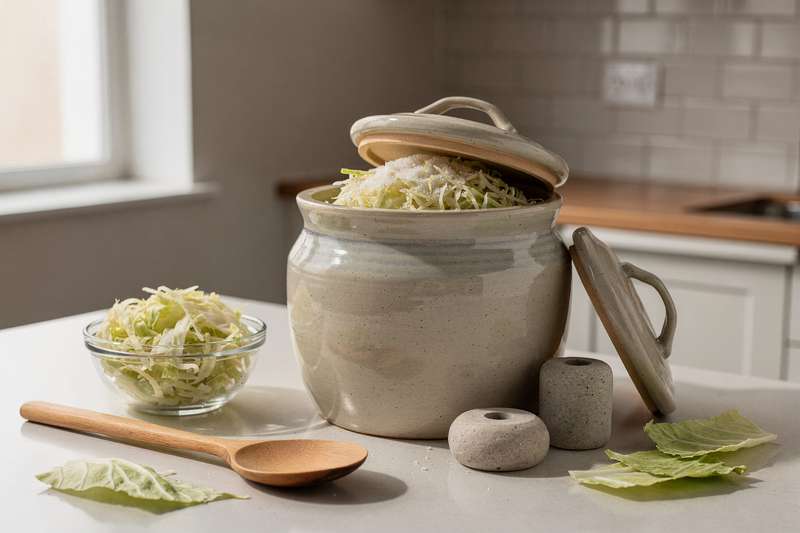
If you’re making sauerkraut for the first time and you want the format that gives you the best chance of a clean, successful ferment with minimal daily fussing, a 2–3 litre water-seal stoneware crock is the sensible starting point. In this style, the lid has a downward-facing rim that sits inside a shallow channel running around the top of the crock. You fill that channel with water, and it acts as a one-way valve: carbon dioxide from fermentation pushes out, but oxygen from the air cannot get in. You don’t need an airlock widget, you don’t need to burp the lid, and you don’t need to drape a cloth over it. Once you’ve packed the cabbage and filled the moat, the crock largely looks after itself.
At the 2–3 L capacity, you can ferment roughly 1–1.5 kg of shredded cabbage at a time, which yields enough sauerkraut to last a household of two or three people through several weeks of use. That’s a practical amount for a beginner: large enough to be worth the effort, small enough that a failed batch doesn’t sting too much. Look for a crock that includes at least one ceramic or glass weight to keep the cabbage submerged beneath the brine — this is non-negotiable for mould prevention. Many budget crocks in this tier omit the weight entirely, which then requires you to improvise with a zip-lock bag filled with brine, which is workable but annoying.
In terms of material, stoneware (a dense, vitrified ceramic fired at high temperatures) is what you want at this price range. It’s non-porous once glazed, doesn’t absorb brine flavours between batches, and holds a stable temperature reasonably well. When buying, check that the product listing explicitly states the glaze is lead-free and cadmium-free. Reputable sellers at this price point will advertise this openly; if the listing is silent on it, treat that as a red flag. The relevant food-contact safety framework in the UK and EU is Regulation 1935/2004 on materials in contact with food, and ceramic-specific provisions under EN 12873 and the related EU Directive 2023/2015 — compliant products will generally reference food-safe or food-grade certification. Products from established German or Polish ceramic manufacturers are more consistently tested in this regard, though Chinese-made crocks can also comply if the seller is transparent about testing.
The tradeoff with a 2–3 L water-seal crock is weight and fragility. Even at this modest size, a full stoneware crock is heavier than a glass jar and will break if dropped on a hard floor. Cleaning also requires care: the water channel must be dried thoroughly after washing or it can develop its own mould if left damp. That said, for hands-off fermentation that reliably produces good sauerkraut, this format is the most forgiving option a beginner can buy.
Best Budget Pick (Under £20): A Wide-Mouth Glass Jar with Airlock Lid
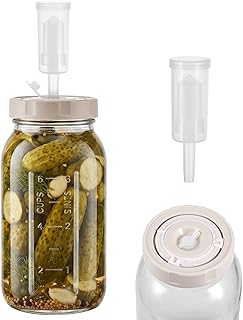
Glass jars fitted with a silicone or plastic airlock lid are the entry point for fermentation on a genuine shoestring, and they work better than most people expect. The principle is simple: the airlock — a small water-filled chamber that clips or screws onto the jar lid — allows CO2 to bubble out while preventing air from getting back in. It’s a cruder system than a ceramic water-seal moat, but for a first batch it’s entirely adequate.
The main practical advantage over a plain jar with a cloth cover is that the airlock removes the oxygen risk without any daily monitoring. You can see inside the jar, which is useful when you’re learning: you can watch the brine level, check that the cabbage stays submerged, and see bubbling activity that confirms fermentation is progressing. For beginners, that visibility is reassuring in a way that an opaque ceramic crock is not.
What to look for: choose borosilicate or thick-walled glass over thin soda-lime glass (more resistant to thermal shock when washing), a wide mouth of at least 8 cm diameter (easier to pack tightly and extract finished kraut), and a capacity of at least 1 litre. Many sets come with a glass or food-grade silicone weight included — prioritise these over sets that include nothing, since you’ll need something to keep the cabbage beneath the brine surface. A simple glass disc weight costs under a fiver separately, so factor that in if the set doesn’t include one.
The honest tradeoffs: airlock lids at the budget end of the market vary in quality. The rubber or silicone grommets that seal the airlock into the lid can degrade or fit poorly on some lids, occasionally leading to a slow oxygen leak that encourages surface yeast. Inspect the fit when the kit arrives — the airlock should seat firmly with no wobble. Also, glass jars at this price range often come without any temperature-moderating properties: a ceramic wall provides a small buffer against sudden kitchen temperature swings, whereas a glass jar doesn’t. This matters more in summer kitchens than in a stable cool larder.
For someone who isn’t sure whether fermentation will become a regular habit, a £10–£18 glass jar airlock kit is a perfectly reasonable place to start. If you enjoy the process and want to move up to a ceramic water-seal crock, you haven’t wasted much money — and the glass jar is still useful for smaller batches or kimchi.
Best for Small Households: A Compact 1–1.5 L Ceramic Crock
A 1–1.5 litre ceramic crock is a genuinely useful size if you cook for one or two people, or if you want to run small experimental batches — different salt percentages, different fermentation temperatures, caraway versus plain — without committing a full kilogram of cabbage each time. At this capacity, you’re looking at roughly 500–700 g of finished sauerkraut per batch, which is about right for a couple eating it regularly as a condiment over two weeks.
Compact crocks in this size often come with a simple lid rather than a full water-seal moat — the moat design becomes physically tricky to execute cleanly at very small diameters. Some use a silicone-gasketed lid that creates a near-anaerobic seal, which is adequate. Others use a basic press-fit ceramic lid, which is less reliable for oxygen exclusion — you’d want to confirm the seal type before buying. If the small crock you’re considering uses a basic lid without any sealing mechanism, it functions more like an open-top fermenter: you’ll need to check the surface every few days for any white film (kahm yeast, which is harmless but visually alarming) and remove it if present. This is manageable, but it’s more hands-on than a water-seal or airlock design.
Dedicated fermentation crocks — including compact ones with proper sealing lids — are specifically designed so that, once sealed and the water channel or airlock is in place, you don’t need to open or burp the lid during normal fermentation. If a small crock you’re considering doesn’t include a water-seal moat or an airlock fitting, check the product description carefully to understand what maintenance the seller recommends. A proper sealed design should require no daily intervention at all.
At the under-£40 price point, compact 1–1.5 L ceramic crocks with proper seals do exist — look for ones that explicitly include a weight (even a small ceramic disc) and list the glaze as food-safe. The tradeoff versus a glass jar at this size is that you lose the visibility but gain better temperature stability and the aesthetics of a proper ceramic vessel on the worktop. For someone who will use fermentation regularly as part of their cooking routine, the ceramic looks better and lasts longer. For someone still experimenting, the glass jar might be the wiser first buy.
Best for Batch Fermenters: A 3–5 L Stoneware Crock with Dual Weights
If you’re the kind of cook who already knows you’ll get through sauerkraut quickly — perhaps you use it in salads, add it to grain bowls, or want to make gifts — a 3–5 litre crock is worth considering even as a beginner purchase. The economics of fermentation strongly favour larger batches: the effort of shredding, salting, and packing cabbage is almost identical whether you’re doing 500 g or 2 kg, but the yield difference is enormous. A 3 L crock can hold roughly 1.5–2 kg of shredded cabbage and will produce a quantity of sauerkraut that justifies the initial effort.
Within the under-£40 bracket, a 3–5 L water-seal crock is at the top of the budget. You’ll find options that just squeeze in — look carefully at whether the listed price includes the weights, because some sellers price the crock and weights separately. Dual weights (two ceramic crescents or a pair of flat discs) are more effective than a single weight at this capacity, because the larger surface area of cabbage means a single small weight can shift and leave part of the batch exposed to air.
A crock of this size is not light. Filled with brine and cabbage, a 5 L stoneware vessel can weigh 4–5 kg. Think about where you’ll store it — a stable shelf at waist height is ideal, not a high cupboard where lifting it down while full is a spill risk. Cleaning a 3–5 L crock is also more of a commitment than cleaning a 1.5 L jar, though it only needs doing between batches rather than daily. If your kitchen has limited worktop space or your storage options are restricted, the compact 1–1.5 L option or a 2 L water-seal crock is more practical.
Buyers who find a 3–5 L crock at the very top of the budget (£35–£40) often report it as the purchase they wish they’d made first rather than starting small and upgrading later. That’s a reasonable view if you’re confident you’ll ferment regularly. If you’re genuinely uncertain, start smaller.
Best Complete Starter Kit: Glass Jar Set with Accessories
A complete fermentation starter kit — typically containing two or three wide-mouth glass jars, silicone airlock lids, glass or ceramic weights, a tamping tool, and sometimes a small recipe booklet — is the most accessible entry point for a total beginner. Everything arrives in one box, at a price that usually sits between £20 and £35 for a decent set, and you can start your first batch within an hour of opening it.
The value of a kit over buying components separately is partly convenience and partly compatibility. The airlock lids are matched to the jar threads, the weights are sized to fit through the jar opening, and the tamper (if included) is the right length for the jar depth. When you buy a crock and then realise the weights are too large to fit through the neck, or the airlock wobbles because it’s designed for a different lid standard, that’s an avoidable frustration.
When evaluating kits, look for: borosilicate or thick-walled glass (not thin-walled soda-lime glass that chips easily); glass weights rather than plastic ones (plastic can leach compounds into acidic brine over time, and flavour absorption is a real issue with cheaper grades); silicone airlock seals rather than hard rubber (silicone holds its elasticity better at low temperatures and doesn’t crack); and a jar capacity of at least 1 litre per jar. A kit with two 1 L jars is more useful than a kit with three 500 ml jars — small jars are awkward to pack properly and can struggle to maintain the right cabbage-to-surface-area ratio.
The limitation of glass jar kits versus ceramic crocks is primarily aesthetic and thermal. They look like lab equipment on your worktop rather than kitchen vessels, and the glass provides no insulation against temperature variation. Neither of these is a fermentation-quality issue in most UK kitchens, but it’s worth knowing. If you primarily want a kit that works reliably and can be stored flat in a cupboard between uses, a glass jar kit is excellent. If you want something that looks purposeful and stays on the worktop as part of your kitchen’s visual character, a ceramic crock is the better fit.
Best for Worktop Minimalists: A Slim Cylindrical Stoneware Crock
Some fermentation crocks are wide, squat vessels with a substantial footprint — fine if you have a large worktop, awkward if you’re working in a galley kitchen or a small flat. A slim cylindrical design (tall rather than wide, with a roughly equal height-to-diameter ratio or taller) takes up less surface area for a given capacity, and several stoneware options in this form exist in the under-£40 bracket at 1.5–2 L capacity.
The functional consideration with a taller, narrower vessel is that packing cabbage tightly becomes slightly more physically demanding — you’re pushing down into a narrower opening, which takes more arm effort with a tamper or your fist. The reward is a smaller footprint and, in some cases, a more attractive vessel: slim cylindrical crocks with a muted glaze (cream, slate grey, or dark brown) look more like intentional kitchen pieces than fermentation equipment. Some have handles on both sides, which helps with moving a full, heavy crock without gripping the smooth body.
Check that any slim crock in this form factor has a water-seal lid or a proper airlock fitting rather than just a push-fit lid — the narrower diameter makes a tight water-seal channel harder to manufacture at low cost, and some budget slim crocks cut corners here. A push-fit lid without a seal is not adequate for unattended fermentation; you’d need to check daily for surface kahm yeast. At the £25–£35 price range you can find properly sealed slim crocks; below £20 it becomes more hit-and-miss and worth reading recent buyer reviews carefully.
What to Look For When Buying a Fermentation Crock
- Water-seal lid vs airlock vs open-top: A water-seal moat (where the lid’s rim sits in a water-filled channel in the crock rim) is the most hands-off design for beginners — no daily maintenance required. An airlock lid (a small water-filled valve attached to a standard jar lid) is almost as good and cheaper. An open-top crock with no seal requires daily checks and brine top-ups, which suits experienced fermenters but not beginners.
- Included weights: Without a weight to keep cabbage submerged beneath the brine surface, you will get surface mould or kahm yeast. The weight should be made from ceramic or non-porous glass — never wood, which absorbs flavours and bacteria, and never bare metal, which can corrode in acidic brine. Check whether weights are included in the listed price or sold separately.
- Glaze safety: Ceramic vessels must use a food-safe glaze that is lead-free and cadmium-free. In the UK and EU, food-contact materials are governed by Regulation (EC) 1935/2004, and ceramics specifically must comply with the provisions of Directive 2023/2015 and testing standards such as EN 12873. Reputable sellers state this compliance explicitly; if a listing doesn’t mention glaze safety at all, look elsewhere.
- Capacity for your household: 1–1.5 L for one to two people making small batches; 2–3 L for two to four people or anyone who eats sauerkraut regularly; 3–5 L for batch fermenters or larger households. Don’t buy a 5 L crock if you’ll only fill it to 1 L — an under-filled crock has too much airspace, which increases mould risk and requires more salt brine to compensate.
- Material: Stoneware (high-fired ceramic) is the preferred choice — non-porous, stable, and odour-resistant between batches. Borosilicate glass is a sound alternative with the advantage of visibility. Avoid plastic fermentation vessels: plastic is porous at a microscopic level, scratches easily (creating bacterial harbours), and can impart flavours into acidic brine over repeated use.
- Cleaning ease: The water-seal channel deserves particular attention — it must be fully dried between uses or it can develop mould itself. Wider-mouthed crocks are easier to clean by hand. Some ceramic vessels are dishwasher-safe (check the listing), though the thermal cycling of a dishwasher can eventually craze fine-detail glazes over years of use.
- Accessories and instructions: A tamper or pounder for packing cabbage tightly is a genuine quality-of-life addition. A recipe card or instruction booklet is useful for complete beginners. These are not essential — you can use a wooden rolling pin as a tamper and find recipes freely online — but a kit that includes them saves a trip to the kitchen drawer in the middle of packing your first batch.
Verdict
For most first-time sauerkraut makers in the UK, the 2–3 litre water-seal stoneware crock is the pick that removes the most variables and gives you the best chance of a clean, successful first batch. The water-seal lid means you don’t need to check or maintain it daily, the included weights keep the cabbage submerged, and the ceramic material is stable, food-safe, and lasts indefinitely with reasonable care. At £30–£40 this is genuinely affordable, and unlike a glass jar starter kit, it’s a vessel you’ll still be using in a decade if you continue fermenting.
If £30 is still more than you want to spend on something you’re not yet sure you’ll keep doing, start with a wide-mouth glass jar airlock kit in the £10–£18 range. It won’t look as purposeful on your worktop, but it will ferment sauerkraut reliably, and if fermentation becomes a habit, you can upgrade to a ceramic crock later without any wasted knowledge — the process is identical.
Whatever format you choose, prioritise one feature above everything else: a proper sealing mechanism. An open-top crock or a jar with a cloth cover is the setup most likely to give you a mouldy first batch and put you off fermentation entirely. Spend the extra few pounds on a lid that seals, and the rest largely takes care of itself.
We were not paid to feature any specific product in this guide. All opinions are independent and based on publicly available specifications, verified buyer feedback patterns, and category research. Prices shown were accurate at time of writing and may change.
Quick Comparison Table



FAQ
Do I really need a fermentation crock, or can I use any jar?
You can make sauerkraut in any clean, non-reactive container — a wide-mouth mason jar works and many people start there. The advantage of a dedicated crock, particularly one with a water-seal lid, is that it removes the need to check and manage the vessel daily. An open jar or cloth-covered container lets oxygen in, which encourages mould if the cabbage rises above the brine even briefly. A sealed crock handles that problem passively, which makes it more forgiving for beginners.
What size fermentation crock should a beginner buy?
A 2–3 litre crock is a practical starting size for most households. It holds enough cabbage (roughly 1–1.5 kg shredded) to produce a meaningful quantity of sauerkraut without committing to a huge batch on your first attempt. Avoid going smaller than 1 litre — the proportion of airspace to cabbage becomes harder to manage — and avoid a very large crock (5 L or more) unless you’re confident you’ll fill it regularly, since an under-filled crock increases mould risk.
Is the glaze on cheap ceramic crocks safe to use with food?
It depends on the manufacturer and how transparent they are about testing. In the UK and EU, food-contact ceramics must comply with Regulation (EC) 1935/2004 and ceramic-specific standards including EN 12873, with lead and cadmium migration limits set out under Directive 2023/2015. Reputable sellers — particularly those producing in Germany, Poland, or the UK — will state clearly that the glaze is lead-free and cadmium-free. If a listing makes no mention of glaze safety at all, choose a different product. Stoneware glazed by established manufacturers in these countries is generally well-regulated and safe.
How do I stop white mould or film forming on my sauerkraut?
The white film you sometimes see is usually kahm yeast rather than dangerous mould — it’s a surface yeast that forms when cabbage is exposed to air. The main preventive measures are: keeping the cabbage fully submerged beneath the brine at all times (hence the importance of a weight), using a sealed lid to minimise oxygen exposure, and fermenting in a cool, stable location (18–22°C is ideal). If you do see a white film, skim it off promptly — it’s harmless, but if left it can impart a musty flavour.
Can I ferment other vegetables in a sauerkraut crock?
Yes — a fermentation crock is a general lacto-fermentation vessel, and the same process that makes sauerkraut works for kimchi, fermented carrots, pickled cucumbers, and most other vegetables. Rinse the crock thoroughly between batches of different vegetables, particularly between strong-flavoured ferments like kimchi and milder ones. A non-porous ceramic crock or glass jar won’t retain flavours between uses the way plastic would, so odour transfer between batches is minimal with proper cleaning.
How long does sauerkraut take to ferment in a crock, and how do I know when it’s ready?
At typical UK kitchen temperatures (18–22°C), sauerkraut reaches an edible, lightly tangy stage in around 7–10 days. Full, well-developed flavour with deeper sourness generally takes 3–6 weeks. Taste it from about day 7 onwards and stop the ferment when it tastes right to you — there’s no single correct endpoint. Refrigerate the finished sauerkraut (still in brine) to halt fermentation; it will keep for several months in the fridge.