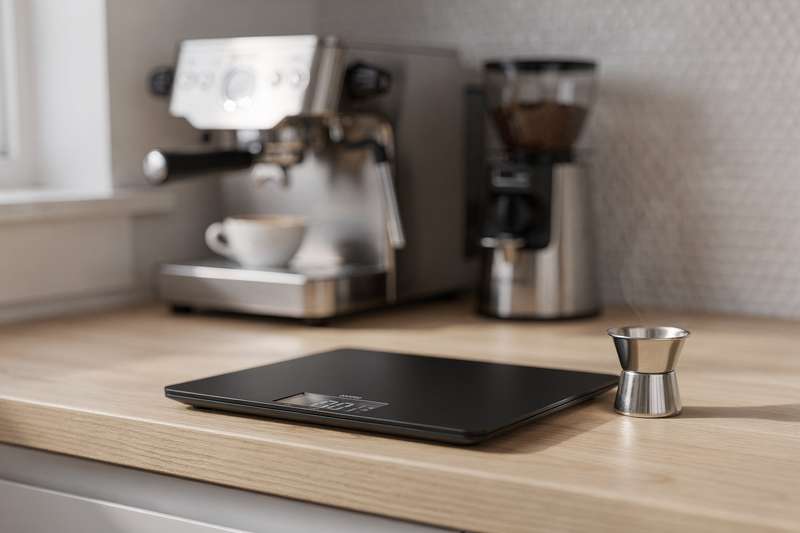
When Your Countertop Is Already Fighting for Space
You’ve got an espresso machine, a grinder, a tamper mat, and a milk jug — and somehow you’re supposed to fit a scale on that countertop too. If your kitchen is compact, or if your espresso setup occupies every available centimetre next to the sink, you already know the frustration: full-size kitchen scales are either too chunky to slide under the group head, too slow to register mid-pour weight changes, or so plasticky they feel out of place next to a £400 machine.
Maybe you tried a cheap postal scale and found it drifts mid-shot. Maybe you bought a baking scale only to discover it takes three full seconds to register a reading — an eternity when you’re pulling a 25-second espresso and trying to stop at 36g. Or perhaps you’re simply fed up with scales that take up the same surface area as a dinner plate.
What you actually need is a scale that fits between the drip tray and the front of the machine, reads in 0.1g increments, responds in real time, and doesn’t dominate your counter when you’re not using it. This guide identifies exactly that: genuinely slim, responsive coffee scales suited to tight countertop espresso stations in UK kitchens.
How We Evaluated These Picks
Every pick in this guide was assessed against five core criteria relevant to espresso preparation in small UK kitchens. First, footprint and height: a scale that won’t fit under a standard machine drip tray, or that towers over the portafilter, is automatically disqualified regardless of its other merits. Second, weighing resolution: 0.1g is the minimum for espresso work — anything coarser makes dialling in ratios unreliable. Third, response speed: a scale that lags two or more seconds behind live flow is largely useless for real-time shot monitoring. Fourth, timer integration: a built-in stopwatch eliminates one more gadget from your workflow. Fifth, battery practicality: rechargeable via USB-C is strongly preferred over disposable cells, and battery life matters when you’re brewing daily. Verified buyer feedback patterns from UK Amazon listings informed real-world observations on display readability, platform durability, and long-term stability calibration.
Quick Picks at a Glance
| Best for | Price range | Key feature |
|---|---|---|
| Tightest countertop spaces | £20–£35 | Under 105mm square, 0.1g resolution, hidden LED display |
| Slightly larger platform with fast response | £25–£40 | 6-unit display, auto-timer, wide silicone pad |
| Budget entry with timer | Under £20 | 0.1g resolution, manual timer, USB-C charging |
| Premium thin-profile with flow rate | £50–£80 | Real-time flow rate display, Bluetooth app, sub-8mm profile |
| Rechargeable with longest battery life | £25–£45 | 800mAh cell, 90+ day standby, waterproof surface |
| Best for pour-over and espresso combined | £30–£50 | 3kg capacity, 0.1g resolution, dual brewing modes |
| Most compact for travel or secondary use | Under £25 | Under 95mm wide, folds flat, pocket-sized |
Best for Tightest Countertop Spaces — The Ultra-Compact 105mm Scale
If your drip tray clearance is the limiting factor — and for many espresso machines it absolutely is — the first thing to check is whether the scale physically fits between the tray and the front of the machine without lifting the portafilter at an angle. A footprint of around 105 × 105mm (roughly 4.1 inches square) is the sweet spot: small enough to sit entirely beneath most commercial-style home machines, but large enough to hold a standard double-shot glass or small espresso cup without tipping.
Scales in this category typically offer 0.1g resolution across a 0.5g–2000g range, which covers espresso doses from 14g single shots up to a full 2kg if you happen to be weighing beans in bulk. The hidden LED display — where digits only appear when the scale is active — keeps the aesthetic clean and avoids the washed-out look of always-on LCD panels in a well-lit kitchen. Touch controls replace physical buttons, which means no raised edges to trap coffee grounds.
The real-world tradeoff here is surface area. A 105mm platform is snug enough that you’ll want to use a small vessel — a 60ml espresso glass or a short tumbler — rather than a wide mug. If your preferred cup has a base wider than about 80mm, it will overhang the edges, which affects both stability and weight distribution. That said, for a dedicated espresso station this is rarely a problem; espresso cups are small by design.
Battery life on scales in this bracket tends to be strong: look for a 500mAh or larger rechargeable lithium cell via USB-C, with real-world life of 60–90 days under daily use. What to avoid: scales that claim this footprint but have a raised lip or rubber frame that adds effective height — check the stated profile thickness and ensure it’s under 22mm so it clears the bottom of a standard drip tray.
Best for a Slightly Larger Platform with Fast Response
Not every espresso machine has a low-clearance drip tray. If yours sits the portafilter outlet a comfortable 80–100mm above the tray surface, you have room to use a scale with a slightly wider platform — around 170mm × 130mm — which offers meaningful practical advantages. A larger weighing surface means you’re not balancing a cup on a postage stamp, the silicone mat keeps it stable, and you can switch to pour-over or Aeropress without swapping to a second scale.
Scales in this tier typically support more measurement units — grams, millilitres, fluid ounces, pounds, and combinations — which is useful if you share the kitchen with someone who bakes or follows US-format recipes. The auto-start timer function is worth highlighting here: when the scale detects the first drop of liquid, it begins counting automatically, so you don’t need to fumble for a button the moment you flip the portafilter lever. This seemingly small feature significantly improves repeatability.
Response speed is where this bracket earns its place. Good examples in this category stabilise within 0.5–1 second of a weight change, which is responsive enough to monitor mid-shot extraction without the reading chasing the flow. Paired with a 0.1g resolution and a 3kg maximum, you can weigh out beans, tare the vessel, pull the shot, and time the extraction — all in one uninterrupted workflow.
The tradeoff is obvious: a larger footprint uses more counter space. On a genuinely cramped surface — think a 40cm-wide section of worktop between a machine and a wall — this may simply not be practical. Also check that the raised rim of the silicone mat doesn’t create a rocking effect if the mat is slightly misaligned; this is a noted issue in buyer feedback patterns for some models in this class. Opt for a flat silicone pad rather than one with a pronounced lip.
Best Budget Entry with Timer — Under £20
The sub-£20 segment has improved markedly over the past two years. Scales in this band now routinely offer 0.1g resolution, a manual timer, USB-C charging, and a two-unit display (grams and ounces at minimum), which covers everything most home baristas actually need. The compromise is usually in response speed — budget sensors tend to have a slightly longer stabilisation time, typically 1.5–2.5 seconds — and build quality, where ABS plastic housings feel less substantial than glass-topped units.
For someone dialling in their first espresso machine, or who wants a secondary scale to keep at the office without worrying about it being knocked around, the budget tier is a perfectly rational choice. The key specifications to look for even at this price point: 0.1g resolution (not 0.5g or 1g, which are too coarse for espresso), a maximum capacity of at least 500g (2kg is preferable), and a platform large enough to hold a standard espresso glass without the base overhanging.
What you’ll give up in this tier includes: flow rate display (a feature found only on purpose-built coffee scales above £40), Bluetooth connectivity, and the premium tactile feel of a glass platform. The displays on budget scales also tend to be smaller and harder to read at an angle — which matters when your scale is sitting under a machine and you’re reading it from slightly above and to the side. If readability is a priority, look for a display positioned at the front edge of the scale rather than centred.
One consistent pattern in buyer feedback for this category: auto-off timers set too short (30–60 seconds) are a common frustration when you’re mid-recipe and the scale powers down unexpectedly. Look for models where auto-off is either adjustable or set to at least 3 minutes.
Best Premium Thin-Profile with Flow Rate Display
Flow rate — the grams-per-second readout that tells you how fast liquid is passing through your puck — is a feature that separates purpose-built espresso scales from general kitchen scales marketed for coffee. If you’re chasing extraction consistency beyond just ratio, it’s the single most useful additional data point a scale can provide.
Scales with this feature sit at the higher end of the market, typically £50–£80, and they justify that premium with sub-8mm body profiles, Bluetooth connectivity for logging shots in a companion app, and extremely fast sensor response (often 0.3–0.5 second stabilisation). The profiles are genuinely thin — some are barely thicker than a thick credit card — which means they slide under drip trays where even compact 20mm-profile scales won’t fit.
The Bluetooth app integration varies significantly in usefulness. The better implementations allow you to log extraction parameters over time, spot trends in dose or yield drift, and even overlay a flow rate curve. The less useful implementations add only a cluttered interface and a dead battery within six months. When evaluating options in this tier, check whether the app has been updated in the past 12 months and whether UK buyers report reliable Bluetooth connectivity.
The practical tradeoff is fragility. Ultra-thin glass-topped scales in this bracket are more susceptible to damage from a dropped portafilter or a knock from a tamper. Many come without a protective silicone mat, assuming the glass surface is adequate — but a silicone pad is still worth sourcing separately to protect both the scale and your cups. If your kitchen station is tidy and deliberate, this tier rewards you with genuinely professional-grade data. If your workflow is faster and less careful, a mid-range scale with a thicker housing will serve you better long-term.
Best Rechargeable Scale with Longest Battery Life
Battery management is one of those things that only becomes a problem when you ignore it — until you’re mid-shot-pull at 7am and the scale dies. USB-C charging has largely solved the cable-hunting problem, but the actual battery capacity still varies significantly between scales at similar price points.
Scales with 800mAh cells are the standout performers in this regard. Under typical daily use — one or two shots per day, auto-off enabled — an 800mAh scale can realistically go 60–90 days between charges, compared to 20–30 days for 300–400mAh alternatives. The practical upshot is that you charge it once a month rather than once a week, which removes an irritating friction point from your routine.
Beyond capacity, look at how the scale charges: a USB-C port on the underside or side of the unit is preferable to a micro-USB port, which is being phased out across quality electronics. Some scales in this tier also support pass-through charging, meaning you can use the scale while it’s plugged in — helpful if you’re a heavy daily user with multiple shots across the day.
The waterproof surface deserves attention here. A borosilicate glass top is more resistant to moisture ingress than ABS plastic with a silicone overlay, and it wipes down cleanly even if espresso runs over during a shot. If the scale also has a detachable silicone mat, removal for separate cleaning is a clear advantage — coffee oils accumulate under the mat over time and are difficult to clean without removing it entirely. Avoid scales where the silicone is glued or integrated; it becomes unhygienic within weeks of daily espresso use.
Best for Pour-Over and Espresso Combined — Dual-Mode 3kg Scale
Not everyone has a single-purpose coffee station. If you switch between espresso in the morning and a larger pour-over or batch brew later in the day, a scale that tops out at 2kg becomes genuinely limiting — a 600ml kettle of water alone approaches or exceeds 600g, and with a server, Chemex, or V60 stand, you’ll quickly exceed a 2kg maximum.
Scales with a 3kg maximum capacity and 0.1g resolution cover both use cases without forcing a compromise. The 0.1g resolution at 3kg requires a more capable sensor than a 2kg/0.1g unit, which is partly why these scales sit slightly higher in price — typically £30–£50. The key specification to verify is whether 0.1g resolution is maintained across the full 3kg range, or whether it steps up to 0.5g or 1g above a certain threshold. Some scales advertise 0.1g resolution but only maintain it up to 1kg, switching to coarser increments above that. For espresso, this matters less; for precision pour-over with a heavy server, it matters considerably.
The dual brewing mode — where the timer can be set to count up automatically from first drop, or triggered manually — is well-suited to different brewing styles. Espresso benefits from auto-start (where hands are occupied at the lever); pour-over is often better with manual start so you can tare the vessel first without the timer running. The best scales in this bracket offer both modes switchable via a long-press or dedicated button.
Footprint is the natural downside here: a 3kg scale with a stable platform typically measures around 170mm × 130mm or larger, which is noticeably more counter space than an ultra-compact 105mm unit. If your countertop can accommodate it, the flexibility is worth it. If not, accept the 2kg limit and buy a separate scale for non-espresso brewing tasks.
Best for Travel or Secondary Use — Ultra-Portable Under 95mm
If you travel with an AeroPress, a Handpresso, or a portable espresso maker, or if you want a spare scale for a work kitchen or a campervan setup, the priority shifts from countertop ergonomics to portability and durability. Scales under 95mm wide fit in a jacket pocket or a small coffee travel pouch, weigh under 100g, and typically fold flat or have no raised elements that could catch in transit.
The core specifications remain unchanged — 0.1g resolution, a timer, USB-C charging — but the capacity is usually limited to 500g–1kg, which is fine for espresso and single-serve pour-over but unsuitable for batch brewing. Display size is the main practical limitation: a sub-95mm scale often has a display measuring just 25–35mm across, which can be difficult to read in low light or at an angle without leaning in.
Build quality varies more in this tier than any other. The best ultra-portable scales use a full stainless steel or toughened glass platform that withstands travel knocks; lower-quality examples use thin ABS plastic that develops hairline cracks after a few weeks in a bag. Check for a carrying case or protective sleeve — scales sold with a case are significantly less likely to arrive at a hotel with a cracked display.
For home use, an ultra-portable scale works well as a secondary unit: one dedicated scale lives under the espresso machine, and the portable one handles ad-hoc tasks — checking the dose before grinding, weighing beans for a travel kit, or sitting in a kitchen drawer for occasional use. At under £25, the entry cost is low enough that buying one as a backup is rational if you already own a primary scale.
What to Look For When Buying a Slim Espresso Scale
- Resolution and range: 0.1g is the minimum resolution for espresso. The range should cover at least 0.5g–2000g. Confirm that 0.1g resolution is maintained across the full range, not just below a threshold.
- Footprint and profile height: Measure the clearance between your machine’s drip tray surface and the bottom of the portafilter basket before buying. Profile heights vary from under 8mm (premium thin-profile) to 25mm (budget entry). Width matters too — 105mm is the practical minimum for a stable cup; 170mm+ suits pour-over vessels.
- Response speed: Look for sub-1-second stabilisation for live espresso monitoring. Budget scales often lag 1.5–2.5 seconds, which makes real-time flow management difficult but is acceptable for pre- and post-shot weighing.
- Timer integration: A built-in timer removes the need for a separate device. Auto-start (triggered by weight change) is most convenient for espresso; manual mode is useful for pour-over. Ideally, the scale offers both.
- Battery type and life: USB-C rechargeable is strongly preferable to AA/AAA cells. Battery life of 60+ days under daily use is realistic in mid-range and above. Avoid scales with micro-USB charging — the connector type is being phased out and cables are harder to source.
- Display readability: A front-edge display is easier to read under a machine than a centred display. Backlit or high-contrast LED is preferable to standard LCD in a kitchen environment with variable lighting.
- Surface material and cleaning: Borosilicate glass or stainless steel surfaces wipe clean easily and resist staining from coffee oils. ABS plastic with an integrated silicone mat requires more frequent cleaning. A removable silicone mat is preferable to a fixed one.
Side-by-Side Comparison
| Pick | Max capacity | Resolution | Footprint (approx.) | Profile height | Battery / charging |
|---|---|---|---|---|---|
| Ultra-compact 105mm | 2kg | 0.1g | 105 × 105mm | ~20mm | 500mAh, USB-C |
| Wider platform, fast response | 3kg | 0.1g | 170 × 130mm | ~25mm | 600mAh, USB-C |
| Budget entry with timer | 2kg | 0.1g | 130 × 100mm | ~22mm | 300–400mAh, USB-C |
| Premium thin-profile, flow rate | 2kg | 0.1g | 120 × 110mm | Under 8mm | 400mAh, USB-C |
| Long battery life (800mAh) | 2kg | 0.1g | 100 × 100mm | ~19mm | 800mAh, USB-C |
| Dual-mode 3kg | 3kg | 0.1g | 170 × 130mm | ~25mm | 600mAh, USB-C |
| Ultra-portable under 95mm | 500g–1kg | 0.1g | Under 95 × 90mm | Under 15mm | 250–350mAh, USB-C |
Verdict
For most UK home baristas with a compact countertop espresso setup, the ultra-compact 105mm scale with a hidden LED display and 0.1g resolution is the most practical choice. It fits under virtually every home espresso machine, charges via USB-C every four to six weeks under daily use, and keeps the counter free for everything else. The glass surface wipes down in seconds, the touch controls don’t accumulate grounds, and the integrated timer handles shot timing without a second device.
The only scenario where we’d suggest stepping up is if you regularly brew methods beyond espresso — in that case, the dual-mode 3kg scale with a larger platform gives you meaningful flexibility without sacrificing resolution. And if you’re serious about extraction data and don’t mind the premium, a thin-profile scale with flow rate display will tell you things about your puck preparation that a simple ratio can’t.
Start with the 105mm compact option. It handles the core task well, takes up almost no space, and costs less than a bag of specialty beans per month when amortised over its lifespan.
Editorial note: This guide was produced independently. No manufacturer or retailer paid for inclusion or influenced the editorial recommendations. All assessments are based on publicly available specifications, verified buyer feedback patterns, and category research. Prices quoted are indicative at the time of writing and may have changed.
FAQ
What resolution do I need in a kitchen scale for espresso?
0.1g resolution is the standard for espresso work. It allows you to measure doses to within a tenth of a gram, which matters when you’re working with 18–20g doses where even a 0.5g variation can shift the flavour profile noticeably. Scales that only resolve to 0.5g or 1g are too coarse for consistent espresso dialling-in, though they’re fine for baking or general cooking.
Will a slim kitchen scale fit under my espresso machine’s drip tray?
It depends on your specific machine. Most home espresso machines have between 50mm and 90mm of clearance between the drip tray surface and the bottom of the portafilter basket — enough for a scale with a 20–25mm profile. Measure this gap before buying. Some commercial-style home machines have shallower trays, which is where purpose-built coffee scales with sub-10mm profiles become the only viable option.
Is a built-in timer necessary, or can I use my phone?
A built-in timer is not strictly necessary, but it simplifies the workflow considerably. When both hands are occupied starting the shot and controlling flow, triggering a phone timer adds one more action. Auto-start timers — which activate when they detect a weight change — remove that step entirely. If you’re new to espresso and mainly focused on ratio rather than shot time, a phone timer works fine as an interim solution.
How do I clean a coffee scale without damaging it?
For scales with a glass or stainless steel surface, a damp cloth with a small amount of washing-up liquid is sufficient. Avoid submerging the unit or spraying liquid directly at the charging port or sensor area. If the silicone mat is removable, take it off weekly and rinse it separately — coffee oils build up underneath and are difficult to clean once hardened. For plastic-platform scales, use a soft cloth only; abrasive pads scratch the surface and make it harder to read weight from above.
Can I use a slim espresso scale for pour-over and Aeropress as well?
Yes, with caveats. A scale with a 2kg maximum capacity covers most single-serve pour-over and Aeropress brews comfortably. The platform size matters more here: a 105mm ultra-compact scale will fit an espresso cup but will be unstable under a wide V60 dripper or a full Chemex. If you brew multiple methods, either choose a scale with a larger platform (170mm+) or buy two scales — a compact one for espresso and a larger one for batch brewing.
What battery life should I expect from a rechargeable espresso scale?
Under typical home use — one to three shots per day with auto-off enabled — a scale with a 500mAh cell lasts roughly 30–60 days per charge; an 800mAh cell stretches to 60–90 days. Battery life drops significantly if you disable auto-off or use the scale in high-frequency commercial settings. USB-C charging is the current standard; a full charge typically takes 60–90 minutes. If you find yourself charging more than once a week under normal use, the battery cell is likely undersized or the auto-off threshold is set too high.