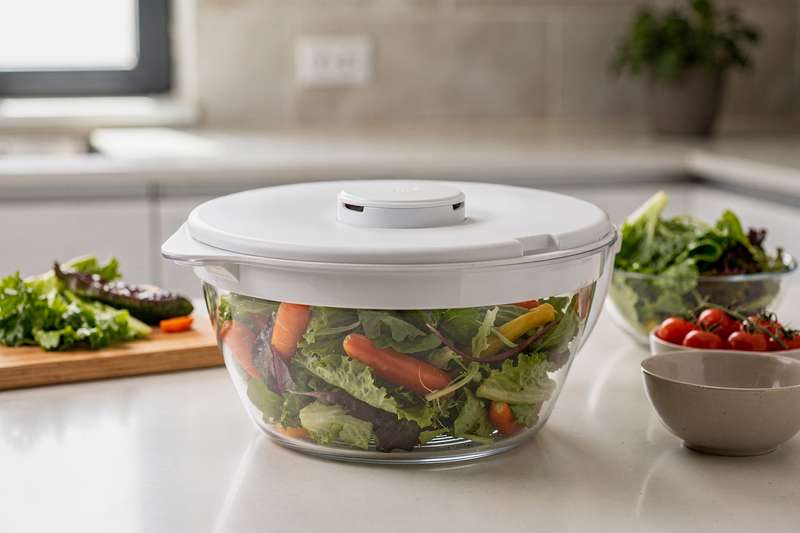
The Problem: Soggy Salads and a Spinner That’s Simply Too Small
You’ve just washed three heads of romaine, a bag of baby spinach, and half a cucumber’s worth of rocket. You pile it all into your current salad spinner and instantly realise the lid won’t close properly — you’re pressing down with one hand, spinning with the other, and water is still flying across your worktop. Half the greens are still dripping when they hit the bowl. Sound familiar?
Feeding a family of five means you’re dealing with volumes that most standard salad spinners were simply never designed for. The compact 3-litre models that look fine in a product photo are genuinely frustrating in daily use when you’re prepping for five people. You’ve tried shaking leaves dry in a colander (messy), wrapping them in a tea towel (they end up bruised), and buying those salad bags that come pre-washed (expensive and they still need a rinse). What you actually need is a proper large-capacity spinner — and one that won’t cost you more than £25, because this is a kitchen tool, not a lifestyle investment.
This guide is written specifically for that scenario. You need a spinner with at least 4–5 litres of usable basket capacity, a mechanism that doesn’t tire your hand out after ten seconds, and a build quality that will survive a dishwasher cycle. Let’s get into it.
How We Evaluated These Picks
Without access to a lab, the most reliable method is combining category expertise with deep pattern analysis across verified buyer reviews on Amazon UK, cross-referenced against product specifications. For this guide, the evaluation criteria were: basket capacity (minimum 4 litres usable — not the outer bowl figure manufacturers tend to quote), mechanism type (pull-cord, pump, or crank), ease of cleaning including dishwasher compatibility, bowl stability during spinning, lid locking for storage, and overall build quality relative to the sub-£25 price point.
Repeat complaints across dozens of reviews — a lid that cracks after two months, a cord that jams, a basket that wobbles — were weighted heavily. So were consistent positives: a basket that genuinely fits a whole cos lettuce, or a non-slip base that keeps the bowl anchored to the worktop. The result is a shortlist of options covering different mechanism styles and use cases, all within the £25 budget ceiling.
Best Overall for Family Use: The Large Pump-Top Spinner (5-Litre Basket)
If there’s one category of salad spinner that consistently wins over families, it’s the pump-top (also called press-top or push-button) mechanism. You push down repeatedly on a central button or disc on the lid, the basket spins, and a brake button stops it when you’re done. No cord to snap, no handle to wind — just a simple, repeatable action that even children can help with.
For a family of five, you want to be looking at spinners where the basket holds at least 5 litres. This is not the same as the outer bowl capacity — manufacturers routinely advertise the total assembly volume, which includes the outer bowl, and the usable basket is often 20–30% smaller. Read the listing carefully. The basket is what holds your leaves; the outer bowl collects the water. When a listing says “5-litre capacity” without specifying which part, check the dimensions. A basket roughly 25 cm in diameter and 14 cm deep gets you into genuinely family-sized territory.
The pump mechanism on the best options in this tier uses a central gear system: the pump action turns a spindle that rotates the basket at a useful speed without requiring much arm strength. Look for a brake button that’s integrated into the pump — so one button both drives and stops the spin. Spinners where the brake is a separate switch are clunkier to use in practice.
Real-world tradeoffs: pump-tops are excellent for speed and ease, but the mechanism does add complexity. On cheaper pump spinners (under £10), the plastic gear can strip after a few months of daily use, leaving you with a basket that won’t spin at all. In the £18–£22 range, the internal mechanism tends to be more robust. A non-slip base is important here — a 5-litre spinner full of wet leaves is heavy, and if the bowl slides across your worktop, you’ll be cleaning up more water than if you’d just used a tea towel. Look for a rubberised ring or silicone feet on the base.
The outer bowl doubling as a serving or prep bowl is a useful bonus: once you’ve spun the leaves dry, you can remove the basket and inner mechanism, and use the bowl as a salad bowl directly at the table. Not all models allow this cleanly — some have a central spindle fitting in the base of the bowl that makes it awkward. Check that the bowl base is flat and smooth if this matters to you.
Best Budget Pick (Under £12): The Pull-Cord Spinner
Pull-cord salad spinners have been around for decades and they still work. You thread a cord through a mechanism in the lid, pull sharply, and the basket spins. Pull again. Keep going until the leaves are dry. It’s more physical than a pump-top, but these models are cheaper to manufacture, which means more of the budget goes into build quality of the actual basket and bowl rather than an internal gear assembly.
For a family of five on a tight budget, a pull-cord model with a 4–4.5 litre basket is a functional choice. The key thing to look for is the quality of the cord mechanism itself. Budget models sometimes use a retractable cord that snags or a gear that strips quickly. The best-reviewed pull-cord spinners use a simple one-way ratchet: you pull, the cord retracts, you pull again. No fiddly mechanism, nothing to jam.
Where pull-cord spinners fall down is ease of use for children or anyone with limited hand or wrist strength. The pulling motion is straightforward, but you do need to grip the lid firmly with one hand while pulling the cord with the other. On cheaper models, the lid can lift off the bowl during spinning if you’ve overfilled the basket — which is both inconvenient and wet. A locking tab or clip that holds the lid to the bowl during operation is a feature worth prioritising.
On the positive side, pull-cord spinners tend to be simpler to clean precisely because the mechanism is contained within the lid: the bowl and basket are usually plain plastic with no moving parts, making them easy to rinse or pop in the dishwasher. The cord mechanism in the lid is rarely dishwasher-safe, but a wipe-down usually suffices. At under £12, you’re accepting some compromise on longevity — these are not lifetime purchases — but if you replace them every couple of years, the value case still holds.
Best for Easiest Cleaning: Simple Two-Piece Dishwasher-Safe Design
Cleaning a salad spinner sounds trivial until you’ve dealt with one that has a complex lid mechanism, narrow basket gaps that trap grit, and a bowl shape that pools water in corners. For families with five people eating and someone doing the washing-up, ease of cleaning matters more than you might expect.
The cleanest design is a spinner where the lid separates cleanly from the mechanism and all three parts — lid, basket, bowl — are clearly labelled dishwasher-safe on the top rack. Some manufacturers say “dishwasher safe” but mean “hand-wash recommended” in practice; look for listings that specify top-rack dishwasher safe and are backed by reviewers who confirm this over multiple cycles without warping or discolouration.
Basket construction matters here. Fine-mesh baskets with small holes drain water more efficiently but trap small herb leaves and bits of grit, requiring a thorough rinse after every use. Wider-spaced basket holes are easier to rinse but may let very small leaves through into the water-catch bowl. For a family eating mainly cos, romaine, spinach, and mixed leaves, medium-spaced holes (roughly 4–6 mm) hit the right balance.
Look for a bowl with a smooth, rounded interior — no ridges, no moulded details that trap residue. The area around the central spindle fitting at the bottom of the bowl is a common problem spot: if there’s a groove or recess here, it collects dirty water and leaf matter that’s genuinely awkward to clean without a brush. The best designs have a smooth, flat bowl base with a centre post that lifts cleanly out of a smooth socket.
One honest tradeoff: the simplest-to-clean spinners sometimes sacrifice spin efficiency. Without a well-engineered gear mechanism, the basket may not spin as fast or as smoothly, meaning you need more pulls or pumps to dry the leaves properly. This is a reasonable exchange if cleaning is your priority, and for most salad leaves it makes little practical difference — you’re not trying to achieve laboratory-grade dryness, just leaves dry enough that dressing sticks rather than sliding off into a puddle at the bottom of the bowl.
Best for Arthritic or Weak Hands: Ergonomic Pump-Top with Low Resistance
Not everyone in the family, or preparing food for the family, has strong or pain-free hands. Rheumatoid arthritis, repetitive strain, or simply tired hands at the end of a working day make a pull-cord or standard pump feel like unnecessary effort. There are salad spinners specifically designed with this in mind, where the pump mechanism requires very little downward force and the geometry keeps your wrist in a neutral position.
What to look for: a pump button that sits at a comfortable height (roughly 5–8 cm above the bowl rim when the lid is on), a smooth rather than stiff depression action, and a short pump stroke — you want to be pressing down 2–3 cm rather than 6–8 cm per pump. Some models also have a wider, palm-friendly pump disc rather than a small button, which distributes force across more of your hand.
In this category, the brake mechanism deserves attention. A spinner that brakes with the same button you pump — so releasing pressure gently decelerates the basket — is far more comfortable than one where you have to press a separate, stiff brake switch. Look for reviews that specifically mention ease of use for those with hand issues, as this is a genuinely frequent comment in this product category.
At the under-£25 price point, you won’t get the silky-smooth premium mechanisms of high-end spinners, but there are solid options that score well for low-effort operation. The outer bowl diameter on these tends to run slightly larger to accommodate the more engineered lid assembly — factor this into your storage space. Most measure around 26–28 cm across the base, which is manageable in a standard UK kitchen cupboard but worth measuring against your shelving before you order.
Best for Storage-Conscious Kitchens: Collapsible or Lockable-Lid Design
In many UK homes, kitchen storage is genuinely limited. A large salad spinner that sits on the worktop permanently is fine if you have the space; if you don’t, you need a model that stores efficiently. Two design approaches solve this differently.
The first is a collapsible spinner. The basket collapses down into itself like a concertina, shrinking to roughly half its operating height when not in use. These are typically made from flexible silicone or a combination of silicone and plastic. The advantage is obvious: you can store a collapsed spinner in a drawer or even in a cupboard alongside your pots with minimal fuss. The disadvantage is that silicone-heavy designs can feel flimsy during spinning, and the basket may not hold its shape as firmly, meaning it can wobble on the central post at high spin speeds. For a family of five, you’re also putting more volume through the spinner — check that the collapsed basket can actually hold enough volume in its extended position.
The second approach is a rigid spinner with a lid that locks down flat, keeping the assembly compact and stable in a cupboard. The better models also allow you to store washed, partially dried leaves directly in the sealed spinner in the fridge: the lid clips down, the bowl has enough depth to hold a day’s worth of salad, and the mesh basket keeps leaves from sitting in residual water. This is a genuinely useful feature for families who like to prep salad in advance — you wash and spin on Sunday, store in the spinner, and pull it out over the next two or three days as needed.
For storage-conscious buyers, also check the overall footprint of the bowl. A wider, shallower bowl takes up more shelf space than a narrower, deeper one. Think about where you’ll actually keep it — if it’s a cupboard shelf with a fixed height, a taller spinner may not fit even if the diameter is fine.
Best Crank-Handle Option: Side-Crank Salad Spinner
The side-crank mechanism is less common in the UK market than pump-tops or pull-cords, but it has genuine advantages worth considering. Instead of pressing a button or pulling a cord, you turn a handle mounted on the side of the lid, like winding a reel. This converts your turning motion into basket rotation via a gear, and because you’re using a continuous circular motion, you can build up impressive spin speed without the interrupted action of a pump or the arm-jerk of a cord pull.
Crank-handle spinners are particularly good for people who find the repetitive pumping motion uncomfortable, but who want more control over spin speed than a cord provides. You can speed up gently, hold a steady speed, and wind down gradually. The mechanism also tends to be durable: gear-and-crank assemblies have fewer failure points than cord retraction mechanisms.
The main practical disadvantage is that the crank adds width to the lid — you need enough worktop clearance to turn the handle without it hitting a wall, splashback, or adjacent appliance. On most models the crank is around 8–10 cm long, so you need roughly 12–15 cm of clear space to one side of the spinner. In a compact kitchen this can be genuinely annoying.
In the under-£25 bracket, crank spinners are available and decent. Look for a model where the crank folds or detaches for storage — a fixed horizontal crank makes the spinner awkward to stack or store in a cupboard. Basket capacity in crank models varies, so check the specs carefully: some are marketed for families but have baskets that are closer to 3.5 litres usable, which is undersized for five people with a proper salad as a side dish.
Best Dual-Use Design: Spinner That Doubles as a Serving Bowl
A salad spinner that functions as a serving bowl at the table is genuinely useful when you’re cooking for five, because it removes one step from dinner service. You spin the leaves, remove the basket (and lid mechanism), and carry the outer bowl to the table. The clear or frosted plastic bowl looks presentable enough that guests won’t feel underdressed dining from it, and you’ve saved yourself dirtying another piece of crockery.
For this to work well, the outer bowl needs a smooth, clean interior — no central post socket that’s left behind when the basket is removed, no mechanism mount that mars the base. It should also be a shape you’d actually want on your table: a gently flared rim and clear material usually reads better than an opaque bowl with branding moulded into the side.
The basket must lift cleanly out of the bowl without carrying the lid mechanism with it — on some designs, the basket is bonded to the lid mechanism and you can’t separate them easily, making this dual-use idea impractical. Check that the basket and lid are genuinely separate parts before buying.
Capacity is again the key spec here. A 5-litre outer bowl that’s only 10 cm deep won’t hold a family-sized dressed salad comfortably — you want depth as well as diameter. Around 12–14 cm of bowl depth, combined with a 24–26 cm diameter, gives you space for tossing and serving without leaves escaping over the rim. At the under-£25 price point, you’ll find several options that hit this, though build quality of the outer bowl varies. Look for BPA-free materials (most modern options are, but it’s worth checking the listing) and a bowl that’s confirmed dishwasher-safe.
What to Look For When Buying a Large Salad Spinner
- Usable basket capacity, not total bowl volume: Always look for the basket measurement — 4 litres minimum for a family of five, 5 litres preferred. If the listing only states total capacity, check the dimensions and calculate. A basket around 25 cm across and 13–14 cm deep is roughly 5 litres.
- Mechanism type and durability: Pump-tops are the most convenient but have more moving parts to fail. Crank handles are smooth and durable but need worktop clearance. Pull-cords are simple and cheap but can snap or jam over time. Choose based on how you’ll actually use it, not just what looks easiest in the product photo.
- Non-slip base: A large spinner full of wet leaves is heavy and awkward. Without rubber feet or a silicone ring on the base, the bowl will slide every time you pump or pull. This is a small detail that makes a disproportionate difference in daily use.
- Dishwasher compatibility: Check whether all parts — not just the bowl — are top-rack dishwasher safe. The lid mechanism often isn’t, even when the bowl and basket are. If the lid can’t go in the dishwasher, it needs to be easy to rinse by hand.
- Lid locking for fridge storage: If you prep salad in advance, a lid that clips or locks shut lets you store washed leaves in the spinner in the fridge for 2–3 days without them wilting as fast. Not all spinners offer this, and it’s worth the minor premium.
- Brake mechanism: A spinner without a brake means you wait for the basket to decelerate on its own — which takes longer than you’d expect at full spin speed. An integrated brake button (ideally the same button as the pump) is a significant convenience improvement.
- Material and BPA status: Most salad spinners in this price range are made from polypropylene (PP), which is food-safe and BPA-free. Double-check listings that don’t specify — older or very cheap imports occasionally use materials you’d rather not have in contact with food you’re eating raw.
How They Compare: Specifications Side by Side
Verdict: Which One Should You Actually Buy?
For the majority of UK families of five, the best salad spinner under £25 is a large pump-top model with a 5-litre basket, integrated brake, non-slip base, and a lockable lid for fridge storage. This combination solves the most common family-kitchen frustrations: the basket is actually big enough to fit a whole cos lettuce with room for rocket on top, the pump is fast and easy enough that you’ll use it every day rather than avoiding it, and the lockable lid means Sunday’s batch of washed leaves is still fresh and ready on Tuesday evening.
If budget is the primary constraint and you’re prepared for a slightly smaller capacity and a bit more physical effort, a well-reviewed pull-cord model under £12 is a genuinely functional alternative — just prioritise one with a locking lid tab and confirmed non-slip base.
Avoid anything that quotes a total capacity figure (bowl + basket combined) without specifying usable basket volume — this is the single most misleading spec in the category, and it’s how a “5-litre spinner” can leave you unable to fit half a bag of spinach.
We were not paid to feature any specific product in this guide. All opinions are independent and based on publicly available specifications, verified buyer feedback patterns, and category research. Prices shown were accurate at time of writing and may change.
Quick Comparison Table


FAQ
What size salad spinner do I need for a family of five?
For five people eating salad as a side dish, look for a basket with at least 4.5 to 5 litres of usable capacity. That typically means a basket around 25 cm in diameter and 13–14 cm deep. Remember that manufacturers often quote the combined volume of the outer bowl and basket — always check the basket measurement specifically, as that’s where your leaves actually go.
Are pump-top salad spinners better than pull-cord ones?
Pump-top spinners are more convenient for everyday use — the action is gentler on your wrists and you can control speed more precisely. Pull-cord models are simpler, cheaper, and have fewer parts to fail, but they require more physical effort and the cord can snap or jam over time. For a family using a spinner daily, a pump-top with an integrated brake is generally the better long-term choice.
Can I store washed salad leaves in the spinner in the fridge?
Yes, and it’s one of the most useful things a salad spinner can do. After spinning, remove excess water from the outer bowl, leave the leaves in the basket, and place the whole assembly (lid locked or clipped down) in the fridge. Leaves stored this way — slightly damp but not sitting in water — typically stay fresh for two to three days. Not all spinners have lids that lock shut, so look for this feature if fridge storage matters to you.
Are salad spinners dishwasher safe?
Most modern salad spinners have bowls and baskets that are top-rack dishwasher safe. The lid mechanism — whether pump, crank, or cord — is more variable. Cord and pump mechanisms often trap water internally and manufacturers usually recommend hand-washing these parts, or at least wiping them down. Always check the specific listing rather than assuming the entire spinner is dishwasher safe.
Why does my salad dressing slide off even after spinning?
The most common cause is that the leaves still carry a thin film of water on their surface after spinning — either the spinner wasn’t run long enough, the basket was overfilled, or the mechanism isn’t generating enough speed to fling the water off efficiently. Overfilling is the usual culprit: a 5-litre basket loaded beyond two-thirds of its capacity won’t spin leaves dry as effectively because the outer leaves block water from escaping. Spin in two batches if you have a very large volume of leaves.
Is a salad spinner worth buying if I mostly buy pre-washed salad bags?
Pre-washed leaves still benefit from a quick rinse — the ‘washed’ label refers to a brief commercial rinse, and for five people eating salad regularly, the cost of pre-washed bags adds up quickly compared to buying whole heads or loose leaves. A salad spinner also works for washing and drying fresh herbs, which go into everything from weeknight pasta to weekend roasts. If your family eats salad two or more times a week, a spinner pays for itself within a few weeks in saved packaging costs alone.