You’ve sat down at your desk with every intention of getting through a solid block of work. Within ten minutes, your feet are tapping against the floor, your legs are bouncing, and you’ve opened three browser tabs that have nothing to do with the task in front of you. It’s not a discipline problem — for many adults with ADHD, and for plenty of people whose nervous systems crave movement to stay regulated, sitting still is a constant challenge. Your body needs proprioceptive input — physical feedback from movement and pressure — to settle into a state where sustained focus becomes possible.
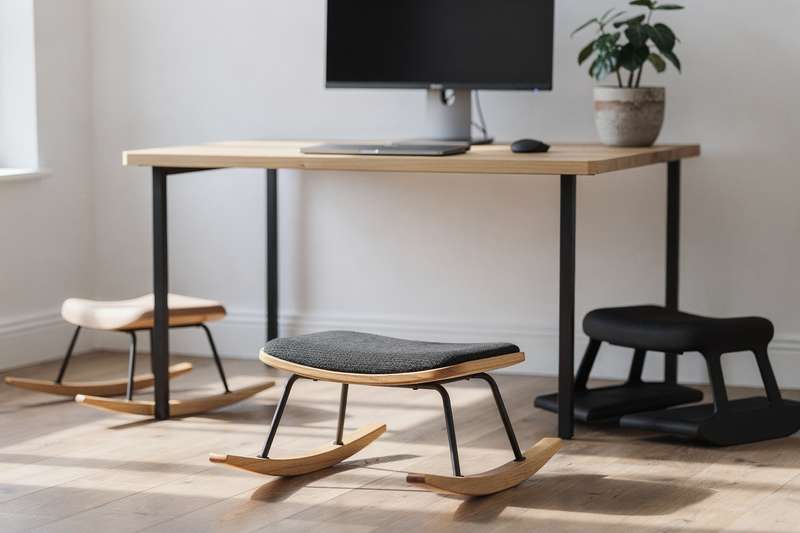
This is where a rocking footrest comes in. It sits under your desk and gives your feet somewhere purposeful to go, channelling restless energy into a quiet, rhythmic motion rather than letting it scatter your concentration. The concept is rooted in occupational therapy practice around sensory regulation — when your body’s movement needs are met at a low level, higher-level cognitive work becomes less of a battle. The difference between three hours of fractured attention and three hours of meaningful output can sometimes come down to what’s happening under your desk.
This guide covers the best rocking and active footrests currently available on Amazon.co.uk, with honest assessments of what each one does well and where it falls short.
How These Picks Were Evaluated
Evaluating footrests for ADHD focus requires different criteria from a standard ergonomics assessment. For this guide, each product was assessed on: the quality and smoothness of the rocking motion (an abrupt or jerky movement becomes its own source of distraction), noise level during use (critical in shared offices or on video calls), surface texture and sensory feedback, height adjustability for varied desk and chair configurations, structural quality relative to price tier, and weight capacity. Verified buyer reviews were central to the process — specifically, feedback from buyers who mentioned ADHD, restlessness, or sensory processing differences as their reason for purchase. General comfort feedback was useful context but carried less weight than reviews grounded in focus and regulation challenges. Products with very small review samples are flagged clearly in each section so you can calibrate your confidence accordingly.
Best Overall for Active Sitting — StrongTek 2 in 1 Footrest Rocker
The StrongTek 2 in 1 Footrest Rocker Wood Height Adjustable Non Slip is the strongest all-round choice in this guide, combining a solid natural wood build, height adjustability, and a dual-mode function that works whether you want active rocking or a stable platform to rest your feet.
The dual-mode design is the key differentiator. It functions both as an active rocking footrest and as a conventional flat footstool, so you can switch between modes depending on your task or energy level. During sustained concentration work — writing, coding, working through a lengthy document — a gentle, repetitive rocking motion occupies the part of your nervous system that would otherwise drive leg bouncing or chair fidgeting, without pulling your attention away from the screen. During a video call where you’d rather not appear visibly restless, switching to static mode keeps you grounded while maintaining ergonomic foot positioning.
The natural wood construction gives it a heft that translates directly to stability on the floor. At 4.2 stars from 95 reviewers on Amazon.co.uk, this has the most substantial verified feedback base of any product in this guide. The pattern across those reviews is consistent: buyers describe the rocking motion as smooth and controlled rather than abrupt, and note that the build quality holds up to daily use over time. Several reviewers specifically mention using it to manage leg bouncing and restlessness in a home office environment — the exact scenario this guide addresses.
There are real tradeoffs to acknowledge. This sits at the premium end of this category’s price range, making it a considered purchase rather than an impulse decision. The height adjustability is useful, but users with very low chairs or unusually shallow under-desk clearance may find the available range limiting. The natural wood surface is clean-looking but provides less tactile stimulation than a footrest with dedicated massage rollers — if your ADHD includes a strong drive for varied texture underfoot, you could add a textured mat on top, though that introduces a workaround to an otherwise straightforward setup.
On hard floors, wooden rockers produce a faint rhythmic sound. It’s considerably quieter than audible foot-tapping, but in a very quiet shared office it’s worth factoring in. Placing a thin rubber mat beneath the footrest or using it on carpet largely eliminates this. The non-slip pads on the underside keep the footrest from shifting during use — a rocker that drifts unpredictably will frustrate more than it helps.
For desk workers with ADHD who want one footrest that covers active rocking, static support, a durable natural wood build, and height adjustability, this is the clear recommendation. The depth of its verified review base provides confidence that newer entrants in this guide simply cannot yet match.
Best Budget Rocking Footrest — Foot Rest Under Desk Wood Rocking Foot Stool Curved Legs Massage Roller
If you’re uncertain whether active rocking will suit your particular focus style, the Foot Rest Under Desk Wood Rocking Foot Stool Curved Legs Massage Roller lets you test the concept at a lower outlay before committing to a premium spend.
The curved-leg design creates a natural pendulum arc when you press your feet forward and release. This back-and-forth motion is the active component — your feet stay in continuous, habitual movement rather than pressing down statically against the floor. The massage roller on the upper surface adds a second layer: as you rock, the roller provides pressure feedback to the soles of your feet. For people whose sensory needs include texture alongside motion, this combined input can be more effective at sustaining regulated focus than a plain rocking surface alone.
At 3.9 stars from 50 reviewers, the rating accurately reflects a capable budget option with some real-world limitations. Positive reviews focus on the value and describe the rocking motion as responsive to light foot pressure — some users actually prefer a slightly looser feel, finding it requires less deliberate effort to keep the movement going. Critical feedback clusters around two recurring themes: build consistency (a handful of buyers noted minor variations between units) and sliding on smooth floors (the curved legs can drift on hard flooring during vigorous rocking). Both are practical to address — a small non-slip mat underneath resolves the floor-sliding issue for most users and costs next to nothing.
This is not a long-term premium investment. The wooden construction is functional rather than refined, and while no reviewers reported structural failure during regular use, buyers wanting a footrest to survive five or more years of daily heavy use should look at the StrongTek above. The curved-leg rocker suits someone testing the active-rocking concept for the first time, or furnishing a secondary desk setup that doesn’t require the product to take sustained daily punishment.
The 3.9-star rating sits below the threshold where you’d choose a product unreservedly. Go in expecting a capable starter rocker with some rough edges, and it will likely satisfy. Expect the refinement of something twice the price, and you’ll be disappointed. The honest framing is: it’s a credible proof-of-concept for active sitting, not a keeper.
Best Foldable Rocking Footrest — Foldable Under Desk Foot Rest, Wooden Rocking Footrest with 4 Massage Rollers
The Foldable Under Desk Foot Rest, Wooden Rocking Footrest with 4 Massage Rollers brings portability to a category that rarely offers it. If your working pattern spans multiple locations — a home desk, a co-working space, a client’s office — the ability to fold and carry your footrest is a practical advantage most wooden rockers simply can’t provide.
The four massage rollers across the upper surface are the most distinctive sensory feature in this guide. Rather than a single roller bar or a uniform textured pad, four individual rollers allow different areas of your feet to work independently as you shift and rock. This variety can sustain sensory engagement longer than a single repeated texture — when one pressure point becomes habitual and your nervous system starts to filter it out, your feet naturally migrate to a different roller, refreshing the input. For ADHD nervous systems that habituate quickly to repetitive stimuli, this variation can extend the regulating effect meaningfully across a long working day.
The foldable hinge is the structural element that determines whether a portable footrest works well or poorly over time. Flimsy hinges develop play quickly, translating to an unstable rocking surface — the worst outcome for an active-sitting tool. The available reviews describe the mechanism as solid and the rocking surface as stable during use, which is the right signal to look for. The silicone anti-slip elements referenced in the product description are also important: without them, a lightweight foldable footrest on a hard floor would drift under rocking rather than maintaining a controlled arc.
The honest caveat is the review sample size. At 5.0 stars from 4 reviewers, the rating is promising but not statistically meaningful. Four buyers cannot reliably indicate long-term durability, consistency across production batches, or daily performance over months of sustained use. You’re taking a larger leap of faith here than with the StrongTek or the curved-leg budget option, and it’s worth acknowledging that upfront.
If portability is a genuine requirement of your working setup, and the four-roller sensory design specifically matches how your ADHD manifests, this is worth considering. If you’re primarily desk-bound and reliability over time is the priority, a more thoroughly reviewed pick will serve you with greater confidence. The concept is compelling; the data behind it is still thin.
Best Adjustable Ergonomic Footrest — FootRest Under Desk- Adjustable Ergonomic Foot Stool with Massage Surface
The FootRest Under Desk- Adjustable Ergonomic Foot Stool with Massage Surface takes a different approach from the curved-leg rockers: rather than prioritising vigorous rocking motion, it pairs height customisation with a textured massage surface that provides continuous, low-level sensory feedback while you work.
Height adjustability is genuinely underappreciated in footrest design. The relationship between your chair height, desk height, and the natural resting position of your feet is highly individual. A footrest set even slightly too high creates knee compression and hip discomfort; too low, your feet barely make contact and the ergonomic benefit disappears. Getting this right matters because physical discomfort is an often-overlooked driver of restlessness in people with ADHD. When your body is at ease, that layer of distracting physical sensation is removed — and the neurological component of fidgeting becomes somewhat easier to address on its own terms.
The massage surface provides persistent, low-level engagement. Your feet press and shift against the textured surface, stimulating pressure receptors continuously without requiring active rocking. This is qualitatively different from the pendulum feel of a curved-leg rocker — a sustained, quiet sensory presence rather than a rhythmic back-and-forth. Many ADHD adults find this preferable during tasks demanding very deep concentration, where even a gentle rocking motion can start to feel intrusive. If you’ve tried active rockers and found that the movement itself became a distraction, a textured stationary surface may be a better fit for your sensory profile.
At 5.0 stars from 7 reviewers, the small sample caveat applies: this isn’t a statistically reliable picture yet. The available feedback describes it as well-constructed for its price tier, easy to move between height positions, and with a massage texture that is effective without being aggressive on bare feet. The positive signals are there; the volume of data to confirm them isn’t.
The limitation is straightforward: this footrest does not rock. If your ADHD manifests primarily as a need for physical, rhythmic foot movement, a stationary textured footrest won’t meet that need. It works best for ADHD adults who need subtle, consistent sensory support during deep focus work rather than the more vigorous stimulation of an active rocking arc. For those users, it’s a well-thought-out option.
Best for Soft Sensory Input — Ergonomic Foot Rest Cushion Foot Stool Under Desk Footrest Office
Not everyone with ADHD has the same sensory profile. Some adults are sensory-sensitive rather than sensory-seeking, finding hard surfaces and vigorous movement more overwhelming than regulating. For this group, the Ergonomic Foot Rest Cushion Foot Stool Under Desk Footrest Office is the most appropriate option in this guide: a foam cushion with two adjustable height positions, a non-slip fabric surface, and a removable washable cover.
At 4.6 stars from 28 reviewers, this is one of the better-reviewed products here — second only to the StrongTek on review count — and the feedback pattern is telling: buyers focus almost entirely on the comfort improvement. Moving your feet from a hard floor to a well-positioned foam cushion changes the physical experience of long desk sessions — less pressure accumulating in the heels, less tension in the calves, less lower-back ache from compensatory posture. For ADHD adults whose restlessness is partly a response to physical discomfort rather than purely neurological urge, addressing the discomfort directly can be more effective than attempting to channel it into controlled motion.
The two height positions suit most standard desk-and-chair configurations. Users who need very precise ergonomic calibration may find this limiting, but for the majority of common setups the two options cover the necessary range without requiring ongoing adjustment throughout the day.
The washable cover deserves specific mention as a practical differentiator. Under-desk footrests collect dust, pet hair, and the general accumulation of floor-level daily life quickly — particularly in the embedded fabric of a foam surface. A removable cover that can go in the washing machine keeps the footrest hygienically fresh with minimal effort over time. Foam footrests with fixed, unremovable covers become noticeably grubby faster than you’d expect, and this product avoids that problem neatly.
The non-slip fabric surface prevents your feet from sliding as you shift and reposition — important for restless feet that are constantly adjusting angle and pressure. You can move freely without the cushion migrating under you during a long session.
The key limitation is clear and upfront: this footrest does not rock. It holds firm. If the core of what you need is a movement outlet for your feet, a foam cushion won’t provide it. Think of it as a comfort and ergonomics upgrade rather than an active-sitting tool. For sensory-sensitive ADHD adults, or for those who find physical discomfort is a primary driver of their restlessness, it’s a practical and well-supported choice. For everyone else, the rocking options above are the better fit.
What to Look For in a Rocking Footrest for ADHD and Active Sitting
- Rocking mechanism type: Curved-leg designs create a pendulum arc when you press your feet forward and release — this tends to feel organic and habitual, requiring minimal conscious effort to maintain. Roller-based footrests roll in a more controlled direction. Consider which type of movement your natural fidgeting most resembles: if you bounce your heels rhythmically, a curved rocker is the closer analogue; if you push and drag your feet, a roller may suit you better.
- Noise level: In a shared office or during video calls, a noisy footrest creates a new problem instead of solving the original one. Wooden rockers on hard floors produce a soft rhythmic sound. Look for silicone or rubber anti-slip pads on the base, and consider a thin mat underneath on hard flooring. Foam and cushion options are effectively silent in all settings.
- Height adjustability: Your feet should rest flat with your knees at approximately 90 degrees and your thighs roughly parallel to the floor. A fixed-height footrest that doesn’t match your specific chair-desk configuration provides limited ergonomic benefit. Look for at least two height positions, preferably three or more for finer calibration.
- Surface texture: Massage rollers, textured pads, and smooth wooden surfaces each engage the nervous system differently. If tactile stimulation is a significant part of how you self-regulate, prioritise rollers or pronounced texture. If you need movement without texture overload, a smooth rocking surface is sufficient and less likely to become overwhelming during a long working day.
- Weight capacity and stability: Check the stated weight limit, particularly if you tend to lean forward and apply significant downward force during concentration. A heavier, solid-wood build tends to be more stable during vigorous rocking than lighter bamboo or composite alternatives.
- Material durability: Solid natural wood holds up well to daily use. Foam compresses over time under constant foot pressure — check whether foam density is described, as higher density means longer-lasting support. Foldable designs should have metal-reinforced hinges rather than plastic-only mechanisms, which tend to develop play quickly.
- Portability needs: If you work across multiple locations, a foldable footrest with a compact profile is worth the slight stability compromise. For a fixed desk setup, a heavier non-folding model is preferable — it stays put and there’s nothing to fold and unfold each day.
Verdict
For most UK desk workers with ADHD looking for a rocking footrest that will hold up to daily use and actively support focus, the StrongTek 2 in 1 Footrest Rocker Wood Height Adjustable Non Slip is the most well-rounded choice available on Amazon.co.uk right now. With 95 verified reviews, a 4.2-star rating, solid natural wood construction, height adjustability, and the flexibility of dual rocking and static modes, it covers the broadest range of ADHD focus needs in a single product. That review base gives real confidence in the consistency of the rocking motion and build quality — both of which matter considerably in this specific use case.
If the budget tier is where you need to start, the Foot Rest Under Desk Wood Rocking Foot Stool Curved Legs Massage Roller is a credible entry point — it demonstrates the active-rocking concept at a lower cost, with the understanding that build quality and long-term durability are commensurately modest. If it works for your focus style, you’ll have a clear baseline from which to upgrade later.
If your sensory profile leans sensitive rather than seeking, or physical discomfort is a bigger driver of your restlessness than neurological fidgeting, the Ergonomic Foot Rest Cushion Foot Stool Under Desk Footrest Office at 4.6 stars from 28 reviewers is the most practical comfort-first choice in this guide. Making a long day at your desk meaningfully more comfortable is sometimes the more impactful intervention.
This guide was produced independently. We were not paid to feature any specific product in this guide. All opinions are independent and based on publicly available specifications, verified buyer feedback patterns, and category research.
Quick Comparison Table


FAQ
Does a rocking footrest actually help with ADHD focus?
For many people with ADHD, proprioceptive input — the physical sensation of movement and pressure — helps the nervous system settle into a more regulated state that supports concentration. A rocking footrest provides this input at a low, continuous level, giving restless feet something productive to do rather than tapping or bouncing uncontrollably. The approach is well-established in occupational therapy for managing sensory-seeking behaviour, though individual responses vary — what regulates one person’s nervous system may distract another’s.
What’s the difference between a rocking footrest and a standard footrest?
A standard footrest holds your feet at a fixed height and angle, providing ergonomic positioning without any movement. A rocking footrest has a curved base or roller mechanism that allows your feet to move back and forth while you sit. For active sitting and ADHD management, the movement component is the defining feature — it provides ongoing sensory input that a static footrest simply cannot replicate.
Will a wooden rocking footrest be noisy in an open-plan office?
Wooden rockers on hard floors can produce a soft rhythmic sound as they move. In most shared offices this is minimal and significantly quieter than audible foot-tapping, but on very smooth flooring it can carry somewhat. Placing a thin non-slip or anti-fatigue mat beneath the footrest absorbs most of the contact sound. Foam cushion footrests are effectively silent in all settings.
How do I find the right height setting for my desk setup?
Your feet should rest flat and comfortably with your knees at approximately 90 degrees and your thighs roughly parallel to the floor. If your feet float above the surface or your knees are forced sharply upward, the footrest is too high for your current chair. Most ergonomists recommend that the footrest supports the position you would naturally sit in, rather than forcing your legs into a new angle.
Can children with ADHD use these footrests at a homework desk?
Most of the products in this guide are sized and rated for adult use — the surface dimensions and rocking arc are calibrated to adult foot size and standard desk heights. For children, look specifically for footrests marketed for classroom use or sized for younger users. The underlying concept of proprioceptive input to support focus is the same, but the physical dimensions need to match the child’s chair and desk height to be effective and safe.
How long before I notice a difference in focus when using a rocking footrest?
Most people notice within a few days whether active rocking makes a meaningful difference to their focus. The effect tends to be noticeable fairly quickly — there is often a clear shift in how settled your lower body feels, which translates to less split attention and fewer involuntary fidget breaks. If after a week or two of consistent use you are not noticing any improvement, rocking footrests may not match your specific sensory profile, and alternatives such as a standing desk converter, balance board, or seated wobble cushion may be worth exploring instead.