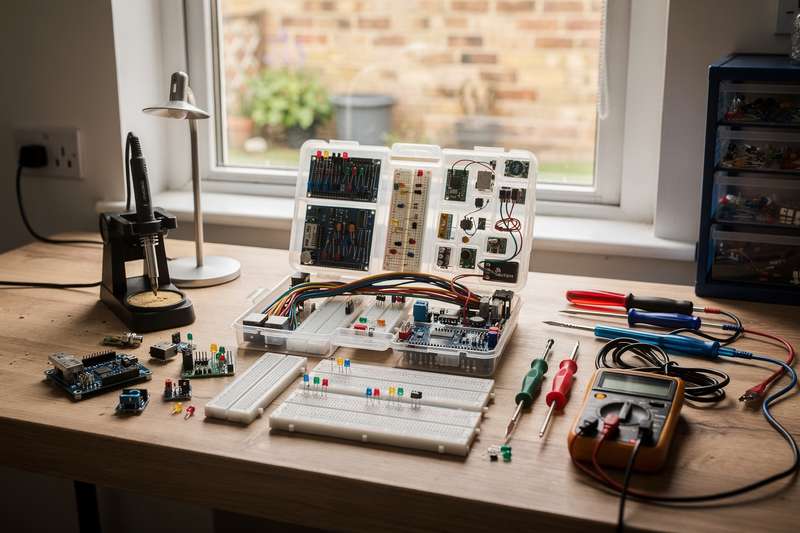
There you are, Sunday afternoon, with a half-built circuit spread across your desk and a breadboard bristling with components that should be working but aren’t. You’ve traced the fault to a single electrolytic capacitor — possibly 47µF, possibly 100µF, you’re not entirely certain — that has gone bad. You pull open the parts drawer under your bench. Nothing close to what you need. The local Maplin is long gone, and the nearest trade electronics counter is an hour’s round trip. You order the part on Amazon, and the project sits cold for three days while you wait for delivery.
This is the most common frustration in hobby electronics: not the complexity of the circuit, not the soldering technique, but the empty drawer. If you’ve been buying components piecemeal — one value at a time, one project at a time — you already know what it costs in time, postage fees, and lost momentum. A well-chosen assortment kit changes this permanently. When you’ve got 50 resistor values and 24 capacitor values within arm’s reach, your projects stop stalling.
This guide is for anyone building circuits, repairing electronics, teaching themselves to solder, or stocking a school or maker-space workshop. Whether you’re deep into Arduino projects, reviving vintage audio gear, building sensor modules for a Raspberry Pi, or simply learning the basics on a breadboard, a well-stocked components library is where everything starts. These picks are all available on Amazon UK with standard delivery, covering resistors, ceramic capacitors, electrolytic capacitors, and mixed component bundles that combine several types in a single purchase.
How These Picks Were Evaluated
Choosing between component assortment kits is more nuanced than picking the box with the highest piece count. Each pick was assessed against five criteria: value breadth (the number of distinct values included, since variety matters far more than raw piece count), specification clarity (does the listing clearly state wattage, voltage rating, capacitance range, and tolerance?), physical organisation (do parts arrive pre-sorted and labelled, or loose in a bag?), storage quality (will the box survive a busy bench without spilling components everywhere?), and verified buyer feedback patterns where UK Amazon reviews existed. For listings without a UK review history at the time of writing, this guide cross-references technical specifications against accepted standards in the electronics hobby community — and each such section flags this clearly so you can factor it into your decision.
Best All-in-One Starter Kit
The Electronic Component Assortment Kit, Total 1410Pcs, Metal Film Resistors, LED Diodes, Common Diodes, Electrolytic Capacitor, Ceramic Capacitors is the pick for anyone who wants to fill their components drawer in a single purchase rather than assembling separate specialist kits across several orders. At 1,410 pieces spanning multiple component types — metal film resistors, LED diodes, common signal diodes, electrolytic capacitors, and ceramic capacitors — it addresses the core passives and active components that appear in practically every beginner-to-intermediate circuit project.
What makes a mixed kit useful, rather than just a bulk-buy gimmick, is whether the individual components inside meet a decent quality threshold. The metal film resistor specification here is a positive indicator. Metal film resistors run quieter (lower noise) and maintain tighter tolerances than carbon film alternatives, making them appropriate for signal-sensitive work beyond simple power circuits. The ceramic capacitors handle the high-frequency decoupling that shows up constantly in microcontroller designs, while the electrolytic capacitors cover bulk energy storage and power rail filtering. Having all three component types in a single order means you’re not waiting on separate deliveries before you can start prototyping.
This kit carries a 4.6-star rating from 19 verified UK reviewers on Amazon — a positive signal, though a modest one. With a relatively small review base, treat this as a promising option rather than a widely battle-tested product. Before ordering, check the listing carefully to confirm the resistor wattage (1/4W is the standard minimum for typical hobby use) and that the capacitors specify voltage ratings appropriate for your work (16V or 25V is standard for most low-voltage 5V and 12V circuits). The inclusion of LED diodes is a practical bonus for visual feedback in Arduino and breadboard projects, removing the need for a separate LED purchase.
The main tradeoff with any mixed assortment kit is depth per component type. You’ll get a range of each type, but typically fewer total values per type than a dedicated specialist kit. If your projects lean heavily on one component — say you’re building audio preamp stages and need 20 or more electrolytic capacitor values — a mixed kit works best as a starting base, supplemented with a focused specialist kit. For general prototyping, microcontroller experimentation, and anyone learning electronics from first principles, the breadth this kit provides makes it an efficient single-purchase option.
Storage quality deserves a close look before ordering any mixed kit. A kit with 1,410 individual components is useful only if those parts stay organised and identifiable. Examine the product listing images carefully: the most useful versions arrive in compartmentalised boxes with labelled sections, rather than loosely packed bags where a small knock scrambles hundreds of identical-looking components. Losing a handful of 100nF ceramic capacitors among a pile of 10µF electrolytics sounds minor, but it becomes a real frustration when you’re mid-build and need a specific part quickly.
Best Electrolytic Capacitor Kit
The AUKENIEN Electrolytic Capacitor Kit 24 Values 670pcs Aluminum Industrial Electrical Radial Capacitors Assortment Set from 0.1uF to 1000uF is the most evidence-backed pick in this guide, supported by 467 verified UK Amazon reviews and a 4.6-star average. That review volume — the largest in this selection by a significant margin — provides a level of real-world buyer confidence that is difficult to replicate from specifications alone. In a product category where quality is hard to judge from a listing photograph, seeing that nearly 500 buyers rated something at 4.6 stars tells you something meaningful about consistent quality across production runs.
The kit covers 24 distinct capacitance values, ranging from 0.1µF up to 1000µF, which spans the vast majority of electrolytic capacitor values you’ll encounter across power supply filtering, audio coupling, timer circuits, and microcontroller power rail decoupling. The classic 555 timer circuit, for instance, uses electrolytic capacitors extensively for its timing elements — values covered here. Radial electrolytic capacitors, where both leads emerge from the same end of the component, are the standard form factor for through-hole breadboard and PCB work, and that’s exactly what this kit provides.
The aluminium electrolytic construction described in the title is standard for through-hole capacitors in this class. Aluminium electrolytics have a finite lifespan when operated near maximum ratings, but in typical low-voltage hobby applications they’re highly reliable. Check the listing to confirm voltage ratings across the value range — most kits in this class carry a mix of ratings across different capacitance values, with higher-capacitance values typically rated at lower voltages. For standard 5V and 12V hobby circuits, a 16V or 25V rating on the relevant values is more than adequate; if you’re working with 24V or higher supply rails, verify the specific values you need before building.
With 670 pieces across 24 values, the average is roughly 28 pieces per value — though a well-designed kit weights the distribution towards the most commonly burned-through values. Capacitors like 10µF and 100µF appear in practically every circuit with a microcontroller or voltage regulator. Verified buyers frequently comment on the organisation: components arrive sorted into a labelled compartment box, which turns the process of finding a specific value from a rummage into a quick lookup. That practical usability is reflected consistently in the review feedback.
The limitation to understand: electrolytic capacitors are polarised, meaning the positive and negative leads must connect in the correct orientation. Reverse polarity can cause a dramatic failure. They’re also unsuitable for circuits where the voltage across the capacitor may reverse, or for high-frequency RF applications where ceramic capacitors are the appropriate choice. Within the enormous range of DC-powered hobby circuits — which covers the overwhelming majority of maker projects — this AUKENIEN kit addresses your electrolytic capacitor needs thoroughly and with genuine buyer confidence behind it.
Best Resistor Assortment Kit
The BOJACK Resistor Assortment Kit 0 Ohm – 5.6M Ohm 1/4W Metal Film Resistor Assortment Resistor Kit (50 Values 1350 Pcs) takes the specialist approach to the component that appears more frequently than any other in hobby electronics. Resistors aren’t exciting, but being without the right value mid-project — or discovering your stock is carbon film when a circuit calls for the quieter, more precise metal film type — is project-halting. This kit addresses both problems directly.
Fifty distinct values from 0Ω through 5.6MΩ covers the E24 resistor series and extends beyond it, meaning every standard value that appears in textbook circuits and open-source project schematics is represented here. The 0Ω resistors included are more useful than they might initially seem: in PCB layout they serve as placeholder jumpers that allow routing flexibility without redesigning the board, and in breadboard prototyping they function as tidy wire links in the same physical format as your other resistors — keeping builds looking intentional rather than patched.
The metal film specification matters for any serious work. Carbon film resistors are manufactured at ±5% tolerance as standard, which is adequate for many applications but problematic in precision voltage dividers, reference circuits, and audio builds where component values need to match reliably. Metal film resistors run at ±1% tolerance as standard, which gives far more predictable behaviour in sensitive circuits. Most electronics project tutorials assume metal film resistors; substituting carbon film can produce measurably different results in circuits that depend on accurate resistance ratios.
This kit has no UK Amazon reviews at the time of writing, which means your decision rests on specification quality and brand reputation rather than verified buyer feedback. BOJACK is a recognised name in the electronic components kit space, and 1/4W metal film resistors in a 50-value format are a standard hobby-grade product with a well-understood specification. The absence of reviews doesn’t make this a poor choice, but check the current listing for any updated buyer feedback before purchasing — new reviews may have arrived since this guide was researched.
Practical organisation is worth considering carefully for resistor kits. Individual resistors are physically tiny, look nearly identical to each other, and the colour band coding system that identifies their values requires good lighting and some practice to read reliably. A kit that stores each value in its own labelled compartment is significantly more usable than one where all values arrive in a mixed bag. Check the product listing images to confirm that compartmentalised, labelled storage is included — a well-organised resistor kit is meaningfully easier to work with than one requiring a multimeter to identify parts.
Best Ceramic Capacitor Kit
The BOJACK 15 Values 600Pcs Ceramic Capacitor Assortment Kit Capacitors from 10pf to 100nF in a Box rounds out the passive components toolkit with the capacitor type that appears constantly in digital circuits but that beginners often overlook until a project demands one. Ceramic capacitors handle the high-frequency decoupling and bypass applications that electrolytic capacitors are not suited for, and having a stocked range of them is as important as having the right resistors to hand.
The range covered — 10pF to 100nF (0.1µF) — addresses the values used in the vast majority of microcontroller bypass circuits, crystal oscillator stabilisation, RF filtering, and signal coupling applications. Every Arduino tutorial that calls for a 100nF decoupling capacitor placed close to a microcontroller’s power pin is asking for exactly the component type in this kit. Similarly, 22pF ceramic capacitors appear in crystal oscillator circuits across a wide range of microcontrollers and processors, and having them on hand means you can build reliable clock circuits without a separate order and a three-day wait.
One practical advantage ceramic capacitors have over electrolytics is that they are non-polarised — you can orient them either way in a circuit without risk of reverse polarity damage. They’re also physically small and robust, making them straightforward to handle on a breadboard and to solder onto PCBs. At 600 pieces across 15 values, the average is roughly 40 per value — enough that you won’t run low on the most commonly used 100nF bypass caps even if you’re building multiple boards simultaneously or teaching a group where components occasionally wander.
Like the BOJACK resistor kit, this one has no UK Amazon reviews at the time of writing. The 4.7-star average shown in the listing suggests positive feedback exists, but without UK buyer verification this is a specification-based recommendation. Ceramic capacitor kits are generally lower-risk purchases than some component types because the parts are robust, inexpensive, and easy to spot-check with a basic capacitance meter if you want to verify values on arrival. Still, check the current listing for updated buyer feedback before ordering.
One limitation to understand before buying: standard Class 2 ceramic capacitors (X7R, Y5V types) exhibit voltage-dependent capacitance — their effective capacitance shifts with the applied voltage, particularly near their rated maximum. For low-voltage decoupling applications in hobby electronics (5V microcontroller circuits, for instance), this effect is negligible. For precision audio work or measurement applications where exact capacitance values matter throughout the operating range, film capacitors are the more appropriate choice. For the broad sweep of digital prototyping and basic analogue circuits that define most hobby work, these ceramic capacitors perform exactly as required.
What to Look For When Buying an Electronic Component Kit
- Value breadth versus piece count: Marketing copy emphasises total piece count because large numbers look compelling, but 1,000 components of a single resistor value has very limited practical use. Look instead at how many distinct values are included — 24 capacitor values or 50 resistor values tells you far more about a kit’s real-world usefulness than raw piece count alone. A kit with 600 pieces across 15 values often beats one with 1,500 pieces across 5 values.
- Wattage and voltage ratings: Every resistor kit should state a wattage rating (1/4W is the standard for hobby use; 1/2W provides extra headroom for slightly higher-current circuits). Every capacitor kit should specify voltage ratings per value. Components operated beyond their rated parameters fail — sometimes dramatically. If a listing omits these specifications entirely, look for an alternative that is more forthcoming about what you’re buying.
- Component type and tolerance: Metal film resistors (typically ±1% tolerance) outperform carbon film (±5%) for precision work. Ceramic capacitors cover the high-frequency applications that electrolytic types cannot handle. Polarised electrolytics and non-polarised ceramics serve different circuit roles — understanding the distinction before you buy prevents ordering the wrong kit for your needs and wasting money on components that won’t suit your projects.
- Physical organisation and storage quality: A component kit that arrives in labelled, divided compartments is significantly more useful than one where values arrive loose in a bag. Once parts get mixed together, identifying individual values without a multimeter or LCR meter becomes time-consuming and risks errors in builds. Check product listing images carefully, and look specifically for reviewer comments about packaging quality and whether compartments stay securely closed during transit.
- A component index or value list: The best kits include either a printed index sheet or a readable sticker on the box lid listing every included value and its compartment location. This turns finding a specific component from a guessing game into a quick lookup — particularly valuable when you’re working from a schematic and need to move efficiently through a build without hunting through compartments one by one.
- Breadboard and PCB compatibility: Virtually all through-hole components in these kits are breadboard-compatible as standard. The one area worth checking is lead spacing on larger electrolytic capacitors — very large capacitance values (470µF and above) sometimes use slightly wider lead spacing that may not seat cleanly in standard 0.1-inch pitch breadboard holes. Most values covered in these kits fall within standard spacing, but it’s worth confirming if you’re regularly working at the higher end of the capacitance range.
- Review history and specification transparency: A kit with hundreds of verified buyer reviews provides far more confidence than one with a polished specification sheet but no real-world feedback. Where review history is limited, check whether the seller provides clear information about tolerances, wattage ratings, and voltage ratings. Sellers of reliably good components are usually comfortable providing detailed specifications — opacity in a listing is itself a signal.
The Verdict
Of the four kits covered here, the AUKENIEN Electrolytic Capacitor Kit earns the clearest recommendation, and for a straightforward reason: 467 verified UK buyers have used it and given it 4.6 stars. In a product category where quality is difficult to assess from a photograph and a specification list, that volume of real-world feedback provides a level of confidence the other picks here cannot yet match. The 24-value range from 0.1µF to 1000µF covers practically every electrolytic capacitor value you’ll encounter across years of hobby projects, and the compartmentalised storage that reviewers consistently praise makes it usable day-to-day rather than just purchased and forgotten.
If you’re stocking a components library from scratch, a sensible approach is to pair the AUKENIEN electrolytic kit with the BOJACK Resistor Assortment Kit for your resistor drawer — fifty metal film resistor values from 0Ω to 5.6MΩ covers the full range of standard hobby circuit requirements. Add the Electronic Component Assortment Kit if you want LEDs, signal diodes, and additional capacitor types covered in one further order. This mixed kit functions well as a complement to the specialist options rather than a standalone replacement for them.
The honest caveat: three of the four picks have limited or no UK review history, so lean on the AUKENIEN electrolytic kit with the most confidence, and check for updated buyer feedback on the other three before purchasing. Component kit quality can vary between production runs, and reviews written close to your purchase date are more reliable than older ones.
We were not paid to feature any specific product in this guide. All opinions are independent and based on publicly available specifications, verified buyer feedback patterns, and category research.
Quick Comparison Table


FAQ
What is the difference between ceramic and electrolytic capacitors?
Ceramic capacitors are small, non-polarised, and best suited for high-frequency decoupling and bypass applications — you will see them constantly in microcontroller power supply filtering and crystal oscillator circuits. Electrolytic capacitors are polarised (one lead must connect to the positive side of a circuit) and are used for bulk energy storage, audio coupling, and power supply smoothing. Both types serve essential roles in most circuits, which is why having both in your components drawer is a practical priority rather than an optional extra.
How many resistor values do I actually need in a starter kit?
The E12 series covers 12 distinct values per decade (10Ω, 12Ω, 15Ω, 18Ω, 22Ω and so on) and is sufficient for most beginner projects. A 50-value kit covering the E24 series and beyond provides twice the resolution, which matters for precision voltage dividers and audio circuits where component ratios need to be accurate. For general Arduino and Raspberry Pi breadboard work, a 24-to-30 value range is typically sufficient; 50 values gives comfortable headroom for more advanced analogue and signal-processing projects.
Are component assortment kits accurate enough for real electronics projects?
Metal film resistors at standard ±1% tolerance are accurate enough for the vast majority of hobby projects, including audio circuits and precision reference designs. Ceramic and electrolytic capacitors have wider tolerance ranges (typically ±10–20%), but most circuit designs account for this variation in their component selection. Where tighter capacitor tolerance is required — precision timing or oscillator designs — you would measure and select individual components rather than relying on kit tolerances, but this level of precision is rarely needed in standard maker projects.
Can I use these components with Arduino and Raspberry Pi projects?
Yes — through-hole components in these kits are designed for breadboard prototyping and PCB construction, which is exactly the format used in most Arduino and Raspberry Pi accessory builds. The voltage and current levels in standard 5V and 3.3V circuits are well within the ratings of 1/4W resistors and capacitors rated 16V or above. The 100nF ceramic capacitors used for power rail decoupling, electrolytic capacitors for bulk filtering, and resistors for LED current limiting are all core requirements that these kits cover without needing supplementary orders for most standard projects.
How should I store electronic components to keep them organised?
Keep components in their original labelled compartments if the kit box is well-designed, or transfer them to a dedicated compartment organiser box if the original packaging doesn’t separate values adequately. Label each compartment with the component value rather than relying solely on colour codes or body markings. For resistors specifically, keep a printed colour-code reference chart nearby until you can read the bands reliably — it saves time and prevents accidentally installing the wrong value in a build, which can be a frustrating fault to trace later.
What does the 1/4W wattage rating on a resistor mean for hobby use?
The wattage rating (1/4W = 0.25 watts) indicates the maximum power the resistor can safely dissipate before risking overheating or failure. For the overwhelming majority of hobby circuits — LED current-limiting resistors, voltage dividers, and pull-up or pull-down resistors in microcontroller designs — 1/4W is more than adequate. In higher-current applications, calculate the power dissipation using P = I² × R and confirm you are within the component’s rating. Standard 5V Arduino circuits rarely push a 1/4W resistor anywhere near its thermal limit under normal operating conditions.