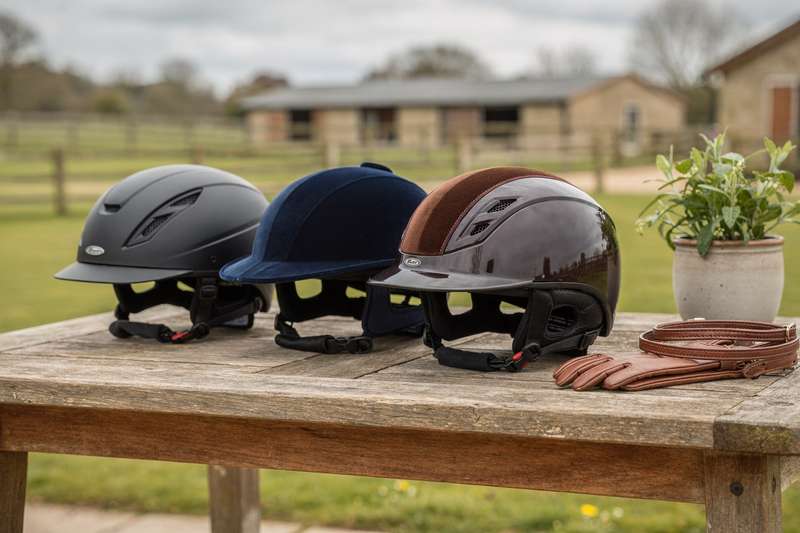
You’ve tried on three different hats — one from a catalogue, one from a tack shop, one off Amazon — and none of them quite works. The first shifts at canter. The second felt fine in the car park but creates a dull ache after an hour in the saddle. The third looks the part but you have no idea whether it’s accepted for the affiliated show you’re entering next month. If this sounds familiar, you’re in good company: riding hat shopping catches out even experienced equestrians, largely because it sits at the intersection of personal safety, fit complexity, and competition rules that vary between disciplines and get revised annually.
Add in the confusion around safety certifications — PAS 015, VG1, EN 1384, SNELL E2016 — the question of whether your hat needs replacing after a fall, and the choice between a peaked hat and a jockey skull, and it becomes easy to see why so many riders default to whatever’s in stock and hope for the best. This guide cuts through all of that. It covers riding hats and helmets available on Amazon.co.uk, including the essential hat cover accessory that competition riders need, and gives you the information to make a genuinely informed choice before you buy.
How We Evaluated These Hats
Every hat in this guide was assessed against a consistent set of criteria. Safety certification came first: we looked for recognised standards such as PAS 015, VG1, BS EN 1384, and SNELL E2016, and noted which hats carry them. Fit system quality came next — covering traditional sizing cradles, dial-to-fit mechanisms, and free-fit ventilation designs. We also considered ventilation provision, harness design, build quality, and — where available — verified buyer review patterns from Amazon purchasers. Competition suitability was cross-referenced against published guidance from British Eventing, British Showjumping, the Pony Club, and other governing bodies. Products with zero buyer reviews are flagged plainly; where buyer feedback exists, it is central to the assessment.
Best Budget Pick: Manken Equestrian Helmet Velvet Horse Riding Hat
The Manken Equestrian Helmet Velvet Horse Riding Hat Sport Helmets with CE Certification for Men Women Children is the most-reviewed riding helmet in this lineup by a considerable margin — over 420 buyer ratings averaging 4 out of 5 stars, which is a meaningful data point in a product category where buyers are not reluctant to flag disappointment.
This helmet is aimed at recreational riders, beginners, and families looking for an everyday yard hat without a premium price tag. The traditional velvet covering gives it a clean, classic appearance suited to hacking, general flatwork, and Pony Club-style activities. Sizing caters to men, women, and children, making it a practical option for yards or families where multiple riders share an equipment budget without everyone needing a bespoke competition lid.
The CE certification is worth understanding correctly. CE marking indicates the product has been assessed against European product safety directives, but it is not the same as a specialist equestrian standard such as PAS 015, VG1, or BS EN 1384. Before entering any affiliated competition, download your governing body’s current hat rules and confirm which specific standards are accepted — different governing bodies have different requirements, and those requirements are reviewed annually. For everyday hacking, leisure riding, and general yard work, CE certification is a reasonable baseline, and the Manken is a competent, accessible option at this tier.
The internal fit relies on a conventional sizing cradle rather than a dial-fit mechanism, which means getting the right size from the outset matters. Measure your head circumference in centimetres at the widest point — just above your eyebrows at the front and across the fullest part of the back of your skull — and compare carefully against the sizing chart before ordering. A subset of Amazon reviewers noted the harness adjustment can feel stiff during the first few weeks of regular wear; this typically loosens with use, but it is worth being aware of. The velvet surface is lighter in weight than you would find on a heritage brand’s equivalent, which is an expected characteristic at this price tier rather than a defect.
One rule that applies here as much as to any riding hat: always buy new. A secondhand helmet may have sustained invisible internal damage from a previous fall — the foam liner that absorbs impact can be compromised without any outward sign. The Manken is accessible enough in price that buying new is the obvious and sensible choice, and you get the confidence of knowing the hat’s history from the moment it was manufactured.
Best for Showing and the Dressage Arena: Rhinegold Glitter Pro Riding Hat
If appearance in the show ring or dressage arena matters as much as technical compliance, the Rhinegold Glitter Pro Riding Hat is a strong contender. It carries a 4.9-star average from 41 Amazon reviewers — the highest rating in this selection — and buyer feedback consistently suggests it meets expectations across fit, finish, and comfort.
Rhinegold is an established UK equestrian brand, and the Glitter Pro is designed for riders who want a premium-looking hat at a mid-range outlay. The glitter finish makes it especially popular in showing and dressage, where visual presentation matters alongside technical compliance. Before entering any affiliated competition, confirm with your specific governing body that decorative finishes are permitted in your class — some competitions specify plain, conservative hat tops, while others are more flexible about decorative surfaces.
What Amazon buyers consistently highlight is the quality of fit and internal comfort relative to the price. The harness sits cleanly, the internal padding feels more substantial than comparable hats at this tier, and the shell shape accommodates a reasonable range of head profiles well. With a 4.9 average across 41 reviews the satisfaction rate is genuinely striking — though 41 is a smaller sample than the Manken’s 420-plus, so reading the most recent reviews before purchasing is a sensible precaution to confirm the picture hasn’t shifted.
The glitter finish benefits from a little more care than a plain velvet surface. Keep it away from prolonged damp conditions and brush gently if it picks up dust or arena surface material. It is not the ideal choice for regular cross-country or wet-weather hacking where a more durable, utilitarian finish makes better practical sense, but as a dedicated showing or flatwork hat that needs to look polished, it performs consistently well across the buyer base.
One practical note on sizing: Rhinegold’s sizing does not necessarily correspond directly to another brand’s equivalent. Measure your head circumference fresh and compare against the brand’s specific chart before ordering. Hat sizing is not standardised across the industry, and the difference between a hat that fits and one that doesn’t is smaller than most buyers assume when ordering online for the first time.
Best Premium Riding Hat: Charles Owen Kylo Crystal Riding Hat
The Charles Owen Kylo Crystal Riding Hat – Navy Gloss/Silver comes from one of the most respected names in equestrian safety engineering. On Amazon this listing carries just two reviews — both 5-star — at the time of writing, so treat that as an early positive signal rather than a statistically robust verdict. The case for this hat rests primarily on Charles Owen’s established reputation across decades of equestrian safety development, rather than an Amazon-specific track record.
Charles Owen invests significantly in real-world safety testing, and the Kylo range was developed with multiple international safety standards in mind. The crystal version brings a decorative gloss finish with subtle crystal detailing that suits the show ring, affiliated dressage, and showjumping contexts where a premium, well-finished lid is expected. The navy gloss and silver colourway is a popular competition choice that looks distinctly polished without being ostentatious.
What separates the Kylo range from more basic helmets is the dial-fit precision mechanism. Rather than being committed to a fixed-cradle size, you can micro-adjust the internal circumference after the hat is on your head — a meaningful practical improvement for riders who fall between conventional hat sizes. The adjustment is made via a dial at the back of the shell and requires only a few clicks. Many riders find, after years of conventional fixed sizing, that this approach is noticeably more comfortable across longer rides and varied hairstyle changes between seasons.
Some variants in the Kylo range also support the optional addition of MIPS (Multi-Directional Impact Protection System) — a liner technology designed to reduce rotational energy transfer to the brain in angled falls. Whether this specific Amazon listing includes MIPS should be confirmed in the product detail before purchasing. Rotational force in riding falls is increasingly discussed by equestrian safety researchers, and MIPS is worth seeking out if you jump or ride in higher-risk situations where angled impacts are a realistic concern.
With just two Amazon reviews at this stage, the honest position is that you are relying on Charles Owen’s wider brand reputation rather than a deep pool of Amazon-specific buyer feedback. If certainty about fit is a priority, visiting a specialist equestrian retailer where you can be properly measured and fitted in person remains the most reliable approach for any premium helmet purchase — but if you already know your Charles Owen size from a previous hat, the Amazon listing is a convenient route to this model.
Best Hat Cover for Competition Riders: Luvponies Riding Hat Cover – Personalised
The Luvponies Riding Hat Cover – Personalised – Lots of Colours is not a riding hat itself, but it belongs in any complete guide to equestrian headwear. If you own a jockey skull cap — the peak-free helmet required for cross-country eventing phases and most racing contexts — you will need a hat silk or cover for dressage and showjumping phases, and for showing classes where a neat, traditional peaked appearance is expected. A hat silk transforms the look of a skull cap without requiring you to own two entirely separate helmets.
Luvponies holds a 4.3-star rating from 76 Amazon reviewers — solid, consistent feedback suggesting the product reliably delivers what buyers expect. The personalised element is a practical bonus: having your name or initials on your hat cover is genuinely useful at a busy competition where multiple riders have similar-looking kit. It is a common sight at Pony Club events and unaffiliated shows, and it removes the risk of accidentally picking up someone else’s silk from the lorry park on a busy competition day.
Colour choice matters in a competition context. British Eventing specifies conservative colours for hat silks in certain phases; showing classes typically prefer dark, plain covers. Having access to a range of colours means you can select the appropriate option for your specific discipline and competition class rather than being limited to a single shade. Always check your governing body’s current published hat rules before each season, as hat silk colour requirements can vary between classes and organisations and may be updated.
The fit over the skull cap is the most important practical factor. A hat cover needs to stay securely in place during active riding — not bunch under a harness strap or slide when you are moving at pace. Luvponies buyers generally report a snug, reliable fit, though as with any hat cover, the result varies slightly depending on the skull cap brand and shell profile underneath. If the cover feels slightly loose on your particular hat, a small safety pin at the back, tucked discreetly under the harness, is the time-honoured fix that has served riders reliably for many years.
If you are preparing for your first affiliated competition and already own a skull cap, a well-reviewed hat cover like this rounds out your kit practically and cost-effectively. It removes one source of last-minute concern before a class and means you can use the same helmet across multiple competition phases with a quick change of cover.
Best for Fuss-Free Fit Adjustment: Rhinegold Dial to Fit Riding Hat
The Rhinegold Dial to Fit Riding Hat – S – (54-56) – Black brings a modern dial-fit sizing mechanism to Rhinegold’s range — a practical feature that lets you fine-tune the internal circumference of the hat after putting it on, rather than being fixed at a single cradle size. This makes it particularly attractive for riders whose head measurement falls between standard hat sizes, or for shared-use situations where more than one rider wears the same hat across different sessions.
An honest caveat upfront: this hat has no Amazon buyer reviews at the time of writing. There is no verified buyer feedback to draw on for this assessment, which means the case here rests on the dial-to-fit mechanism’s established utility across the category and Rhinegold’s broader track record as a UK equestrian brand — as illustrated by the strongly-reviewed Glitter Pro hat featured above. If having substantial buyer evidence before purchasing matters to you, the Manken or the Rhinegold Glitter Pro are the more substantiated choices at this stage.
The dial mechanism itself is a genuinely practical design choice. It typically operates via a wheel or dial at the back of the shell, clicking the internal band tighter or looser in small increments — a quick process even with riding gloves on. The adjustment range is modest, so you still need to start from the correct base size; this listing is sized Small (54-56cm head circumference). From that starting point, the dial lets you close the gap between slightly too loose and perfectly snug — a useful margin for riders who have found conventional hat sizing a persistent source of frustration when shopping across brands.
The plain black finish keeps this hat versatile across hacking, flatwork, and everyday riding. Without buyer reviews to draw from, ventilation performance, harness comfort during extended wear, and long-term build durability are harder to assess with confidence — these are precisely the variables that buyer feedback typically illuminates most clearly. If you are interested in this hat, purchasing through a channel that accepts returns for fit issues is a prudent approach until the Amazon review profile builds further and gives a clearer picture of how it performs in real-world use.
What to Look for When Buying a Riding Hat
- Safety certification matching your discipline: Different governing bodies specify different accepted standards. PAS 015 (2011 onwards), VG1, and BS EN 1384:2023 are widely accepted across UK and European competition contexts, typically requiring a BSI Kitemark or INSPEC IC mark to be valid. SNELL E2016 is the most stringent standard and is required for some higher-risk disciplines. Always check your governing body’s current hat rules — they are reviewed annually. CE marking alone is not a specialist equestrian standard and may not satisfy affiliated competition requirements.
- Accurate head measurement before ordering: Use a soft tape measure and measure at the widest point — just above your eyebrows at the front and across the fullest part of the back of your skull, in centimetres. Hat sizing is not standardised across brands; your size in one make may differ from your size in another. Always measure fresh and compare against the specific brand’s chart before ordering online, even if you have bought riding hats before.
- Fit system — cradle, dial-to-fit, or free-fit: Traditional fixed-cradle hats are sized in discrete steps; if your head falls between sizes, neither adjacent size may fit ideally. Dial-to-fit mechanisms allow micro-adjustment after the hat is on your head, giving a more precise result. Some premium hats feature a free-fit ventilation design that improves airflow through channels built into the shell. Consider which approach suits your head shape and how much adjustment flexibility you realistically need.
- Ventilation for longer rides: Ventilation slots significantly reduce discomfort on warm days or during extended schooling sessions. Good airflow also reduces the temptation to loosen the harness for comfort — which you should never do. Skull caps typically offer better airflow than full peaked hats by design, which is one practical reason they are popular with cross-country and endurance riders.
- Peak vs skull cap for your discipline: Cross-country eventing phases require a jockey skull with no peak or peak-type extension. Showjumping and dressage permit a fixed-peak hat or a skull cap with a hat silk. Showing classes typically favour the traditional peaked hat appearance. Knowing which type your discipline requires before you shop removes one of the most common sources of hat-buying confusion.
- Harness quality and correct adjustment: The harness is what keeps your hat on your head in a fall and deserves more attention at point of purchase than it typically receives. The straps should sit flat against your jaw without rubbing, the fastening mechanism should release and adjust smoothly, and when properly fastened you should be able to fit no more than one finger between the harness and your chin.
- Replace after any impact event: Any hat that has sustained a significant impact should be replaced immediately, even with no visible damage. The foam liner compresses to absorb energy in a single event and cannot be relied upon to perform the same function again. Some manufacturers operate a replacement scheme following a verified fall — it is worth investigating this before you buy, as it can significantly affect the long-term cost of owning a premium hat.
Verdict
For the majority of UK riders — those who hack regularly, take lessons, and want a hat that looks the part without a premium outlay — the Manken Equestrian Helmet Velvet Horse Riding Hat Sport Helmets with CE Certification for Men Women Children is the most straightforward recommendation in this selection. Over 420 reviews at 4 stars gives genuine confidence that the product consistently meets buyer expectations, and the traditional velvet appearance works across a wide range of everyday riding situations without looking out of place.
If you compete at affiliated level and want a hat that will serve you for several seasons with the safety engineering to back it up, the Charles Owen Kylo Crystal Riding Hat – Navy Gloss/Silver is the premium choice — the brand’s safety reputation is well-founded, and the dial-fit system addresses a fit problem that catches out many riders. For those focused on showing or dressage who want strong buyer evidence alongside visual polish, the Rhinegold Glitter Pro Riding Hat is the most enthusiastically received hat in this group and is worth serious consideration.
Whichever hat you choose, proper fit matters more than any other single factor. A helmet that doesn’t sit securely and level on your head offers less protection than it should, regardless of the certification printed inside it or the price on the tag.
We were not paid to feature any specific product in this guide. All opinions are independent and based on publicly available specifications, verified buyer feedback patterns, and category research.
Quick Comparison Table


FAQ
How often should I replace my riding hat?
Most manufacturers and equestrian governing bodies recommend replacing a riding hat every three to five years, even without a significant fall, as internal materials degrade over time with regular use and UV exposure. You should replace it immediately after any impact event — even with no visible damage — as the foam liner may have compressed in ways that prevent it from protecting you effectively in a subsequent fall.
What is the difference between PAS 015, VG1, and BS EN 1384?
These are specialist equestrian helmet safety standards assessed by independent certification bodies. PAS 015 (2011 onwards) and VG1 are widely accepted in UK and European competition contexts and typically require a BSI Kitemark or INSPEC IC mark to be valid. BS EN 1384:2023 is the updated European standard that most governing bodies now also recognise. SNELL E2016 is considered the most stringent standard and is required for some higher-risk disciplines. Always check your specific governing body’s current published hat rules, as these are reviewed annually and can change between seasons.
Is it safe to buy a secondhand riding hat?
No — purchasing a secondhand riding hat is strongly inadvisable. A helmet that has been involved in a fall, dropped from height, or stored incorrectly may have sustained internal damage that is completely invisible on the outside. The foam liner, which absorbs impact energy, can be compromised without any visible sign. Always buy new from a reputable retailer and keep your purchase receipt as proof of the hat’s age and provenance.
Do I need a different hat for different equestrian disciplines?
Not necessarily a physically different hat for each discipline, but the hat you own must meet the specific certification standard required by your governing body and be the correct physical type — a jockey skull without any peak is required for cross-country eventing, while a fixed-peak hat is permitted for dressage and showjumping. Check your governing body’s current hat rules before entering any affiliated competition, as requirements differ between disciplines and are updated regularly.
How do I know if my riding hat fits correctly?
A correctly fitting hat should sit level on your head without tipping backwards or forwards. When you grip the brim and attempt to move the hat side to side, it should move very little — and your forehead skin should move with it rather than the hat sliding independently. It should feel snug all the way around without specific pressure points or gaps, and with the harness fastened you should be able to fit no more than one finger between the strap and your chin.
What is a hat silk and when do I need one?
A hat silk — also called a hat cover — is a fabric cover that fits over the outside of a jockey skull cap to change its appearance for different competition phases or discipline requirements. In eventing, riders wear a skull cap alone for cross-country and add a silk in a conservative colour for dressage and showjumping phases. In showing, a dark silk can give a skull cap the traditional peaked-hat look that some classes require. The Luvponies Riding Hat Cover is a well-reviewed option that can be personalised with your name or initials, which is useful for identifying your hat quickly at busy competitions.