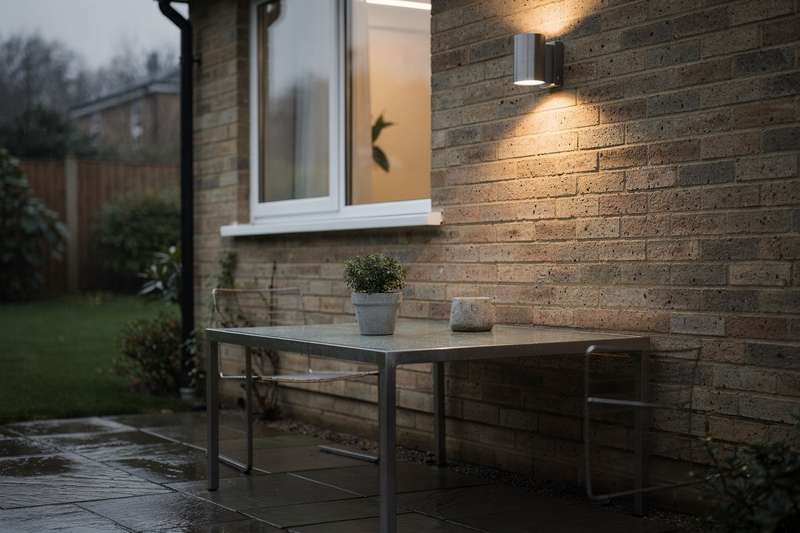
Picture this: you’ve just had the front of your house rendered, the new door is hung, and now that tired old wall lantern — the one that came with the house and has been quietly yellowing since the nineties — is suddenly the most conspicuous thing on your front elevation. Or perhaps the driver is more practical: it’s October, it’s dark by half four, and every time you hear a sound outside you’re squinting at a gloomy path from an unlit porch. So you head online. What greets you is a sea of near-identical listings: black aluminium bodies, IP65 ratings, vague promises of “warm white LED,” and brand names you’ve never encountered. Several look identical but ship from different sellers. You order one based on the photo; it arrives looking smaller than expected, the supplied fixings don’t match a UK back box, and by spring the lens has started fogging up after every shower.
This is the standard outdoor wall light buying experience in the UK — and it is far more avoidable than it looks. Outdoor fittings face demands that indoor lights never do: frost cycles, driving rain at near-horizontal angles, condensation that builds between the glass and the fitting body, and UV degradation that strips cheaper coatings within a season. The gap between a fitting that photographs well and one that handles a British winter without corroding, flickering, or leaking is significant. This guide cuts through the noise so you can make a confident choice.
How These Picks Were Assessed
A consistent set of criteria was applied across every fitting considered for this guide. IP65 certification was treated as the floor — anything below that rating is a liability on a permanently mounted UK exterior. Build material matters more than most listings acknowledge: powder-coated aluminium and quality stainless steel hold up through years of freeze-thaw cycling; uncoated or vaguely specified alloy bodies rust at the screw heads within a season. Lighting effect was assessed too — whether the up-down beam pattern illuminates a path or entry point usefully, and whether a warm colour temperature produces welcoming light rather than harsh blue-white glare. Installation complexity was weighed against what a competent DIYer can manage safely at mains voltage. Where buyer reviews were available, patterns around longevity and post-rain performance were prioritised over first-impression star ratings. Two products in this guide carry no verified buyer reviews at time of writing; this is flagged plainly in those sections so you can factor it into your decision.
Best Overall: Kerry Outdoor Wall Lights
The Kerry Outdoor Wall Lights, Mains Powered, Up and Down, Silver, 2 Pack is the most reviewed product in this selection, with over 740 buyers having left feedback at a 4.6-star average — a result that is difficult to sustain on a budget exterior fitting unless the product is consistently performing as expected. That depth of verified feedback is the primary reason this pair takes the top position.
The silver finish sets the Kerry apart from the all-black or anthracite crowd, and this matters more than it might appear at first glance. If your property has chrome or brushed-steel door furniture, stainless handrails, or a light render in grey or off-white, silver wall lights tie the exterior together in a way that darker fittings cannot. The wrong metallic finish on a carefully considered front elevation creates a subtle but persistent visual disconnect. For properties with warmer brickwork or brass hardware, the silver tone picks up those lighter hues more sympathetically than a cool black alternative would.
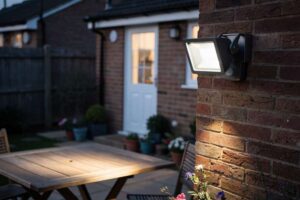
Functionally, the up-down beam pattern does exactly what it should: a directed flow throws light upward to wash the wall face and downward to illuminate the step or threshold below. You get ambient path lighting and a degree of architectural definition simultaneously, without the omnidirectional glare that a traditional bulkhead or bare-bulb lantern produces. The 2-pack format is a practical advantage — both units come from the same production batch, so they will match in finish and tone rather than arriving slightly mismatched as can happen when ordering individual units separately.
Installation follows the standard approach for mains-powered exterior fittings in the UK: mount to a surface or flush back box, connect to the existing circuit, and seal around the base with exterior-grade sealant to prevent water ingress behind the plate. The IP65 rating covers the fitting against driving rain from any direction. Buyers in the review pool consistently note that the lights look more premium than the asking price suggests — which is the key value statement for this pick.
The obvious caveat: silver is not for every property. If your exterior has an all-black aesthetic — black frames, black ironmongery, black garage door — the silver finish will sit awkwardly. In that scenario, the EBION Black option below is the natural substitute. But for homes where silver or brushed chrome is the dominant tone in the exterior metalwork, the Kerry is a considered match that a substantial body of buyers has confirmed in real-world conditions.
Best Budget Pick: EBION Outdoor Wall Lights
The EBION Outdoor Wall Lights, IP65 Up Down Lights Mains Powered, Black, 2 Pack matches the Kerry’s 4.6-star average while being backed by nearly 400 reviews — a strong and sustained result for a budget exterior fitting that suggests the product holds up well beyond the first few weeks of ownership.
Black is the most versatile finish for contemporary UK properties. The combination of black window frames, black front doors, and black ironmongery has dominated both new-builds and refurbished Victorian terraces for the better part of a decade, and these fittings slot into that aesthetic without friction. The up-down beam design creates the same wall-wash effect as more expensive alternatives: light rises toward the soffit and drops toward the threshold, framing the entry point neatly without flooding the immediate area with glare.
What budget means in practice here comes down to the finer details. The fixings supplied are functional rather than premium — UK buyers with rougher masonry sometimes find they need to supplement with their own stainless screws and plugs to get a secure, weatherproof mount. The aluminium body is the correct material choice and won’t corrode, but finish consistency across a batch can vary slightly. If you’re ordering several units for a larger project and uniformity matters, this is worth factoring in before you commit.
The EBION range offers useful flexibility. If flat black is too stark for your property, the same fitting is available in anthracite — a softer dark tone that reads less sharply against lighter render. If you need more than two units for a longer boundary wall, a rear garden terrace, or matched fittings on separate elevations, a 4-pack variant is available from the same product line, reducing the per-unit cost further while keeping the finish consistent across your installation.
One practical limitation worth flagging: up-down lights look their best on smooth or lightly textured render. On heavily textured surfaces — exposed stonework, pebbledash, or rough-cast — the upward beam catches surface irregularities in a way that can look patchy rather than polished. If your exterior wall has significant texture, an enclosed lantern with a more diffuse output may be a better fit for your property.
Best for Illuminating a Long Wall: Outside Wall Lights 8 Lamps
The Outside Wall Lights – 3000K Warm White Lighting, IP65 Waterproof Modern Indoor Outdoor Black Wall Lamp, Up Down 8 Lamps Outside Lights takes a completely different approach to value: rather than a 2-pack for a single entry point, it delivers eight fittings in one purchase at a per-unit cost that makes a larger outdoor lighting project financially realistic.
Eight fittings suit a specific need — a long continuous stretch of wall where evenly spaced illumination creates a cohesive result. Think the back wall of a garden that doubles as an outdoor entertaining space, a long side-return passage, a driveway with a masonry boundary wall on one side, or a terrace where ambient lighting matters alongside functional visibility. A run of directional up-down lights at regular intervals produces a far more considered outcome than trying to light the same space with one or two high-output floodlights, which tend to create an uneven pattern of bright spots and deep shadows.
The 3000K colour temperature is worth calling out: this is the warm-white end of the spectrum, closer in tone to a traditional incandescent than the neutral or cool white that some budget fittings default to. Warm white flatters brick, stone, timber, and render and produces a more welcoming atmosphere for a space where people actually spend evenings outdoors. If ambience matters alongside visibility, 3000K is the right specification.
The honest caveat is the review sample. At time of writing, this product holds a 5.0-star rating based on 16 reviews — a sample too small to treat as reliable evidence of long-term weather performance. The reviews that exist are positive, and the specification aligns with what you’d expect from a functional IP65 fitting. Treat it as an affordable option worth trialling on a lower-stakes run of wall before committing it to your most visible elevation.
If you’re routing cable to eight new mounting positions on an exterior wall, plan the installation time and materials carefully. Running cable to eight individual back boxes represents a meaningful amount of work — a surface-mounted conduit run along a continuous stretch significantly reduces the labour compared to individually chasing eight separate cable drops into the wall.
Best for Flexible Bulb Choice: CHENBEN IP65 GU10 Porch Light
The CHENBEN IP65 Up Down Outdoor Wall Lights Mains Powered GU10 Porch Light is the pick in this guide that gives you the most long-term control over your lighting output, because it uses a standard GU10 bulb holder rather than a fixed integrated LED module.
This distinction matters more than it might seem at first. With an integrated LED fitting, when the LED module reaches the end of its service life — and eventually they all do — you replace the entire fixture, which means disconnecting the wiring, sourcing a matching replacement, and resealing the mount. With a GU10 holder, you remove the fitting cover, pull out the spent bulb, and push in a new one — a job that takes seconds and costs a fraction of the price of a new fitting. GU10 is one of the most widely available lamp formats in the UK, stocked in every DIY store, supermarket lighting aisle, and online in bulk packs. For a light you’re planning to keep in place for a decade, that replaceability is a tangible practical advantage.
The GU10 format also gives you genuine control over output and colour temperature from the outset. If you prefer a warmer 2700K glow for a residential front door, buy 2700K GU10 lamps. If you need something brighter and more functional for a side gate or utility area, fit a 4000K lamp in the same holder. No other product in this guide offers that flexibility — the integrated LED picks are locked to whatever colour temperature their module was specified for.
With 95 reviews at 4.4 stars, the CHENBEN has a respectable if smaller review base than the Kerry or EBION picks. Consistent buyer feedback points to solid build quality and a straightforward installation process. The up-down aesthetic follows familiar lines — slim, wall-hugging, directional — and suits smooth render or painted masonry well.
The tradeoff is that GU10 bulbs are an additional purchase on top of the fitting itself. Importantly, make sure you buy lamps specifically rated for enclosed or outdoor fittings — standard indoor GU10 bulbs can fail early if any moisture reaches the socket, even with the IP65 body doing its job around the aperture. This is a detail buyers sometimes overlook and then attribute incorrectly to the fitting rather than the bulb specification.
Best Architectural Sconce Design: LED Black Long Wall Sconce
The Outdoor Wall Lights LED Black Long Wall Sconce IP65 Waterproof Outside Lights Rectangular Wall Lighting 3000K 20W Aluminum is the most architecturally distinctive option in this selection, with a taller rectangular profile that makes a deliberate statement on the wall rather than blending quietly into the background.
An important disclosure first: this product carries no verified buyer reviews at time of writing. The risk profile is accordingly different from the Kerry or EBION picks — you’re making a decision based on specification and visual appeal rather than on the reported experience of buyers who have lived with the fitting through a UK winter. Factor this in when comparing it against the reviewed alternatives.
On specification: the aluminium housing is the correct material for a UK exterior. The 3000K colour temperature falls in the warm-white range that suits residential properties. The IP65 rating meets the standard required for permanent exterior mounting. At 20W, this is a brighter unit than the compact up-down fittings elsewhere in this guide, making it well suited to illuminating a wider entry canopy, a larger porch, or a higher wall where a smaller fitting would look proportionally lost.
The rectangular form factor is the reason to choose this over the alternatives. Contemporary architecture — flat-fronted new-builds, rendered extensions, board-and-batten cladding, properties with strong horizontal or vertical proportions — responds well to a sconce that echoes those lines. A compact round fitting on a long, flat elevation can look incidental; a tall rectangular sconce sits in better proportion and reads as a considered design element. If the visual case is strong for your property and you’re prepared to accept the absence of a review base, this is a coherent option. If you’d prefer the reassurance of an extensive buyer review pool, the Kerry or EBION are the more prudent starting points.
Best from a Specialist UK Brand: Long Life Lamp Company ZLC035B
The Long Life Lamp Company Black Stainless Steel Double Wall Light IP65 Up Down Outdoor Wall Light ZLC035B is the only fitting in this guide from a brand with an established presence in the UK lighting market. Long Life Lamp Company have been supplying lamps and fittings to UK trade and retail customers for years, and that provenance carries weight when you’re choosing something you plan to leave on an exterior wall for the better part of a decade.
Like the rectangular sconce above, the ZLC035B carries no verified buyer reviews on this listing at time of writing. That’s a straightforward limitation and worth stating plainly. What it has in its favour is the brand’s background and a meaningful material upgrade: stainless steel rather than powder-coated aluminium. For most UK properties, aluminium is perfectly adequate. But for coastal locations — within a mile or two of the sea, where salt-laden air degrades surface coatings over time — stainless steel offers resistance that coated alloy cannot fully replicate. If you’re fitting a coastal property and want the lights to remain presentable without surface deterioration, the material choice here has a practical basis.
The “Double” descriptor in the product name refers to the dual aperture of the up-down design — this is a single fitting with openings at top and bottom, not a twin-pack. Order the quantity you need accordingly. The black finish suits contemporary and transitional architecture equally, and the slim vertical body follows the same up-down logic as the EBION and Kerry picks.
For a buyer who is purchasing once, wants to avoid revisiting the decision in five years, and either has a coastal property or simply prefers to buy from a named UK lighting brand rather than a generic listing, the ZLC035B makes a coherent case. The caveat remains: the absence of verified buyer reviews on this specific product page is a genuine unknown you’re accepting at purchase, and you should weigh it accordingly against the picks that carry a substantive review base.
What to Look For When Buying Outdoor Wall Lights
- IP rating: IP65 is the minimum for any permanently mounted UK exterior wall light. The “6” confirms the housing is dust-tight; the “5” means it’s protected against water jets from any direction — which covers the driving, near-horizontal rain that UK properties face regularly. IP44 is acceptable only under a covered porch or deep overhang with no direct rain exposure. Don’t rely on it for an exposed front or side elevation.
- Build material and finish: Aluminium is the standard choice — lightweight, corrosion-resistant, and it holds powder-coat finishes well through seasonal temperature swings. Stainless steel is heavier but better for coastal or high-humidity environments. Be cautious of listings that don’t specify the body alloy or describe it vaguely. If the fitting has a glass element, check whether it’s described as reinforced rather than thin decorative glass.
- Colour temperature: 3000K (warm white) suits most residential front-of-house applications — it flatters brick, stone, render, and timber and produces a welcoming glow from the street. 4000K (neutral white) is better for functional areas like garages or side passages where clarity matters more than atmosphere. Avoid 5000K or higher on a home exterior unless you specifically want a cold, clinical appearance.
- Integrated LED vs GU10 vs E27: Integrated LED fittings are compact and convenient but commit you to a full fixture replacement when the module fails. GU10 or E27 holders let you replace just the bulb — far cheaper and extending the practical lifespan of the fitting significantly. For a front-of-house light you expect to keep long-term, a replaceable bulb format is worth prioritising.
- Up-down vs enclosed lantern: Up-down fittings project light through narrow directional openings and suit contemporary architecture and smooth walls. Traditional enclosed lanterns with decorative bodies suit period properties and heavily textured facades. The right choice depends on your property’s character, not on which style is more popular in the current moment.
- Back box compatibility: Most UK outdoor wall lights are designed to cover a standard single-gang back box, typically 86mm wide. Check the base plate dimensions before ordering — a plate narrower than the box will leave its edges visible. Some fittings include a surface conduit adaptor; most assume an existing back box is already in place.
- Mains vs solar: Every fitting in this guide is mains powered, giving consistent output year-round regardless of daylight conditions. Solar wall lights have improved considerably, but UK winter conditions — short daylight hours and frequent overcast skies — mean battery charge is lowest precisely when you most need the light. For an entry or security light you depend on, mains power is the reliable choice.
Verdict
For most UK readers, the Kerry Outdoor Wall Lights, Mains Powered, Up and Down, Silver, 2 Pack is where to start. The 740-plus review base at 4.6 stars gives you meaningful, real-world evidence of durability and weather performance, and the 2-pack format means you can light either side of a door or gate symmetrically from a single order. The silver finish is the differentiator — if your property suits it, it reads as a more considered choice than the standard black option.
If your exterior has an all-black theme or you’re working to a tighter budget, the EBION Black 2 Pack is the natural alternative — the same strong rating, a solid review base, and the option to extend to a 4-pack without mixing suppliers. For buyers who value long-term serviceability above all else, the CHENBEN GU10 porch light offers a replaceable bulb format that none of the integrated LED options in this guide can match — it’s the only pick here that won’t require a full fitting replacement when its light source eventually reaches the end of its life.
Whatever you choose: verify the IP65 rating is stated explicitly in the product description, confirm your back box dimensions before ordering, and get a qualified electrician to make the final mains connection if you’re running a new circuit rather than extending an existing one.
We were not paid to feature any specific product in this guide. All opinions are independent and based on publicly available specifications, verified buyer feedback patterns, and category research.
Quick Comparison Table


FAQ
What IP rating do I need for an outdoor wall light in the UK?
IP65 is the standard for permanently mounted exterior wall lights in the UK. The first digit (6) confirms the housing is dust-tight; the second (5) means it’s protected against water jets from any direction, covering typical UK driving rain conditions. IP44 is acceptable only under a deep porch or overhang with no direct rain exposure — on an exposed front or side elevation, IP65 is the practical minimum.
Can I install an outdoor wall light myself in the UK?
Replacing a like-for-like fitting on an existing switched circuit is work many competent DIYers handle themselves. Mains electrical work in the UK falls under Part P of the Building Regulations, and new circuits require notification via a qualified electrician or registered competent person. If you’re in any doubt about the scope of the work, having an electrician make the final connection on a surface-mounted fitting is typically quick and low cost.
What is the difference between up-down wall lights and traditional outdoor lanterns?
Up-down wall lights have narrow directional apertures that project light upward and downward simultaneously, creating a controlled wash across the wall face. Traditional lanterns enclose the light source in a decorative housing and throw light more broadly, in a pattern suited to period or traditional architecture. Up-down fittings suit contemporary and minimalist exteriors; both styles can carry IP65 ratings. The choice between them is primarily aesthetic rather than technical.
Are mains-powered outdoor wall lights better than solar models for UK conditions?
For a permanently mounted entry or security light, mains power is consistently more reliable. Solar wall lights depend on daylight to charge their batteries, and UK winter conditions — frequent overcast days and short daylight hours from November through to February — mean solar units often produce noticeably reduced output precisely when you need them most. If reliable brightness on a dark December evening matters to you, mains-powered is the straightforward choice.
What colour temperature should I choose for an outdoor wall light?
3000K (warm white) is the right choice for most residential front-of-house applications — it flatters brick, stone, render, and timber and produces a welcoming, amber-toned glow rather than a clinical glare. 4000K (neutral white) works better in functional areas such as garages or side passages. Avoid 5000K or higher for a home exterior; it tends to make properties look commercial rather than residential.
Do I need to check back box sizing before buying an outdoor wall light?
Yes, and it’s worth confirming before you order. Most UK mains-powered outdoor wall lights are designed to cover a standard single-gang back box, typically 86mm wide. If the fitting’s base plate is narrower than the box, the box edges will be visible — a minor but persistent cosmetic issue. If you’re mounting at a new position on an exterior wall, a weatherproof surface-mounted back box and conduit gives a tidy, regulation-compliant finish.