Picture this: you’ve got a stack of revision notes or a pile of work documents spread across your desk, and you’re trying to flag the key points before tomorrow morning’s meeting. You reach for the highlighter you bought in a rush from a corner shop, and within two lines the ink has bled straight through to the page beneath, turning your carefully written notes into an orange smear. Or the tip skips across the surface, leaving patchy streaks over the text you most need to remember. Worse still, you forgot to replace the cap last night, and now you’re pressing a desiccated felt nib against your notes hoping something happens — it doesn’t.
If any of that sounds familiar, you already know that not all highlighters are created equal. Whether you’re a student marking up lecture handouts, a professional annotating contracts, or someone who journals and plans visually, the right pen changes how efficiently you work. This guide helps you identify the best markers and highlighters for your actual situation, accounting for paper type, colour preference, tip style, and how much ink you’ll burn through every week.
How These Picks Were Selected
The highlighters in this guide were assessed against a set of practical criteria that reflect real frustrations in this category: bleed-through resistance on standard printer paper and common notebook stock, tip quality and wear over time, ink brightness and pigmentation, drying speed to prevent smearing, cap security so pens don’t dry out between sessions, colour range, and ergonomics for extended annotation work. Where verified buyer feedback was available, patterns across dozens or hundreds of reviews were weighed — particularly recurring complaints about leaking, premature drying, inconsistent ink flow, and tip wear — rather than headline star ratings alone. For two STABILO listings included here, the review count data available at the time of researching this guide was limited, so those picks draw on widely documented product specifications and their long-established track record in the UK stationery market rather than a large pool of verified buyer feedback on those specific listings.
Best All-Round Value Pack
The SOL 12pk Highlighter Pens represent the kind of purchase that makes practical sense for most buyers: twelve bright-ink chisel-tip pens across a solid colour range, backed by close to 500 verified reviews at an average of 4.5 out of 5 stars. That’s a meaningful pool of real-world feedback, and the patterns in it are encouraging: consistent ink flow, minimal bleed on 80gsm printer paper, and colour brightness that holds up on both white and cream-coloured paper stock.
The chisel tip handles the two main tasks most people need: broad sweeps across whole lines of text, and finer underlining when you rotate the pen to use the tip’s edge. It’s a shape that experienced highlighter users already know, and it works reliably here. The tip doesn’t fur or splay quickly, which is a common failure with budget chisel-tip highlighters, and the ink keeps flowing evenly rather than going patchy towards the end of a pen’s lifespan.
With twelve pens in a single pack, you’re getting enough colour variety to support practical colour-coding systems: one colour per subject, per project, or per priority tier. Students working across multiple modules and professionals managing several parallel workstreams both benefit from having that range at hand without buying separate single packs. The variety also means that when one colour runs dry, you can switch to another while waiting for a replacement without breaking your workflow.
Where the SOL set is less ideal is on very thin paper, the sort you’d find in Bible-style reference books or some art sketchbooks. On that stock, show-through is more likely. On standard printer paper and most spiral-bound or hardback notebooks, bleed-through is minimal. Also worth noting: these are single-tip pens without a bullet tip on the reverse end, so if you want dual-tip functionality for detailed journalling annotation, take a look at the Sharpie S-Note Duo reviewed below.
For anyone who goes through highlighters at pace — students in intensive revision periods, teachers marking papers, office workers processing documents daily — buying a twelve-pack upfront is more economical than picking up a four-pack repeatedly. The volume of positive feedback from UK buyers suggests this set holds up consistently across different paper types and working environments, making it the default recommendation for general use.
Best for Creative Journalling
The Sharpie S-Note Duo Highlighters are clearly aimed at a different kind of user than a traditional office highlighter. With a dual-ended design — bullet tip on one end, chisel tip on the other — and a set of 16 pastel-leaning creative marker colours, these are built for journalling, bullet planning, lettering, and annotation work where you want visual variety alongside functional highlighting.
The chisel end handles conventional highlighting well: broad strokes, colour-coded text marking, underlining with the tip’s edge. The bullet end opens up a different range of uses: handwritten annotations in the margins, small illustrative details in journal spreads, and fine underlining where the chisel tip would be too wide. Together, they make one pen do two meaningful jobs, which matters when you’re working on a spread and don’t want it cluttered with multiple uncapped pens.
The pastel ink palette is worth discussing on its own merits. Pastel colours are popular in journalling partly for aesthetics and partly because the lower ink saturation keeps highlighted text clearly legible — there’s less risk of the ink overwhelming the content beneath. The Sharpie S-Note colours hit that balance well. They’re soft without being washed-out, and the chisel tip lays them down evenly rather than streaking. Across 261 reviews the set averages 4.6 out of 5, which indicates performance is consistent rather than variable between individual pens within a pack.
There are tradeoffs worth noting. If you’re purely looking for a functional office highlighter to work through reports quickly, the dual-tip format and pastel palette are more feature than you need, and a simpler, less expensive set would serve that task better. The 16-pen count is good for building a varied creative toolkit, but in environments where pens go missing (shared offices, classrooms), a cheaper disposable set is the more sensible choice.
Because these inks are pastel-toned rather than fluorescent, they don’t produce the high-contrast visibility that a traditional yellow highlighter gives you. For revision notes where you need key information to jump off the page instantly, the fluorescent options reviewed elsewhere in this guide will serve that purpose better. For planning spreads, creative annotation, and multi-colour journalling systems where legibility and aesthetics both matter, the S-Note Duo is a well-constructed tool with a broad enough range to support nuanced colour-coding.
Best Budget Bulk Buy
The Q-Connect Yellow Highlighter Pen (Pack of 10) answers a question that teachers, office managers, and students near the end of their budget all ask eventually: what’s the most reliable highlighter you can buy in bulk without compromising on the basics? A pack of ten yellow chisel-tip highlighters, rated 4.6 out of 5 stars across 170 reviews, this is a workmanlike choice for environments where highlighters are used heavily, shared freely, or prone to going missing.
Yellow is unsurprisingly the most commonly used highlighter colour — it offers the highest contrast against black text on white paper, it has been the default choice in offices and classrooms for decades, and it reproduces clearly if you’re scanning or photographing annotated documents. Buying yellow in bulk makes practical sense if you’re a teacher who uses highlighting tasks in lessons, a legal professional who works systematically through dense documents, or a student deep in revision season who doesn’t want to keep running short.
The chisel tip is consistent. It doesn’t skip on standard 80gsm paper, lays down an even line without requiring multiple passes over the same area, and the ink brightness holds up throughout the pen’s lifespan rather than fading noticeably as the ink level drops. For a budget option, that kind of consistency matters, because some cheaper pens start strong and deteriorate quickly. The Q-Connect avoids that particular failure mode.
The main limitation is obvious: you’re getting ten of one colour. For anyone who uses colour-coding systems, a single-colour bulk pack isn’t the right purchase. Likewise, on very thin paper stock some bleed-through is possible, as with most highlighters at this tier. But for high-volume yellow highlighting on standard paper, this pack performs reliably, and the 170 reviewers who gave it 4.6 stars broadly confirm the basics are handled correctly.
Q-Connect is a well-established office supplies brand in the UK, and their highlighting pens reflect a no-frills design philosophy: cap, barrel, chisel tip, bright yellow ink. That straightforwardness is precisely the point. You won’t find dual tips or extended colour palettes here, but you will find a reliable tool that does exactly what it promises. For office environments where the stationery cupboard needs periodic restocking, or for a student who simply needs to work through a stack of notes without running dry, this pack handles that dependably at a budget tier.
Best for Drying Protection
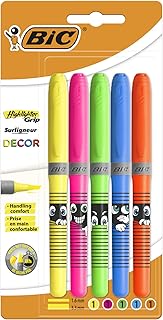
The BIC Highlighter Grip Decor Highlighter Pens address one of the most common frustrations with highlighters in daily use: pens that dry out within minutes of losing their cap. BIC has built drying protection specifically into this design, and across 240 verified reviews it averages 4.3 out of 5 — a rating that reflects solid, dependable performance focused on that specific problem rather than any broad feature advantage.
The practical benefit is that these pens retain usability after being left uncapped for a meaningful period. This is helpful in classroom environments where caps frequently end up on the floor, or in shared office conditions where someone reliably leaves pens uncapped on the desk. You shouldn’t rely on this indefinitely — prolonged exposure will still dry them out — but for the accidental cap-off situations that are more common than most buyers admit, the protection significantly reduces those dead-pen discoveries.
The line width range of 1.6mm to 3.3mm, depending on how you angle the chisel tip, covers both broader highlighting passes and finer edging when you rotate the pen. The ink is bright and the colours are bold rather than pastel, making these suitable for high-visibility annotation on standard documents. The rubber grip on the barrel is a practical ergonomic detail: over long highlighting sessions across a lot of paper, a textured surface reduces the fatigue that builds from holding a plain smooth barrel.
Where the BIC Grip Decor is less compelling is on very thin paper. Like most water-based highlighter inks, the potential for bleed-through increases on lightweight stock. Some buyers also note that individual pens within a pack can vary slightly in ink saturation, which is more of a quality control observation than a design flaw, but worth knowing if consistency across every pen in the set matters to you. The 4.3-star average is lower than some picks in this guide, and the honest tradeoff is that you’re gaining drying protection at a slight cost in overall performance consistency.
If you work in a setting where caps go missing regularly, or you’re managing a class set of stationery, the drying protection feature makes this a sensible choice. Combined with a comfortable grip and a line width range that covers standard annotation tasks, the BIC Grip Decor is a practical option for heavy everyday use where reliability under imperfect conditions matters more than additional features like dual tips or extended colour ranges.
Best Classic Highlighter
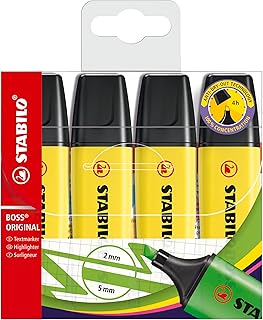
The STABILO BOSS ORIGINAL Highlighter is probably the most recognisable highlighter on the UK market, and the design has endured because it genuinely works better for detailed annotation than most alternatives. This specific listing’s review count wasn’t fully captured at the time of researching this guide, so these observations draw on the product’s well-documented design specifications and its long-standing position in UK stationery retail rather than a large pool of verified buyer feedback on this particular listing.
The wedge tip is the defining feature. Unlike a conventional chisel tip, the BOSS ORIGINAL’s wedge gives you a fine point on one corner for underlining and detail annotation, a broader face for full-line highlighting, and the ability to transition between the two mid-stroke without breaking your rhythm. Once you’ve worked with this tip geometry, a standard chisel can feel imprecise by comparison. That’s not a trivial observation: it changes how you interact with text on the page in a way that becomes immediately apparent when doing close annotation work.
The ink formulation is water-based and designed for use on sensitive paper types, including fax paper and thermal stock, that older solvent-based inks could damage. On standard paper, it dries quickly and smear risk is low. The barrel is chunkier than a standard pen but ergonomically shaped, flatter on one face and rounded on the other, so it sits comfortably in the hand over extended sessions. It also rests flat rather than rolling off the desk when set down, which is a small detail that proves practical day after day.
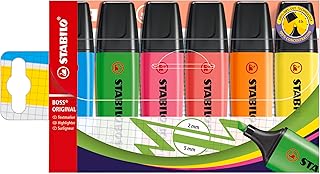
The BOSS ORIGINAL is available in a broad range of fluorescent colours, making it compatible with detailed colour-coding systems. The ink saturation is high enough that colours are clearly distinguishable from each other, which matters for anyone who highlights systematically rather than just occasionally reaching for yellow.
The tradeoff is cost: as a premium stationery brand, the per-pen price is higher than budget alternatives like the Q-Connect pack. For environments where pens go missing regularly or get used up quickly across multiple people, that premium may not be justified. For someone who uses highlighters seriously — a student in intensive revision, a lawyer or academic annotating dense text repeatedly — the BOSS ORIGINAL’s functional design decisions make it a considered choice rather than mere brand loyalty.
Best Pastel Highlighter
The STABILO BOSS ORIGINAL Pastel Highlighter takes the classic BOSS ORIGINAL format and applies it to a palette of softer, lower-saturation colours that have become popular for journalling, aesthetic note-taking, and creative planning. Like the standard BOSS ORIGINAL, the review count data for this listing was limited at the time of writing, so these observations rely on its documented design characteristics and its position within the established STABILO BOSS product family.
The available pastel colours — typically soft pink, mint, lilac, peach, and similar tones depending on the pack — are markedly different in character from fluorescent highlighters. They create a more visually restful reading experience, which some readers find helpful during long study sessions where fluorescent ink can become harsh over time. The ink remains transparent enough that text is clearly legible through the colour, even on dense pages where multiple highlighting passes might otherwise obscure rather than clarify the content.
Critically, the wedge tip geometry carries over from the standard BOSS ORIGINAL. You get the same fine-corner precision for underlining and detail annotation alongside the broader face for conventional highlighting. This is the key differentiator that separates the STABILO BOSS Pastel from other pastel highlighter ranges, which typically use a standard chisel tip. If you’re doing detailed margin annotations or close journal work, that level of control is practically useful rather than cosmetic.
The limitation of pastel inks is visibility: they produce less contrast against black text than fluorescent alternatives. For situations where you need key information to stand out immediately on a page you’ll reference under time pressure, fluorescent highlighting is more effective. The Pastel variant is at its best when you’re building visual structure into notes or journal spreads rather than purely flagging urgent information for quick retrieval.
For anyone using a layered annotation system, pairing the STABILO BOSS Pastel and the standard BOSS ORIGINAL in complementary colours gives you a nuanced approach on a single page: softer tones for secondary context, brighter tones for primary importance, with both pens sharing the same consistent tip shape so switching between them feels natural rather than disruptive.
What to Look for When Buying Markers and Highlighters
- Tip shape: Chisel tips are the standard choice for broad-line highlighting and can be rotated for finer underlining. Wedge tips, as used on the STABILO BOSS range, add a fine corner point that handles detail annotation without needing a separate pen. Bullet tips work well for journalling annotations in tighter spaces. Dual-ended pens give you two formats in one barrel, which is useful for creative work but unnecessary for straightforward office annotation.
- Fluorescent vs pastel ink: Fluorescent inks give maximum contrast against black text on white paper, which is what most study and office annotation tasks require. Pastel inks are softer on the eye over long sessions and popular for journalling and aesthetic note-taking. Many users combine both: fluorescent for primary flagging, pastel for secondary structure or decorative organisation.
- Bleed-through resistance: Nearly all highlighters will bleed through very thin paper. On standard 80gsm printer paper or typical notebook stock, most quality highlighters perform acceptably. If you work with lightweight notebooks or reference books with thin pages, check specifically for bleed-related complaints in buyer reviews before purchasing. Using a single pass rather than running over the same line twice also reduces bleed risk considerably.
- Drying speed and cap security: Fast-drying ink matters especially for left-handed writers who pass their hand across fresh highlighting immediately. Cap security is equally important: a well-fitting cap keeps a pen usable for months, while a loose or absent cap can dry one out in days. Some designs, such as the BIC Grip Decor, include specific drying-protection features that provide tolerance for accidental cap-off situations.
- Colour range and differentiation: If you colour-code your notes or documents, you need colours that are meaningfully distinct from each other under artificial light. Some sets include very similar tones that are difficult to tell apart at a glance — neighbouring shades like orange and amber can be hard to distinguish. Look at actual product photos rather than just colour swatches before committing to a multi-colour set.
- Pack size vs variety: Bulk packs in one colour offer better economy for high-volume use in that specific colour. Multi-colour variety packs make more sense for colour-coding or creative work. Consider how quickly you actually use each colour and whether having multiple pens in one colour or a wider variety of fewer pens each serves your actual workflow.
- Paper compatibility: Water-based highlighter inks work across most paper types, including thermal and fax paper. For annotating over gel pen ink, allow the writing to cure fully before highlighting over it — gel ink smears more easily than ballpoint when highlighted too soon after writing, so a short wait makes a visible difference.
Verdict
For most UK buyers — students, office workers, or anyone who needs reliable multi-colour highlighting across a lot of paper — the SOL 12pk Highlighter Pens are the pick to start with. Twelve pens, a practical colour range, consistent ink performance backed by close to 500 reviews, and chisel tips that hold their shape through extended use: it covers the daily highlighting needs of most people without asking you to spend more than the task requires.
If your needs are more specific, the decision shifts. Journallers and creative planners who want dual tips and a broader palette will find the Sharpie S-Note Duo a better fit. For bulk restocking in yellow, whether for a classroom or an office stationery cupboard, the Q-Connect ten-pack is the pragmatic budget choice. If you work somewhere caps go missing and dry pens are a constant annoyance, the BIC Grip Decor targets that specific problem directly.
The STABILO BOSS ORIGINAL, in either its standard fluorescent or Pastel variant, remains the reference point for serious annotation work. The wedge tip is more precise than a standard chisel, and for close text annotation that precision has a real cumulative effect on how your notes look and how quickly you can move through a document. The per-pen cost is higher, but for regular, focused use, the quality difference is evident and worth the difference.
We were not paid to feature any specific product in this guide. All opinions are independent and based on publicly available specifications, verified buyer feedback patterns, and category research.
Quick Comparison Table




FAQ
What is the difference between a chisel tip and a wedge tip highlighter?
A chisel tip has a flat angled face that creates a broad line when used flat and a thinner line when rotated to its edge — the standard shape used by most highlighters on the market. A wedge tip, as used on the STABILO BOSS range, adds a distinct fine corner that allows precise underlining alongside broad-face highlighting, giving you more control without switching pens. For most everyday use the difference is subtle, but during close annotation work it becomes noticeable quickly.
Do highlighters bleed through standard printer paper?
Most quality highlighters perform well on standard 80gsm printer paper without significant bleed-through. The risk increases on thinner paper stock such as lightweight notebooks, newsprint, or tissue-thin reference book pages. Using a single pass rather than running over the same line repeatedly also reduces bleed risk considerably, regardless of the pen brand or tip type.
Are pastel highlighters suitable for study and revision?
Pastel highlighters can work well for revision, particularly during long study sessions where fluorescent colours become visually tiring over time. The key consideration is contrast: pastel inks produce less visibility against black text than fluorescent inks, so for flagging key information you need to find quickly, fluorescent options are more effective. Many students use pastel for secondary annotation and fluorescent for primary highlights, combining the two into a layered system.
Can I highlight over ballpoint or gel pen ink without smearing?
Ballpoint ink cures quickly and can generally be highlighted over almost immediately without issue. Gel ink takes longer to dry fully, and highlighting over it too soon can cause smearing or running. Waiting around 30 seconds after writing with a gel pen before highlighting substantially reduces the risk. This applies to most water-based highlighters regardless of brand or tip type.
How do I stop my highlighters from drying out?
Replace the cap immediately after each use and store pens horizontally or with the tip facing slightly upward rather than tip-down, as downward storage causes ink to pool in the tip and can lead to leaking. If a pen has started to dry out, storing it horizontally for 24 hours sometimes allows the ink to redistribute to a usable state. Pens with built-in drying protection, such as the BIC Highlighter Grip Decor, provide some tolerance for accidental cap-off situations.
Which highlighter colour gives the best contrast for black-and-white printed text?
Yellow gives the highest contrast against black text on white paper while remaining transparent enough to read through, which is why it has been the default highlighter colour for decades. Orange and green are close alternatives. Darker colours such as blue or purple reduce the legibility of text beneath them on some paper types, so for straight contrast and readability, lighter fluorescent tones serve the purpose best.