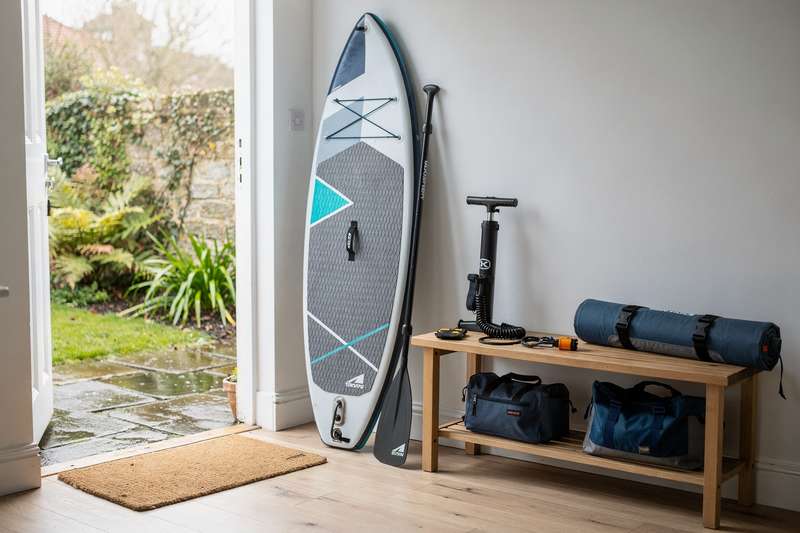
You’ve watched people glide across a glassy reservoir on a Saturday morning, or spotted a group drifting along the Wye and thought “that looks wonderful.” But every time you try to research which board to buy — or where to actually go once you have one — you end up buried in jargon-laden spec sheets, American reviews for gear that doesn’t ship to the UK, or listicles that lump a Scottish sea loch and a Florida bay into the same recommendation. You want something practical: a board that arrives complete, won’t eat your savings, and stores under the stairs when you’re not using it. And then, once the board is inflated and you’re standing on water for the first time, you want to know where to take it beyond your nearest car park reservoir.
That’s the gap this guide fills. Below you’ll find two of the highest-rated inflatable SUP boards currently available on Amazon UK, plus four destination guidebooks written specifically for British paddlers. Together, they cover everything from your first wobbling session on a calm lake to planning a proper paddleboarding weekend in the Cumbrian fells.
How These Picks Were Selected
For the boards in this guide, the key criteria were straightforward: board dimensions adequate for beginner stability (a width of at least 30–33 inches), what’s actually included in the box (paddle, pump, leash, carry bag), construction quality signals drawn from verified Amazon UK buyer feedback, and overall value relative to what you receive. Boards with zero verified reviews were excluded — there’s no meaningful feedback to weigh when that’s the case, and beginners deserve the reassurance of real-world testing. For the destination guidebooks, the assessment shifted to geographical coverage across the UK, the quality and practicality of route information, and how useful each title is for a paddler exploring unfamiliar territory. Star ratings and review volumes from Amazon UK buyers informed every selection in both categories.
Best All-Round Inflatable SUP
The SereneLife Premium Stand Up Paddle Board Inflatable SUP is one of the better-reviewed entry points on Amazon UK right now, holding 4.6 stars from over 100 verified buyers — a score that carries real weight in a product category where disappointed customers rarely stay quiet. The 32-inch width is a deliberate design choice for beginner-friendliness: it gives you a platform wide enough to focus on your stroke and surroundings rather than fighting for balance every few seconds. The non-slip EVA deck pad covers a generous standing area, which matters enormously when you’re still working out where to position your feet and how to shift weight between strokes.
What distinguishes this board from cheaper alternatives in its segment is the completeness of the package. Rather than arriving with a flimsy paddle and a note directing you elsewhere to fill equipment gaps, it ships with the essentials for getting on the water quickly. The GoPro-compatible mount is a practical inclusion — it’s the kind of feature typically reserved for more expensive boards but built into this one from the start, which matters if you plan to capture footage on UK coastlines or rivers.
The 32-inch width proves its value on flat water. Anyone who has spent 20 minutes on a narrow board in their first session wrestling with balance before taking a single proper stroke will understand why those extra inches matter. On lakes, sheltered bays, slow canals, and calm rivers, this board performs reliably. Where any wide all-round inflatable understandably struggles is in choppier open-water conditions or faster-moving rivers — that’s not a criticism specific to this model; it’s an honest characteristic of the all-round inflatable category across the board.
Buyers consistently report positive experiences with the board’s stiffness once fully inflated, which is the single most important performance indicator for inflatables. A board that feels floppy underfoot loses glide, makes every paddle stroke feel like work, and compromises stability in ways that become obvious quickly. At the premium tier within this entry-level segment, the build quality reflects the positioning. If your goal is a complete, well-kitted board for a season or two of weekend paddling on UK waterways, this is the most capable package in this guide for getting on the water without a second shopping trip.
The honest limitation is that this is firmly a recreational all-rounder, not a touring or racing shape. After six months of regular paddling, you may find yourself wanting more speed or a narrower profile for longer distance work — at that point, an upgrade makes sense. But for the overwhelming majority of UK recreational paddlers — weekend lakes, coastal inlets, canal routes — it does what it promises.
Best Board for First-Timers on a Budget
The Glymnis Inflatable Stand Up Paddle Board 10’6″ carries the largest review count of any board in this guide, with over 350 verified Amazon UK buyers weighing in. That volume of feedback gives you a more complete picture of what to expect than a handful of reviews ever can. At 4.3 stars across that sample, it’s the most thoroughly tested budget option here: the majority of buyers are satisfied, but there are enough candid mid-range reviews to set realistic expectations about its limits.
The 10’6″ length is a considered choice for a recreational all-rounder. Boards shorter than 10 feet feel more manoeuvrable on rivers but sacrifice the glide that makes paddling enjoyable over distance — you take more strokes to cover the same ground, which tires you out faster. Boards over 11 feet track better and move more efficiently, but become harder to transport and manage at launch spots. At 10’6″, this board occupies comfortable middle ground: on a lake or calm river it glides well between strokes and doesn’t demand constant course correction. The included backpack is a practical detail buyers mention consistently in their reviews, because carrying a deflated board and its accessories to a remote or scenic access point without a proper bag is a genuine inconvenience.
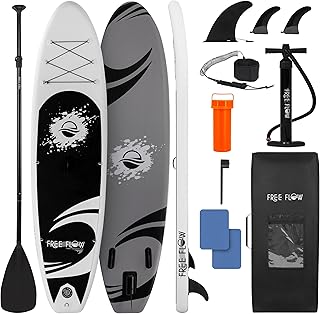
The kit includes an adjustable paddle, pump, and backpack, covering the basics without any additional purchases. The paddle is entry-level by the standards of regular touring paddlers — if you progress to paddling several times a week, you’ll likely want to replace it with something lighter — but for a beginner’s first twenty sessions, it functions well enough. The manual pump takes more effort than you might expect on a cold morning at a canal car park; factoring in an electric pump as a future upgrade is sensible if you plan to paddle regularly.
Where this board trails the SereneLife Premium is in the finer details of long-term construction. Buyers note that the fin system and some fittings feel less robust after extended regular use. This doesn’t mean it fails early — plenty of reviews describe multiple seasons without incident — but if you intend to paddle several times a week throughout the year, this isn’t the board for that workload. For a beginner paddling fortnightly through a British summer, it represents solid value within its price tier.
If you’re still unsure whether stand-up paddleboarding will stick as a hobby, this board gives you a low-commitment way to find out. The high review count means any recurring issues in the design are well-documented, and you can read through the feedback yourself before committing. The value proposition is honest: you get a functional board that gets you on the water, not a premium product engineered for longevity.
Best UK-Wide SUP Location Guide
Stand-up Paddleboarding in Great Britain: Beautiful places to SUP in England, Scotland & Wales is the closest thing to an essential companion for the British paddleboarder, rated 4.6 stars from 184 Amazon UK reviewers — the largest review base of any book in this guide. Having a board is one thing; knowing where to take it across England, Scotland, and Wales is quite another, and this guide makes a meaningful difference to that second problem.
The book covers a wide spread of paddling locations across all three nations, giving it value at multiple stages of a paddler’s development. Whether you’re in the Scottish Highlands and want to find loch access, in the West Country eyeing a harbour estuary, or heading to Snowdonia and wondering which lake is accessible with an inflatable board rolled into a rucksack, this guide addresses those decisions. Coverage breadth is one of the most consistently praised aspects in buyer reviews; paddlers describe discovering locations they’d never considered, often within a manageable drive from home.
Practically, the guide provides more than a bare list of place names. It covers the character of each location — sheltered versus exposed, tidal versus non-tidal, beginner-appropriate versus technically demanding — alongside access information and photography that gives you a real feel for a spot before you commit to the journey. That detail matters more than it sounds, because satellite imagery and online photos rarely capture how a place feels from the water. A photograph taken from the bank doesn’t tell you whether the surface will be choppy, how far a decent paddle run extends, or whether there’s adequate parking nearby for a board bag.
Buyers note that the book reads as a destination-inspiration resource rather than a step-by-step navigational guide with GPS coordinates. For granular navigational data you’ll use it alongside mapping apps or OS maps. Where it excels is in building your shortlist of worthwhile UK locations, saving hours of cross-referencing SUP club websites, wild swimming forums, and outdated blog posts. For anyone who wants to explore Britain by water, this is the most practically useful single purchase after the board itself.
One honest observation: the book’s coverage naturally reflects where the authors have paddled most, meaning some regions receive richer treatment than others. A handful of reviewers mention this, though the overall geographical breadth remains substantial enough to keep any UK paddler busy for several seasons.
Best Guide for Cumbria and the Lakes
For paddlers with their sights set on the most iconic inland paddling landscape in England, Stand-up Paddleboarding in the Lake District: Beautiful places to paddleboard in Cumbria is the specialist companion you want. Rated 4.8 stars from 56 Amazon UK reviewers, it holds the highest average score of any book in this guide — a rating sustained across a meaningful number of reviews, which makes it genuinely impressive.
The Lake District offers extraordinary variety for UK inland paddleboarding. Windermere is large and suited to longer distance sessions; Grasmere is intimate and sheltered; Ullswater offers a long scenic corridor with well-established access points. Coniston Water is famously calm on still mornings. The book covers how to approach each of these locations sensibly, including practical guidance on access rights and seasonal conditions — the National Park becomes very busy in high summer, and knowing when and where to launch to avoid crowded sections of motor boats, hire kayaks, and open-water swimmers is useful information not easily found consolidated elsewhere.
What makes this specialist title worth buying even alongside the Great Britain-wide guide reviewed above is depth. A national guide gives the Lake District a double-page spread; a dedicated title gives individual locations full chapter treatment, covering entry points, recommended routes, what you’ll encounter on the water, and what to watch out for. For anyone planning a paddleboarding holiday or a focused Cumbrian weekend, that depth changes how useful the book is on the ground.
Buyers appreciate the photography, which captures the conditions you’re likely to encounter rather than only flattering perfect-weather shots. Multiple reviewers describe using it as a planning tool before trips and as something to browse through winter to keep paddling ambitions alive until the season opens again. The one limitation is geographical: if you’re based in the South East or Scotland and have no immediate plans to visit Cumbria, you’ll only reach for this title when you head north. Within its stated remit, it’s the best in its class.
Best for the Scenic Pub-Stop Paddle
Paddle and Pub: The best British pubs to get to by kayak, canoe or paddleboard occupies a niche in the paddling book market that no other title quite fills. Rated 4.7 stars from 17 Amazon UK reviewers, it captures a specific kind of British paddling adventure: routes planned around reaching a worthwhile pub by water. That might sound whimsical, but it’s practically useful — British waterways weave through villages, market towns, and countryside in ways that mean some of the most scenically situated pub gardens in England and Wales back directly onto navigable water.
The concept is simple; the execution is thoughtful. Each route in the book includes practical information about launching, the character of the paddle (distance, likely conditions, technical difficulty), and what you’ll find at the destination pub — whether it serves food, whether there’s space nearby for boards or boats, and whether it’s worth the journey. For a paddleboarder planning a summer Saturday with friends, this is the kind of guide that transforms a vague idea into a properly structured afternoon that ends somewhere memorable.
The book is written for all paddlers — kayakers and canoeists feature alongside SUP users — so some routes suit a paddleboarder more naturally than others depending on current strength, distance, and conditions. Canal routes tend to be the most forgiving for paddleboarders of all abilities; river routes vary significantly by season and rainfall levels. The book is honest about these factors, and reading route descriptions carefully before committing is more important here than with a flat-water lake guide.
At 17 reviews, the sample is smaller than some titles here, but the average score is high and the reviews are detailed enough to be informative. Multiple buyers describe it as a gift that goes down consistently well with paddling friends, which says something about the quality of the content beyond the concept alone. If your paddling has a social, exploratory flavour — weekends away, groups of friends, outings where the destination matters as much as the journey — this book earns its shelf space.
One practical note: pub hours and food availability change, so treat the book as a starting point and confirm current details before setting off. That’s a minor caveat common to any printed hospitality guide, not a structural flaw in the concept.
Best Multi-Discipline UK Paddling Atlas
For paddlers who want a single reference covering the broadest range of British waterways across multiple disciplines, Bradt Paddling Britain (Travel Guide): 50 Best Places to Explore by SUP, Kayak & Canoe takes the widest view of any book in this guide. Published by Bradt, a travel guide house with strong credentials for destination research, it covers 50 locations spanning stand-up paddleboarding, kayaking, and canoeing. The Amazon UK review count currently stands at four, which is worth acknowledging plainly — it’s a thin sample and you’re taking more on trust here than with the higher-reviewed titles above.
The multi-discipline framing is both the book’s strength and its minor constraint depending on your needs. If you paddle exclusively on a SUP board, some sections covering kayak-specific techniques and canoe logistics will be less directly relevant. But if your household includes paddlers of different types — or if you’re open to trying kayaking as your confidence on a board grows — this is the most versatile single paddling reference you can own. The 50-location scope gives it the broadest geographical reach of any title here, which makes it useful for UK-wide exploration planning across a full year of paddling.
Bradt’s approach to travel guides prioritises practical accessibility information alongside destination inspiration: how to get there, where to launch, what conditions are typically like, and what makes each location worth the journey. For paddlers who organise trips around waterways rather than just adding a paddle session to an existing holiday, this structure is directly useful. You can scan the 50 locations and build a shortlist of destinations to visit across multiple seasons without doing separate research for each individual spot.
Because it covers multiple disciplines, the SUP-specific advice is necessarily less detailed than you’d find in a dedicated paddleboarding title. Routes described for canoes may include stretches with faster water that require a different risk assessment if you’re on an inflatable paddleboard. The book doesn’t always draw those distinctions, so your own judgement about board type and conditions remains important. As a starting point for discovering 50 British locations worth paddling, it covers more ground than anything else in this guide — and the Bradt name is a reasonable quality signal even where the review count remains low.
What to Look For When Buying Your First SUP Kit
Whether you’re choosing an inflatable board or deciding which guidebooks to add to your kit, a few specific factors separate purchases you’ll be glad you made from those that disappoint.
- Board width for stability: As a beginner, prioritise width above all else. A board that’s at least 30–33 inches wide provides a stable platform for learning. Narrower boards are faster but far less forgiving, and spending your first sessions fighting to stay upright strips all enjoyment from the experience.
- What’s actually in the box: A board that includes a pump, paddle, leash, and carry bag is significantly better value than a cheaper board you then kit out separately. Check the box contents carefully before buying — boards at different price tiers often look similar in headline specs but differ considerably in what they ship with.
- Inflation pressure rating: Look for boards capable of inflating to at least 15 PSI. Higher pressure means a stiffer board underfoot, which translates directly into better glide and stability. Boards that max out at lower pressures often feel noticeably soft and make paddling more effortful than it needs to be.
- Board length for your intended use: A 10 to 10’6″ all-round board is the sensible starting point for most recreational paddlers. Shorter boards (under 10 feet) are more manoeuvrable on rivers but sacrifice glide. Boards over 11 feet offer better tracking for distance work but become awkward to transport and manage at launch points.
- Breadth versus depth in guidebooks: When choosing a paddling guidebook, decide whether you need breadth (a UK-wide guide for exploring multiple regions) or depth (a specialist title for an area you paddle regularly). The most practical approach combines both — a national guide for planning and a regional specialist for detailed local knowledge.
- Weight capacity and realistic load: Your board’s stated maximum weight capacity should be comfortably above your own weight plus any gear you plan to carry. Paddling at or near the limit reduces stability and performance in ways that become obvious quickly on the water.
- Construction quality indicators: Double-layer PVC construction is more durable than single-layer alternatives. A tri-fin or twin-fin setup offers better straight-line tracking than a single centre fin alone, though single fins are simpler to manage and adequate for calm-water recreational paddling.
Verdict
For the new UK paddler who wants to get on the water with minimal faff, the most practical combination from this guide is the Glymnis board paired with the Stand-up Paddleboarding in Great Britain location guide. The Glymnis has the highest review count of the two boards, giving you the most complete picture of what to expect before you commit, and it includes everything you need in the box. Pair it with the Great Britain SUP guide and you have both the equipment and the knowledge to explore the best of what British waterways offer.
If your budget allows a step up, the SereneLife Premium SUP is the stronger board — better-rated per star and with the added utility of a GoPro mount for capturing your sessions. The Lake District specialist guide is worth adding if Cumbria features on your paddling plans, and Paddle and Pub is the one to grab if your ideal outing ends at a good pub garden rather than a car park.
The short version: start with the Glymnis to get paddling, add the Great Britain SUP guide to know where to go, and build out your specialist library as your ambitions grow. The hobby tends to expand quickly once you’ve had your first genuinely good session on the water.
This guide was produced independently. We were not paid to feature any specific product in this guide. All opinions are independent and based on publicly available specifications, verified buyer feedback patterns, and category research.
Quick Comparison Table




FAQ
Can I use an inflatable SUP on any body of water in the UK?
Most calm inland waters — lakes, reservoirs, canals, and slow rivers — are suitable for inflatable SUPs. Open-coast paddling is possible but requires more experience and appropriate weather conditions. Always check local access rights and bylaws for specific waterways before you launch, as not all rivers and lakes permit SUP use and enforcement varies considerably across regions.
How long does it take to inflate an inflatable paddleboard by hand?
Most inflatable SUPs take between 10 and 20 minutes to pump up to the recommended pressure using a manual hand pump. The final few PSI require noticeably more effort than the rest. If you plan to paddle regularly, a battery-powered or 12V electric pump is a worthwhile addition that removes most of the effort from the pre-session setup routine.
Do I need a wetsuit for stand-up paddleboarding in the UK?
You don’t strictly need a SUP-specific wetsuit, but given UK water temperatures, one is strongly recommended for anything outside the warmest summer months. A 3/2mm full wetsuit covers most of the British paddling season; thicker suits (5/4mm) are appropriate for winter sessions and colder northern waters. A buoyancy aid is also advisable for open-water and river paddling.
What board length suits an adult beginner?
A 10 to 10’6″ board, at least 30 to 32 inches wide and 5 to 6 inches thick, is the standard recommendation for adult beginners. This combination balances stability, glide, and manoeuvrability without demanding advanced balance skills. Avoid anything shorter than 9’6″ for your first board unless you have a specific reason to need a compact travel option.
Are the UK paddleboarding location guidebooks suitable for complete beginners?
Yes — most UK SUP location guides include clear information about difficulty levels, access conditions, and which locations suit beginners. Starting with sheltered inland spots such as lakes, reservoirs, and flat canal sections before progressing to tidal or river routes is the recommended approach, and the guides in this list reflect that gradation in their route descriptions.
Do I need a licence to paddleboard on UK waterways?
On most National Trust and privately managed lakes, no licence is required. Paddling on rivers managed by the Canal & River Trust, the Environment Agency, or other navigation authorities may require a small annual licence or permit. Check with the relevant authority for your specific waterway before paddling, as requirements vary considerably across England, Scotland, and Wales.