You’ve got exam revision scattered across sticky notes, dog-eared textbooks, and half-filled notebooks — and very little of it is sticking. Or you’re a parent watching your toddler point excitedly at picture books, wondering whether a proper set of learning cards might help words and concepts click into place earlier. Either way, you’ve typed “best flash cards” into Amazon and been confronted with a wall of listings: blank kraft-paper notecards, colour-coded sets with organiser rings, pre-printed first-words decks, and electronic cards that play audio when touched.
The problem isn’t the choice — it’s that the differences between products are nearly invisible in thumbnail form. Then the cards arrive: the stock is flimsier than you hoped, the ruled lines bleed when you reach for a highlighter, or the colour variety shown in the photo doesn’t match what’s actually in the box. This guide covers five distinct flash card products currently available on Amazon UK, spanning two clear use cases — blank revision cards for students, and pre-printed learning cards for young children — so you can pick the right set without the guesswork.
How These Flash Cards Were Evaluated
Five core criteria shaped each pick in this guide: card thickness and durability (how well the stock withstands repeated handling and pen ink without warping or curling), sizing accuracy (whether stated dimensions match what actually arrives), real-world usability in revision or play contexts, quantity relative to price tier, and patterns across verified buyer reviews — particularly complaints that only surface after extended use rather than in the first few days. For blank revision cards, particular attention went to ink performance: does biro, pencil, or highlighter bleed through? For pre-printed children’s cards, image clarity, card rigidity for small hands, and genuine age-appropriateness were the priorities. All five picks come from the live Amazon UK catalogue, with ratings and review counts drawn from real buyer feedback.
Best Blank Revision Cards for Heavy Writers
The ojussa Flash Cards 300 PCS Revision Cards 3×5 Inch Kraft Paper Notecards are the pick for anyone who writes densely and often — the kind of student who fills both sides of every card with diagrams, mnemonics, and closely packed bullet points. With 4.6 stars from over 600 verified buyers, these sit at the top of the reviewed blank card options in this guide, and the kraft paper format sets them apart from the plain white stock that dominates most revision card listings.
The natural brown kraft surface is noticeably pleasant to write on. It takes ballpoint and pencil cleanly without significant bleed-through, and the slight texture means the cards feel robust in the hand rather than slippery or lightweight. The unlined format is a significant design choice that many revisers prefer. Without ruled lines dictating where text goes, you can hold the card in landscape or portrait orientation, draw a mind-map branch across the centre, or divide the card into quadrants for a four-part definition. If you tend to draw flowcharts or annotated diagrams alongside written facts, unlined cards remove the visual clutter that printed lines create around illustrations.
The 300-card count is a real strength at this price tier. Most sets at a comparable cost offer 200 cards, so this gives you meaningful headroom for a full subject’s worth of key terms without running out halfway through a module. GCSE students covering multiple sciences, geography case studies, or a language vocabulary bank will find 300 cards covers a complete revision cycle. University students working through a dissertation literature review or a language acquisition list may still exhaust a single pack — but ordering a second won’t stretch the budget.
The main trade-off is colour — or the absence of it. Kraft paper is brown, and pale highlighters (yellow, light green) barely show against that background, which limits colour-annotation as a technique. If your revision strategy relies on colour-coding subjects by card colour, look at the coloured options below instead. And if you write with a fountain pen, note that wetter inks can spread more on natural paper than on coated white stock. For ballpoint or mechanical pencil writers, the surface performs very well.
Buyers in the review pool highlight that these cards survive being thrown into a school bag without curling noticeably after a week of daily use — a practical marker of stock quality. If you want plain, durable, high-capacity blank cards and don’t rely on card colour as an organisational tool, this is the most well-reviewed option in this guide.
Best Coloured Ruled Revision Cards
If colour-coding by subject is central to how you organise your revision, the 300Pcs Flash Cards, 127x76mm Ruled Index Cards, Revision Cards Coloured give you the structure that a single-colour or kraft-paper set cannot. With 4.5 stars from 440 buyers, this set has a solid feedback record, and it suits students who want to pick up a blue card and immediately know it’s chemistry, or a pink card and know it’s vocabulary.
The ruled lines are the other defining feature here. If your handwriting naturally drifts across the page without a guide, lined cards impose the discipline that keeps notes legible when you return to them three weeks later. The lines on this set are evenly spaced and printed at a weight that’s visible without dominating — they don’t make the card feel like a notepad page, but they’re clear enough to follow comfortably. This matters more than it might seem: cards you struggle to read quickly under exam conditions undercut the whole point of making them in the first place.
The 127×76mm size is the standard index card format — broadly equivalent to 5×3 inches — and this matters for practical storage. Standard index card boxes, ring files, and revision card holders are designed around this format. If you plan to add compatible storage later, standard sizing keeps your options open rather than locking you into a proprietary system.
The trade-off with ruled, coloured cards is the same as with any lined surface: diagrams are awkward. If you’re revising biology and need to annotate a cell structure, or studying history and want to sketch a rough timeline with branching events, the printed lines impose structure that works against freehand illustration. Some students solve this by using ruled cards for text-heavy definitions and keeping a separate small pack of blank cards for diagram content — having two card types for two distinct tasks is more efficient than forcing one format to do everything.
One note from buyer feedback: the colour distribution across a 300-card pack isn’t always evenly split between shades. Most packs include four or five colours, but the number of cards per colour can vary. If you’re assigning specific colours to specific subjects, count your allocation before revision season starts rather than discovering you’ve run out of one colour mid-unit. With that caveat, this is a well-priced, well-reviewed set for students who organise by colour.
Best Revision Cards with a Binder Ring
The 300PCS Flash Cards, 3×5 Inches Colored Revision Cards with Ring is the most reviewed product in this entire guide, with over 700 verified buyer ratings — and the included binder ring explains much of its popularity. Loose cards in a bag invite chaos: one bad zip-up and 300 cards are scattered across the bottom. The ring keeps a working set together, bound in order, and ready to flip through on a bus or between lessons without searching for stragglers.
The ring mechanism is a standard metal binder ring that clips through a pre-punched hole in one corner of each card. This lets you add, remove, and reorder cards freely, so as you master a topic you can move those cards to a completed pile while keeping the ring focused on what still needs work. This kind of active sorting — sometimes called the Leitner system — is one of the most effective ways to use flash cards for retention, and the ring makes it far easier to implement than with loose cards where reordering quickly becomes laborious.
The cards themselves are coloured, retaining the subject colour-coding option. At 3×5 inches (76×127mm), they’re the same standard index card size as the other blank sets in this guide. The key mechanical difference is purely the ring — but that one addition meaningfully changes how you interact with the set during a revision session. Flipping through a ring-bound stack feels more deliberate than rifling through a loose pile, and the physical act of moving a card from front to back after successfully recalling it carries a small but satisfying sense of progress.
The trade-off is the punch hole. One corner of every card has a pre-punched hole, which takes up a small amount of writing space. For most students this isn’t a problem — you simply avoid writing in that corner. But if you annotate right to the card’s edges and resent any lost surface area, the hole can be mildly frustrating. Some buyers also note that the metal ring can feel stiff when new; it loosens with use, but initially threading all 300 cards requires patience.
At 4.4 stars from more than 700 buyers, this set has the largest real-world feedback pool in this guide. That volume suggests consistent satisfaction even among buyers with minor gripes — and for organisation-conscious students who need their revision set to stay intact through an entire term, the ring alone justifies choosing this over an unbound coloured set.
Best First Words Flashcards for Toddlers
Switching to the children’s learning side of this guide: the First Words Flash Cards For Toddlers Ages 1 2 3 – 150 Unique Flash Cards for Toddler Baby is a pre-printed set designed to help very young children connect pictures with words. At 4.6 stars from 58 reviewers, it’s the highest-rated pre-printed children’s set in this guide, though with fewer reviews than the blank revision cards — worth bearing in mind when interpreting that rating.
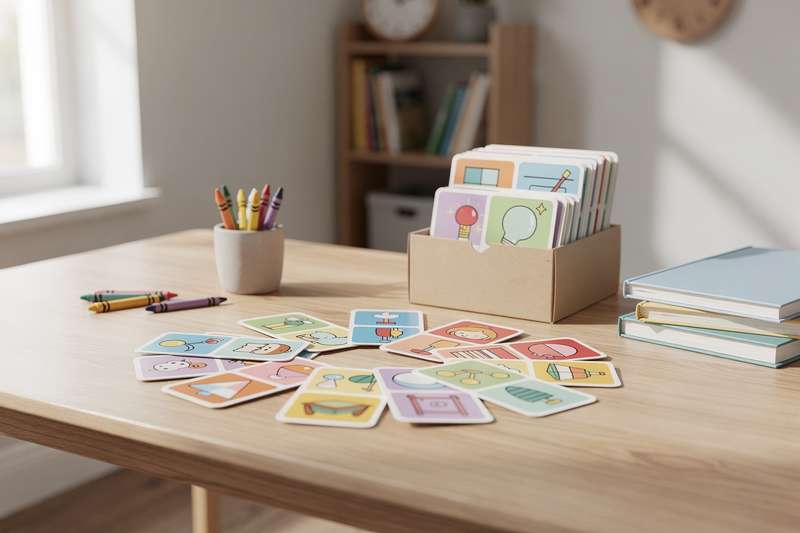
With 150 unique cards, this is a substantial set for the toddler age range. A typical first-words collection covers vocabulary clusters: animals, fruit and vegetables, transport, household objects, colours, body parts. A larger set like this gives a parent enough material to rotate through different categories over days or weeks rather than cycling through the same twenty cards on repeat. Repetition matters for early language acquisition, but variety maintains engagement — a two-year-old who has already memorised every card in a small set will disengage long before the learning cements.
The “durable” descriptor in the product listing is a meaningful specification for this age group. Cards handled by children between one and three years old need to survive being gripped, dropped, occasionally chewed, and repeatedly touched with sticky fingers. If the card stock is too thin — the type that folds under accidental pressure — it won’t last a week of toddler play. Buyers reviewing this set note that the cards feel sturdy enough for normal toddler handling, which is the baseline requirement for any children’s flashcard set.
The pictures on pre-printed children’s cards matter more than buyers sometimes anticipate. Clear, unambiguous illustrations — where an image of “dog” looks distinctly like a dog and not a stylised abstract shape — are important for children at the early vocabulary stage who are still learning to map between image and word. Overly cartoon-stylised or visually cluttered illustrations can confuse rather than teach. From the feedback on this set, the imagery is clear and age-appropriate, with a friendly, colourful art style rather than photographic imagery — generally the right approach for the one-to-three bracket.
The main limitation is that this is a passive learning tool. For younger toddlers, you’ll be holding up cards and naming the pictures, with your narration doing the pedagogical work. The cards are the prompt, not the teacher. If you want something that can engage a child more independently or plays audio cues without a parent’s direct involvement, the talking cards section below covers that. For structured parent-and-child sessions, though, this 150-card set provides plenty of material across several months of play.
Best Talking Flashcards for Early Learners
The 510 Words Talking Flash Cards Early Learning Toys for 3 4 5 Year Old Boys take a fundamentally different approach to the learning card format: rather than relying on a parent to narrate the content, these cards produce audio output when used with their accompanying device. With 4.5 stars from over 560 buyers, this is the most reviewed children’s learning product in this guide, which gives that rating real weight.
The 510-word vocabulary is a significant figure for the three-to-five age bracket. Where a basic first-words set might cover 50 to 100 core vocabulary items, 510 words allows coverage across multiple subject areas — animals, colours, everyday objects, numbers, and more — providing scope for learning progression over months rather than weeks. Children at three years old are typically in a rapid language acquisition phase, and a broad vocabulary bank naturally supports their inclination to name and categorise everything they encounter.
The audio element changes how children interact with these cards. Rather than waiting for a parent to read the word aloud, a child can engage with the cards more independently — practically valuable for parents who need to prepare a meal while a three-year-old works through a card stack at the kitchen table. The spoken pronunciation also provides a consistent phonetic reference point: if a child encounters a word they’ve never heard aloud, the audio supplies the model rather than relying entirely on the parent’s delivery.
There are real trade-offs here. Electronic talking flashcard systems require a power source — batteries or recharging — which adds an ongoing dependency that blank card sets don’t have. If the device runs out of power mid-session, the interactive function disappears entirely. The audio element can also become a distraction: some young children are more interested in pressing buttons and hearing sounds than in focusing on the vocabulary being taught. Whether this applies to your child depends on temperament and attention span, and it’s a pattern common to many audio-interactive learning toys.
This set targets ages three to five, meaning it suits children who are ready to engage more independently than the one-to-three bracket targeted by standard first-words cards. For parents whose child has outgrown the basic picture-naming format but isn’t yet ready for reading-based learning, talking cards sit neatly in the middle ground. The mid-range price reflects the added electronic component — it’s a more considered purchase than a pack of blank revision cards — but for the right child at the right developmental stage, the audio feature provides learning value that passive cards cannot replicate.
What to Look for When Buying Flash Cards
- Card thickness and stock weight: Thin, flimsy cards warp when written on and fall apart quickly under regular handling. For blank revision cards, look for stock that resists pen and highlighter bleed-through on both sides. For children’s pre-printed cards, rigidity is the priority — cards need to survive enthusiastic toddler handling without folding or tearing at the corners.
- Lined vs. unlined: Ruled cards keep handwriting neat and legible, which benefits text-heavy revision notes and definitions. Unlined cards work better for diagrams, annotated images, or any layout that doesn’t follow straight lines. Consider which revision style suits you — or buy both types for different tasks rather than forcing one format to do everything.
- Standard card size: The 3×5 inch (76×127mm) format is the most common and fits standard index card boxes, binder rings, and storage holders. If you’re building a revision system with compatible accessories, sticking to this size keeps your options open and avoids the frustration of cards that don’t fit existing storage.
- Colour distribution across the pack: Colour-coded sets support subject organisation, but check whether colours are evenly distributed. Buyer reviews frequently flag uneven splits — where one colour dominates and another runs out quickly — which can disrupt a planned colour-coding system. Read the feedback section carefully if consistent distribution is important to you.
- Included binder ring: Some sets include a metal binder ring, which makes active recall sorting significantly more practical. If you plan to use a structured system where you move mastered cards to one pile and still-learning cards to another, a ring is far easier to work with than loose stacks spread across a desk.
- Quantity per pack: Larger packs offer better value and more flexibility. For a full GCSE or A-level revision cycle covering several subjects, 200 cards can feel limiting; 300 cards gives you more working room. Consider whether you’ll need multiple packs before buying a smaller quantity and having to reorder mid-revision.
- Pre-printed vs. blank: Pre-printed children’s cards with illustrations serve early learning and language acquisition; blank cards are for self-directed study where you write your own content. These are fundamentally different tools for different needs — confirm which type you actually need before ordering, as the two are often listed side by side in Amazon search results.
Verdict
For the majority of UK buyers searching for flash cards — students revising for GCSEs, A-levels, or university exams — the 300PCS Flash Cards, 3×5 Inches Colored Revision Cards with Ring is the most practical all-round pick. The binder ring transforms a box of loose cards into an organised, portable revision tool. The coloured stock supports subject coding. And with over 700 buyer reviews at 4.4 stars, the feedback volume gives that rating credibility that a handful of early reviews simply cannot match.
If you’re a heavy writer who prefers unlined cards and doesn’t need colour-coded card stock, the ojussa Flash Cards 300 PCS Revision Cards 3×5 Inch Kraft Paper Notecards rate marginally higher at 4.6 stars from over 600 buyers, and the kraft paper surface suits biro and pencil writers particularly well. For parents of toddlers, the 510 Words Talking Flash Cards Early Learning Toys for 3 4 5 Year Old Boys is the more engaging option for children aged three and above, while the First Words Flash Cards For Toddlers Ages 1 2 3 – 150 Unique Flash Cards for Toddler Baby is the simpler entry point for one-to-two-year-olds working through picture-naming sessions with a parent.
Start with the ring-bound coloured set if you’re buying for revision and aren’t sure where to begin — it’s the most versatile option, and the one that buyers consistently praise for holding up through a full exam season.
We were not paid to feature any specific product in this guide. All opinions are independent and based on publicly available specifications, verified buyer feedback patterns, and category research.
Quick Comparison Table


FAQ
Are flash cards actually effective for studying?
Yes — flash cards work because they use active recall, the process of retrieving information from memory rather than passively re-reading it. Research consistently shows that testing yourself on material strengthens long-term retention more effectively than highlighting or re-reading alone. Writing the cards yourself adds an additional benefit, as summarising content into card-sized notes is itself a learning step that reinforces understanding.
What size flash cards should I buy for GCSE or A-level revision?
The standard 3×5 inch (76×127mm) index card size is the most practical for revision. It’s large enough for a definition and several supporting notes, small enough to carry a stack in a bag or pocket, and compatible with standard index card boxes and binder rings. Avoid unusually small cards if you tend to write in detail — you’ll run out of writing space faster than you expect.
What is the difference between lined and unlined flash cards?
Lined (ruled) cards help keep handwriting neat and consistent, which is useful for text-heavy definitions and notes. Unlined (blank) cards give full flexibility — you can draw diagrams, annotate images, or write in any direction without printed lines cutting across your layout. Many revisers use both: lined cards for written content and unlined cards for diagrams or visual summaries.
At what age should children start using flash cards?
Pre-printed picture flash cards can be introduced from around 12 months old within parent-led play sessions. By ages two to three, children can engage more actively with first-words sets, matching images to familiar words. Talking flashcard sets with audio output suit children from around age three, when they are ready to interact with content more independently and sustain a session without constant parental direction.
How many flash cards do I need for a full exam subject?
A practical estimate is 50 to 100 cards per major topic, and most exam subjects cover four to eight key areas. For a single GCSE subject, 200 to 300 cards typically covers the key terms, definitions, and case studies needed for one revision cycle. A-level and university modules often require more nuanced content per card, so a 300-card pack may be exhausted within one subject before needing a refill.
Can I reuse flash cards after an exam?
Blank flash cards written in pencil can be partially erased and reused, though repeated erasure gradually degrades the card surface. Cards written in biro or marker are effectively single-use. Some students write on both sides — term or question on one side, answer or definition on the other — to maximise each card. Heavier card stock holds up to erasing better than thin, lightweight alternatives.