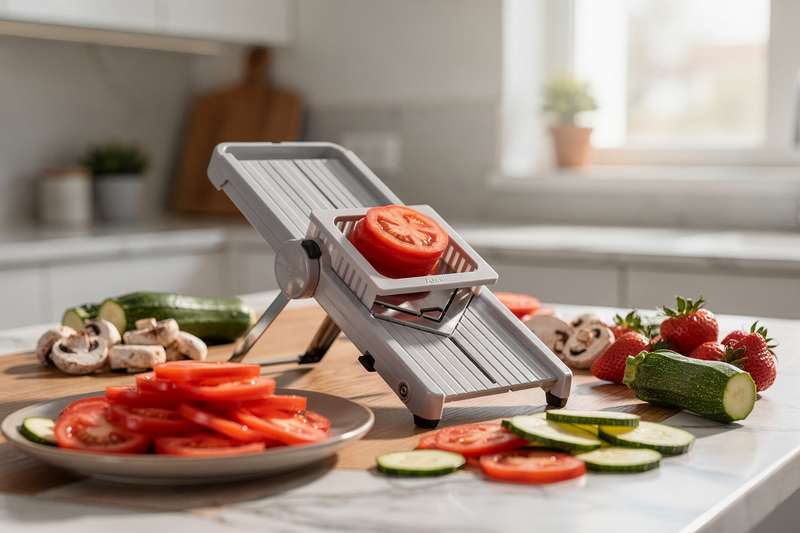
The Problem: Soft Vegetables, Sharp Blades, and That Guard That Never Quite Works
You buy a mandoline slicer because you want paper-thin cucumber rounds for a salad, translucent courgette ribbons for a gratin, or evenly sliced tomatoes that actually stay intact instead of turning into a pulpy mess. You set it up, press the safety guard down onto a soft tomato — and immediately feel it slip sideways, the food squirming out from under the teeth before the blade has even touched it. You reposition. It slips again. Eventually you ditch the guard and use your fingers, which is precisely how mandoline injuries happen.
This is the core frustration that most buying guides gloss over. They talk about blade sharpness and slice thickness settings, but the safety guard is the component that determines whether a mandoline is genuinely usable on soft produce like tomatoes, peaches, courgette, cucumber, or ripe peppers — or whether it’s only safe on firm carrots and potatoes. A guard designed for hard vegetables grips via rigid teeth that dig into dense flesh. Place that same guard on a ripe tomato and those teeth either skid across the skin or bruise the fruit before the blade has done anything useful.
If you have tried one cheap slicer that came with a flimsy plastic pusher, concluded that mandolines are dangerous, and gone back to a knife — this guide is for you. The right combination of guard design, blade geometry, and frame stability makes a real difference, and it is entirely possible to slice soft produce quickly and safely once you know what to look for.
How We Evaluated These Picks
The picks in this guide were assessed against five criteria that specifically matter when slicing soft or delicate produce, rather than the generic mandoline benchmarks you find elsewhere. First: guard grip quality — whether the food-contact teeth or prongs can hold soft, slippery vegetables without bruising them or losing contact mid-stroke. Second: blade angle and sharpness, since a low-angle blade requires less downward force, which is what causes soft produce to compress and distort. Third: frame stability — a slicer that rocks or twists on the worktop is dangerous regardless of how good the guard is. Fourth: thickness range and adjustment precision, because soft vegetables often need finer settings (1–2 mm) than firm ones. Fifth: real-world reviewer feedback patterns, specifically filtering for comments from users who mentioned soft or ripe produce, rather than only carrots and potatoes. Blade storage and cleaning safety were assessed as secondary criteria. No manufacturer paid for inclusion.
Quick Picks at a Glance
| Best for… | Price range | Key feature |
|---|---|---|
| Beginners slicing soft veg for the first time | £25–£40 | Wide, stable base; large non-slip handle guard; three preset thicknesses |
| Batch-cooking households wanting versatility | £35–£55 | Integrated dial for slice/julienne modes; dial-set thickness; cut-resistant gloves included |
| German-quality workhorse for everyday slicing | £40–£60 | German manufacture; Multibox blade storage; finger guard with prong inserts for soft produce |
| Upgrading a guard on a slicer you already own | £8–£15 | Replacement safety hand guard; non-slip grip surface; dishwasher safe |
| Pro-style precision on delicate produce | £60–£100 | Continuous thickness dial; very low blade angle; rubber feet on all four corners |
| Compact storage in small kitchens | £20–£35 | Foldable legs; slim profile; integral guard storage clip |
Best for Beginners: Wide-Base Slicer with Non-Slip Handle Guard
If you have never used a mandoline before and your main concern is slicing soft vegetables safely without injuring yourself, start here. The category of wide-base slicers with a large, ergonomic handle guard was designed specifically with nervous or occasional users in mind. The distinguishing feature is a guard that does not rely purely on rigid spike teeth — instead, a broad, slightly flexible grip surface distributes pressure across the food rather than puncturing it at two or three points. That matters enormously when you are pressing a ripe tomato or a cucumber quarter against a blade: a wide contact patch holds the food steady without squashing it out of shape.
Look for a model in this bracket with a foot or stabilising base that grips the worktop surface — either via rubber pads or a fold-out brace. One of the most common causes of mandoline cuts is the frame sliding towards you mid-stroke, and soft produce requires a lighter touch than firm veg, which means the frame does not get anchored by downward pressure in the same way. A stable base compensates for that. Three preset thickness positions (typically around 1 mm, 2.5 mm, and 4 mm) are sufficient for most home uses, and a click-in or lever-style adjuster is safer to operate than a freeform dial, since you do not need to hold the blade frame at an awkward angle while changing settings.
The tradeoff in this category is versatility. A beginner-oriented slicer will typically lack julienne inserts or a waffle-cut option, and the thickness range is limited compared to pro-grade models. That is a reasonable compromise: you are getting a slicer that is genuinely safe and produces consistent results on everyday produce, without the complexity that tends to cause accidents. The viewing window on some models — a small transparent section in the guard body that lets you see how much food remains — is a genuinely useful detail, not a gimmick, because it helps you stop slicing before your fingers get dangerously close to the blade.
What to avoid: guards in this category that are very small or use a single central spike rather than a distributed grip. Small guards are marketed as compact, but they leave insufficient distance between your hand and the blade. Also avoid models where the guard simply rests on the slicer surface rather than engaging a track — on soft produce, lateral movement during a stroke is the primary hazard.
Best Versatile Pick: Integrated Dial with Multiple Cutting Modes
For households that do genuine batch preparation — slicing courgette for a gratin, julienning carrots for a slaw, then switching to thin cucumber rounds for a starter — the adjustable-dial mandoline with multiple cutting modes saves meaningful time. The key distinction from basic models is that switching between slice, julienne, and occasionally a dicing setup does not require you to handle loose blade inserts with your bare hands. An integrated dial or lever means the blade geometry changes within the same sealed unit, which removes one of the most underappreciated injury risks in mandoline use: fumbling with a separate sharp insert while washing up or mid-prep.
When evaluating models in this bracket, pay close attention to how the thickness dial operates. A good continuous-adjustment dial lets you move in small increments — 0.5 mm steps or finer — which is genuinely important for soft produce. Slicing a ripe tomato at 3 mm gives you a result that holds together; at 5 mm the slices can still be useful but start to collapse under their own weight. Being able to dial to an intermediate setting matters in a way it simply does not for a firm potato. The cut-resistant gloves often bundled with these kits are worth keeping: they are not a substitute for the guard, but they provide a useful secondary layer of protection when you are transferring or washing blades.
The tradeoff here is that integrated multi-mode slicers tend to be bulkier than single-purpose models. They also sit in a middle quality tier — the mechanism that switches cutting modes needs to be well-engineered to avoid flex or wobble at the blade, and cheaper versions of this format can produce uneven slices as the insert loosens over time. Reading verified long-term reviews is worth your time before purchasing: look for comments from users who have owned the slicer for six months or more, since that is when blade wobble and dial looseness tend to appear.
This type of slicer suits households where at least two different people use it regularly — one who is comfortable with mandolines and one who is not — because the all-in-one format is simpler to explain and use safely than a system with multiple loose parts. It is not the right choice if you predominantly slice very soft or very ripe produce, where a purpose-designed low-angle blade outperforms a general-purpose one.
Best German-Made Workhorse: Börner-Style V-Slicer with Multibox Storage
German-manufactured mandolines in the V-slicer format have earned a loyal following in professional catering and among serious home cooks for a straightforward reason: the V-shaped blade geometry pulls the food towards the centre of the cut rather than pushing it sideways. That self-centring action is particularly helpful with round or ovoid vegetables — tomatoes, radishes, small courgette — that would otherwise roll under a flat blade during a stroke. Combined with a deep, well-designed finger guard that fits securely into side tracks, a V-slicer from an established German manufacturer produces remarkably consistent results on soft produce.
The Multibox blade storage system found on leading German models is worth singling out as genuinely thoughtful design. Loose blade inserts stored in a drawer or loose in a kitchen cabinet are a consistent injury source — you reach in, misjudge the position of a blade, and cut yourself before you have even started cooking. A dedicated storage box with defined slots for each insert means the sharp edges are always oriented safely, and it keeps the full kit together so you are not hunting for the right thickness insert mid-prep. This is not a feature unique to one brand, but German kitchen tool manufacturers have tended to take it more seriously than generic importers.
Where V-slicers in this bracket struggle is with very large produce. A full-size aubergine or a large onion often exceeds the width of the blade frame, which limits your options. They also sit at a higher price point than beginner models, and the learning curve is steeper — the guard tends to have a specific way of engaging the track that takes a few sessions to feel natural. If you try to use it freehand without engaging the track correctly, the guard can jump, which is exactly the situation you are trying to avoid.
The specific models to look for in this category come from manufacturers with a verifiable German production address and a minimum five-year guarantee on blades. That guarantee is a useful proxy for build quality: a manufacturer confident in their metallurgy will back it. The finger guard prong inserts — small plastic pins that screw into the guard face — should have multiple positions or be replaceable, since they are the part most likely to wear or deform after extended use on soft produce.
Best Guard Upgrade: Replacement Safety Hand Guard for Existing Slicers
Not every home cook needs a new mandoline. If you already own a slicer that slices well but came with a guard that is flimsy, too small, or uncomfortable to use on anything softer than a carrot, a quality replacement hand guard is a cost-effective solution. This is a category that does not get nearly enough attention in buying guides, possibly because the margins are lower and the product is less photogenic, but it addresses the exact source of most mandoline-related frustrations.
A quality aftermarket guard in the £8–£15 range offers two features that cheap original guards typically lack: a non-slip grip surface on the top (where your palm contacts it) and a food-contact face with enough prong length and flexibility to hold soft produce without bruising it. The non-slip palm surface matters more than it sounds — during a fast slicing stroke, your hand generates lateral force, and if the guard surface is smooth plastic, that force can cause your hand to shift position relative to the guard. On soft produce where you are using a lighter touch, that shift is more likely than on firm veg where downward pressure locks everything in place.
Before buying, check compatibility. Most replacement guards are designed to fit mandolines with a standard rail width (typically 80–90 mm between rails), which covers the majority of box-frame slicers sold in the UK. If your mandoline uses a proprietary rail system — as some Japanese and high-end European models do — you may need a brand-specific replacement. Check the internal width of your slicer’s side rails before ordering, and look for a guard listed as compatible with your brand, or one that explicitly states a measurement range.
The dishwasher-safe property is worth prioritising here. A guard that has to be hand-washed is a guard that gets washed less carefully, and food residue on the food-contact prongs is both a hygiene concern and a grip concern — dried vegetable matter on the prongs reduces their grip on the next item you slice. A guard rated for the top rack of the dishwasher removes that issue entirely.
Best for Precision: Continuous-Dial Pro-Grade Slicer with Low-Angle Blade
At the upper end of the home-use market — roughly £60–£100 — you find mandolines built to a specification closer to catering equipment than to kitchen gadgets. The defining features are a continuous thickness dial with fine increments (0.5 mm or less), a blade angle that is noticeably lower than budget models, and a frame with four-corner rubber feet rather than two rear feet. Each of these details makes a measurable difference when slicing soft produce specifically.
The blade angle is the most technically significant factor. A steep blade angle — common on budget slicers because it is cheaper to manufacture — requires the food to be pushed against significant resistance, which causes soft produce to compress before it is cut. That compression produces a slice with a thicker leading edge and a thinner trailing edge, which is why your tomato slices look uneven even when the thickness setting has not changed. A low-angle blade cuts with a more slicing motion and less forcing motion, which means soft produce passes through without compressing. The visual difference in the finished slice is immediately apparent, and it also means you need to apply less downward force, which is a safety benefit.
Four-corner rubber feet matter on soft-produce slicing because, as mentioned in the beginner section, lighter touch means the frame receives less stabilising force from the food itself. A frame that rocks even slightly will produce inconsistent slice thickness and increases the risk of a lateral slip mid-stroke. On a hard worktop surface, four well-designed rubber feet are noticeably more stable than two, particularly if you are working at speed.
The tradeoff is bulk and cost. A pro-grade slicer in this bracket is typically larger, heavier, and harder to store than a beginner model. It also requires more careful cleaning: the precision blade geometry is more vulnerable to corrosion if left damp, and the thickness dial mechanism needs occasional light maintenance to stay accurate. If you slice soft produce once a month for a salad, this is overkill. If you are producing 20 portions of courgette carpaccio or preparing vegetables for a dinner party regularly, the difference in quality and safety justifies the investment.
Best for Small Kitchens: Compact Foldable Slicer with Integral Guard Storage
Storage space is a genuine constraint in most UK kitchens, and a mandoline that lives in a drawer has a much better chance of being used safely than one that has been shoved to the back of a high shelf. Compact foldable mandolines — typically under £35 — fold flat to around 30 mm thickness and often include a clip or slot that holds the guard against the slicer body, so the whole unit stores as a single object rather than a slicer plus a loose guard plus a loose insert.
The key thing to verify on a foldable slicer is that the fold mechanism locks positively when deployed. A slicer where the legs can fold back under the frame during use is more dangerous than no legs at all, because the sudden angle change causes the food to jam or the frame to shift. Look for a positive-click deployment mechanism and test it before your first use by pressing down on the frame with some force — it should not flex or move. Cheaper foldable models sometimes use a friction-based locking mechanism that loosens with use; avoid these.
Guard design in this category is where compromises most often appear. Because the guard needs to fold or clip flat for storage, manufacturers sometimes reduce its size or simplify its grip mechanism, which brings you back to the problem of inadequate grip on soft produce. Before purchasing, check that the guard dimensions — particularly the food-contact face — are at least 60 mm wide. Anything narrower than that effectively limits you to small produce items and reduces your safety margin on larger soft vegetables like courgette halves or large tomatoes.
This category suits those who cook primarily for one or two people, use a mandoline occasionally rather than daily, and whose kitchen genuinely cannot accommodate a larger unit. It is not the right choice for batch cooking or for producing large quantities of uniform slices quickly — the compact frame width is a limiting factor that becomes frustrating at volume.
What to Look For When Buying a Mandoline Slicer for Soft Vegetables
- Guard contact-face design: For soft produce, the food-contact surface of the guard needs to distribute pressure across a wide area. Guards with a single central spike or very short, widely spaced prongs are designed for firm vegetables and will lose grip on anything with a soft skin. Look for guards with multiple prongs, adjustable-depth inserts, or a broad semi-flexible grip surface.
- Blade angle: A lower blade angle (often described as a “slicing” rather than “chopping” geometry) requires less downward force and produces more consistent slices on soft produce. This is rarely stated directly in product listings, but you can infer it from the physical profile of the slicer — a low-profile frame with a shallow incline indicates a lower blade angle.
- Frame stability: Four-corner rubber feet, a fold-out brace that contacts the worktop, or a weighted base all improve stability. Soft-produce slicing requires lighter touch than firm-produce slicing, which means the frame needs to be self-stabilising rather than relying on downward pressure from the food.
- Thickness range and fine adjustment: For soft vegetables, settings below 2 mm are often the most useful. A slicer with only three preset thicknesses (e.g., 1 mm, 2.5 mm, 4 mm) is workable but limiting. A continuous dial with 0.5 mm increments gives you more control over the final result, especially for produce like tomato or ripe pepper where the difference between 1.5 mm and 2.5 mm affects whether the slice holds together.
- Blade storage: Any model that requires you to handle loose blade inserts introduces injury risk. Look for an integrated storage box, a magnetic blade cover, or a blade-safe drawer. This matters most when washing up — a blade left loose in a sink of soapy water is the classic mandoline injury scenario.
- Frame width: Most home mandolines have a usable cutting width of 75–100 mm. For large soft produce like beefsteak tomatoes or full-size courgette, you need at least 85 mm of usable width, otherwise you are working with the produce at an angle, which increases the risk of a slip.
- Cut-resistant glove inclusion: A glove is a secondary safety measure, not a replacement for a good guard. But models that include one are signalling that the manufacturer has thought about safety comprehensively. If your chosen slicer does not include one, budget a few pounds extra for a separate cut-resistant glove — it provides meaningful protection during the last few strokes when your fingers are necessarily closer to the blade.
Comparison Table
| Pick | Thickness range | Guard type | Frame stability | Blade storage | Best soft-veg performance |
|---|---|---|---|---|---|
| Beginner wide-base slicer | 3 presets: ~1 mm, 2.5 mm, 4 mm | Large non-slip handle guard; wide contact face | Fold-out brace + rubber base pad | Guard clips to frame; no loose inserts | Good for cucumber, courgette; less confident on very ripe tomato |
| Versatile dial slicer | Continuous dial, typically 0.5–8 mm | Handle guard with prong inserts; gloves included | Two rear feet; moderate stability | Integrated blade modes; no loose inserts for slice/julienne | Strong on cucumber and courgette; acceptable on tomato at thicker settings |
| German V-slicer | 2–3 preset thicknesses; some models with fine-tune | Deep track-guided finger guard with prong inserts | Four rubber feet; very stable on flat surface | Multibox system; defined blade slots | Excellent on round soft veg (tomato, radish); V-blade centres produce naturally |
| Replacement hand guard only | N/A — accessory only | Non-slip palm grip; adjustable or flexible contact face | Depends on host slicer | N/A | Depends on host slicer blade; guard itself improves grip on all soft produce |
| Pro-grade continuous-dial slicer | Continuous: 0–9 mm in 0.5 mm steps | Large professional guard; rail-tracking with depth stop | Four-corner rubber feet; heavy frame | Blade cover plate; safe for washing | Best in category; low blade angle handles very ripe produce with minimal compression |
| Compact foldable slicer | Typically 2–3 presets; some with simple dial | Compact guard; check contact-face width before buying | Foldable legs — must lock positively | Guard clips to body; stored as single unit | Adequate for small courgette and cucumber; less reliable on large, very ripe tomato |
Verdict
For most UK home cooks who want to slice soft vegetables safely and consistently, the German V-slicer with a Multibox blade storage system represents the most balanced choice. The V-blade geometry solves the specific problem of round or ovoid soft produce rolling under a flat blade, the track-guided finger guard is genuinely secure rather than decorative, and the blade storage system removes the most common source of non-slicing mandoline injuries. It sits at a mid-range price that reflects real manufacturing quality rather than brand premium.
If you are an absolute beginner or you are buying for someone who rarely cooks, the wide-base beginner slicer is the safer starting point — it forgives technique errors that would cause problems on a more precise instrument. If you already own a functional slicer but your guard is the problem, buying a quality replacement guard costs less than £15 and often resolves the issue entirely without replacing the whole unit. And if precision and performance on very ripe produce are your priority, the investment in a pro-grade continuous-dial slicer pays back quickly in confidence and consistently better results.
We were not paid to feature any specific product in this guide. All opinions are independent and based on publicly available specifications, verified buyer feedback patterns, and category research. Prices shown were accurate at time of writing and may change.
FAQ
Why does my mandoline guard lose grip on soft vegetables like tomatoes?
Most standard guards are designed with firm produce in mind — their spike-style prongs dig into dense flesh and hold it securely. On soft or ripe vegetables, those prongs bruise the surface or skid across it without achieving proper purchase. The solution is a guard with a wider contact face, softer or adjustable-depth prongs, or a distributed-grip surface that holds the food through broader contact rather than penetration.
Is a cut-resistant glove a substitute for a safety guard on a mandoline?
No — a cut-resistant glove is a secondary protection measure, not a replacement for a guard. A guard keeps your fingers away from the blade entirely; a glove reduces the severity of a cut if your fingers do make contact. Use both: keep the guard in place throughout slicing and put the glove on your non-dominant hand as a backup for the final few strokes when food is running low.
What thickness setting should I use for slicing ripe tomatoes on a mandoline?
For ripe tomatoes, 2–3 mm is the practical minimum for slices that hold together on a plate. Below 2 mm, a very ripe tomato tends to collapse under its own weight as it comes off the blade. At 3–4 mm you get a slice that is thin enough for carpaccio-style presentation but robust enough to handle. If your slicer only has preset thicknesses and the closest option is 4 mm, that is preferable to going thinner on very ripe fruit.
Can I put a mandoline slicer and safety guard in the dishwasher?
It depends on the specific model. Many guards and frames are rated for the top rack of the dishwasher, but stainless steel blades can corrode if left in a dishwasher with pooled water at the end of a cycle. If your model is dishwasher-safe, remove it promptly after the cycle and allow it to air-dry fully before storing. Always check the manufacturer’s guidance — ceramic blades and certain anodised aluminium frames are dishwasher-safe; carbon steel blades are not.
What is the difference between a V-blade and a flat blade on a mandoline?
A V-blade has two cutting edges meeting at an angle in the centre of the frame. As food is pushed across it, the V shape draws the produce towards the middle of the cut, which self-centres round or ovoid vegetables and prevents sideways rolling. A flat blade has a single horizontal edge and relies entirely on the guard to keep produce aligned. For soft, round produce like tomatoes and radishes, the V-blade design produces more consistent results with less technique required.
How do I safely store a mandoline slicer between uses?
The safest approach is to store the blade covered — either with a dedicated blade guard cover, within a Multibox-style storage system, or in its original packaging if you use it rarely. Never store a mandoline with its blade exposed in a drawer where you might reach in without looking. The guard should be clipped to the frame or stored in the same box as the slicer, not kept separately, so the unit is always ready to use safely without hunting for the guard before you start.