When Your Pantry Is One Avalanche Away from Disaster
You open the cupboard door and something falls out. Again. It might be a half-eaten bag of pasta, a rogue tin of chickpeas, or the cereal box you were convinced you’d finished. Your pantry — whether it’s a narrow floor-to-ceiling cupboard, a single shelf above the worktop, or a small alcove under the stairs — has become the place where good intentions go to die. You’ve tried grouping things by category, you’ve tried decanting into whatever containers you had to hand, and you’ve watched approximately four YouTube videos about “the capsule pantry.” None of it stuck, because the containers you used didn’t actually stack reliably, didn’t fit the shelf depth, or left so much wasted vertical space that you gained nothing.
The specific frustration here isn’t a lack of organisation motivation — it’s that most storage containers are designed for spacious American-style pantries, not the average UK kitchen cupboard that’s 30–35 cm deep and maybe 45 cm wide. You need containers that stack without toppling, are clear enough to see contents at a glance, and come in sizes that actually fit together when you mix them. This guide is built around exactly that scenario.
How We Evaluated These Picks
The assessment criteria for this guide focused on five things that genuinely matter in a small UK pantry context. First, stackability: not just whether containers stack, but whether they stay stacked when the cupboard vibrates from a slammed door or when you pull one from the middle of a column. Second, space efficiency: how much usable volume you get versus the footprint taken up on the shelf. Third, visibility: clear sides and lids save real time; frosted or opaque containers are a daily friction. Fourth, seal quality: an airtight or secure-sealing lid matters for flour, cereals, and pulses — not because pantry pests magically avoid one brand over another, but because a good seal keeps contents fresh, prevents moisture ingress, and contains any fine-powder mess. Fifth, size consistency across a range: the best systems offer multiple container sizes that share the same base footprint, so they stack in neat columns without wasted gaps. Real buyer feedback patterns from UK purchasers were also reviewed, particularly around lid durability, whether stacking tabs break with regular use, and whether sizing matched the listed dimensions.
Quick Picks at a Glance
| Best for… | Price range | Key feature |
|---|---|---|
| Overall best system (mixed dry goods) | £25–£40 | Uniform base footprint across sizes, airtight clip lids |
| Budget starter set (single shelf) | £20–£28 | Clear snap-lid bins, stackable interlocking design |
| Narrow shelves (under 25 cm deep) | £18–£30 | Slim rectangular profile, open-front access option |
| Bulky items (flour, sugar, oats) | £28–£45 | Large-capacity canisters, wide-mouth opening |
| Snacks and small packets | £15–£25 | Divided or small-format bins with secure lids |
| Under-shelf or low-clearance space | £12–£22 | Low-profile flat bins, stackable in pairs |
| Eco-conscious households | £30–£55 | Bamboo-lidded glass or BPA-free certified containers |
Best Overall: A Uniform-Footprint Modular Canister System
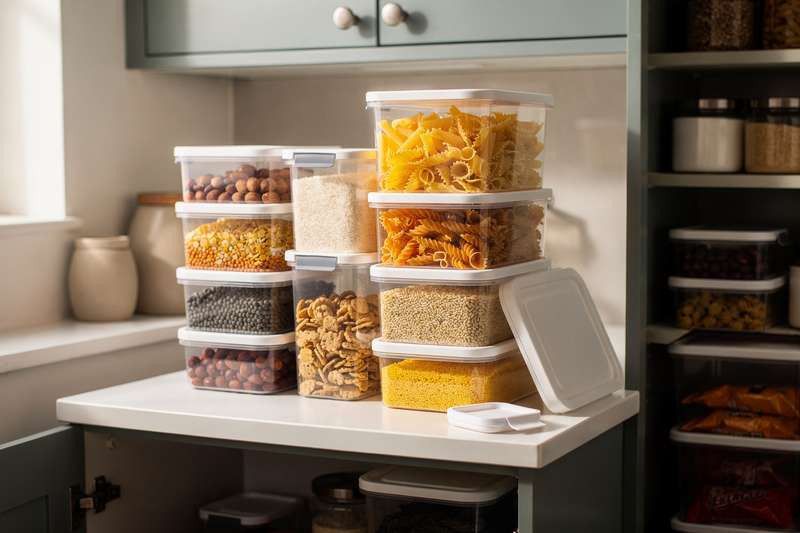
If you can only buy one type of container for your pantry and you want it to work properly, a modular canister system where every size — small, medium, large — shares the same square or rectangular base footprint is the answer. The reason this matters so much in a small pantry is simple geometry: when your 1-litre, 1.5-litre, and 2-litre canisters all have the same base, you can stack them in a single column regardless of which size is on top. You don’t end up with an unstable pyramid or awkward overhangs.
Look for containers in this category made from clear PET or tritan plastic with a wall thickness substantial enough to hold shape when stacked three or four high. The lid mechanism matters enormously: four-point clip lids (a clasp on each side) create an even downward seal and give you a flat, stable stacking surface. Avoid containers where the lid has a raised central handle or dome — these prevent flat stacking entirely unless the base of the container above has a recessed underside to accommodate it. The best systems have bases with a subtle raised ring that locks into the flat lid below, giving real lateral stability.
Where this type of system genuinely excels is flour, rice, dried pasta, lentils, and any dry good you buy in kilogram bags. A 2-litre canister takes a standard 500g bag of pasta with room to spare; a 3-litre takes a full 1kg bag of plain flour. The tradeoff is cost: a six-piece set in this category typically runs £25–£40, and to fully decant a pantry of eight to twelve product types, you’ll spend more. It’s also worth measuring your shelf depth before buying — containers in this category are often 12–14 cm wide, so on a 30 cm shelf you can run two columns side by side, but on an 18 cm shelf you may only fit one. For narrow shelves, see the dedicated section below.
One thing to avoid: sets where the sizes included aren’t actually useful together. A set that gives you four small containers and one large is harder to organise around than a balanced set. Look for sets that include at least two larger canisters (2–3 litres) alongside the smaller ones.
Best Budget Pick (£20–£28): Clear Snap-Lid Stackable Bins
At under £28 for a multipack, you won’t get the airtight clip-seal of a premium canister system, but you can get a genuinely useful set of clear, stackable open-top or snap-lid bins that transform a chaotic shelf into something coherent. This type of bin — essentially a rectangular clear plastic container with a press-fit or snap lid that doubles as a stable stacking surface — is the workhorse of budget pantry organisation.
The appeal is straightforward: you get more units per pound spent, so you can cover an entire shelf in one purchase rather than buying piecemeal. Sets of six to twelve bins in the £20–£28 range are common, and the uniformity of identical bins makes the shelf look tidier almost immediately. They work particularly well for categories you access frequently — snacks, tea bags, coffee pods, biscuits — because the snap lid opens and closes quickly without the effort of clip clasps.
The honest tradeoff is that snap lids are not airtight. They’ll contain a spilled bag of rice, but they won’t keep a crusty bread roll fresh or prevent moisture from reaching sugar over time. If you’re storing anything that genuinely needs an airtight environment (ground coffee, opened spice blends, flour in a humid kitchen), budget snap-lid bins aren’t the right tool. Use them for things in sealed manufacturer packaging that you’re just corralling — the bin keeps them upright and grouped, and you don’t need an airtight seal on a sealed packet of oat biscuits.
Stacking durability is the other variable to watch at this price point. Some cheaper snap-lid bins stack by nesting the base of the container above into the lid of the container below, which works fine when the contents are light. When both containers are full and heavy — say, each with 800g of dried goods — the lid can bow slightly and the stack becomes wobbly. Read UK buyer reviews specifically for comments on lid warping or cracking at the snap points after a few months of use, as this is where cheaper sets tend to fail.
For a single shelf or a first attempt at pantry organisation, a budget set like this is a practical starting point. You can always upgrade specific containers to an airtight system for the goods that need it, while keeping the snap-lid bins for lower-priority items.
Best for Narrow Shelves (Under 25 cm Deep): Slim Open-Front Bins
Many UK kitchen pantry shelves — particularly in older properties or galley kitchens — are genuinely shallow. If your shelf is 18–22 cm deep, a standard pantry canister simply won’t fit, or will overhang the shelf edge uncomfortably. The solution is a slim rectangular bin with an open front (or a very low-profile lid), designed specifically to present contents at the front of the shelf rather than requiring you to reach to the back.
Open-front bins in this category typically measure around 30 cm wide, 20 cm deep, and 12–15 cm tall — shallow enough to sit fully on a 22 cm shelf while still holding a reasonable volume. The open front means you can pull out a packet or loose item from the front without lifting a lid, which is genuinely useful when you’re mid-cook. Some designs include a step or ridge on the top surface that slots into the base of an identical bin stacked above, giving a two-high or three-high column.
What you gain in shelf compatibility you give up in containment: open-front bins don’t seal, so loose items like breadsticks or crackers can become stale faster if left in their original opened packaging without being resealed separately. They’re best used as corralling bins — you put sealed packets, tins, and jars inside them rather than decanting loose goods directly. Think of them as drawer dividers turned vertical.
One specific issue to watch with narrow shelves and stackable bins: the stability of the stack depends heavily on the bin being on a level, smooth surface. Wire shelf grids — common in older freestanding pantry units — can cause the flat base of a plastic bin to flex and wobble. If your shelves are wire, look for bins with a ribbed base designed to sit across the wires rather than flex between them, or lay a thin acrylic or melamine shelf liner first. This applies to all container types on wire shelves, but it’s most acute with slim, open-front bins because they’re lighter and have less inherent rigidity.
For households with both standard-depth (30 cm+) and narrow shelves in the same pantry, it’s worth using two different container types rather than forcing a compromise. A slim open-front bin on the narrow shelf and a canister system on the deeper shelves gives you the best of each without awkward overhangs anywhere.
Best for Bulky Items (Flour, Sugar, Oats): Large Wide-Mouth Canisters
There’s a category of dry goods — plain flour, caster sugar, rolled oats, rice — that you buy in 1–1.5 kg bags and use regularly. These are the items that most benefit from being decanted, because the manufacturer bags are awkward (prone to splitting, hard to reseal, and stack poorly), but they’re also the items where you need a genuinely large container. A 3-litre canister holds a 1.5 kg bag of plain flour comfortably; anything smaller means you’re storing the overflow bag separately, which defeats the point.
For this category, prioritise a wide mouth opening. You need to be able to scoop flour with a standard measuring cup without hitting the sides; a canister with a diameter narrower than about 11 cm at the opening will frustrate you every time. Some canister sets look appealing because they’re tall and slim (good for shelf depth), but if the opening is narrow, daily use becomes a chore. Wide, square-section canisters — roughly 12 x 12 cm in base — tend to give the best combination of scoopability and stackability.
Lid seal quality is more critical here than for smaller containers. Flour in particular can go stale or absorb ambient odours from a pantry if the lid isn’t sealing well. A four-point clip lid is preferable to a simple press-fit on anything above 2 litres. Some canisters in this size range use silicone gasket seals around the lid rim — this is worth paying extra for, as silicone stays flexible over time whereas plain plastic-on-plastic seals can develop micro-gaps.
The tradeoff with large-capacity canisters is weight when full. A 3-litre canister full of flour weighs around 1.5–1.8 kg, so if you stack two of these, the combined weight on a shelf-mounted bracket needs to be considered. On solid shelving it’s rarely an issue, but on clip-in or adjustable shelving in a fitted kitchen cupboard, check the rated load before building a column of four large canisters. For most UK kitchen cupboard shelves, two large canisters stacked is practical; three starts to feel precarious, and you lose the visual benefit of a neat column if the top container is too high to see into.
Best for Snacks and Small Packets: Small-Format Divided Bins
The snack category is where pantry organisation tends to unravel quickest, because snacks come in a huge variety of packet sizes and shapes — mini chocolate bars, cereal bars, small crisp packets, individual nuts pouches — and none of them stand up on their own. A bin or container that corrals these without requiring decanting is the most realistic solution for busy households.
Small-format bins (roughly 15–20 cm wide, 10–15 cm deep, 10 cm tall) work well here, especially designs with internal dividers or compartments. A bin divided into two or three sections lets you separate, say, chocolate biscuits from savoury crackers without needing separate containers for each. Look for bins with a slight inward taper at the top — this keeps small packets from falling sideways and becoming invisible at the back.
Clear sides are, if anything, even more important in the snack category than elsewhere, because snack items tend to be high-turnover goods that you want to see and grab quickly. Opaque bins for snacks mean you’re rummaging blind at the worst moment (mid-afternoon hunger, small child demanding a snack). A fully clear front at minimum, ideally all four sides, makes a genuine difference to daily use.
For stacking, small-format bins work best in a two-high column rather than taller — partly because snack items are typically lighter and a tall column of full bins can still become top-heavy, and partly because having the top bin too high puts the contents above comfortable reach height for shorter family members. Position snack bins at mid-shelf height where everyone can see and access them without climbing or crouching.
Best for Under-Shelf or Low-Clearance Space: Low-Profile Flat Bins
In many small pantries, there’s a gap above the top shelf and the cupboard ceiling, or a low-clearance zone between two fixed shelves, that doesn’t fit standard-height containers. Flat, low-profile bins — typically 6–8 cm tall — are specifically useful here. They also work well in the zone under a pantry shelf if you add a shelf riser or under-shelf basket, turning dead air into usable storage.
This type of bin is most suited to flat or compact items: baking paper rolls, tin foil, zip-lock bag boxes, spare cling film, or items like seed packets and stock cubes that are thin enough to lie flat. The stackability of low-profile bins is genuine — because they’re flat, a column of four takes the same vertical space as one medium-height container, so you can make real use of a 25–30 cm vertical gap that would otherwise fit only one or two standard bins.
The limitation is obvious: low-profile bins have low capacity. Don’t try to force-fit tall items into them; they’ll stick out of the top and the next bin won’t stack flat. Use them purposefully for the categories described above, and accept that they’re a supplementary solution rather than a primary storage type. In a small pantry that’s using every centimetre of space, one or two of these in a specific zone can recover surprisingly useful storage that would otherwise be wasted.
Best for Eco-Conscious Households: Glass Canisters with Bamboo or Wood Lids
If you want to move away from plastic entirely, glass canisters with bamboo or sustainable wood lids are the most practical long-term option. Glass doesn’t absorb odours, doesn’t stain, and maintains an accurate view of contents permanently — clear plastic can scratch and cloud over time, making it progressively harder to see what’s inside. Glass canisters are also non-reactive, which matters if you store anything acidic or strongly aromatic (dried citrus peel, whole spices, vinegar-based items).
The stacking story with glass is more nuanced. Genuine stacking — where the base of one container locks into the lid of another — is rare in glass canisters, because the bamboo or wood lid rarely has the precision geometry needed for a locking stack. What you typically get is flat-stacking, where you place one canister’s base on top of another’s lid. This works adequately for two-high columns but becomes risky at three or more, particularly because glass is considerably heavier than plastic and a toppling column is more consequential. For shelf stability with glass, stick to two-high maximum and use taller canisters on the bottom.
The cost premium is real: a six-piece glass canister set with bamboo lids runs £30–£55 for quality options, versus £20–£35 for an equivalent plastic set. The durability case for glass is strong if you keep the containers in one place — glass that isn’t being carried around doesn’t break. The bamboo lids, however, do need care: wash them by hand and dry them immediately. Bamboo that’s repeatedly submerged or left wet will eventually crack or warp, and a warped lid won’t seal properly.
This option suits households that are committed to the pantry organisation long-term, have a stable shelf arrangement they won’t be constantly rearranging, and want something that looks genuinely attractive on an open shelf or in a larder. If your pantry is a closed cupboard that no one sees, the aesthetic argument for glass is weaker and the practical advantages of a good plastic system are harder to dismiss.
What to Look for When Buying Stackable Pantry Storage
- Consistent base footprint across sizes: The single most important feature for a functional system. If a small, medium, and large container all share the same base dimensions, they stack in clean columns without overhangs or instability. Systems where each size has a different footprint force you to arrange containers side-by-side rather than up-and-down, and you lose the vertical space advantage entirely.
- Lid design and stacking surface: A flat lid is the minimum for stackability. A lid with a raised central handle, dome, or protruding clasp prevents flat stacking unless the base above has a matching recess. Four-point clip lids tend to produce the most reliably flat top surface. Check product images from the side, not just from above.
- Seal type matched to contents: Airtight (silicone-gasket or four-point clip) for flour, sugar, coffee, ground spices, and any opened packaging. Snap-fit or press-fit lids are adequate for dry goods still in sealed manufacturer packaging. Open-front bins are fine for corralling packets but not for loose goods.
- Clarity and wall thickness: Fully clear containers save time daily. Wall thickness matters for longevity — thicker-walled containers resist flexing under load and don’t yellow or cloud as quickly. Tritan plastic is more scratch-resistant than standard PET over time.
- Dimensions versus your actual shelf: Measure your shelf depth, width, and height before buying. A standard UK kitchen cupboard shelf is typically 30–35 cm deep and 45–60 cm wide. Tall canisters (20+ cm) may not fit between fixed shelves. Low-profile bins (6–8 cm) may be the only option in low-clearance zones. Always check listed container height against your available shelf height, not just the footprint.
- BPA-free certification: For anything storing food directly, look for explicit BPA-free labelling. This is standard on reputable products but worth confirming, especially on cheaper sets.
- Ease of cleaning: Dishwasher-safe containers are a significant practical advantage for anything storing floury, oily, or sticky goods. Many clear plastic canisters are hand-wash only; check before buying and decide whether that’s acceptable for your specific use case.
Side-by-Side Comparison
| Pick | Price range | Seal type | Ideal capacity range | Stackable method | Best shelf depth |
|---|---|---|---|---|---|
| Modular canister system (overall best) | £25–£40 | Four-point clip, airtight | 0.5–3 litres per unit | Base locks into flat lid | 28 cm+ |
| Budget snap-lid bins | £20–£28 | Snap/press-fit, not airtight | 0.8–2 litres per unit | Base nests into lid | 25 cm+ |
| Slim open-front bins | £18–£30 | None (open front) or flat lid | 2–4 litres per unit | Stepped lid surface | 18–25 cm |
| Large wide-mouth canisters | £28–£45 | Clip or silicone gasket, airtight | 2.5–5 litres per unit | Base locks into flat lid | 28 cm+ |
| Small-format divided bins | £15–£25 | Snap-fit or open | 0.5–1.5 litres per section | Flat base on flat lid | 20 cm+ |
| Low-profile flat bins | £12–£22 | Snap or press-fit | 0.3–0.8 litres per unit | Flat stacking, no lock | 20 cm+ |
| Glass canisters with bamboo lids | £30–£55 | Bamboo lid, moderate seal | 0.5–2 litres per unit | Flat base on lid (2-high max) | 25 cm+ |
Verdict
For most UK households with a small to medium pantry cupboard, the modular canister system with a consistent base footprint and four-point clip lids is the pick that pays off longest. Yes, it costs more upfront than a budget snap-lid set, but the combination of true airtight storage, reliable stacking stability, and the ability to mix sizes in the same column means you actually use the system rather than reverting to shoving things in wherever they fit after a week.
Start with a set that includes at least two large (2.5–3 litre) canisters for flour and oats, two medium (1.5 litre) for rice and pasta, and two small (0.8–1 litre) for smaller dry goods like lentils or nuts. That six-piece configuration covers the core of most UK pantry shelves in one purchase. If you have a narrow shelf (under 25 cm deep) anywhere in your pantry, add two slim open-front bins to that zone rather than trying to adapt the canister system where it doesn’t fit. The two types coexist fine and each does what it’s actually suited for.
Budget is genuinely tight? Start with the snap-lid bin set. It’s a real improvement over no system at all, and you can layer in airtight canisters for specific high-priority items over time.
We were not paid to feature any specific product in this guide. All opinions are independent and based on publicly available specifications, verified buyer feedback patterns, and category research. Prices shown were accurate at time of writing and may change.
FAQ
Do stackable food storage containers actually keep food fresh, or is that marketing?
It depends on the lid seal. Containers with a four-point clip lid and a silicone or rubber gasket genuinely create an airtight seal that slows moisture ingress and keeps dry goods like flour, oats, and ground coffee fresh noticeably longer than an opened manufacturer bag. Snap-fit or press-fit lids, by contrast, are not airtight — they keep contents corralled and protected from spillage, but they don’t create the pressure differential needed to stop moisture or air exchange over time. Match the lid type to the content: airtight for anything you decant from its original packaging, snap-fit for goods still in sealed packets.
What size containers do I actually need for a UK pantry?
A practical starting point: 2.5–3 litres for flour and oats (holds a standard 1–1.5 kg bag), 1.5 litres for dried pasta and rice (holds 500g comfortably), and 0.8–1 litre for nuts, dried fruit, seeds, and spice mixes. Avoid going too large — an oversized container for a small quantity means lots of empty air inside, which can accelerate staleness in some goods and wastes shelf space. A six-piece set with two of each size is a practical starting configuration for most UK kitchens.
Can I stack heavy filled containers safely on kitchen shelves?
Yes, with some caveats. Most adjustable kitchen cupboard shelves are rated for 10–15 kg per shelf, so a column of four filled 2-litre canisters (roughly 6–8 kg total) is fine on a solid shelf. The risk is lateral instability rather than weight: stacked containers on a smooth shelf can slide if the cupboard is opened or closed firmly. Containers with interlocking bases and lids, or a non-slip mat under the bottom container, address this. Avoid stacking more than three or four canisters high, and keep heavier columns on lower shelves where a topple is less consequential.
Is it worth decanting everything, or just some things?
Decanting has a clear benefit for goods you buy in bags or boxes that don’t stack well, that you use regularly, and where the original packaging isn’t resealable. Flour, oats, pasta, rice, lentils, nuts, and ground coffee are the core candidates. Things not worth decanting: tins, jarred goods, anything in manufacturer packaging with a secure reseal (some coffee bags, dried fruit pouches), and anything you use so infrequently that you’d be washing out a canister between very occasional uses. Keep the decanting commitment realistic — if you wouldn’t maintain it, a simpler corralling system is more useful than an aspirational decanting system you abandon.
What’s the best way to label pantry containers?
Chalk labels on a blackboard-paint surface are attractive but less practical if your container range changes. Adhesive label holders (small transparent pockets that stick to the container front and hold an index card) allow you to swap labels easily and work on any smooth surface. For a cleaner look, frosted adhesive labels written with a fine permanent marker are quick and cheap. Avoid writing directly on the container with permanent marker — the resin in some plastics makes it almost impossible to remove completely, which matters if you ever want to repurpose a container for something different.
How do I stop containers from smelling like previous contents?
For plastic containers, a paste of bicarbonate of soda and warm water left inside for 24 hours removes most residual odours, including coffee and strong spices. Rinse thoroughly and air-dry completely before refilling. Glass containers are naturally odour-resistant and rarely retain smells. If a plastic container has a persistent odour after bicarbonate treatment, sunlight can help — UV exposure naturally breaks down many odour compounds, so leaving the container outside on a dry day (without lid) for several hours often finishes the job.