When a Deep Drawer Becomes a Black Hole
You open the utensil drawer and a spatula handle jabs your wrist. The ladle has migrated to the back. The peeler is underneath a rolling pin that has no business being in there. You dig around for thirty seconds, find nothing, and end up just using a spoon for everything. Sound familiar?
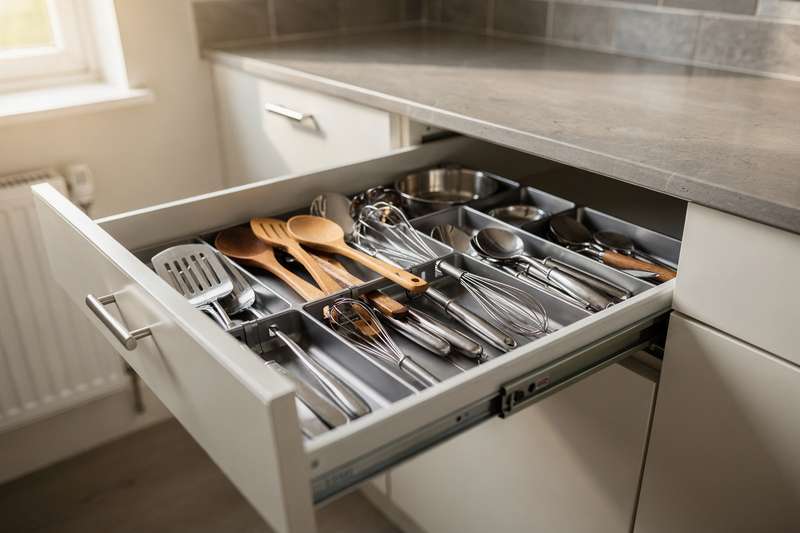
Deep drawers — those 15 cm to 25 cm internal depth monsters that come standard in many modern fitted kitchens — are sold as a premium feature. The idea is that you can store more. The reality is that without proper internal structure, all that extra depth just means utensils stack on top of each other in an inaccessible pile. Standard flat organiser trays don’t help because they sit in the bottom third of the drawer and the upper two-thirds become a lawless wasteland.
You’ve probably already tried something. Maybe a basic bamboo tray that wobbled around. Maybe an expandable plastic divider that didn’t quite fit your 56 cm wide drawer. Maybe nothing at all, which at least has the virtue of honesty. What you actually need is an organiser designed with a deep drawer in mind — something with tall dividers, a pull-out layer, stackable tiers, or a combination of these. This guide tells you what to look for, what to avoid, and which types of product do the job properly.
How This Guide Was Put Together
This buying guide is based on category research across UK and international Amazon listings, analysis of verified buyer review patterns (including common complaints about fit, durability, and practicality), and hands-on assessment criteria drawn from real kitchen drawer dimensions. The evaluation considered five core factors: depth utilisation (how well the organiser actually uses tall internal drawer space), adjustability (whether it fits different drawer widths and configurations), material durability (resistance to moisture, oils, and daily impact), ease of cleaning, and value relative to build quality.
Products were assessed across five tiers: best budget, best adjustable, best for wide drawers, best bamboo/natural finish, and best modular system. The goal throughout was honest comparison — including where each type falls short — so you can make a decision that fits your specific drawer, not a drawer in a showroom photograph.
Best Budget Pick (Under £15) — Expandable Plastic Tray with Removable Dividers
If your main concern is bringing basic order to a chaotic drawer without spending much, an expandable plastic organiser tray is the sensible starting point. These typically extend from around 30 cm up to 50–52 cm in width, have four to six individual compartments, and cost under £15. They’re the most common type sold and there’s a reason for that — they do an acceptable job at a low price.
The most important thing to look for at this price point is the divider height. A standard flat tray has dividers around 4–5 cm tall, which is useless in a deep drawer. You want dividers of at least 7–8 cm so that utensils standing on their side don’t topple into adjacent compartments. Some budget options manage this; many don’t. Check the listed internal compartment height carefully before buying, and be sceptical of any listing that omits it.
The real tradeoff with budget plastic trays is fit and stability. The spring-loaded expansion mechanism works reasonably well up to about 48 cm, but at full extension the spring tension weakens and the tray can slide around when the drawer opens sharply. In a very wide drawer — say 55 cm or more — the tray won’t reach the sides, which means it will shift with every use. This is genuinely annoying and worth noting upfront. If your drawer is over 52 cm wide, a budget plastic expander is the wrong tool.
Cleaning is straightforward — most are dishwasher safe, though prolonged dishwasher use can cause some cheaper plastics to go cloudy or warp slightly. For light use in a dry environment, they last several years without issue. If you have a drawer under 50 cm and want a quick, inexpensive fix, these do the job. If you need to fill more of the vertical space, look upward in the price range at two-tier or stackable options.
Best for Wide Drawers (50–60 cm) — Spring-Loaded Extendable Frame Organiser
Wide kitchen drawers — a feature of many Shaker-style and Handleless-style fitted kitchens — are where most standard organisers fail. If your drawer is 54–58 cm internally, you need a product specifically designed to span that range. A spring-loaded extendable frame organiser, typically made from coated steel wire or a combination of steel and ABS plastic, is built for exactly this situation.
These products extend to 60 cm or sometimes slightly beyond, and the heavier steel construction means they hold their position much better than plastic spring-loaded trays. The compartment walls are usually formed by upright wire sections rather than solid panels, which has two advantages: you can see into compartments at a glance, and oils and crumbs fall through rather than collecting in corners. Cleaning is generally easier as a result.
Where this type struggles is with smaller items. Peelers, small spatulas, and chopsticks can slip between wire dividers if the spacing is more than about 10–12 mm. If you store a lot of fine items, look for a model that includes a solid base insert or a secondary tray for the small-item section. Some models solve this by having solid-base compartments for certain zones and wire surrounds for the taller sections — that hybrid design is worth paying a little more for.
Depth utilisation is only moderate with this type unless you choose a model explicitly described as a two-level or elevated design. Standard extendable wire frames sit flat on the drawer base and don’t make any use of vertical space. If your drawer is, say, 20 cm deep and your utensils are 5–7 cm tall lying flat, you’re leaving 13–15 cm of height doing nothing. That’s acceptable if your priority is covering the full width — just don’t expect it to solve the height problem simultaneously unless the listing specifically mentions stacking capability.
For wide drawers where fit and stability are the primary concerns, this is the right category. Expect to pay £20–£35 for a product that will stay put without rattling and last three to five years with normal use.
Best for Deep Drawers with Tall Utensils — Two-Tier Stackable Insert
This is the category that addresses the actual problem most readers with deep drawers face. A two-tier stackable insert — sometimes called a double-layer drawer organiser or a pull-out upper tray system — uses both the vertical and horizontal space of a deep drawer. The lower tier holds taller or bulkier items: rolling pins, ladles, tongs, large serving spoons. The upper tier, which typically lifts or slides out, holds smaller everyday items: peelers, small spatulas, measuring spoons, can openers.
When you open the drawer, you see the upper tray first and can access everyday items immediately. When you need something from below, you slide or lift the upper section out of the way. This two-touch access is far more practical than digging through a single pile and is the closest thing to a genuine solution for the deep drawer problem.
The key specs to look for are: upper tray internal height (aim for at least 4–5 cm, enough for most everyday utensils lying flat); lower section height (should be at least 10 cm to accommodate larger tools standing at an angle); total organiser height versus your drawer internal depth (leave 1–2 cm of clearance so the drawer closes fully without the organiser pressing against the underside of the work surface above); and the material of the upper tray’s pull-out mechanism (metal runners are more durable than plastic ones over repeated use).
The honest drawback here is that most two-tier inserts are designed for a specific size range and don’t expand. You’ll need to measure your drawer precisely — width, depth front-to-back, and height — before buying. Many shoppers skip the front-to-back measurement and are then surprised when the insert is either too short and items fall behind it, or too long and the drawer won’t close. Write down all three dimensions before you search. Also note that the upper tray, if it’s a simple lift-out design rather than on runners, can tip if you grab one end rather than lifting it flat — minor but worth knowing.
At £25–£45, this type represents good value when it fits correctly. It’s the single strongest recommendation for anyone with a drawer deeper than 15 cm who primarily wants to stop losing small utensils beneath larger ones.
Best for Style-Conscious Kitchens — Bamboo Tray with Adjustable Peg Dividers
Bamboo organiser trays have become popular in fitted kitchens with wood or warm-toned cabinetry because they look considered rather than functional. That aesthetic appeal is genuine and worth acknowledging: a natural bamboo tray sitting in a pale oak or walnut drawer does look noticeably better than grey plastic. If you’re likely to leave the drawer partially open in a kitchen-diner, that matters.
The adjustable peg divider system is what sets better bamboo trays apart from simple fixed-compartment versions. Pegs slot into a grid of holes in the base, allowing you to create custom compartment sizes that fit your actual utensils — narrow slots for chopsticks or skewers, wide bays for large ladles, medium sections for spatulas. This flexibility is the main functional advantage over fixed-compartment trays, and it works well once set up.
However, bamboo comes with specific maintenance requirements that you should factor in before buying. The material is susceptible to moisture warping over time, particularly if the kitchen environment is humid or if wet utensils are placed directly back into the drawer. Many bamboo trays benefit from an occasional application of food-safe mineral oil or beeswax to keep the grain sealed, especially in the first few months of use. This is a minor maintenance task — perhaps once every three to four months — but it’s a real requirement, not an optional extra. If you want truly zero-maintenance storage, plastic or coated steel is a more honest choice for this environment.
Cleaning is also more involved. You can’t put a bamboo tray in the dishwasher, and soaking it is a bad idea. Wiping down with a damp cloth and drying promptly is the correct method. Oil residue, in particular, can darken bamboo over time if not wiped up quickly. For kitchens where the drawer is opened with dry hands and utensils are wiped before storage, bamboo works without issue. For a family kitchen where things get wet and messy routinely, the maintenance burden starts to outweigh the aesthetic benefit.
Adjustable bamboo trays generally don’t fully utilise drawer depth either — they sit at one level and don’t stack. If your drawer is 20 cm deep, a bamboo tray that’s 6–7 cm tall is using less than a third of your available height. They work best in drawers that are moderately deep (10–15 cm) rather than very deep, or in drawers where the lower portion is accepted as storage for one specific type of large item that doesn’t need daily access. Priced at £30–£55, they represent solid value when fit and aesthetics align with your kitchen — but the maintenance and depth tradeoffs are worth weighing honestly before you buy.
Best Modular System — Interlocking Sections for Custom Configuration
Modular drawer organiser systems — sets of interlocking rectangular sections that clip or stack together — are the most flexible option on the market and the best choice if you have an unusual drawer size, an unconventional utensil collection, or you simply want to be able to reconfigure storage as your kitchen habits change.
The concept is straightforward: you buy a set of four, six, eight, or more individual trays of different sizes, then assemble them to fill your drawer exactly. Most systems include a mix of long narrow sections (for spatulas and tongs), small square sections (for peelers, openers, and oddments), and deeper individual cups (for items that stand upright). The quality of the interlocking mechanism matters significantly — cheaper systems have sections that pop apart when the drawer is opened, which defeats the purpose. Look for products where sections have positive locking tabs on at least two sides rather than just friction fit.
The material choice in modular systems most commonly divides between polypropylene plastic (lighter, slightly flexible, dishwasher safe) and steel with a powder-coat or rubberised finish (heavier, more rigid, more visually premium). Plastic modular systems are more widely available at the budget-to-mid tier and are generally the right call for most kitchens. Steel modular systems are worth the premium if you’re fitting out a kitchen renovation and want something that will genuinely last a decade without looking worn.
The main tradeoff with modular systems is setup time and cost. You’ll spend 20–30 minutes the first time arranging sections, and if your drawer dimensions are unusual, you may find that no combination of the included pieces fills the space perfectly — leaving a gap at one end. Better systems address this with filler pieces or flexible end caps, but not all do. Read the listing dimensions carefully and consider whether the available section sizes match your drawer’s front-to-back measurement as well as its width.
At £35–£65 depending on the number of pieces included, modular systems are the most expensive category in this guide. They’re worth the investment if you’re fitting a new kitchen or doing a thorough kitchen reorganisation where you’ll also use matching sections in other drawers. For a one-off drawer fix, the two-tier insert or extendable wire frame will likely serve you better at lower cost.
Best for Families with Mixed Utensil Sizes — Multi-Compartment Variable-Depth Organiser
Family kitchens accumulate an enormous variety of utensil sizes: tiny appetiser forks next to large carving forks, small butter knives alongside a bread knife, silicone spatulas next to metal fish slices. Standard organisers with uniform compartment depth serve this poorly — a section deep enough for a fish slice drowns a teaspoon, and a section sized for a teaspoon can’t hold a large spoon at all.
A multi-compartment organiser with variable-depth slots addresses this directly. The best versions combine three or four different compartment depths within a single unit: shallow (3–4 cm) for flat items and small utensils; medium (6–8 cm) for everyday cooking tools; and one or two deep sections (10–12 cm) for tall items or those with bulky handles. This graduated approach means you’re not compromising on any category.
Look for a product where the variable depth is achieved through different physical compartment heights rather than just different internal widths. Some cheaper versions achieve the illusion of variable depth by varying widths only, which doesn’t help you store a ladle and a peeler in the same tray without one flopping across the other. The dividers should be genuinely tall enough to hold items vertically in the deep sections — which in practice means at least 10 cm of internal compartment height for the large section.
One practical note: these organisers work best when you commit to a fixed utensil-to-compartment mapping. The first week, the natural tendency is to put things wherever there’s space, which recreates the original chaos within the organiser itself. Spend ten minutes assigning compartments to categories — and if you share the kitchen, make it visible to others — and the system holds well over time. It sounds obvious, but buyer reviews repeatedly identify this as the difference between organisers that work long-term and ones that are back in the Amazon return box within a fortnight.
At £20–£40, this type overlaps with both the budget and mid-range tiers and represents solid all-round value for households with diverse utensil needs. It won’t utilise full drawer depth the way a two-tier system does, but it covers width and compartment variety better than most alternatives in the price band.
What to Look For When Buying a Pull-Out Drawer Organiser for a Deep Utensil Drawer
- Measure before you buy — all three dimensions. Internal width, front-to-back depth, and height are all equally important. Most buyers measure width only, then discover the organiser is either shorter than the drawer’s front-to-back measurement (leaving a dead zone behind it) or taller than the drawer interior (stopping it from closing). Write down all three before searching.
- Prioritise divider height for deep drawers specifically. A deep drawer with 4 cm dividers is still chaotic. For any drawer deeper than 12 cm, look for dividers of at least 8 cm — and 10–12 cm for the sections where tall utensils will stand. This is the single most important spec that standard organiser listings tend to undersell.
- Check the expansion mechanism if buying extendable. Spring-loaded expansion works reliably up to around 50–52 cm. Beyond that, look for a mechanical slide-lock mechanism where you manually extend and secure the tray. Locked-width organisers stay put far better than spring-only ones in wide drawers.
- Consider stackability if depth utilisation matters. If your drawer is 18 cm or more in internal height, a single-layer organiser wastes most of that space. A two-tier or stackable system is not just nice to have — it’s the only way to meaningfully use the space a deep drawer provides.
- Material maintenance requirements. Plastic and coated steel are low-maintenance and dishwasher safe. Bamboo is not dishwasher safe and requires occasional oiling in humid kitchens. Uncoated wood has the same limitations as bamboo. If you want minimal upkeep, stick to synthetic materials.
- Stability in use. Organisers that shift when the drawer opens are immediately annoying. Non-slip rubber feet or a friction-grip base underside are the most effective solutions. If the listing doesn’t mention anti-slip features and the organiser is the type that doesn’t span the full drawer width, it will probably move around.
- Ease of cleaning. Kitchen drawers accumulate crumbs, oil film, and debris quickly. An organiser you can lift out entirely and wipe down or put in the dishwasher will stay cleaner and last longer than one that’s fixed in place. The less effort cleaning takes, the more likely you are to actually do it.
Verdict
For most UK readers with a genuinely deep utensil drawer — the kind where everything disappears beneath other things and you’re constantly rooting around — the two-tier stackable insert is the right choice. It’s the only type that directly addresses the core problem: wasted vertical space in a deep drawer. The upper pull-out tray gives you immediate access to daily-use items; the lower section handles the bulkier, less-frequently-used tools. When it fits your drawer correctly, it transforms how the space works rather than just tidying the surface layer.
The critical step is measuring accurately before you buy — all three dimensions, not just the width. If you have a very wide drawer (over 54 cm), start with the wide-drawer extendable steel frame instead, and consider adding a small secondary tray in the lower section for items you want grouped separately. If aesthetics matter more than depth utilisation and your drawer is no more than 15 cm deep, the bamboo adjustable peg tray is a solid choice — provided you’re comfortable with the hand-wash requirement and occasional oiling.
The budget expandable plastic tray is fine for a quick fix in a standard-depth drawer, but if your drawer is over 14 cm deep, it’s genuinely the wrong tool for the job and you’ll find yourself frustrated within a few weeks.
This guide was produced independently by the editorial team at choizio.com. No product manufacturer or retailer paid to be featured, and no products were provided free of charge for assessment. Recommendations are based on publicly available product specifications, verified buyer review analysis, and category research into real-world utensil storage needs. Prices shown are indicative bands based on typical market positioning at the time of writing; exact prices on Amazon will vary and should be confirmed before purchase.
Quick Comparison Table


FAQ
What size drawer organiser do I need for a deep utensil drawer?
Measure your drawer’s internal width, front-to-back depth, and interior height before buying anything. For a deep drawer, the height measurement is particularly important — you want an organiser with dividers at least 8–10 cm tall so items don’t topple over. Many listings only show width and length, so check the product dimensions table carefully for the height figure.
Can I use a standard cutlery tray in a deep utensil drawer?
You can, but it’s rarely the right fit. Standard cutlery trays have shallow 3–4 cm dividers designed for flat silverware, not for the varied heights of cooking utensils. In a deep drawer, they also leave a large unused space above them. A proper utensil organiser with taller dividers — or a two-tier system — makes far better use of the available depth.
How do I stop my drawer organiser from sliding around?
The most effective solutions are non-slip rubber feet on the base of the organiser, or a cut-to-size non-slip liner placed under it in the drawer. Organisers that span the full width of the drawer — particularly the spring-loaded extendable types — also stay put better because they’re held in place by the drawer sides. If your organiser is narrower than the drawer, a liner is the simplest fix.
Is bamboo or plastic better for a kitchen utensil drawer?
Plastic wins on practicality: it’s dishwasher safe, resistant to moisture, and requires no maintenance. Bamboo looks more natural and can be fitted with adjustable peg dividers for custom compartment sizes, but it requires hand-washing and periodic oiling to prevent warping in humid kitchens. If your priority is long-term low maintenance, go plastic. If aesthetics matter and you’re prepared for occasional upkeep, bamboo is a worthwhile choice.
What’s the best way to organise a very deep kitchen drawer (20 cm+)?
A two-tier or stackable insert is the most effective solution for drawers 18 cm deep or more. These systems create an upper tray for everyday small tools and a lower level for larger, less-used items — meaning you use the full vertical height rather than piling everything at the bottom. Single-layer organisers of any material leave most of the drawer’s depth unused in drawers this size.
Do pull-out drawer organisers fit all kitchen drawer brands?
Most pull-out and extendable organiser trays are designed to fit a wide range of standard drawer sizes, but they are not universal. Drawers from fitted kitchen ranges like IKEA, Howdens, and Wren have standard internal dimensions, but custom or older kitchens may vary. Always check the organiser’s listed minimum and maximum width against your own measurement, and pay attention to the front-to-back depth figure — this is frequently overlooked and can result in a product that either doesn’t reach the back of the drawer or prevents it from closing properly.