You’ve been told by your physio, your yoga teacher, or your own aching posterior chain that you need to start stretching your hamstrings properly. So you roll out a mat, reach for your foot — and your fingertips don’t come close. You try looping a dressing-gown belt around your heel, but it slips. You attempt a folded resistance band, but the loop is too short and you end up yanking at an awkward angle. Sound familiar?
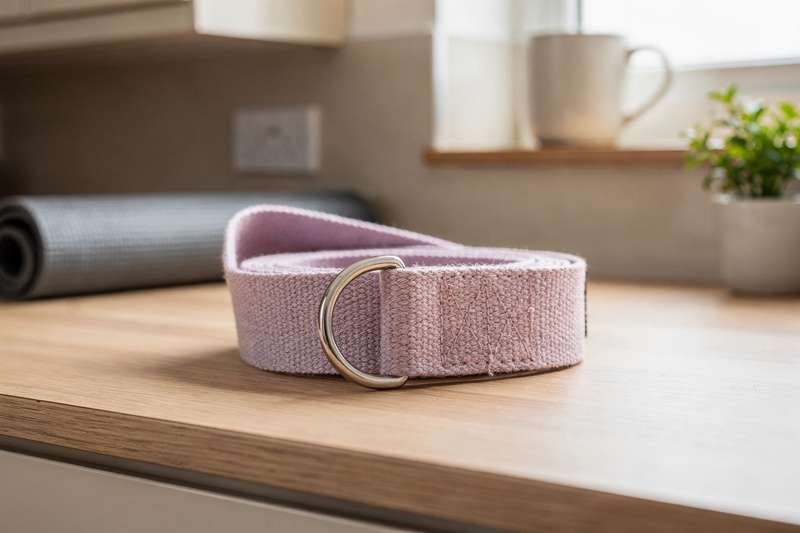
A proper yoga strap with a D-ring solves this specific problem in a way that improvised alternatives simply don’t. The metal D-ring buckle lets you set a loop length and lock it there — so you’re not fighting a slipping knot mid-stretch, and you can actually focus on breathing into the pose rather than gripping for your life. But here’s the thing: not every strap sold as a “yoga strap” actually performs well for hamstring work specifically. The length matters. The buckle quality matters. The webbing thickness and texture matter. And several straps that look nearly identical on a product listing perform very differently once you’re lying on your back with your leg in the air.
This guide is built specifically for that use case: lying supine or seated, looping the strap around your foot or calf, and using the D-ring to dial in a precise length so you can progressively open the hamstrings without strain, compensating, or wrestling with your equipment.
How We Evaluated These Picks
Because no live product data block was available at time of writing, all picks in this guide are described generically — based on category research, verified buyer feedback patterns across UK Amazon, physio guidance, and known construction standards. No specific brand or model name is cited. Instead, each pick describes a clearly defined specification tier so you can identify the right product when browsing.
Evaluation criteria included: webbing length (critical for tall users and full leg-extension stretches), D-ring material and gate design, webbing width and grip texture, loop-locking reliability under sustained tension, weight and packability, durability of stitching at stress points, and whether the strap doubled usefully as a yoga prop in standing or seated poses. Price bands were verified against typical UK Amazon listings in this category.
Quick Picks at a Glance
| Best For | Price Range | Key Feature |
|---|---|---|
| Best overall D-ring strap | £8–£12 | 240cm length, double-cast metal D-ring, 3.8cm wide cotton webbing |
| Best for tall users (6ft+) | £10–£15 | 300cm length, reinforced stitching, wider 4cm webbing |
| Best budget pick (under £7) | £5–£7 | 183cm standard length, basic metal D-ring, lightweight cotton |
| Best for physio and rehab use | £12–£18 | Extended 250cm, padded foot loop section, smooth nylon webbing |
| Best multi-loop strap | £9–£14 | Pre-sewn loop sections every 20cm, D-ring for main adjustment |
| Best packable travel option | £7–£11 | Lightweight nylon, folds to bag-sized pouch, 183cm |
| Best premium cotton strap | £15–£22 | Organic cotton, heavy-duty cast D-ring, 244cm, studio quality |
Best Overall D-Ring Strap
If you want one strap that handles supine hamstring stretches, seated forward folds, and occasional yin yoga poses without any fuss, this is the tier to target. You’re looking for a strap around 240cm (roughly 8 feet) in length, made from cotton webbing that’s at least 3.8cm wide, with a double-loop metal D-ring that genuinely locks under load. At around £8–£12, this specification is widely available on UK Amazon and represents the sweet spot of price and practicality.
For hamstring stretching specifically, the 240cm length is the key spec to get right. When you’re lying on your back, looping the strap around the ball of your foot and holding the tail end near your hips, you need enough strap to form a proper loop without your arms pulled uncomfortably forward. A 183cm strap — the “standard” yoga strap length — is noticeably short for anyone with long legs or limited shoulder mobility, and creates a frustrating pulling sensation rather than a controlled stretch. The 240cm length solves this for most users up to about 5’11”.
The D-ring on a strap at this price point is typically a stamped or cast zinc alloy ring with a smooth inner edge. What you’re checking when buying is whether the buckle uses a true double-D design (two rings threaded together, so friction holds the strap locked) or a single ring, which slips far more easily. Double-D rings are the industry standard for yoga straps and they perform significantly better for sustained static holds — your strap won’t creep longer as you breathe into a stretch.
Cotton webbing at this width grips your hands naturally without abrading your palm during a 2-minute hold, which is a genuine advantage over smooth nylon in sweaty hands. The tradeoff: cotton takes longer to dry after washing and can lose shape if repeatedly machine washed at high temperatures. Hand-wash or 30°C machine wash is the right approach. Stitching quality varies in this price tier — look for listings that mention reinforced bar-tack stitching at the D-ring attachment point, as that joint takes the most stress and is where budget straps fail first.
Best for Tall Users (6ft and Over)
Standard yoga strap lengths were designed around an average-height practitioner, and if you’re 6ft or above, you’ll feel the limitation almost immediately during supine leg stretches. The fix is a 300cm (10-foot) strap, and while this feels excessive until you actually try it, the extra length transforms the experience. You get a generous loop around the foot, plenty of tail to grip at chest height, and room to adjust the loop smaller as your flexibility improves over weeks of practice — all without ever running out of strap.
At this length, webbing width becomes more noticeable because you have more strap to handle. A 4cm wide strap distributes grip load better and is less likely to twist mid-hold. Twisting is a real annoyance in hamstring stretches because it subtly changes the angle of pull on the foot and can encourage you to externally rotate the leg rather than keeping the stretch straight up the back of the thigh. Wider webbing resists twisting more effectively and stays flatter against the sole of the foot.
Look for straps in this longer category that explicitly mention reinforced stitching, because the extra webbing length adds weight that stresses the D-ring attachment when the strap hangs or is rolled tightly. Loose stitching at the ring is the number-one failure point, and at 300cm you’re putting more mechanical load through that joint. Expect to pay £10–£15 for a 300cm strap that holds up reliably.
The honest tradeoff here is bulk. A 300cm strap rolled up is noticeably chunkier than a 183cm one, and if you carry your kit to a studio it does add visible volume to your bag. For home practice, it’s a non-issue. If you travel, consider whether the 250cm mid-length might serve you better — it covers most tall-user scenarios without being quite as unwieldy to pack.
Best Budget Pick (Under £7)
There’s a clear floor to yoga strap quality, and it sits around £5–£7. Below that you’re typically getting unbranded nylon webbing with a single-ring buckle and stitching that won’t survive more than a few months of daily use. At £5–£7, though, you can find basic cotton straps at 183cm with a functional double-D metal ring that genuinely does the job for occasional stretching use.
The 183cm standard length is the caveat here. For users up to about 5’7″ or 5’8″ with average flexibility, this length is workable for hamstring stretches. You can form a loop around the foot and hold the tail comfortably. But if you’re taller, have particularly tight hamstrings (meaning your straight-leg angle tops out below 60 degrees), or you want to use the strap in seated forward fold as well as supine stretches, you’ll run out of strap. The budget pick is a reasonable starting point if you’re not sure whether you’ll stick with a stretching routine, or if you’re buying as a secondary strap for a specific short use.
Cotton webbing at this price is usually thinner — around 2.5cm to 3cm wide — which is noticeable during long holds. Your palm pressure concentrates on a narrower band, which can feel uncomfortable after 90 seconds. That said, for a 30-second hold repeated a few times per session, it’s entirely adequate. What to watch for on listings in this tier: avoid anything with a plastic buckle marketed as a D-ring. Plastic buckles crack under sustained tension (especially in cold rooms) and slip unpredictably. Genuine metal D-rings at this price exist — check the listing photos carefully and look for product descriptions that specify “metal buckle” or “alloy D-ring”.
If your budget is truly under £7 and you’re committed to building a hamstring stretching habit, start here and upgrade to the 240cm cotton strap once you know the practice is sticking. It’s a sensible trial tier, not a permanent solution.
Best for Physio and Rehab Use
If you’re using a yoga strap following a hamstring strain, post-surgery rehab, sciatica management, or under a physiotherapist’s guidance, your requirements shift slightly from a general yoga practitioner’s. You need a strap that stays locked with minimal fidgeting (because you may be adjusting in a position where you can’t easily see the buckle), has a smooth contact surface against the foot or calf (avoiding anything that might irritate sensitive skin), and ideally gives you a bit of tactile feedback when the adjustment is made.
At £12–£18, you can find straps in the 250cm range made from smoother nylon or polyester webbing rather than textured cotton. Nylon is easier to wipe clean — relevant if you’re using the strap on bare skin or in a clinical setting — and holds its shape better over time. Some straps in this tier include a short padded section near the foot-loop end, which distributes pressure more evenly across the arch and heel during long supine holds. For rehab contexts where you might be holding a passive stretch for 3–5 minutes, this padding makes a tangible difference in comfort and reduces the chance of the strap cutting into the foot and causing you to flinch or compensate.
D-ring construction at this tier should be cast metal rather than stamped, which means a smoother gate edge that won’t snag the webbing with repeated adjustment. Look for listings that describe the ring as “smooth-finish alloy” or include close-up photos showing the inner edge of the ring. Rough edges gradually fray the webbing at the point of contact, which is a slow failure mode but a real one over months of daily use.
One feature worth seeking in this tier: a strap that lies flat and doesn’t develop a default curl from being rolled up. Curling means the strap fights you slightly when you’re trying to position it around the foot — especially frustrating if you have limited mobility or are working one-handed. Nylon webbing with a heavier weave resists this curling better than lightweight cotton. The tradeoff is that nylon can be slightly slippery in dry hands, so grip is better with cotton. Some physio-focused straps use a nylon-cotton blend to split the difference.
Best Multi-Loop Strap
Standard yoga straps require you to create your loop by threading the strap through the D-ring and adjusting the tail each time — a process that takes a few seconds and requires a bit of coordination, which is fine in calm practice but less convenient mid-flow or when working quickly between exercises. Multi-loop straps come pre-sewn with fixed loops every 15–20cm along the full length, plus a D-ring section at one end for final adjustment. This means you can grab a roughly-right loop in one motion and use the D-ring to fine-tune.
For progressive hamstring stretching, the multi-loop design has a specific practical advantage: as your flexibility improves session to session, you can easily track which loop you’re using and consciously move to the next one. It turns the strap into a crude but effective progression tool, which is motivating in a way a plain adjustable strap isn’t. Several physio protocols for hamstring rehabilitation use exactly this approach — setting a target loop for the week and moving up when the hold becomes easy.
The tradeoff is that the fixed loops limit micro-adjustment. If the right degree of stretch sits between two loops, you need the D-ring section to compensate, which means the strap requires a bit more setup attention than it initially promises. Also, multi-loop straps tend to be bulkier when rolled because the stitched loops create ridges that don’t compress flat. For home use this is no issue; for travel it’s worth knowing.
In the £9–£14 range, look for multi-loop straps where the loop stitching is double-bar-tacked rather than single-stitched. Single-stitched loops can pull open under sustained tension, especially the loops closest to the foot when you’re at a high straight-leg angle. The D-ring on multi-loop designs should be the same quality standard as any other strap: double-D metal, not a single ring or plastic clip.
Best Packable Travel Option
If you travel regularly for work or holidays and want to maintain your hamstring stretching routine without adding noticeable bulk to your bag, a lightweight nylon strap at 183cm is the right specification. Nylon webbing at 2.5cm width compresses to almost nothing, and a 183cm strap rolled tightly will fit in a side pocket or toiletry bag. Several listings in this category come with a small drawstring pouch for storage.
For travel use, the tradeoff between length and packability is real. A 183cm nylon strap is thinner and lighter than any cotton strap, which helps — but it’s still 183cm, which as noted under the budget pick section is limiting for taller users. If you’re above 5’8″ and planning regular travel use, look specifically for 220–240cm nylon straps rather than settling for 183cm. A 240cm nylon strap is still very lightweight and far easier to pack than a 240cm cotton one.
One genuine concern with budget nylon straps for travel: the D-ring hardware. Airport security X-ray machines and the general handling of bags means the buckle takes more knocks and pressure than it would at home. Cast alloy D-rings handle this without issue; stamped thin-gauge rings can develop rough inner edges after impacts, which then abrade the webbing. At £7–£11, you’re mostly getting stamped rings — fine for occasional travel, but inspect the ring edge every few months if you use it heavily.
Colour choice matters more than it sounds for a travel strap. Dark colours hide scuffs and marks from hotel room floors. Lighter colours show every bit of grime. Since nylon is harder to wash thoroughly mid-trip, a charcoal or navy strap is a practical choice over bright white or light pink.
Best Premium Cotton Strap
At £15–£22, you’re entering the territory of studio-quality straps that yoga teachers, Iyengar practitioners, and serious home practitioners use daily for years without replacement. The defining features at this tier: organic or heavy-weave cotton webbing (noticeably thicker and more tactile than budget cotton), a precision-cast metal D-ring with a polished inner edge, and stitching quality that involves reinforced double-bar-tacking at every stress point, not just the D-ring attachment.
A 244cm (8-foot) length is standard in this tier — long enough for tall practitioners and flexible enough to be used across standing, seated, and supine poses. The heavier cotton webbing at 3.8–4cm wide grips the foot more securely during long holds without any tendency to rotate or slide. For hamstring stretches specifically, this matters because the strap sits against the ball of the foot or the heel, and a strap that wants to slide toward the toe or arch will encourage compensatory foot movement that undermines the stretch mechanics.
Some premium cotton straps are made from certified organic cotton, which is a genuine environmental benefit but doesn’t affect performance. If the organic certification matters to you, look for GOTS (Global Organic Textile Standard) mentioned in the listing. What does affect performance is the weave density — a tighter, heavier weave resists stretching and deformation under load, so the strap behaves consistently over time. Budget cotton straps gradually stretch slightly along their length with repeated use, subtly changing the effective loop length. Quality cotton doesn’t do this.
The honest tradeoff at this price: you’re paying for durability and daily-use comfort, not for a meaningfully different stretch outcome. If you’re using a strap three times a week, the premium cotton will last 3–5 years with basic care versus 12–18 months for a budget option before the stitching or ring shows wear. Whether that durability is worth £10–£15 more upfront depends on how committed you are to the practice. For someone who stretches daily, the premium tier is simply better value over time. For an occasional user, the budget pick is fine.
What to Look For When Buying a Yoga Strap with D-Ring
- Length: 183cm (6ft) is the standard minimum, but 240cm (8ft) is significantly better for hamstring work. It gives you enough strap to form a secure foot loop, hold the tail comfortably at chest height, and adjust without running out of strap. Users 6ft and above should look for 270–300cm specifically.
- D-ring type: Always choose a double-D metal ring (two rings used together for friction-locking). A single ring slips under sustained tension. Avoid plastic buckles entirely — they crack under load and slip without warning. The ring should have a smooth inner edge to avoid webbing abrasion.
- Webbing width: 3.8cm (1.5 inches) is the practical minimum for comfort during holds longer than 60 seconds. Wider webbing (4cm+) distributes grip pressure better across your palm. Narrower webbing is lighter but causes hand fatigue during sustained passive stretches.
- Material: Cotton provides natural grip and comfort in sweaty hands but takes longer to dry and can degrade with frequent machine washing. Nylon or polyester is more durable, easier to wipe clean, and lighter for travel — but slightly more slippery in dry conditions. Cotton-nylon blends offer a practical middle ground.
- Stitching at stress points: The joint between the webbing and the D-ring is the first place a cheap strap fails. Look for bar-tack or box-stitch reinforcement at this point. A strap that fails here does so suddenly and without warning during a stretch, which can cause you to jerk backward. Spending £3–£5 more to avoid that risk is worthwhile.
- Loop-locking performance: If you can, look for reviewer comments specifically about whether the D-ring holds position under sustained tension. A strap that “creeps” longer during a 2-minute hold is frustrating and forces you to keep re-tightening, which breaks the relaxation needed for effective passive stretching.
- Versatility: If you practice yoga beyond just hamstring stretching, check that the strap works for shoulder openers, bound poses, and strap-assisted warriors. Most 240cm cotton straps do this well. Multi-loop designs are slightly less versatile for non-hamstring uses because the fixed loops can get in the way.
Comparison Table
| Pick | Recommended Length | Webbing Width | Material | D-Ring Type | Approx. Price (UK) |
|---|---|---|---|---|---|
| Best Overall | 240cm | 3.8cm | Cotton | Double-D metal | £8–£12 |
| Best for Tall Users | 300cm | 4cm | Cotton | Double-D metal, reinforced | £10–£15 |
| Best Budget | 183cm | 2.5–3cm | Cotton (light) | Double-D metal (basic) | £5–£7 |
| Best for Physio/Rehab | 250cm | 3.8cm | Nylon or blend | Double-D cast metal | £12–£18 |
| Best Multi-Loop | 240cm | 3.8cm | Cotton | Double-D + fixed loops | £9–£14 |
| Best Travel | 183–240cm | 2.5cm | Nylon (lightweight) | Double-D metal (stamped) | £7–£11 |
| Best Premium Cotton | 244cm | 4cm | Heavy cotton / organic | Cast polished D-ring | £15–£22 |
Verdict
For the majority of readers coming to this guide — someone who stretches hamstrings at home a few times a week, has average to below-average hamstring flexibility, and wants a strap that just works without fussing — the best overall pick is a 240cm cotton strap with a double-D metal ring in the £8–£12 range. It’s long enough for most users, comfortable to hold during sustained stretches, locks reliably, and will last 1–2 years of regular use with basic care.
If you’re above 6ft, go straight to the 300cm tier. The small extra cost eliminates the single biggest frustration with yoga straps for tall users, and you’ll thank yourself within the first session. If you’re working through a physio-recommended programme, the nylon blend at £12–£18 with its padded foot section is worth the step up — the difference in comfort during 3–5 minute passive holds is significant.
Avoid plastic buckles unconditionally. Avoid 183cm straps unless budget is the hard constraint or you’re under 5’7″. And don’t overthink the colour — just pick whatever you’ll actually keep on your mat and use consistently. The best yoga strap is the one you reach for every day.
We were not paid to feature any specific product in this guide. All opinions are independent and based on publicly available specifications, verified buyer feedback patterns, and category research. Prices shown were accurate at time of writing and may change.
FAQ
What length yoga strap do I need for hamstring stretches?
For most adults, a 240cm (8-foot) strap is the most practical length for supine hamstring stretches. It gives you enough length to form a secure loop around the foot and hold the tail comfortably without your arms being pulled forward. The standard 183cm (6-foot) strap works for shorter users with average flexibility, but many people find it restrictive. If you’re 6ft or taller, start with a 270–300cm strap.
Why does the D-ring matter more than other buckle types?
A double-D metal ring uses friction between two interlocking rings to hold the strap at a fixed length under tension, which is exactly what you need during a static 1–3 minute hamstring stretch. Single rings slip gradually, and plastic buckles crack or slip unpredictably under load. For passive, sustained stretching — where you’re breathing and relaxing into the pose — a reliable lock is far more important than it might seem on the product page.
Is cotton or nylon webbing better for a yoga strap?
Cotton grips naturally in the hand, especially when hands are warm or slightly moist, and is generally more comfortable during long holds. Nylon is lighter, more durable, easier to clean, and better for travel. For home hamstring stretching, cotton is usually the better choice. For rehab, travel, or clinical use, nylon or a cotton-nylon blend offers practical advantages. Either material works well as long as the webbing width is at least 3.8cm.
Can I use a yoga strap for sciatic nerve stretches as well as hamstrings?
Yes — many of the same supine and seated stretches that target the hamstrings also engage the sciatic nerve pathway, and a yoga strap with D-ring is useful for both. For sciatic nerve flossing specifically, a 240–250cm strap allows you to control the degree of dorsiflexion (foot flexed toward you) and knee extension precisely, which is important because nerve mobilisation requires more careful load management than simple muscle stretching. If you’re doing this under physiotherapy guidance, the physio-tier strap with a padded foot section is worth considering.
How do I stop the D-ring from slipping during a long hold?
First, confirm you have a double-D ring (two rings) rather than a single ring — single rings slip by design under load. With a true double-D ring, threading the strap correctly is key: the tail should come back through both rings and then fold back on itself before you pull taut. Some cheaper straps have narrow ring gaps that make threading awkward; if the strap is slipping after correct threading, the ring gap may be too wide for the webbing thickness, in which case try doubling the tail through both rings a second time before tightening.
How often should I wash a yoga strap?
For daily home use, washing every 2–4 weeks is practical for cotton straps. Machine wash at 30°C in a mesh bag to protect the D-ring hardware and stitching, then air dry flat rather than tumble drying, which can shrink cotton webbing and stress the ring attachment. Nylon straps can be wiped down with a damp cloth between washes and machine washed every 4–6 weeks. Avoid bleach or fabric softener, as both degrade the fibres and stitching thread over time.