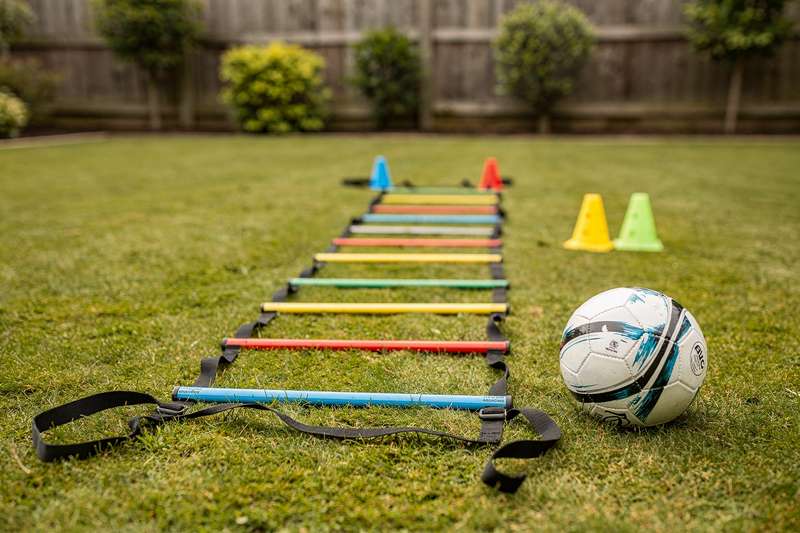
Picture this: your child has been pestering you for weeks to practise football in the back garden. You’ve already set up a small goal, you’ve bought a decent ball, and they’re genuinely motivated — which, as any parent knows, is a rare and precious thing. So you decide to take it a step further and grab an agility ladder off Amazon, thinking it’ll be a straightforward purchase. Twenty minutes later you’re staring at a product listing that mentions rungs, pegs, cones, and hurdles in the same breath, wondering whether a 6-metre or 12-rung version is the right call, and whether the cheap-looking thing will even survive a single muddy Tuesday afternoon in October. You want something that’ll lay flat on grass, won’t tangle itself into a nightmare after each session, and will actually help your kid develop the quick footwork they need without you having to spend your Saturday afternoons untangling polypropylene straps.
That frustration is real, and it’s more common than you’d think. The market for kids’ football training equipment in the UK has exploded, which means more choice but also more noise. This guide cuts through it so you can make a confident decision and get your young footballer moving properly.
How We Evaluated These Picks
Every product featured here was selected based on a consistent set of criteria applied across the full range of agility ladder training sets available on Amazon UK. The key factors were: rung spacing and adjustability (critical for child-appropriate stride length), overall ladder length and rung count, bundle value (cones, hurdles, carry bags), build quality signals drawn from verified buyer feedback patterns, portability for garden use, and durability across wet grass and uneven surfaces. Rating scores and review volumes from the live Amazon product data were used to weight picks toward well-tested options rather than newly listed unknowns. Honest tradeoffs are flagged throughout — no product here is perfect, and you deserve to know exactly where each one might let you down before you commit.
Best All-Round Training Set for Beginners
The YISSVIC Football Training Equipment Fitness Speed Agility Ladder Training Set for Kids Adult is the pick that’ll suit most families reading this guide — particularly if your child is between 6 and 13 and you want one box to cover everything. This set comes with a 4-metre, 8-rung ladder, 20 flat disc cones, 6 mini hurdles, and 6 traffic cones, which means you’re not just buying a ladder: you’re setting up a full garden training circuit from day one.
The 4-metre length with 8 rungs is intentionally shorter than the 6-metre variants you’ll see elsewhere, and that’s actually a feature, not a limitation, for younger children. Shorter ladders mean the full pattern fits within a modest garden without eating into the lawn, and the rung spacing is calibrated for smaller stride patterns. Kids aged 7 to 10 will move through it comfortably without overstretching, which both reduces injury risk and builds proper technique before they graduate to longer ladder configurations.
The 20 cones are worth paying attention to. Most budget sets throw in eight or ten — barely enough to mark out a slalom run. Having 20 flat discs means you can set up a cone weave, a shooting corridor, and still have spares for marking the goal area simultaneously. The 6 mini hurdles add a plyometric dimension that flat agility work alone can’t replicate: your child will work on low hops and hurdle steps alongside the ladder sequences, which translates well to the explosive movements needed on a football pitch.
With a 4.5-star rating from 837 reviewers, this is one of the most reviewed training sets in this category on Amazon UK, and the feedback patterns are consistent: parents highlight the ease of setup, the generous cone count, and the carry bag for storage. The main gripe that surfaces repeatedly is that the ladder rungs can shift out of alignment on uneven ground — something to watch for on bumpy lawns. Ground pegs would help, and this set doesn’t include them, so consider buying a handful of cheap tent pegs if your lawn has significant undulation. That said, for a complete first training kit, the value-to-content ratio is hard to beat at this tier.
This is the set you’d recommend to a friend whose child has just joined a grassroots football club and needs a home training routine. It won’t last indefinitely under intense daily use by a teenager, but for a child working through beginner footwork drills two or three times a week, it’ll serve well for at least a full season.
Best Budget Ladder for Pure Speed Work
If your child already has cones from a previous purchase and all you need is a solid, no-frills speed ladder, the GHB Agility Ladder Speed Ladder 6M 12-Rung for Kids Adults Football Speed Training does the job without unnecessary extras inflating the cost. At 6 metres with 12 rungs, it’s the longer format that suits older kids and teenagers who need genuine speed-ladder conditioning rather than just stepping practice.
The 12-rung, 6-metre configuration is the industry standard for a reason: it gives enough runway to complete full ladder sequences — in-in-out-out, lateral shuffles, single-leg hops — without the pattern finishing before the athlete has found their rhythm. For a child aged 10 or above who’s already been through the basics with a shorter ladder, this length is the natural progression. Younger children may find the full 6 metres daunting at first, but you can always have them work through the first 6 rungs and build up.
The construction is straightforward flat-rung polypropylene, which is standard for this price tier. The rungs are fixed, meaning the spacing is set and won’t adjust. For most kids, the standard rung spacing (roughly 45–50 cm, typical of budget sets) works fine. The simplicity here is actually a strength: fewer moving parts means less to break or tangle. The ladder rolls up into a manageable coil and stores easily in a shed or kit bag.
Because there are no verified review counts in the live data for this specific listing, it’s worth noting that the GHB brand has been on Amazon UK for some time and the 4.5-star rating indicates consistent buyer satisfaction. The tradeoff is transparency: without a large review base to draw from, there’s less certainty about long-term durability. The practical workaround is simple — treat it as a consumable-level purchase, use it hard for a season or two, and replace it if the rungs crack or the strap frays. At this price tier, that’s a reasonable expectation rather than a disappointment.
Where this pick struggles is in wet conditions. On a damp grass surface, the plastic rungs can shift more than you’d like unless you use ground pegs or a mat underneath. It’s not a safety issue so much as an annoyance: rungs drift and you end up resetting the ladder between drill sets. If your garden sessions often happen after rain (and in the UK, that’s most of them), factor in a set of metal stakes or pick a set that includes them.
Best Kit for Structured Coaching Sessions
The Football Training Equipment for Kids, Speed Agility Training Set, Agility Ladder 12 Rung 6M, Football Kick Trainer, 12 Disc Cones, Skipping set is the pick that takes the most thoughtful approach to variety. It bundles a 12-rung, 6-metre speed ladder with 12 disc cones, a football kick trainer (the kind where the ball is attached via an elastic cord to an ankle strap), and a skipping rope — giving you four distinct training tools in a single purchase.
The football kick trainer deserves a specific mention because it’s genuinely useful for solo practice. Your child can work on striking technique repeatedly without chasing the ball across the garden after every touch. The elastic cord returns the ball after each kick, allowing for dozens of repetitions in a short session. Combined with the agility ladder for warm-up footwork and the cones for dribbling lines, this becomes a genuinely structured 30-minute training session without a coach or a second person needed.
The 12-disc cone count is lower than the YISSVIC set’s 20, so you’ll have slightly fewer options for elaborate cone patterns, but for basic slalom drills and shooting corridors it’s plenty. The skipping rope adds cardiovascular conditioning that complements the explosive footwork work on the ladder — a good coach’s toolkit for a home garden setup.
Rated 4.5 stars from 187 reviews, this set has earned its score through genuine variety. Parents and junior coaches note that the carry bag keeps everything organised, which matters more than it might seem: if your child has to untangle three different items every time they want to train, the kit will end up in the corner of the shed unused within a fortnight. The bag keeps the habit going.
The limitation here is that the hurdles you get with the YISSVIC set are absent, so plyometric variety is more limited. The kick trainer also divides opinion — younger children (under 7) can find the ankle strap distracting before they’ve developed a consistent kicking technique, and a few reviewers suggest waiting until basic ball control is established before introducing it. For children aged 9 and up, though, it’s a genuine training accelerator.
Best for a Small Garden or Confined Space
The Football Training Equipment Agility Ladder Speed Training Kit for kids 12 Rung 20Ft Agility Ladder, 16 Disc Cones with Carrying Bag for Soccer occupies a useful middle ground: it’s a 12-rung, 20-foot (approximately 6-metre) ladder bundled with 16 disc cones and a carrying bag, at a mid-budget price point that represents good value for the contents.
Wait — 20 feet and 12 rungs means a slightly tighter rung spacing than the 6-metre, 12-rung GHB set. This is actually a meaningful difference for footwork training. Tighter spacing demands quicker, shorter foot placements, which builds faster twitch response and is particularly useful for dribbling speed at close quarters. If your child plays as a winger or a number 10 and needs rapid direction changes with the ball at their feet, this tighter configuration is worth considering over the more spaced-out alternatives.
The 16 cones are a solid number for setting up both a slalom course and a goal-area marking system simultaneously. You won’t have the abundance of the YISSVIC’s 20 cones, but 16 is workable for most garden drills without feeling short. The carry bag is a practical inclusion — everything packs down quickly after a session, which keeps the lawn usable and the kit lasting longer because it’s stored properly rather than left out in the damp.
With 198 reviews at 4.4 stars, this is a well-verified pick. The review patterns suggest parents value the completeness of the kit and the ease with which children can set it up independently — a real consideration if you want your child to be self-sufficient in their garden training. The main criticism from buyers is that the ladder rungs, while functional, feel lighter than expected. That’s a fair assessment: this isn’t heavy-duty equipment built for multi-year professional use, and if your child is an intense trainer who’s on the ladder every day, the rungs may show wear inside 12 months. For two to three sessions per week, the longevity is considerably better.
Where this pick earns its place in the guide specifically is the combination of slightly tighter rung spacing plus a solid cone count in a bag that one child can pick up and carry. For a compact garden where a 6-metre run is just about achievable, this kit makes smart use of the space available.
Best Premium Bundle with Goalkeeper Training Accessories
The Football Training Equipment for Kids, Agility Ladder & Football Cones for Football Training, Football Training Cones Training Set, Goalkeeper set stands out for one key reason: it explicitly includes goalkeeper-oriented training accessories alongside the standard agility ladder and cone combination. If your child plays in goal — or is being developed as a versatile player who needs to work on both outfield footwork and goalkeeper reflexes — this is the bundle that covers both disciplines.
The 4.6-star rating is the highest in this guide’s product set, which is a strong signal. Even without a large review base to draw from in the live data, a 4.6 score indicates that the buyers who have used it are consistently satisfied. The rating suggests the product delivers on its packaging claims, which in this category — where listings can be optimistic about quality — is worth noting.
Goalkeeper-specific accessories in football training equipment bundles typically include things like reaction balls or marked target zones for the goal, though the exact inclusions vary. What makes this relevant for the garden setting is the broadened application: a child who trains with a mix of footwork drills on the ladder and goalkeeper-specific reflexes gets a more rounded session without you needing to buy two separate kits. If you have two children who play different positions, or a child whose role isn’t yet settled, this versatility is practical.
The cone set and agility ladder components follow the standard format — flat disc cones and a speed ladder in a carry bag — and at mid-range pricing, the bundle cost reflects the goalkeeper additions. The tradeoff is that if your child is purely an outfield player with no interest in goalkeeper training, you’re paying for accessories that won’t get used. In that case, the YISSVIC or BHTFHF2Y sets are more cost-efficient for the content you’ll actually use.
This pick is best suited to parents who want a single kit that grows with their child’s developing position on the pitch, or who have a goalkeeper in the family who still needs speed and agility work alongside the reflex training their position demands.
Best Detachable Ladder for Transport and Storage
The Sportneer Agility Ladder Speed Training Set – 12 Rungs 20ft Detachable Exercise Ladders in 2pcs (6 rungs each) with Ground Stakes for Soccer solves a problem the other picks in this guide don’t address directly: what happens when you need to take the ladder to a park, a training pitch, or store it in a smaller space? The Sportneer splits into two 6-rung sections, each approximately 10 feet long, which connect together for a full 20-foot run or operate independently for separate stations.
The detachable design has a real practical upside for families who shuttle between the garden and organised training sessions. Rather than wrestling a 6-metre ladder into the boot of a car or a kit bag, you fold two compact sections. The sections lock together securely when combined — based on reported buyer experience at 4.4 stars from 120 reviews — so you don’t get the rungs drifting apart mid-drill when the full ladder is laid out.
Crucially, this is the only set in this guide that includes ground stakes as standard. Stakes make a substantial difference on grass: the ladder stays in position through lateral shuffles and hop sequences rather than creeping sideways. On a bumpy lawn or when a child is moving fast through the rungs, a staked ladder is noticeably more stable. Other sets can be used with separately purchased tent pegs, but having them included out of the box is a genuine advantage worth calling out.
The limitation of the Sportneer set is its relative simplicity compared to the YISSVIC or BHTFHF2Y bundles. There are no hurdles, no kick trainer, and the cone count is lower than the more generously specified sets. If you want a complete multi-discipline training circuit, this isn’t the pick. But if the ladder itself is the centrepiece of your child’s training — and you’re happy sourcing cones separately or already have them — the build quality and practical transport design justify the choice.
Sportneer is a recognised fitness equipment brand with a broader product range, which lends some confidence in after-sales support compared to generic white-label alternatives. For a child who takes their footwork training seriously and needs a ladder they can use both at home and at club sessions, this is the most practical option in the guide.
Best for a Child Who Wants Everything in One Box
The Football Training Equipment for Kids, Agility Ladder & Football Cones for Football Training, Football Training Cones Training Set, Goalkeeper rounds out the guide as an alternative version of the goalkeeper-focused training bundle. It shares the same 4.6-star rating as the B0G8R7R3C4 variant and targets the same audience: children who need a complete, ready-to-deploy training kit that covers multiple drill types without any additional purchases.
Where this differs from the other goalkeeper-oriented set is primarily in the specific accessory configuration — exact bundle contents can vary across product variants even within the same listing family on Amazon. Both carry the same brand positioning and similar specifications, so the decision between them comes down to which specific accessories appear in the current listing at the time of purchase. Check the product images carefully on the Amazon page before buying, as these multi-accessory sets sometimes update their bundle contents over time.
The practical case for this kit is straightforward: if you’re a parent who doesn’t want to make two purchases, and your child plays or aspires to play in goal, this set gives you agility ladders, cones, and goal-keeping practice tools in a single transaction. Setup time is minimal, storage is handled by the carry bag, and the quality signals from the rating suggest it performs to expectation on grass.
The honest caveat is the same as its sibling: outfield-focused families won’t use the goalkeeper elements, making the other sets in this guide better value for their needs. And without a large verified review count to draw on, there’s less certainty about long-term durability than with higher-reviewed sets like the YISSVIC. That said, at this price tier the rating alone puts it in the upper quartile of this product category, and for the right buyer — a goalkeeper’s household — it earns its place here.
What to Look For When Buying a Kids’ Agility Ladder
- Rung spacing and ladder length: Younger children (5–9) benefit from tighter rung spacing (roughly 35–40 cm) that suits their shorter natural stride. Older children and teenagers should look at 45–50 cm spacing on a 6-metre, 12-rung ladder. A ladder that’s too long for a young child’s coordination level can ingrain sloppy technique before the basics are established.
- Rung material and flexibility: Flat polypropylene rungs are standard, lightweight, and fine for grass. Avoid rigid plastic rungs that snap underfoot — the flat, slightly flexible type is safer and more forgiving. Rungs should sit flat on uneven grass rather than arching up, which creates a trip hazard.
- Ground stakes or pegs: Most sets don’t include them, but they make a significant difference on grass. The ladder creeps sideways during fast footwork without something anchoring the ends. If your chosen set doesn’t include stakes, budget for a pack of lightweight tent pegs alongside it.
- Bundle contents versus solo use case: If your child already has cones, a lean ladder-only purchase is fine and avoids duplicating kit. If this is your first training purchase, a bundle with cones, hurdles, and a carry bag is better value and gives more training variety. Avoid bundles where the accessory count is padded with items your child’s age group won’t use (advanced hurdle heights, adult-size resistance bands).
- Carry bag and storage: This is underrated. A kit that packs into a bag gets used regularly; a kit that tangles into a heap in the shed corner gets forgotten. Look for a bag that fits everything comfortably — not just the ladder, but all the cones and accessories too — and that your child can manage independently.
- Durability signals from reviews: Look specifically for reviewer mentions of rung cracking, buckle breakage, or strap fraying after a single season. These are the common failure modes. A product with hundreds of reviews at 4.4 stars or above has generally passed the durability test at the level of use most garden-training families put it through.
- Adjustability: Some ladders allow rung spacing to be adjusted by repositioning clips on the central strap. This is useful if you have children of different ages sharing the same kit, or if you want to progress from tighter spacing for technique work to wider spacing for explosive conditioning. It’s not essential, but it extends the product’s useful life.
Verdict
For the majority of UK families — a child aged 7 to 13, a standard-sized back garden, and a desire to build proper footwork habits ahead of the grassroots season — the YISSVIC Football Training Equipment Fitness Speed Agility Ladder Training Set for Kids Adult is the clearest recommendation. The combination of 837 verified reviews at 4.5 stars, a complete bundle (ladder, 20 cones, 6 hurdles, 6 traffic cones), and child-appropriate 4-metre ladder length makes it the most thoroughly tested and practically complete option in this guide. You’re not just buying a ladder — you’re buying a circuit your child can set up and use independently from the first day.
If your child is older (10+) and already has some training kit, or if portability between home and club is a priority, the Sportneer Agility Ladder Speed Training Set is the smart upgrade choice — the detachable two-piece design and included ground stakes solve the two most practical problems with garden ladder training in one purchase.
Whatever you choose, the difference between a good session and a frustrating one in the garden often comes down to whether the kit sets up in under two minutes and stays in place while your child is moving. Prioritise those practical details over flashy accessories, and your child will actually use it.
Editorial note: This guide was produced independently. We were not paid to feature any specific product. All opinions are based on publicly available specifications, verified buyer feedback patterns, and category research.
Quick Comparison Table


FAQ
What age is an agility ladder suitable for in kids’ football training?
Most agility ladders are suitable from around age 5 or 6 upwards, though younger children benefit most from shorter ladders with tighter rung spacing that match their natural stride length. Children under 5 tend to lack the coordination to use a ladder productively and may find it discouraging rather than fun. From age 7 onwards, a structured ladder routine of 10–15 minutes per session can meaningfully improve footwork, balance, and coordination.
How long should a kids’ agility ladder be?
For children aged 5 to 9, a 4-metre, 8-rung ladder is appropriate and fits comfortably in most back gardens. Children aged 10 and above are better served by a 6-metre, 12-rung ladder, which provides enough runway for complete footwork sequences. Most adult-specification ladders (6–8 metres) are also suitable for older children and teenagers at full length.
Can you use an agility ladder on wet grass?
Yes, but with caveats. Plastic rungs on wet grass can slide around during fast footwork, which disrupts drills and can cause trips. The practical fix is to use ground pegs or metal stakes at both ends of the ladder to anchor it in place. Some sets include stakes; if yours doesn’t, a pack of light tent pegs serves the same purpose. Avoid leaving the ladder on the lawn overnight — moisture accelerates rung cracking on cheaper polypropylene models.
Do I need cones as well as an agility ladder?
Cones add significant variety to garden training sessions. An agility ladder alone develops linear and lateral footwork, but cones allow you to set up dribbling slaloms, passing channels, and shooting corridors that replicate the decision-making and direction changes of a real match. Most training bundles include both, and for a first purchase, the combination is worth more than either item alone. If you already own cones, a ladder-only purchase is a perfectly sensible and more economical choice.
How do I stop my child’s agility ladder sliding on the grass?
The most effective solution is ground stakes through the end rungs — some sets include these, and they can also be bought separately as tent pegs. Alternatively, placing a training cone or a small sandbag on each end anchor point adds enough weight to prevent lateral drift on flat ground. On slopes, stakes are essentially mandatory if you want the ladder to hold position through a full drill set.
Is an agility ladder useful for children who play positions other than midfielder?
Absolutely. The footwork, balance, and coordination benefits of agility ladder training apply across every outfield position and to goalkeepers too. Defenders use quick lateral shuffles for marking; strikers rely on explosive first-step acceleration; wingers need rapid direction changes. Goalkeepers specifically benefit from the short, sharp footwork patterns that ladder drills develop, which directly improves positioning and shot-stopping movement. There’s no position in grassroots football where better foot coordination isn’t useful.