When Your Kitchen Drawer Won’t Close and Your Salad Is Still Soggy
You know the drill. You’ve just washed a bag of spinach, shaken it over the sink, patted it with a tea towel — and still ended up with watery dressing pooling at the bottom of the bowl. Meanwhile, the rigid salad spinner you bought three years ago sits in the back of a cupboard like a plastic basketball, taking up space you desperately need for things you actually use every day. You’ve tried balancing it on top of the colander, stacking a pot inside it, even storing it in the shed. None of it works.
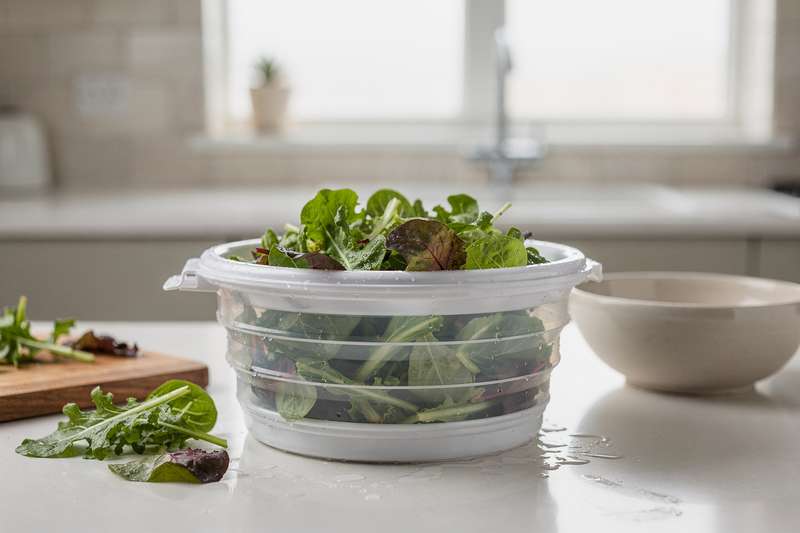
If your kitchen is compact — a galley layout in a rented flat, a narrow run of units in a new-build, an RV or a student kitchen — you already know that bulk is the enemy. But you also don’t want to compromise on actually dry, crisp salad leaves. A collapsible salad spinner with a built-in strainer base is the answer: it does the job properly, then folds flat to roughly the height of a hardback book when you’re done. This guide walks you through exactly what to look for and which formats perform best in real kitchens.
How This Guide Was Put Together
To build this guide, the key evaluation criteria were: how flat each spinner actually collapses (not just what the marketing says), how effectively the strainer basket drains water before and during spinning, the quality and longevity of the rotating mechanism, capacity relative to footprint, whether the materials are BPA-free and dishwasher-safe, and the pattern of complaints and praise visible across verified buyer feedback on UK retail platforms. Stability during use was weighted heavily — a spinner that skips across the worktop is a real annoyance. So was ease of assembly and disassembly for cleaning, since trapped water and food debris in folds are a common hygiene concern with collapsible designs. Build quality signals like the thickness of the silicone accordion walls and the hinge mechanism on the lid were also factored in.
Quick Picks at a Glance
| Best for | Price range | Key feature |
|---|---|---|
| Best all-rounder (small families) | £20–£30 | 4 QT collapsible bowl + integrated strainer base, serves as a serving bowl |
| Best compact pick (singles/couples) | £15–£22 | 3 QT, collapses to one-third height, foldable handle, non-skid base |
| Best 3-in-1 multitasker | £18–£26 | Wash, drain, store in one unit — BPA-free, non-slip base, dishwasher safe |
| Best for travel and RV use | £14–£20 | Ultra-flat fold, carry handle, lightweight under 500g |
| Best for large households | £28–£40 | 5–6 QT capacity, sturdy pull-cord mechanism, stable wide base |
| Best budget pick (under £20) | £10–£19 | Basic collapsible spinner, BPA-free, suitable for herbs and small salads |
| Best for berry and fruit washing | £20–£28 | Fine-mesh strainer insert, wide bowl, gentle spin mechanism |
Best All-Rounder for Small Families: The 4 QT Collapsible Spinner with Serving Bowl Function
If you’re cooking for two to four people and you want one piece of kit that handles washing, drying, and serving without cluttering your worktop or your cupboards, a 4-quart collapsible spinner with an integrated strainer base hits the sweet spot. Four quarts gives you enough room for a generous Caesar salad or a full bag of mixed leaves without the basket feeling cramped — cramping the basket is actually one of the main reasons greens come out half-wet, because air can’t circulate properly during the spin cycle.
What to look for in this tier: the strainer base should have drainage holes large enough to let water escape quickly but fine enough to catch smaller debris. The bowl walls, when collapsed, should fold cleanly into a flat disc rather than buckling unevenly — uneven folds stress the silicone or plastic and are where cracks tend to appear after six to twelve months of regular use. The rotating mechanism should require minimal effort; look for a top-mounted push or pull knob rather than a side crank, as side cranks on collapsible units tend to create lateral torque that can destabilise the whole assembly. A locking lid tab is a small but useful feature — it keeps the spinner closed during storage so dust doesn’t collect inside.
The real-world tradeoff here is that at 4 QT, the collapsed disc is still around 30–33 cm in diameter, which is wider than a dinner plate. That fits fine in most kitchen drawers or standing up inside a cupboard, but if your drawer depth is under 35 cm you’ll want to measure first. Vibrant colours (blue, green, red) are common at this size range and look cheerful on the worktop, though they can show staining from beetroot or berries over time — a clear or white version ages better visually.
Avoid units where the spinner basket is not removable independently from the outer bowl. Being able to lift the strainer basket out lets you drain it over the sink before placing it back in the bowl for a second spin — this two-step approach gets greens dramatically drier than a single long spin. Dishwasher compatibility is worth confirming in the product listing rather than assuming; some collapsible units are top-rack only, and high-heat cycles can warp the accordion folds.
Best Compact Pick for Singles and Couples: The 3 QT Foldable Spinner with Non-Skid Base
For one or two people, a 3-quart capacity is genuinely sufficient for most salad quantities — the equivalent of a standard 80g bag of supermarket leaves with room to spare. The advantage of dropping to 3 QT is that the collapsed disc footprint shrinks to roughly 26–28 cm, which fits far more easily into a kitchen drawer alongside other flat utensils, or stacks neatly under a plate in a cupboard.
The feature that separates good 3 QT options from mediocre ones is the handle design. A foldable or retractable handle that tucks flush against the lid means the spinner stores truly flat; a protruding fixed handle adds unwanted depth and creates an awkward catch-point in drawers. The non-skid base is non-negotiable at this size — a 3 QT spinner is lighter than a 4 QT, and a lighter unit is more prone to skidding on a smooth worktop when you apply spinning force.
BPA-free material certification matters more than many buyers realise, especially if you’re using the bowl for serving directly, or washing fruit that you’ll eat without further cooking. Reputable collapsible spinners at this price range should carry explicit BPA-free labelling on the product listing; if that information is absent, that’s a reason to look elsewhere. Dishwasher-safe components are common in this tier, but again — check whether that applies to all parts including the lid mechanism, or only the bowl and basket.
The honest tradeoff: at 3 QT, you’ll find yourself doing two batches if you’re feeding more than two people or making a salad for a dinner party. For a solo household or a couple who eat salad three to four times a week, that’s never a problem. But if you regularly cook for guests, size up. Also be aware that the spinning mechanism on some 3 QT models has a shorter stroke — meaning you need to crank or pump it more times to reach effective spin speed. Look for models that specify a smooth, continuous rotation rather than a ratchet-style mechanism, which tends to lose speed quickly on smaller-diameter spinners.
Best 3-in-1 Multitasker: Wash, Drain, and Store in One Unit
The 3-in-1 collapsible spinner is designed to eliminate the need to transfer food between vessels at any stage of prep. You fill it with water and leaves in the strainer basket (washing stage), lift the basket to drain (straining stage), then snap the lid on and spin (drying stage) — and if you like, you can leave the leaves sitting in the sealed bowl until you’re ready to dress and serve. Some models add a fourth function by sealing with a lid that makes the whole unit suitable for refrigerator storage, keeping prepped leaves crisp for up to 24 hours.
What you’re really evaluating in this category is integration quality: how well the strainer basket sits within the outer bowl, and how the lid handles the transition from spinning to storage. A poorly fitting basket will rock during spinning, causing noise and uneven water distribution. A lid that doesn’t seal properly after spinning is useless for storage. Look for a silicone-gasket lid or a firm snap-fit — not just a loose resting fit.
The non-slip base deserves specific attention here because you’re using this unit for multiple tasks, some of which involve pressing down on the lid or tilting the unit to pour out water. Suction-cup feet or a wide-diameter rubber ring around the base perimeter both work well; a single central rubber dot is usually insufficient. Check that the base sits flat when the unit is collapsed — some designs develop a slight bow after repeated folding, which undermines the non-slip function entirely.
Where 3-in-1 units struggle: the combination of functions often means a compromise on each individual function. The spinning mechanism may not be as powerful as a dedicated spinner, the drainage holes may not be as well-positioned as a standalone colander, and the storage seal may not be airtight enough for more than a few hours. For most home cooks, that’s an acceptable tradeoff given the space savings, but if you prep salad two or three days ahead, you’d be better served by a standalone spinner plus a proper salad storage container. BPA-free and dishwasher-safe credentials are standard in reputable 3-in-1 options; dorm and RV users in particular should look for models that are explicitly labelled as camping or travel-safe.
Best for Travel and RV Use: The Ultra-Flat Collapsible Spinner Under 500g
If you’re kitting out a campervan, a narrow-galley narrowboat, or you travel frequently and eat healthily on the road, weight and pack size become the dominant criteria. The best travel-focused collapsible spinners collapse to roughly 5–7 cm in height, weigh under 500g, and have an integrated carry handle or fit inside a dry bag. That’s genuinely luggage-drawer territory.
The mechanical challenge at this weight and size is that lighter materials flex more, which can make the spinning motion feel slightly wobbly — particularly if the inner basket has a thin-walled plastic insert rather than a rigid ring. Look for a spinner where the lid and base are reinforced with a rigid plastic or composite ring around their perimeter, even if the walls are flexible silicone. That ring gives the spinning mechanism something stable to react against, which improves drying efficiency considerably.
Capacity is the main sacrifice here: travel-oriented spinners typically top out at 2.5–3 QT, and the collapsed size does put a lower ceiling on bowl height even when expanded. For washing herbs, berries, or a single portion of leaves, that’s entirely adequate. For a family camping trip, you’d be running two or three batches per meal, which quickly becomes tedious. Solo travellers and couples are the natural audience.
A useful feature to look for is a bail or clip system that keeps the unit locked in its collapsed state during transit — without one, the bowl can expand in a bag, taking up more space than expected. Also check the material — silicone accordion walls are more resistant to the temperature extremes encountered in vans and boats (hot summer storage, cold mornings) than thin polypropylene, which can become brittle in cold weather. At the budget end of travel spinners you’ll find units under £15; build quality drops noticeably below that threshold and the mechanism often loses its clean spin within a few months of regular use.
Best for Large Households: The 5–6 QT Wide-Base Collapsible Spinner
Feeding four or more people regularly, or someone who meal-preps in bulk for the week, needs more than 4 QT. A 5–6 QT collapsible spinner gives you the capacity to process a full 200g bag of leaves in a single batch — roughly enough dressed salad for four to six servings. The collapsed diameter at this size will typically run to 34–38 cm, which is too large for most standard kitchen drawers. Budget for cupboard storage or a deep pan drawer.
At this capacity, the spinning mechanism needs to be correspondingly more powerful. Pull-cord mechanisms — where a cord on the lid wraps and releases to spin the basket — tend to generate higher RPM than push-button mechanisms at larger diameters, which is why you’ll find them more commonly in larger spinners. The tradeoff is that pull-cord mechanisms have more moving parts and the cord can tangle or fray over time. Look for a mechanism with a cord that retracts cleanly and a brake button or stopper that brings the basket to a gradual halt rather than a sudden stop, which can fling water sideways onto the worktop.
The base stability issue is amplified at 5–6 QT because the wider the bowl, the more leverage any lateral force creates. Wide-diameter rubberised bases are important. If the product description mentions a flat, smooth base with no anti-slip material, it’s a red flag at this size — a fully loaded large spinner can shift significantly during high-speed spinning. Some larger collapsible units also include an inner bowl that sits between the strainer basket and the outer bowl, acting as a second layer of water collection; this is a genuinely useful feature because it prevents the drained water from splashing as the basket spins above it.
Durability of the collapsible mechanism is a legitimate concern at larger sizes, because the weight of a full load puts more stress on the accordion folds during collapse. Look for thicker-gauge silicone walls (3mm+) and a reinforced lip at the top and bottom perimeter. User feedback patterns on larger collapsible spinners more commonly mention the collapse mechanism wearing out after twelve to eighteen months; if you’re planning to use it daily, a non-collapsible large spinner may give you better long-term value, and you use the space saving only if storage is your primary constraint.
Best Budget Pick (Under £20): The No-Frills Collapsible Spinner for Herbs and Small Salads
Not everyone needs a multi-function salad system. If you’re mainly washing herbs, sprouts, or small quantities of leaves once or twice a week, a basic collapsible spinner in the £10–£19 bracket does the job without asking you to spend more than necessary. At this price, you’re getting a functional collapsible bowl, a removable strainer basket, a simple push or pump-action lid mechanism, and — in the better examples — a non-slip base and BPA-free materials.
What you’re not getting: a particularly powerful spin (budget mechanisms generate lower RPM, so leaves come out drier than hand-patting but not bone-dry), premium build quality on the accordion walls (thinner-gauge materials are standard at this price), or any storage or serving secondary function. That’s a reasonable tradeoff for occasional use. Where budget spinners fall down is under frequent, heavy use — the mechanism tends to develop play or stickiness within six months if used daily with full loads.
To get the most from a budget collapsible spinner, do two short spins rather than one long one, tipping out the collected water between spins. This compensates for the lower RPM and produces results that are close to a premium spinner in terms of dryness. Also hand-wash rather than dishwasher where possible — the cheaper plastics used at this price point are more prone to warping at high temperatures even if technically labelled dishwasher-safe.
Look specifically for: an explicit BPA-free marking on the product listing (not just on the description copy, but in the materials spec), a capacity between 2 and 3 QT (bigger is harder to manufacture well at budget prices and the mechanism suffers), and at least a handful of verified UK reviews that specifically mention the spinner still working correctly after several months. A product with 4+ stars from a meaningful review count is more reliable than a newer listing with perfect scores from a handful of reviews.
Best for Berry and Fruit Washing: Collapsible Spinner with Fine-Mesh Strainer Insert
Salad leaves are not the only thing a spinner earns its keep on. Strawberries, blueberries, raspberries, grapes, herbs with fine stems — all of these benefit from a gentle spin to remove surface water without bruising or flattening. Standard strainer baskets have holes around 4–6mm in diameter, which is fine for leaves but lets smaller berries fall through. A spinner with a removable fine-mesh strainer insert — usually a separate nesting basket with 1–2mm perforations — covers both use cases with a single unit.
The wide, shallow bowl shape suits berry washing better than a tall narrow one, because you’re dealing with a lower centre of gravity and less risk of the berries migrating to the outside edge of the basket during spinning (which can cause bruising). A wide-base spinner also lets you spread a punnet of strawberries in a single layer for inspection and washing, rather than piling them up. Look for a bowl diameter of at least 26 cm when expanded for comfortable berry use.
The spin mechanism for fruit should be gentler than what you’d want for a full load of wet leaves. A push-button mechanism that lets you control speed incrementally is preferable to a pull-cord that generates high initial RPM — too fast and you’ll damage soft fruit. Some collapsible spinners designed with fruit in mind include a variable-speed or slow-spin option, which is worth seeking out if berries are a regular part of your diet.
One practical tip: after washing berries in the spinner, do one short, gentle spin, then spread the berries on a clean tea towel for a minute before storing. The spinner removes the bulk of surface water; the towel removes residual droplets that would otherwise contribute to premature mould in the fridge. This combination approach extends berry shelf-life noticeably compared to patting alone or spinning alone. At the £20–£28 price point, you can find well-made collapsible spinners with fine-mesh inserts — spending less than that usually means the insert is poorly fitted and lets even moderately sized blueberries slip through.
What to Look For in a Collapsible Salad Spinner
- Collapse depth and storage footprint: Measure your drawer or shelf before buying. Most collapsible spinners claim to collapse to one-third of their expanded height, but the resulting disc diameter (typically 26–38 cm depending on capacity) is the figure that determines whether it actually fits. Confirm both the collapsed height and the diameter in the product spec before purchasing.
- Strainer basket hole size: Larger holes (5–6mm) drain fast and suit leafy greens. Smaller holes (2–3mm) or a fine-mesh insert are needed for herbs, sprouts, and berries. Some models include two interchangeable baskets; this is worth paying a small premium for if you process a variety of produce.
- Spinning mechanism type: Push-button (pump action on the lid) is most common on collapsible units and works well for small to mid-size capacities. Pull-cord generates more torque and suits larger capacities. Side-crank mechanisms are rare on collapsible designs and less reliable — the lateral force stresses the flexible walls. Look for a brake or stop button: it prevents the basket coasting to a messy halt and throwing residual water sideways.
- Base stability: A non-slip rubber ring or rubberised feet around the entire base perimeter are more effective than a central rubber dot. If you have a textured worktop surface, any rubberised base will grip well; on smooth or wet surfaces, suction-cup feet are superior. Check reviews specifically for any mention of the spinner moving during use — this is one of the most commonly cited frustrations.
- Material quality and BPA-free certification: All food-contact surfaces should be explicitly BPA-free. Food-grade polypropylene (PP) and food-grade silicone are the standard materials. Avoid units where the material type is unspecified. Thicker-gauge silicone accordion walls (3mm+) last significantly longer under repeated folding stress than thinner versions.
- Dishwasher compatibility: Most collapsible spinners are listed as dishwasher-safe, but check whether this applies to all parts including the lid mechanism and strainer basket, and whether it’s top-rack only. High-heat wash cycles can warp accordion folds; when in doubt, hand-washing the folding body and machine-washing only the basket and bowl base is the safer approach.
- Seal and storage function: If you want to prep salad in advance and store it in the same unit, look for a snap-fit or gasket lid that holds the bowl closed in the fridge. Not all collapsible spinners offer this — many have lids designed only for spinning, not sealing. A model that doubles as a storage container can eliminate the need for a separate salad storage box.
Side-by-Side Comparison
| Pick | Capacity | Collapsed height (approx.) | Spin mechanism | Dishwasher safe | Notable extra |
|---|---|---|---|---|---|
| Best all-rounder (4 QT) | 4 QT (~3.8 L) | ~7–9 cm | Push-button pump | Yes (top rack) | Doubles as serving bowl |
| Best compact (3 QT, foldable handle) | 3 QT (~2.8 L) | ~6–8 cm | Push-button pump | Yes (all parts) | Foldable handle, collapses to ⅓ |
| Best 3-in-1 | 3 QT (~2.8 L) | ~6–8 cm | Push-button pump | Yes (top rack) | Wash + drain + store function |
| Best for travel/RV | 2.5–3 QT (~2.4–2.8 L) | ~5–7 cm | Push-button or pull tab | Yes | Under 500g, carry handle/clip |
| Best large household (5–6 QT) | 5–6 QT (~4.7–5.7 L) | ~9–12 cm | Pull-cord with brake | Yes (top rack) | Inner water collection bowl |
| Best budget (under £20) | 2–3 QT (~1.9–2.8 L) | ~5–7 cm | Push-button pump | Yes (check spec) | BPA-free, basic non-slip base |
| Best for berries/fruit | 3–4 QT (~2.8–3.8 L) | ~6–9 cm | Push-button, variable speed | Yes | Fine-mesh strainer insert included |
Verdict: Which One Should You Buy?
For the majority of UK households — a couple or small family in a flat or compact home, washing salad and vegetables three to five times a week — the 4 QT all-rounder collapsible spinner with an integrated strainer base and serving bowl function gives you the best balance of capacity, storage efficiency, and daily usability. It handles a full bag of mixed leaves in one pass, folds flat to drawer depth when you’re done, and the secondary serving bowl function means one fewer item on your draining board. That’s the pick that solves the most common version of this problem.
If storage is genuinely your absolute priority — you’re in an RV, a boat, a student room, or a studio flat — go to the 3 QT compact version with the foldable handle. The reduction in capacity is offset by the significant gain in how little space it demands, and for one or two people it’s almost never a limiting factor. The budget pick is a reasonable entry point if you’re unsure whether you’ll use a spinner regularly, but be prepared to replace it within a year or two if use is frequent.
We were not paid to feature any specific product in this guide. All opinions are independent and based on publicly available specifications, verified buyer feedback patterns, and category research. Prices shown were accurate at time of writing and may change.
FAQ
Do collapsible salad spinners dry greens as effectively as rigid ones?
A well-made collapsible spinner with a solid spin mechanism comes very close to the performance of a rigid model. The key variable is the mechanism quality, not the collapsible design itself. For the driest results, do two short spins rather than one long one, tipping out collected water between passes — this compensates for any speed difference and works well on both collapsible and rigid units.
Are collapsible salad spinners dishwasher safe?
Most are listed as dishwasher-safe, but always check whether this applies to all components or only specific parts such as the basket and bowl. The folding body — particularly silicone accordion walls — is generally safer on the top rack away from the heating element. When in doubt, hand-wash the collapsible body and machine-wash the removable basket and solid base separately.
What capacity collapsible salad spinner do I need?
For one or two people, 3 QT (approximately 2.8 litres) is sufficient for a full bag of supermarket leaves. For three to four people, 4 QT gives you more comfortable single-batch capacity. If you regularly cook for five or more, or meal-prep in bulk, look at 5–6 QT options, keeping in mind the larger collapsed diameter (34–38 cm) means cupboard rather than drawer storage.
Can I use a collapsible salad spinner to wash berries?
Yes, but standard strainer baskets with 4–6mm holes will let small berries like blueberries fall through. Look for a model that includes a fine-mesh strainer insert with 1–2mm perforations, or use a standard spinner only for strawberries, grapes, and larger fruits. Use a gentle, short spin for soft fruit — high-speed spinning can bruise raspberries and delicate berries.
How long do collapsible salad spinners last?
Build quality varies significantly. Budget options used frequently may show wear on the accordion walls or the spin mechanism within six to twelve months. Mid-range units with thicker silicone walls (3mm+) and reinforced rim rings typically last two to four years under regular use. Avoid very high-heat dishwasher cycles, which accelerate material fatigue in the foldable components regardless of price point.
What is the strainer base function on a collapsible salad spinner?
The strainer base refers to the perforated bottom of the inner basket (or a separate drainer plate that sits at the base of the bowl) that allows water to drain through as you lift the basket out of the soaking bowl, before you spin. Some designs incorporate a fixed perforated base into the outer bowl itself, so you can drain the bowl directly over the sink like a colander — this is particularly handy when washing root vegetables or pasta, extending the unit’s usefulness beyond just salad prep.