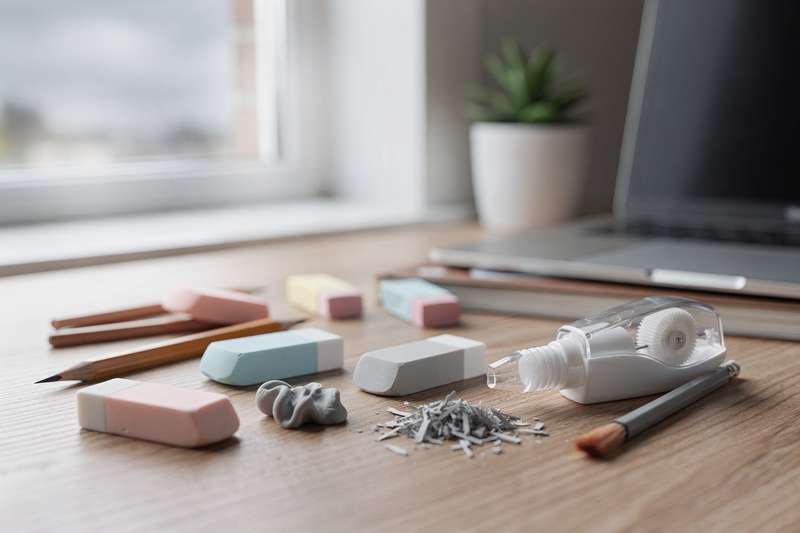
You know the feeling. You’ve spent ten careful minutes on a handwritten report, a sketch, or a form — and then one stray pencil mark, one misplaced word, one smudged line forces you to reach for the eraser or the correction fluid. The cheap pink rubber from the pound shop tears the paper. The correction fluid goes on lumpy and takes an age to dry. The tape dispenser snags. And suddenly what should have been a two-second fix turns into a visible, embarrassing mess that follows the document around for its entire life.
If that scenario sounds painfully familiar, you’re not alone. Most people treat erasers and correction supplies as an afterthought — grabbing whatever’s cheapest at the till — and then wonder why their finished work looks sloppy. The truth is that there’s a real difference between a quality vinyl eraser that lifts graphite cleanly without ghosting or paper damage, and a low-grade rubber that smears and tears. The same applies to correction tape versus fluid, and precision eraser pens versus block erasers. The right tool for your specific use case matters enormously, whether you’re an office worker correcting typed forms, an art student working in graphite, or a teacher marking papers all day.
This guide cuts through the noise. We’ve focused specifically on what’s available and well-reviewed on Amazon UK, covering the key categories — block erasers, PVC-free erasers, kneadable erasers for artists, correction pens, precision eraser pens, and combo starter sets — so you can find exactly what you need without wading through irrelevant options.
How We Evaluated These Picks
Choosing correction supplies sounds trivial until you realise how many variables matter. We assessed products against a consistent set of criteria: eraser cleanliness (how completely a product removes marks without ghosting or residue), paper safety (whether it damages or lifts paper fibres under normal pressure), smudge resistance, material composition (vinyl/PVC-free versus traditional rubber), form factor suitability for different use cases, pack value, and the pattern of verified buyer feedback available on Amazon UK. Where a product had fewer published reviews on the UK storefront, we weighted general category reputation and brand heritage more heavily, and we note this where relevant. Correction supplies were also assessed for dry time, opacity, and applicator design. Products that were clear variants of one another (same brand, same product line) are covered in a single section — we haven’t padded the guide with duplicates.
Best Everyday Office Eraser: Faber-Castell PVC-Free Eraser
The Faber-Castell Miscellaneous Eraser Pvc-Free is the workhorse pick for anyone who needs a reliable, clean-erasing block eraser for day-to-day pencil and light ballpoint corrections. With 775 reviews on Amazon UK and a rating of 4.6 out of 5 stars, this is one of the most battle-tested options in the UK market, and the feedback is consistent: it erases cleanly, leaves minimal crumble, and doesn’t damage standard 80gsm office paper.
Being PVC-free matters more than many buyers realise. Traditional PVC-based erasers can leave faint chemical residue on paper and are less environmentally benign to produce and dispose of. Faber-Castell’s formulation sidesteps that without sacrificing performance — it’s firm enough to give you control on a small mark but not so hard that it drags across the surface. The eraser crumbles into small pieces that brush away easily rather than smearing graphite back into the paper fibres.
Where it’s less ideal: it’s a single eraser at a modest size, so if you’re doing high-volume corrections (e.g., a teacher going through 30 worksheets) you may burn through it faster than you’d like. It’s also not really suited to ink correction — this is a pencil and light graphite tool. For coloured pencil work, results are mixed, as with most block erasers. But for the core use case — correcting pencil writing on standard paper in an office, school, or home study environment — it handles the job with less fuss than most alternatives at its tier.
The compact block form is easy to grip, and the slightly rectangular shape gives you a choice of edge: use the corner for fine detail work or the flat face for broader sweeps. At a budget price point, it represents solid everyday value and is the sensible starting point for anyone upgrading from a generic own-brand eraser.
Best Starter Set: STAEDTLER Eraser & Sharpener Set
The STAEDTLER Eraser & Sharpener Set – Medium Size – Latex & Phthalate-Free Rubber – Pack of 2, 526 N-S1BK is the practical choice if you want a reliable eraser and sharpener combination in one affordable pack. It carries 417 reviews on Amazon UK at 4.7 out of 5 stars — a strong signal that this particular set consistently delivers what it promises.
STAEDTLER’s erasers have a long-established reputation in European stationery — they’re a staple of German-engineered school supplies, and the latex-free, phthalate-free formulation means this is safe for use around children and anyone with latex sensitivities. The medium size sits in a sweet spot: large enough to erase a meaningful area efficiently, compact enough to control when you need precision around other marks you want to keep.
The sharpener included in this set is a straightforward single-hole design, functional and compact. It won’t replace a dedicated quality sharpener if you’re doing serious art work, but for the student or office user who just needs both tools to hand, the convenience of having them paired together is genuinely useful. The twin-pack format also means you’ve got a backup — or one set for home and one for work.
The tradeoff here is that neither component is the absolute best in its category individually. STAEDTLER’s Mars Plastic eraser (see below) outperforms this set’s eraser for truly critical erasing tasks. But as a value-led everyday kit for students, desk drawers, or back-to-school supplies, this set is hard to argue with. It covers the basics without fuss, and the latex-free credential makes it a safer choice for school environments.
Best Premium Vinyl Eraser: STAEDTLER Mars Plastic Eraser
If you want the benchmark against which other block erasers are often measured, the STAEDTLER Mars Plastic, Premium Quality Vinyl Eraser, White, Latex-free, Age-resistant, Minimal Crumbling (526 50 BK) 4 Count (Pack of 1) is it. The Mars Plastic has been a favourite of draughtsmen, architects, and graphic artists for decades, and for good reason: it erases graphite with a precision and cleanliness that most block erasers simply can’t match.
The white vinyl formulation is the key differentiator. Unlike pink or grey rubbers, a quality white vinyl eraser does not add pigment or chemical colour to the paper during erasing — the crumbles are white, the paper stays clean, and there’s no ghosting on quality cartridge paper or standard A4. The “minimal crumbling” claim is genuine; the crumble is fine and manageable, not the kind that flies across your work and deposits graphite dust in a wide radius.
The four-pack format means you’re getting genuine long-term value. These erasers are age-resistant — they don’t harden and crack over time the way cheap rubbers do — so buying a pack of four is a sound investment rather than a gamble on shelf life. They’re latex-free, which is increasingly important in shared workspace and school contexts.
The honest caveat: the Mars Plastic is overkill for someone who just needs to occasionally correct a grocery list. Its qualities shine in technical drawing, architectural drafting, detailed written documents, or any context where you’re erasing regularly and need the result to be invisible. For casual home use, the Faber-Castell PVC-Free eraser covered earlier will serve you well. But if you’re a student submitting handwritten work, a designer, a teacher, or simply someone who cares about the quality of what lands on paper, the Mars Plastic is the standard-setter and worth every penny of the premium.
Best for Artists: Faber-Castell Art & Graphic Kneadable Art Eraser
A kneadable eraser operates on a completely different principle to a block eraser, and the Faber-Castell Art & Graphic Kneadable Art Eraser, Grey, Single Eraser, for Art, Craft, Drawing, Sketching, Home, School, University is the go-to choice for pencil artists, charcoal workers, and anyone doing detailed tonal work.
Rather than abrading the paper surface to remove graphite, a kneadable eraser lifts pigment by adhesion — you press, dab, or pull it across the mark and the graphite transfers into the eraser itself. This means you’re not wearing down the paper surface at all, which is critical when you’re working on delicate art paper, watercolour paper, or building up layered tonal drawings where you need to lighten an area without destroying the tooth of the surface. You can shape the eraser to a fine point for precise highlights, roll it into a ball for broader lightening, or dab to lift without directional marks.
The Faber-Castell version is a quality grey putty eraser that maintains its pliability well in normal room temperatures — a key practical test, since cheap putty erasers can become stiff and crumbly in cold conditions or over time. You clean it by kneading fresh graphite into the body and then stretching it out, redistributing the absorbed pigment. When it’s thoroughly saturated, it loses effectiveness and needs replacing, but a single eraser lasts a long time in normal art use.
It’s important to be clear that this is not a correction tool for written documents. It won’t cleanly remove a word of pencil writing the way a block eraser will, and it’s useless on ink. Its home is in the artist’s toolkit — sketching, portraiture, still life, graphite tonal work, compressed charcoal drawings. If that’s your use case, it’s the right tool; if you’re correcting written text, pick one of the block erasers above.
Best Precision Eraser Pen: Faber-Castell 185610 Precision Eraser Pen
The Faber-Castell 185610 – Precision Eraser Pen, Includes Refill Eraser, for Professionals and Hobby Artists addresses a specific frustration that block eraser users know well: you want to erase a single letter, a tiny detail in a drawing, or a precise area — but every block eraser is far too wide for the task, and you inevitably smudge or remove marks you wanted to keep.
The eraser pen format puts a small, firm erasing tip inside a barrel you can grip exactly like a pen or pencil. This gives you the same fine motor control you’d use for writing — you can erase with directional strokes, work around specific lines, and target marks that are only a millimetre or two wide. The included refill eraser extends the product’s lifespan considerably, which addresses one of the historical frustrations with eraser pens: the feeling that you’re buying a lot of plastic for a small amount of consumable.
Faber-Castell’s positioning of this product is towards professionals and hobby artists — illustrators cleaning up inked lines, architects refining technical drawings, or anyone doing detailed mixed-media work. It’s also genuinely useful for anyone writing dense handwritten notes who needs surgical precision when correcting without disturbing surrounding text.
The tradeoff with any eraser pen is that the small tip means slower coverage over a large area — you wouldn’t want to use this to erase a whole paragraph. For broad corrections, you’d reach for a block eraser first and use the pen for final clean-up. The Faber-Castell build quality is solid and the grip is comfortable for extended use. If precision erasing is a regular requirement in your workflow, this is a tool worth having alongside a conventional block eraser rather than instead of one.
Best Correction Pen: Bic Tipp-Ex Shake ‘n Squeeze Correction Pens
For ink corrections on paper — typed text, ballpoint errors, form filling — a good correction fluid pen beats tape in many situations, and the Bic Tipp-Ex ‘Shake’n Squeeze’, Correction Pens, Opaque Correction Fluid, 8 ml, Pack of 3, White is a well-established choice from a brand synonymous with the category.
The shake-and-squeeze mechanism is the defining feature: you shake the pen to mix the fluid, then gently squeeze the barrel to control flow through the fine tip. This gives you considerably more control over application than a brush-in-a-bottle format, where it’s easy to apply too much fluid and get a thick, slow-drying blob. The 8ml capacity per pen is practical, and the three-pack format means you’re covered for a good while before needing to restock.
Tipp-Ex correction fluid dries opaque — this matters because semi-transparent correction fluid lets the underlying error show through, which defeats the purpose. Once dry, you can write over the corrected area cleanly. Drying time is relatively quick compared to traditional correction fluid, though still not as instant as correction tape. On glossy or coated paper stocks it can bead rather than absorbing evenly, so it’s best used on standard office paper and copier paper rather than high-finish surfaces.
It’s worth being honest about where correction pens struggle: on highly absorbent paper the fluid can bleed slightly at the edges, and on darker paper colours it won’t mask the original text. These are category-wide limitations rather than Bic-specific ones. For standard white or cream office paper, printed forms, and school work, the Tipp-Ex correction pen is reliable and practical. The three-pack makes it a sensible buy for anyone who uses correction fluid with any regularity.
Best Value Multi-Pack: Amazon Basics Block Rectangular Rubber
When you need a reliable eraser to keep at every desk, in every school bag, and in the communal stationery drawer — without agonising over which one to buy — the Amazon Basics Block Rectangular Rubber, 10 Pack, White is the sensible, no-nonsense answer. This is a ten-pack of white block erasers designed for exactly the role the name suggests: basic, reliable erasing across everyday pencil-writing tasks.
White rectangular block erasers are the standard form across most school and office contexts, and the Amazon Basics version does the job without drama. The rectangular form gives you a useful variety of working surfaces — the broad flat face for large-area corrections, the narrow edge for tighter work — and white rather than pink means no colour deposit on the paper during erasing.
The clear value proposition here is the ten-pack. If you’re a teacher who regularly replenishes classroom supplies, a parent equipping multiple children, or an office manager keeping the stationery cupboard stocked, buying in a multi-pack makes far more sense than purchasing individual erasers repeatedly. Each eraser in the pack is a solid functional performer for pencil corrections on standard paper.
The honest tradeoff: these won’t match the erasing precision or paper safety of the STAEDTLER Mars Plastic or the Faber-Castell PVC-Free eraser reviewed above. For critical work — technical drawing, submitted assignments, documents where presentation matters — you’d want a premium single eraser. But for the bulk of everyday erasing needs, where the goal is simply to remove a pencil mark cleanly and move on, this ten-pack delivers solid performance at a price point that makes bulk buying genuinely worthwhile.
What to Look For When Buying Erasers and Correction Supplies
- Material composition: White vinyl and PVC-free erasers are the modern standard for clean, low-damage erasing. Traditional pink rubber works but can leave colour deposits and is harder on paper fibres. Latex-free formulations matter if you’re buying for school environments or for anyone with latex sensitivities. Kneadable putty erasers are a separate category entirely — for lifting pigment in art work rather than scrubbing marks off writing paper.
- Form factor and precision: Block erasers cover broad areas efficiently but can’t target individual characters without risk to surrounding marks. Eraser pens give you fine-point control for detailed corrections. Cap erasers fit standard pencil tops for convenient access. Choose the form factor that matches your typical correction task — bulk erasing or precision work.
- Paper compatibility: Standard 80gsm copier paper is forgiving and works with almost any eraser. Delicate art papers, watercolour paper, and thin writing paper are more vulnerable — on these surfaces, a quality white vinyl eraser or a kneadable eraser is far safer than aggressive rubbing with a harder eraser. Correction fluid works best on plain white or cream uncoated stocks; it may bead on glossy paper.
- Correction fluid vs. correction tape: Fluid pens give you more control around irregular corrections and work well for small areas, but require drying time. Correction tape applies instantly, dries in seconds (no fluid), and is generally neater for covering whole words or lines. Tape can sometimes lift from the surface if the paper flexes; fluid bonds more durably but can be visible at an angle under lighting.
- Pack size and restocking cadence: If you’re buying for a school, office, or family, multi-packs offer clear economies. Single high-quality erasers are the right choice for personal technical or artistic use where you’ll carry the same eraser for months. Think about your actual usage rate before defaulting to the cheapest per-unit option — a premium single eraser used carefully can outlast a cheap pack of twelve.
- Age resistance and shelf life: Cheap rubbers harden and crack over time, especially in fluctuating temperatures. Quality vinyl erasers (particularly STAEDTLER’s Mars Plastic range) are specifically formulated to resist this. If you’re buying in bulk to store, age resistance is worth considering — you don’t want to open a new eraser six months later and find it brittle.
- Ergonomics and grip: For extended erasing sessions — artists working on large drawings, teachers marking papers — the shape and grip of an eraser matters. A chunky block is easier on the hand over long periods than a thin cap eraser. Eraser pens with rubberised grips reduce fatigue when doing precision work. It sounds minor until you’re forty minutes into a marking session.
Verdict
For the typical UK buyer — someone who uses erasers and correction supplies regularly across school, office, or home-study contexts — the Faber-Castell Miscellaneous Eraser Pvc-Free is the single most sensible starting point. It’s well-reviewed by a substantial number of UK buyers, PVC-free, genuinely clean in use, and available at a price that makes it an easy purchase. It covers the vast majority of everyday correction needs on standard paper without any of the frustrations of cheap alternatives.
If you’re a student or professional working in pencil who needs top-tier erasing performance, step up to the STAEDTLER Mars Plastic — the benchmark of the category, and available in a practical four-pack. For ink corrections, add the Bic Tipp-Ex Shake ‘n Squeeze pens. And if you do any kind of pencil or charcoal art work, the Faber-Castell Kneadable Art Eraser is a different tool altogether — one you’ll wonder how you managed without once you’ve tried it.
The core lesson: buy the right type of eraser for your actual use case, invest a little more in material quality, and you’ll spend far less time frustrated by the results.
We were not paid to feature any specific product in this guide. All opinions are independent and based on publicly available specifications, verified buyer feedback patterns, and category research.
Quick Comparison Table


![Swordfish Combo Pencil Sharpener with Mess-Free Canister and Eraser [Pack of 1] Turquoise [40294]](https://m.media-amazon.com/images/I/71GxCMsWRrL._AC_UL320_.jpg)
FAQ
What is the difference between a vinyl eraser and a rubber eraser?
A vinyl (plastic) eraser erases graphite by crumbling away and carrying the marks with it, leaving very little residue on the paper. Traditional rubber erasers work by abrading the paper surface, which can roughen the paper and sometimes smear graphite rather than lifting it cleanly. Vinyl erasers are generally gentler on paper and produce cleaner results, which is why they’ve largely replaced rubber in quality stationery ranges.
Is correction tape or correction fluid better?
It depends on your workflow. Correction tape applies instantly with no drying time, which is ideal when you’re working at speed or need to write over the correction immediately. Correction fluid gives you more flexibility around irregular shapes and small areas, and bonds more firmly to the paper surface — it’s less likely to peel than tape if the paper is handled repeatedly. For clean, straight-line word or line corrections, tape is generally quicker and neater. For awkward spots or fine applicator control, a correction pen wins.
Can I use a kneadable eraser for written corrections?
A kneadable (putty) eraser is designed for lightening and lifting graphite and charcoal in drawings rather than cleanly removing written marks. It can reduce the visibility of pencil writing but won’t give you the clean, complete removal that a vinyl block eraser produces. For correcting written text, use a block eraser; save the kneadable eraser for tonal art work where you want to lighten areas without abrading the paper surface.
Are latex-free erasers actually necessary?
Latex-free erasers are worth choosing if you’re buying for school environments, communal use, or anyone with a known latex sensitivity — reactions range from mild skin irritation to more serious allergic responses. Even if you have no personal sensitivity, latex-free is now the standard across most quality stationery brands at no performance penalty, so there’s little reason not to choose it as a baseline when options are otherwise equal.
Why does my eraser smear instead of erasing cleanly?
Smearing usually happens for one of three reasons: the eraser is too soft or worn and is redistributing graphite rather than lifting it; you’re using too much pressure and grinding graphite into the paper fibres; or the eraser surface is contaminated with previous graphite and needs cleaning (rub it on a clean piece of scrap paper first). Switching to a quality white vinyl eraser and using lighter strokes solves the problem in most cases.
How do I stop correction fluid from going lumpy?
Correction fluid thickens when it’s partially dried out, usually because the cap wasn’t replaced firmly or the pen was stored incorrectly. Before use, shake the pen thoroughly to remix the fluid. If it’s already thickened, most correction fluid can’t be reliably re-thinned at home — degraded fluid produces uneven, slow-drying coverage. Store correction pens with the cap firmly on, and shake before each use to keep the consistency even.