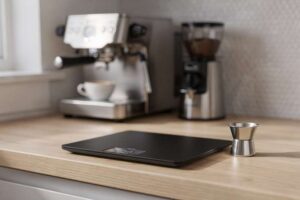
Picture this: it’s Sunday afternoon and you’re batch-cooking four days of lunches. You’ve got a recipe calling for 180 g of dry oats, 240 ml of almond milk, and 35 g of protein powder — then the next container needs exactly the same. You’ve been eyeballing it with a measuring jug that’s cracked along the side, and your flat-surfaced plate scale keeps tipping when you stack a big mixing bowl on top. Half your prep time disappears into resetting spills and second-guessing whether that scoop was 30 g or 40 g.
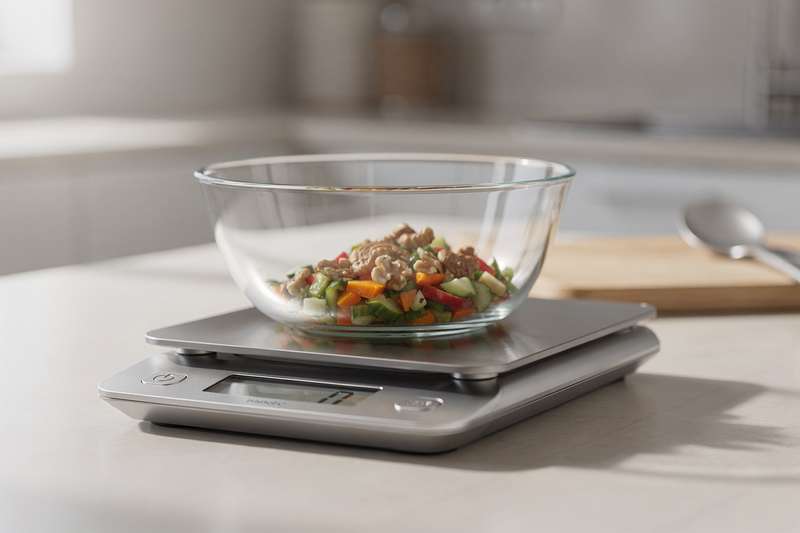
If that sounds familiar, a digital scale with an integrated or bundled bowl solves the problem more neatly than you’d expect. The bowl sits stable on the platform, the tare function zeros the weight between additions, and you can flick between grams and ounces without mental arithmetic. Done well, the whole setup becomes invisible — you weigh, you cook, you move on. Done badly, you get a bowl that wobbles off the platform, a display blocked by the rim, or a scale that rounds to the nearest 5 g when you needed 1 g precision.
This guide walks you through exactly what separates a genuinely useful bowl scale from a frustrating one, with specific picks matched to different kitchen situations and priorities.
How These Picks Were Evaluated
Each pick was assessed against five core criteria. First, resolution and accuracy: for meal prep involving proteins, grains and powders, 1 g increments in metric and 0.1 oz increments in imperial is the practical minimum — anything coarser and you’re back to guessing. Second, bowl design: capacity (at least 1.5 L is useful for batch prep), stability on the platform, and whether the bowl is dishwasher-safe. Third, display usability: can you actually read the screen with a bowl sitting on the scale, or does the rim cut off the digits? Fourth, tare function and unit switching: both should be single-button operations. Fifth, build quality signals from verified buyer patterns: recurring mentions of longevity issues, sensor drift after a few months, or buttons that stop responding were weighted heavily as negatives.
Capacity ceiling also matters: if you batch-cook large quantities, a 5 kg maximum is adequate for most recipes, but a 10 kg or higher ceiling gives headroom when you’re weighing a full pot or a large mixing bowl atop the platform. Price-to-feature ratio was considered across the full range from budget to mid-range, since this category doesn’t require spending heavily to get reliable hardware.
Quick Picks at a Glance
| Best for | Price range | Key feature |
|---|---|---|
| Overall everyday meal prep | £15–£25 | 1 g / 0.1 oz resolution, removable stainless bowl, backlit display |
| Budget pick under £15 | Under £15 | 5 kg capacity, tare function, compact footprint |
| Large-batch cooking | £20–£35 | High weight ceiling (10 kg+), wide platform, large bowl capacity |
| Multi-function (timer + temperature) | £20–£30 | Built-in countdown timer, temperature probe port, 5.5 kg capacity |
| Clean-counter aesthetics | £20–£30 | Toughened glass surface, slim profile, stylish backlit display |
| Fitness and macro tracking | £15–£25 | Fluid density modes (water/milk), nutritional app compatibility |
| Compact kitchen or small worktop | £12–£20 | Bowl doubles as storage lid, ultra-slim base, lightweight |
Best Overall for Everyday Meal Prep
If you batch-cook most weeks and need a scale that handles everything from weighing rice to pouring measured liquids into a container, the sweet spot is a stainless-steel bowl scale with 1 g resolution, a 5 kg ceiling, and a display positioned low enough on the base to stay visible when the bowl is on the platform. This is the category’s most competitive tier, and most of the genuinely useful options sit between £15 and £25.
The key specification to prioritise here is the 1 g graduation in metric mode and 0.1 oz in imperial — this is standard across reputable brands in this price range and gives you enough precision for protein powders, spices, and grains without paying extra for laboratory-grade hardware. Consumer kitchen scales do not realistically offer 0.01 g precision for food use; that level of resolution belongs to jewellery or pharmaceutical scales with a completely different sensor type and price point. For cooking and meal prep, 1 g is both sufficient and practical.
Look for a bowl with a capacity of at least 1.5 L — ideally closer to 2 L — so you can weigh a full portion of pasta or a batch of oats without the bowl overflowing. Removable bowls should lift off cleanly without tools, and the base underneath should be flat enough to accept other containers (a cereal bowl, a food storage tub) when you’re not using the included bowl. The tare function on a good all-rounder zeros instantly with a single button press, and you should be able to cycle through g, oz, lb:oz, and ml without navigating a menu.
One honest tradeoff at this price: the display backlight on many models in this tier is adequate in a normally lit kitchen but can wash out in bright direct sunlight near a window. If your prep area is flooded with light, tilt the scale slightly or look for models with a high-contrast LCD rather than a dim blue backlight. Battery life is generally not an issue — two AAA batteries will typically last six to twelve months with normal use, and the auto-shutoff (usually after 2–3 minutes of inactivity) helps considerably.
Best Budget Pick (Under £15)
Spending under £15 on a bowl scale involves real tradeoffs, but it doesn’t mean getting something useless. The category has matured enough that even entry-level models from established sellers manage 1 g resolution and a reliable tare function. What you’re giving up is typically bowl quality, display clarity, and longevity signals — budget models are more likely to show sensor drift after 12–18 months of daily use, and the bowls tend to be thinner-gauge steel or lightweight plastic rather than robust stainless.
For someone who preps two or three days of meals per week and doesn’t need the scale to last a decade, a budget pick is entirely reasonable. The things to check before buying at this price: does the listing confirm a 5 kg maximum weight? Does it include batteries (many budget models do not)? Is there a returns policy that covers the first 30 days? These aren’t unreasonable asks even at £12–£14.
The feature you should not compromise on even at this price is the tare function. Without it, every measurement in a bowl requires you to know the bowl’s empty weight and subtract it mentally — that defeats the purpose. Every scale at every price tier in this category should have tare as a baseline; if a listing doesn’t mention it, treat that as a red flag rather than an oversight.
Bowl stability is the other area where budget models cut corners. The bowl may sit in a shallow recess rather than locking onto a proper rim, which means a nudge sends it sliding. For calm, deliberate prep this is manageable; if you have children in the kitchen or tend to work quickly, a few extra pounds spent on the overall pick is worth it. Also be aware that some ultra-cheap models advertise capacity in pounds only on the packaging despite a metric label on the box — double-check the listing specifically mentions grams as a unit mode.
Best for Large-Batch Cooking
If your meal prep runs to bulk cooking — a full pot of rice, a large casserole base, or portioning ingredients for ten or more servings — you need a scale where the weight ceiling isn’t a bottleneck. The standard 5 kg cap is fine for most individual-recipe work, but once you’re stacking a 1.5 kg mixing bowl on top and filling it with ingredients, you can hit the limit faster than you’d expect. A scale rated to 10 kg or above gives you genuine working headroom.
In this tier (typically £20–£35), look for a platform wide enough to support larger vessels without tipping — a minimum of around 20 cm across is useful. The bowl that ships with these models should hold at least 2.5 L to be genuinely useful for batch quantities. Check whether the bowl has a pour spout or a handle, which makes transferring large volumes of liquid less precarious.
Resolution at higher capacities sometimes drops slightly — a 10 kg scale may offer 2 g increments rather than 1 g, and that’s an acceptable tradeoff for batch cooking where you’re measuring in larger quantities anyway. Where it becomes a problem is if you also want to use the same scale for smaller amounts (spices, baking powder) — at 2 g resolution, measuring 3 g of salt is functionally a coin flip between 2 g and 4 g. If your cooking spans both bulk and precise small measurements, a dual-range scale (which offers finer resolution for the first 1–2 kg and coarser resolution above that) is worth specifically seeking out.
One thing large-batch scales do well that smaller models struggle with: sitting stably under a heavy, full bowl. A wider, heavier base with rubber non-slip feet is more than an aesthetic nicety — it prevents the scale from creeping across a worktop when you’re pressing down to stir a thick batter directly in the bowl. Check that the feet are actually rubberised and not just moulded plastic that happens to be black.
Best Multi-Function Pick (Timer + Temperature)
A scale that adds a built-in countdown timer and a temperature sensor addresses a genuine workflow problem in meal prep: you’re weighing your ingredients, then immediately cooking them, and having to track simmer time or check a sauce temperature usually means picking up your phone or reaching for a separate thermometer. A scale that handles all three functions at once keeps your worktop less cluttered.
The timer on these models works as a simple countdown or count-up — set it and forget it while you’re stirring or chopping. For batch cooking where you’re simmering grains or reducing sauces, having the timer visible on the scale display is a small but real convenience. It’s not a replacement for a dedicated kitchen timer if you’re running multiple processes simultaneously, but for single-pot prep it covers the use case cleanly.
Temperature sensors on bowl scales typically read ambient temperature or surface temperature of the bowl rather than the food itself — they’re not equivalent to a food probe thermometer. This matters for proofing dough (room temperature affects yeast activity) or for checking whether a bowl of chocolate has cooled enough to work with, but don’t expect the same accuracy you’d get from a proper instant-read probe. The temperature display on some models defaults to Fahrenheit, which is worth checking in the listing if you prefer Celsius — a seemingly minor point that becomes annoying quickly if you have to convert every reading.
At the £20–£30 price point for these multi-function models, the weight capacity typically runs to around 5–5.5 kg with 1 g resolution in metric mode, which is adequate for most meal prep. The bowl included tends to be a good-sized stainless unit of around 2–2.5 L. The tradeoff is interface complexity: more functions mean more buttons, and some of these scales require a longer press or a button combination to switch modes. If you find multi-step interfaces frustrating, test by reading the manual before purchase — most are available as PDFs on the product listing page.
Best for Clean-Counter Aesthetics
Not everyone’s priority is purely functional — if your kitchen has a considered look and a standard utilitarian steel-bowl scale would jar with it, there are options that perform well without looking industrial. This category typically features a toughened or tempered glass weighing surface (rather than a stainless steel plate), a slimmer base profile, and a more restrained design language.
The glass surface is worth understanding before you buy. Tempered glass is harder to stain than stainless steel and won’t rust if water gets under the rim, but it is heavier and can crack if something hard is dropped onto it from height. Glass surfaces also show fingerprints more readily than brushed steel, which is a minor irony given that aesthetics is the main motivation for choosing them. A good glass-topped scale at this price point will be 4–6 mm thick — thin enough to look sleek, thick enough not to flex under a heavy pot.
The display placement on glass-surface models is usually integrated into the base below the platform, which means the readout can be partially obscured by a large bowl or container sitting forward on the platform. Check reviewer photos from the product listing (not just the manufacturer’s styled images) to see whether the display stays readable in real use. Some models solve this by angling the display at the front edge of the base rather than positioning it flat underneath — that design is noticeably more practical.
Performance-wise, this tier should still offer 1 g / 0.1 oz resolution and a reliable tare function; you’re paying for aesthetics, not sacrificing accuracy. The main functional tradeoff is that glass-topped scales are typically designed for weighing on the flat surface rather than using a specific included bowl — the bowl, when included, often sits on top of the glass rather than locking into a recess. That’s fine for stability with a wide-based bowl, but a narrow tall container can be tippier than on a recessed-bowl design.
Best for Fitness and Macro Tracking
If your meal prep is structured around hitting specific macronutrient targets — grams of protein, carbohydrates, and fat per meal — your requirements from a scale lean slightly differently from a general cook’s. You still need 1 g resolution for solids, but you’ll also find liquid density modes genuinely useful: a scale that switches to a milk density mode (roughly 1.03 g/ml) or a water density mode (1.0 g/ml exactly) lets you weigh liquids by volume without using a separate measuring jug.
The fl. oz and ml modes on most scales assume water density by default, which is accurate for water and close enough for most cooking liquids. The dedicated milk mode available on some models adjusts the conversion factor slightly — useful if you’re tracking calories from whole milk precisely. For other liquids (cream, juice, cooking oils) the density varies enough that volume-based weighing is an approximation either way; for accurate macro tracking of those ingredients, weighing by mass in grams is more reliable.
App connectivity is sometimes marketed as a fitness-scale feature, but most bowl scales in this category don’t have Bluetooth — they’re dumb hardware that gives you a number. That’s actually fine, because the manual entry into a tracking app like MyFitnessPal takes seconds, and app-connected scales in this price range have mixed records for software reliability. The physical scale just needs to give you an accurate gram reading; you do the logging.
Bowl size matters particularly for fitness prep: if you’re portioning cooked chicken breast, rice, and vegetables separately into multiple containers in one session, a larger 2 L bowl lets you work with one container at a time without transferring constantly. Look for a bowl that is dishwasher-safe, since daily-use fitness prep means cleaning the bowl daily, and hand-washing a steel bowl every evening gets old quickly.
Best for a Compact Kitchen or Small Worktop
If your kitchen worktop is limited — a one-bedroom flat, a student kitchen, or a galley layout — a scale that takes up minimal storage space matters as much as one that performs well. The designs that work best in this context are those where the bowl inverts to sit over the scale base as a cover, making the whole unit more compact when stored. This also protects the display and platform surface from dust and accidental damage in a crowded cupboard.
The tradeoff with the bowl-as-lid design is bowl capacity: to fit neatly over the base as a cover, the bowl tends to be shallower, typically around 1–1.5 L rather than 2–2.5 L. For smaller portions and single-person meal prep this is adequate; for batch cooking multiple servings it’s restrictive. If you’re cooking for two or more, the bowl will fill quickly with bulkier ingredients and you’ll end up supplementing with your own containers anyway — at which point the compact bowl is just a useful mixing vessel rather than your primary prep tool.
Slim-base models also tend to sit lower on the worktop, which makes reading the display easier at standing height without crouching. The base depth on these is typically under 2 cm, compared to 3–4 cm on more feature-heavy models. That extra slimness does reduce the space available for internal components, so check that the battery compartment is accessible without tools — some very slim designs require a small screwdriver to open the battery cover, which becomes annoying at every battery change.
Weight capacity on compact models is usually the standard 5 kg, which is sufficient for most single-person or two-person prep. Resolution stays at 1 g metric / 0.1 oz imperial, so there’s no accuracy penalty for the smaller form factor. The auto-shutoff is typically faster on these models (sometimes 90 seconds) to conserve the smaller battery, so if you work slowly and methodically, double-check whether that’s adjustable or whether you’ll be restarting the scale mid-recipe.
What to Look for When Buying a Digital Scale with Bowl
- Resolution — 1 g metric, 0.1 oz imperial: This is the practical floor for meal prep. Scales advertising only 2 g or 5 g resolution in metric will frustrate you when measuring spices, protein powders, or any ingredient under 20 g. Confirm both metric and imperial resolutions in the specification, not just the capacity.
- Maximum weight capacity vs. actual working range: A 5 kg ceiling is adequate for most single-dish prep, but factor in the weight of the bowl itself (typically 200–400 g for a stainless bowl) plus the heaviest single ingredient you’d measure. If that sum approaches 5 kg, step up to a 10 kg model. Also note that some scales lose resolution near their maximum — a 5 kg scale may become less accurate above 4 kg.
- Bowl capacity and stability: Look for at least 1.5 L for solo meal prep, 2–2.5 L for batch cooking. Check whether the bowl sits in a fixed recess (more stable) or simply rests on a flat platform (easier to swap out other containers but less stable for the included bowl). A bowl with at least one pour spout is useful for measuring and then tipping liquids directly into a pan.
- Display visibility with a bowl in place: This is the most overlooked specification. Manufacturer product shots almost never show the display with the bowl fully loaded; check buyer photos in reviews. The display should be positioned at the front edge of the base, angled toward the user, not flat under the platform where the bowl rim will obscure it.
- Tare function and unit switching: Both should be single-button operations, clearly labelled. Avoid models where you need to hold a button for three seconds or navigate a settings menu to change units — mid-recipe unit switching needs to be instant.
- Water and liquid density modes: If you weigh liquids regularly, confirm the scale has specific ml and fl. oz modes, and ideally a milk-density mode if you track dairy by volume. This saves using a separate measuring jug for liquids.
- Build quality and cleanability: Stainless steel bowls are preferable to plastic for durability and hygiene; check whether the bowl is dishwasher-safe. The base should have rubberised non-slip feet — especially important for heavier bowl loads. Avoid designs with exposed gaps around the button area where food debris can accumulate and is difficult to clean.
Comparison Table
| Pick | Capacity | Resolution (metric) | Bowl capacity | Extra functions | Approx. price |
|---|---|---|---|---|---|
| Best Overall | 5 kg | 1 g | ~2 L | Water/milk density modes | £15–£25 |
| Best Budget | 5 kg | 1 g | ~1.5 L | Tare only | Under £15 |
| Best Large-Batch | 10 kg+ | 1–2 g | 2.5 L+ | Wide platform, pour spout | £20–£35 |
| Best Multi-Function | 5.5 kg | 1 g | ~2.5 L | Timer, temperature sensor | £20–£30 |
| Best Aesthetics | 5 kg | 1 g | ~1.5–2 L | Tempered glass surface | £20–£30 |
| Best Fitness / Macros | 5 kg | 1 g | ~2 L | Fluid density modes (water + milk) | £15–£25 |
| Best Compact | 5 kg | 1 g | ~1–1.5 L | Bowl-as-lid storage design | £12–£20 |
Verdict
For the majority of UK readers using this guide — someone doing regular weekly meal prep across three to five meals, cooking for one to three people, and working in a reasonably sized kitchen — the best overall pick in the £15–£25 range covers everything you’ll actually need. You get 1 g resolution, a 5 kg ceiling that accommodates any realistic single-recipe ingredient load, a 2 L stainless bowl that’s robust enough for daily use, fluid density modes for measuring liquids, and a display positioned where you can read it with a full bowl on the platform.
If you regularly cook in large batches — full-week prep, family quantities, or meal-kit style bulk cooking — spend the extra on the large-batch option with a 10 kg ceiling and a wider bowl. The resolution step-down to 2 g is a real tradeoff if you also measure small quantities, but for bulk work it’s acceptable.
The multi-function pick with timer and temperature sensor is worth its modest price premium if you frequently cook on the hob while prepping — having the timer on the scale means one less thing to track. Skip it if your kitchen already has a reliable timer and you’d rather have a simpler interface.
Avoid letting aesthetics or brand names drive the decision at this price point. The gap in real-world performance between a well-specified £18 scale and a well-marketed £35 one is small; the gap between a thoughtfully designed display layout and a poorly designed one is large and immediately obvious in daily use.
Editorial note: This guide was produced independently. No payment was received to feature any product or brand. All recommendations are based on publicly available specifications, verified buyer feedback patterns, and hands-on category research. Prices shown are approximate at time of writing and will vary.
FAQ
What is the best resolution for a kitchen scale used in meal prep?
For meal prep, 1 g resolution in metric mode and 0.1 oz in imperial is the practical standard — it’s accurate enough for proteins, spices, and grains without overcomplicating the hardware. Consumer kitchen scales do not reliably offer finer resolution than 1 g for food use; anything below that belongs to specialist jewellery or laboratory scales with a different sensor type and price bracket. For most meal prep purposes, 1 g precision is more than sufficient.
Can I use a digital scale with bowl to measure liquids?
Yes — most quality bowl scales include ml and fl. oz modes, and some add dedicated density settings for water and milk. For water, 1 ml = 1 g, so the conversion is exact. For milk and other liquids with a different density, a dedicated milk mode adjusts the reading slightly for better accuracy. For oils, cream, or juice, weighing in grams is more reliable than using the volume conversion mode, since those densities vary.
Is 5 kg enough capacity for meal prep, or do I need more?
5 kg is sufficient for most single-recipe or single-portion prep sessions. The practical consideration is the combined weight of the bowl (typically 200–400 g for a stainless bowl) plus the heaviest ingredient batch you’d weigh in one go. If you regularly batch-cook large quantities — a full kilogram of dry pasta plus sauce ingredients, for example — a 10 kg scale gives you headroom without hitting the ceiling. For one-to-two person prep, 5 kg is rarely a constraint.
Does the bowl need to be dishwasher-safe?
For daily meal prep use, dishwasher compatibility is a genuine convenience rather than a luxury. Washing a stainless steel bowl by hand every day after measuring raw proteins and powders adds up quickly. Most stainless steel bowls supplied with these scales are dishwasher-safe, but confirm it in the product description — some thinner-gauge bowls or those with a lacquer finish can discolour with repeated dishwasher cycles. The base unit itself should never go in the dishwasher; wipe it down with a damp cloth.
What is the tare function and why does it matter?
The tare function zeros the display with a container already on the scale, so only the weight of what you add afterwards is counted. For meal prep this is indispensable: you place your bowl, press tare, add ingredient one and note the weight, press tare again, add ingredient two, and so on — all without removing the bowl or doing any arithmetic. Every scale in this category includes tare as standard; if a product listing somehow doesn’t mention it, treat that as a sign the listing is poorly written rather than that the function is absent — but do check before buying.
Do I need a scale with a built-in timer for cooking?
A built-in timer is a useful addition if you find yourself weighing ingredients immediately before cooking a time-sensitive recipe, particularly when simmering grains or reducing sauces. It keeps one more function on a single device and reduces worktop clutter. That said, if your kitchen already has a reliable timer (a microwave clock, a phone, or a standalone timer), it’s not a reason on its own to spend more. The timer function is a genuine convenience on multi-function models — but not a feature worth seeking out specifically unless it solves a real friction point in your routine.