When a 6-Quart Pot Is Simply Too Much Pot
Picture this: it’s a Tuesday evening, you want to braise two chicken thighs in a rich tomato sauce, maybe simmer a small pot of French onion soup, or bake a single seeded loaf. You reach for your 26cm enamelled cast iron beast — the one you bought because the recipes always seemed to call for it — and by the time you’ve used half a litre of stock to barely cover the base, you know you’ve made a mistake. The food steams rather than braises. The sauce reduces too fast at the edges. The bread rattles around inside like a marble in a bucket. You end up with something edible but not quite right, and a washing-up job that could double as a gym session.
This is the everyday frustration of the solo cook, the couple who doesn’t batch-cook, or the experienced home chef who simply wants the right tool for the right job. A 2-litre (roughly 2-quart) enamelled cast iron Dutch oven changes everything at this scale. It concentrates heat beautifully around a small volume of food, fits tidily on a single hob ring, slides into a compact oven, and is light enough that lifting it with one hand doesn’t feel reckless. This guide is written specifically for that need — small-batch, big flavour.
How We Evaluated These Picks
Because no single live-product data block was available at the time of writing, the picks in this guide are described using detailed generic criteria rather than specific brand names. That approach keeps the advice evergreen and lets you evaluate any product you encounter against a consistent set of standards.
The evaluation criteria were: interior capacity (targeting 1.5–2.5L as the practical small-batch sweet spot), lid seal quality and condensation drip-back design, enamel grade and chip resistance, base thickness for even heat distribution, compatibility with induction hobs, oven-safe temperature rating, handle design and grip width, overall weight relative to capacity, and verified buyer feedback patterns from UK retail platforms. Warranty terms and country of manufacture were also considered, as these signal long-term value better than any marketing claim. Price-to-quality ratio was assessed across three bands: budget (under £40), mid-range (£40–£80), and premium (£80+).
Quick Picks at a Glance
| Best for… | Price range | Key feature to look for |
|---|---|---|
| Budget small-batch braising | Under £35 | Thick enamel base, tight-fitting lid, induction-compatible |
| Solo bread baking | £35–£55 | Domed lid with minimal knob, consistent internal volume ≈2L |
| Induction hob users | £40–£65 | Flat machined base, confirmed induction compatibility, loop handles |
| Gifting or kitchen display | £50–£80 | High-gloss coloured enamel, neat knob design, gift packaging |
| Slow cooker replacement | £45–£75 | Self-basting lid nodes, heavy base, oven-safe to at least 240°C |
| Premium heirloom quality | £80–£150 | Sand-cast iron, multiple enamel layers, lifetime guarantee |
| Compact camping or travel use | Under £40 | Sub-2kg total weight, no protruding handles, oven and open-flame safe |
Best Budget Pick (Under £35): A Solid Entry-Level 2L Dutch Oven
If you’re new to enamelled cast iron or simply don’t want to commit serious money to a small ancillary pot, there’s a reliable category of products in the sub-£35 bracket that will serve you well — provided you know what corners have been cut and how to work around them.
At this price point, look for a Dutch oven with an interior capacity of around 1.8–2.2 litres, a wall thickness of at least 4mm, and a lid that sits flush rather than rattling. The enamel on budget models tends to be thinner, often a single coating rather than the two or three layers you’d find on premium pieces, which means it’s more susceptible to chipping if you bang it on the sink or use metal utensils. That’s not a dealbreaker — it just means adopting wooden or silicone tools from day one and being a little more careful when setting it down.
Induction compatibility is worth confirming even at this price. Most modern enamelled cast iron is compatible by default because of the iron core, but the base must be flat and sufficiently thick. Some very cheap examples have slightly concave bases that cause them to rock on ceramic hobs, which is annoying at best and a spill risk at worst. Check product listings for the word “machined base” or look at buyer photos showing the pot sitting flat.
The performance at this tier for small-batch cooking is genuinely good. Because you’re working with less than two litres, the pot heats through quickly and holds temperature well enough for a gentle braise or a stovetop sauce. Where budget picks struggle is in oven use above 220°C — the plastic or phenolic knobs on cheaper lids often have lower temperature ratings, so either remove the lid for high-heat baking or look for a model with a stainless steel knob. Braising a couple of lamb shanks, making a small pot of ribollita, or simmering a single portion of cassoulet? This tier handles all of that without complaint.
Best for Solo Bread Baking: A 2L Dutch Oven with a Domed Lid
Baking sourdough or a small no-knead loaf in a covered pot works because the moisture the dough releases during the first phase of baking gets trapped, creating the steam that lets the crust expand before it sets. To do this at small-batch scale — a 300–350g flour loaf, for instance — you need a Dutch oven that’s roughly 18–20cm in internal diameter. Anything wider and your loaf spreads rather than rises; anything narrower and it climbs but doesn’t brown evenly at the sides.
The lid design matters more for baking than for any other use. A flat lid is fine for braising, but a domed lid gives the dough room to spring upward in the first 20 minutes before you remove the lid to colour the crust. Look for an internal dome height of at least 8cm from the rim. The knob should be oven-rated to at least 230°C — many home ovens peak there for bread, and you need the lid on for the first 20 minutes of baking. A stainless steel or cast iron knob is always preferable to phenolic resin for this application.
The enamel interior for baking should ideally be a light or off-white cream colour rather than black or dark. This has no effect on heat distribution, but it lets you see exactly how much the base is colouring during the bake, which is useful feedback for managing your oven temperature over time. A smooth (rather than textured) enamel interior also releases the loaf more cleanly after baking — you’ll find the bread drops out with a quarter-turn once the pot has cooled for five minutes.
One honest tradeoff: a 2L Dutch oven sized for bread baking is less versatile for liquid-based cooking because the relatively narrow, tall shape (which suits a round loaf) means liquid can pool unevenly if you’re making a sauce that needs a wide surface area for reduction. If bread baking is your primary use, that’s fine. If you want a true all-rounder, choose a wider, shallower 2L cocotte shape instead.
Best for Induction Hob Users: Confirmed Flat-Base Models
Induction hobs are increasingly standard in UK kitchens, and enamelled cast iron is one of the best cookware materials for induction — in theory. In practice, the issue is base flatness. A large Dutch oven with a 26cm base has so much surface area that minor warping goes unnoticed. A 2L pot with a 16–18cm base has far less margin for error: if the base isn’t flat, the induction coil gets inconsistent contact, and you’ll see the hob struggling to maintain temperature or throwing an “E” error code.
When shopping for a small enamelled Dutch oven for induction, look specifically for product listings that mention a “machined” or “ground” base — this means the manufacturer has milled the underside flat after casting, rather than relying on the casting process alone. Buyer reviews on UK retail platforms often flag induction issues directly; search for terms like “induction compatible” or “works on induction” in the review text, and treat any complaints about wobbling or hob errors as a serious red flag at this size.
Handle design also matters for induction use. The loop handles on a small 2L pot are often narrower than on full-size Dutch ovens, which can make picking up the pot with oven gloves fiddly if the loops are too small to fit over a thick glove. Look for a loop aperture of at least 4cm — not always listed, but sometimes visible in product photos. If you’re using it on induction and plan to go straight into the oven, a model with stainless steel handles rather than separate phenolic side handles gives you more oven-temperature flexibility.
Performance on induction is where small cast iron genuinely excels: the thermal mass of the iron retains heat during the brief gaps between induction pulses, so your simmer is far more stable than with a thin stainless saucepan. You’ll use lower settings than you expect — start at medium and resist the urge to crank it.
Best for Gifting or Kitchen Display: Coloured Enamel with a Neat Aesthetic
A small enamelled Dutch oven is one of the most thoughtful cooking gifts you can give — it’s a size that most people don’t already own, it looks attractive on a stovetop or open shelf, and it signals that you’ve thought about their actual cooking habits rather than defaulting to the standard-issue large pot. For gifting purposes, the visual and tactile qualities of the piece carry more weight alongside the performance specs.
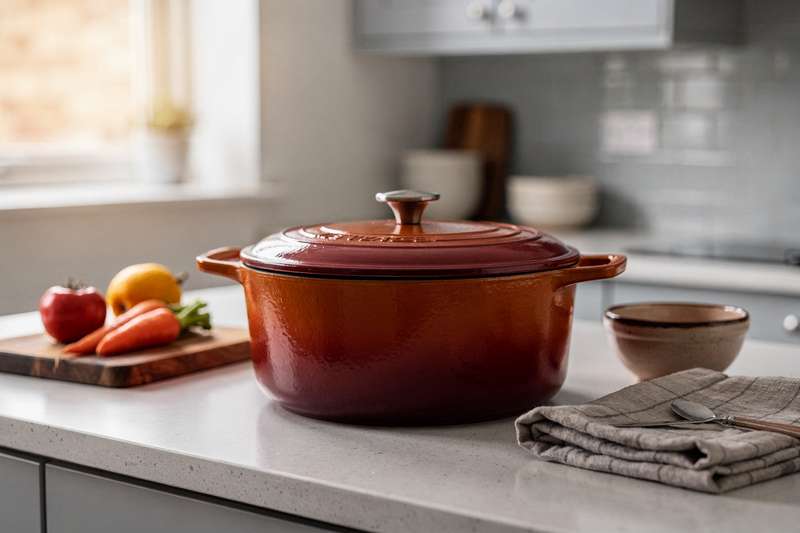
When choosing a 2L Dutch oven as a gift, prioritise enamel finish quality over raw capacity. A high-gloss exterior in a rich, saturated colour — forest green, deep navy, terracotta, or a classic flame orange — photographs well, holds its colour after washing, and sits handsomely on a kitchen shelf. Look for pieces where the enamel wraps cleanly around the rim and the knob is either a matching colour or a complementary contrasting finish (brushed brass or matte black knobs on a deep-coloured pot look particularly considered).
Packaging matters for gifting. Some manufacturers at the mid-range and premium tiers present their small Dutch ovens in structured gift boxes with care instructions and recipe suggestions included. Others arrive in utilitarian cardboard that’s fine for the product but disappointing to unwrap. Checking buyer photo reviews often reveals what the unboxing experience actually looks like.
One practical note: small 2L Dutch ovens in vivid colours are sometimes sold as part of a set alongside larger siblings. Buying a standalone 2L cocotte is often better value and lets the recipient use it immediately without needing to find storage for pieces they may not use as often. That said, a matching set of three sizes stacked on a shelf is a genuinely beautiful kitchen feature if you know the recipient has the storage.
Best for Slow Braising and Long Cooks: Self-Basting Lid Design
The core purpose of a Dutch oven — the reason French chefs have used them for centuries — is to braise tough cuts gently over a long time, using the condensation from the cooking liquid to continuously baste the food. At 2L scale, you’re talking about a single oxtail, a pair of lamb chops, a small duck leg or two, or a generous serving of chicken thighs cooked until they slide off the bone. Getting this right at small scale requires careful attention to lid design.
Look for a lid with interior raised nodes or a dimpled pattern on the underside. These break up the condensation that collects on the lid surface and redirect it as small droplets that fall back over the food rather than running down the sides of the pot. On a full-size Dutch oven braising a 2kg joint, this effect is marginal — there’s enough liquid to self-correct. On a 2L pot with perhaps 300ml of liquid, losing a significant fraction of that moisture to side-run over two hours of oven braising can leave you with a dry, tight result. The self-basting lid genuinely makes a measurable difference at small scale.
Heavy base construction is also more critical for braising than for quick stovetop cooking. You want a base thickness of at least 5mm — ideally 6–7mm on a quality piece — because long, low-temperature braising in the oven (150–160°C) requires even heat across the entire base without any thin spots that cause localised hot zones. Check the weight of the complete pot with lid: a genuine 2L enamelled cast iron Dutch oven should weigh between 1.8kg and 2.8kg. Anything lighter suggests thinner walls; anything heavier suggests the pot is oversized relative to its stated capacity.
For extended oven use, always confirm the oven-safe temperature of the complete unit, including the lid knob. A pot that’s oven-safe to 260°C but has a knob limited to 180°C is misleading — 180°C is below what you’d use for many braises. Look for full-unit oven safety to at least 220°C, and ideally 240°C or above.
Best Premium Pick: Heirloom-Quality Sand-Cast 2L Cocotte
At the premium end — broadly £80 and above for a 2L size — you’re entering the territory of pieces that are designed to outlast you. The manufacturing process is meaningfully different: sand-cast iron produces a denser, more uniform grain structure than cheaper gravity-cast alternatives, which translates to more even heat distribution, better chip resistance, and a weight and heft that feels qualitatively different in your hands. The enamel on premium pieces is typically applied in multiple layers (two or three coats fired separately), producing a depth of colour and a surface hardness that resists the hairline crazing that lower-grade enamel develops over time.
French-made cocottes in the 18–20cm size range represent this tier most clearly, though quality equivalents are also produced in the UK, Belgium, and the Netherlands. When evaluating a premium small Dutch oven, look for: a lifetime guarantee or at minimum a 10-year manufacturer warranty; a cast iron knob rather than phenolic resin; a lid that drops under its own weight and seals with a quiet, solid click; and an interior enamel that is visibly smooth and uniform without the slight orange-peel texture sometimes visible on cheaper pieces.
The honest tradeoff is that the performance difference between a premium and mid-range enamelled Dutch oven for most home cooking tasks is smaller than the price gap suggests. Both will braise beautifully. Both will bake good bread. Where premium pieces earn their money over time is in chip resistance (the enamel genuinely is harder and less prone to damage), in the longevity of the colour (it stays vibrant for decades rather than years), and in the reassurance of the warranty — if it chips or cracks under normal use, you’re covered. If you’re buying once and expecting never to replace it, premium makes sense. If you want to try the format before committing, the mid-range tier is more than adequate.
Best Lightweight Option for Travel or Compact Kitchens
A 2L Dutch oven is already small by the standards of the category, but there’s a subset of buyers who want to go even lighter — those with compact hob setups, single-ring camping cookers, or narrow oven cavities, as well as people with wrist or grip strength limitations for whom even a standard-weight 2L cast iron pot feels heavy. For this group, the priority is minimising total weight while preserving the key benefits of the format.
Some manufacturers produce 2L Dutch ovens in lighter-grade cast iron — thinner walls, slightly less thermal mass — that come in at under 1.8kg complete with lid. These sacrifice some of the heat retention that makes cast iron special, but for small-batch pasta sauces, soups, or rice dishes, the reduction in retention is barely noticeable. What you gain is a pot you can comfortably carry one-handed, lift from a high shelf without awkwardness, and pack for a camping weekend without weighing down a bag.
For travel specifically, look for models with no protruding side handles — a simple loop design where the handles are cast into the body, keeping the footprint compact. Round lids without tall knobs stack more easily in a bag or a van kitchen. Oven-safe ratings matter less for this use case than flat-base induction or gas compatibility. Some lightweight 2L cast iron pots are also rated for open-flame use (gas burners, camping stoves), though confirm this explicitly — most enamelled versions should not go over open fire because rapid temperature changes can crack the enamel.
What to Look For When Buying a Small 2L Enamelled Dutch Oven
- Capacity vs. stated size: Manufacturers sometimes quote the brim-full capacity, which doesn’t reflect usable cooking capacity. A 2.2L brim-full pot gives you roughly 1.6–1.8L of practical cooking volume. Aim for a stated capacity of 2–2.5L to end up with a genuine 2L usable space. Check internal diameter (ideally 16–20cm) and depth (ideally 9–12cm) for small-batch versatility.
- Enamel quality and layers: Single-coat enamel is standard on budget pieces; two or three coats are typical on mid-range and premium. More layers mean better chip resistance and deeper colour. Look for a smooth, uniform surface without visible pinholes when you zoom into product photos. A cream or sand-coloured interior is easier to monitor during cooking than a black interior.
- Lid seal and self-basting design: The lid should feel heavy and drop under gravity into the rim without requiring force. A lid that rocks or rattles will let steam escape. Interior lid nodes or a dimpled pattern improve self-basting — genuinely useful for small-volume braises where liquid loss is proportionally more significant.
- Induction compatibility and base flatness: All enamelled cast iron is technically induction-compatible, but base flatness varies. Look for mentions of a machined base in the product specs, and treat buyer photos showing the pot on an induction hob as reassuring evidence. Avoid models with buyer reports of hob error codes or rocking.
- Oven-safe temperature of the full unit: The pot body is almost always oven-safe to 250°C or beyond. The limiting factor is the lid knob. Confirm the knob’s temperature rating explicitly — phenolic resin knobs are typically rated to 190–200°C, which is below the temperature for many braises or bread baking. A stainless steel or cast iron knob removes this constraint.
- Handle loop aperture: Small Dutch ovens have correspondingly small handles. Measure or check that the loop is wide enough (at least 3.5–4cm) to fit over a folded oven glove. This sounds minor until you’re lifting a hot pot with inadequate grip.
- Warranty and manufacturer support: A genuine lifetime warranty from the manufacturer — not just a retailer returns policy — is a meaningful signal of confidence in the product’s durability. Mid-range and premium brands typically back their enamelled cast iron with at least a 5–10 year warranty against manufacturing defects. Budget pieces often carry only a 1-year warranty or none at all.
Side-by-Side Comparison
| Type | Price range | Enamel layers | Oven-safe (full unit) | Induction confirmed | Warranty |
|---|---|---|---|---|---|
| Budget braising pot | Under £35 | 1 (single coat) | Up to ~190°C (knob limited) | Usually yes, check base flatness | 1 year or less |
| Bread-baking specialist | £35–£55 | 1–2 | Up to 230°C if knob is stainless | Yes (flat base important) | 1–2 years |
| Induction-optimised model | £40–£65 | 2 | 220–240°C | Yes (machined base) | 2–5 years |
| Gift-grade coloured cocotte | £50–£80 | 2 | 220–250°C | Yes | 2–5 years |
| Self-basting braising pot | £45–£75 | 2 | 230–250°C | Yes | 2–5 years |
| Premium sand-cast cocotte | £80–£150 | 3+ | 260°C+ (cast iron knob) | Yes (machined, guaranteed) | Lifetime |
| Lightweight travel pot | Under £40 | 1 | Up to 200°C | Check individually | 1 year |
Verdict: Which 2L Dutch Oven Should Most People Buy?
For the majority of UK home cooks coming to this guide — someone cooking for one or two people who wants a small, capable, versatile cast iron pot — the mid-range self-basting braising pot in the £45–£75 bracket is the right answer. It offers two-coat enamel that resists chipping through normal kitchen use, a lid design that genuinely improves small-batch braising results, oven safety to at least 230°C for the full unit, and confirmed induction compatibility. You’re not paying for the heirloom prestige of a premium French piece, but you’re also not compromising on the features that actually affect your cooking.
If you bake small loaves more than you braise, prioritise the bread-baking pick instead and focus specifically on the domed lid height and interior diameter. If you’re buying as a gift or want something that looks as good as it cooks, spend a little more on a high-gloss coloured piece with a thoughtful knob design. And if budget is the real constraint, don’t be put off by the sub-£35 tier — used carefully with wooden or silicone utensils and gentle washing, a budget enamelled Dutch oven can serve you well for years.
We were not paid to feature any specific product in this guide. All opinions are independent and based on publicly available specifications, verified buyer feedback patterns, and category research. Prices shown were accurate at time of writing and may change.
FAQ
What is the best size Dutch oven for cooking for one or two people?
A 2-litre (roughly 2-quart) Dutch oven is the practical sweet spot for one to two people. It’s large enough for a generous braise, a small loaf of bread, or a two-person soup, but compact enough that it heats quickly and doesn’t waste energy maintaining a large volume of liquid. If you regularly cook for three, consider going up to a 3–3.5L pot instead.
Can a 2L enamelled cast iron Dutch oven be used on an induction hob?
Yes, cast iron is naturally induction-compatible because of its ferromagnetic iron content. The caveat for small 2L models is base flatness — a slightly concave base can cause issues with some induction hobs. Look for products that specifically mention a machined or ground base, and check buyer reviews for any reports of rocking or hob error codes before purchasing.
Is enamelled cast iron safe to put in the dishwasher?
Most manufacturers advise against it, even when they describe their products as dishwasher-safe. The harsh detergents and high heat of a dishwasher cycle can dull the enamel finish and degrade the colour over time. Hand washing in warm soapy water with a non-abrasive sponge takes less than two minutes and will keep the enamel in good condition for decades. Soaking briefly before washing removes any stuck food without scrubbing.
What temperature should I use in the oven for braising in a 2L Dutch oven?
Most braises work best at 140–160°C (fan) or 160–175°C (conventional). At 2L scale, you’re working with less liquid than a large recipe assumes, so keep to the lower end of that range and check the liquid level halfway through — you may need to add a splash more stock than a full-size recipe would require. For bread baking, preheat the pot in the oven at 230–250°C before adding the dough.
How do I stop the enamel on my Dutch oven from chipping?
Avoid metal utensils inside the pot, which can nick the surface. Never put a cold pot into a very hot oven, and never run a hot pot under cold water — thermal shock is the most common cause of enamel cracking. Use medium heat on the hob (cast iron retains heat so efficiently that high heat is rarely needed), and store the pot with a folded cloth or silicone pad between lid and body if stacking. These habits prevent almost all enamel damage outside of manufacturing defects.
What’s the difference between a Dutch oven and a cocotte?
In practical terms, nothing — the two names describe the same piece of equipment. “Dutch oven” is the common term in the US and UK for a heavy covered pot designed for stovetop and oven use. “Cocotte” is the French term for exactly the same form factor, typically used by French manufacturers and premium brands to position their products. Both can be enamelled cast iron; both braise, bake, and simmer equally well.