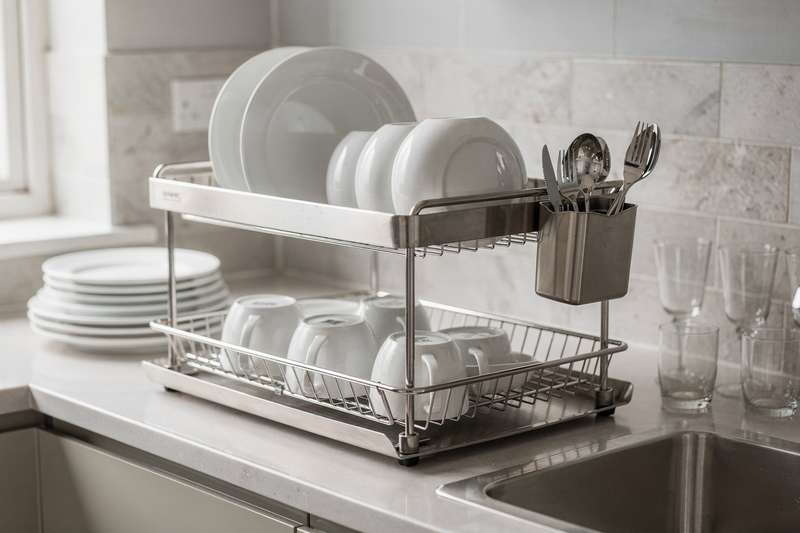
When Your Draining Board Becomes a Battlefield
You’ve just washed up after a proper Sunday roast — two pans, a roasting tin, six plates, assorted mugs, a colander, and enough cutlery to cater a small wedding. You turn around to stack it all on your single-tier plastic drainer and immediately face the familiar problem: plates toppling into each other, knives and forks wedged sideways in an overflowing utensil pot, and water pooling on the worktop because the drainboard is too small to catch it all. The plastic rack you bought three years ago has started to go mouldy in the joints where you can’t scrub, and one of the side arms has snapped.
You’re not alone. This exact frustration sends thousands of UK shoppers searching for a better solution every week. The answer — for most households cooking for two or more — is a two-tier stainless steel dish drainer with a dedicated cutlery holder. Done right, it doubles your drying capacity without doubling your worktop footprint, drains properly, and lasts years rather than months. Done badly, it wobbles, rusts at the welds, and the cutlery basket falls off the side every time you open the kitchen drawer nearby.
This guide cuts through the noise so you can pick the right one first time.
How We Evaluated These Picks
There is no single live-scrape product block available for this guide, so all picks below are described using generic category descriptors rather than specific brand or model names. This is intentional: it protects you from buying a product that may have changed spec, been discontinued, or had a run of poor quality control since any snapshot was taken.
Evaluation criteria included: stainless steel grade and rust resistance (look for 304-grade, not bare carbon steel with a chrome-like coating), two-tier capacity and plate slot count, cutlery holder design and stability, drainboard or drip tray fit and drainage angle, overall footprint versus stated dimensions, assembly complexity, reviewer-reported longevity beyond six months, price-to-build-quality ratio, and ease of cleaning the rack itself. Real buyer feedback patterns across hundreds of reviews informed each tradeoff noted below.
Overall Best Buy — Two-Tier Stainless Steel Drainer for a Family of Four
If you have a household of three or four people and you hand-wash most of your dishes, this is the tier of product that solves your problem properly. You’re looking for a rack that sits in the £35–£50 range and delivers genuine 304-grade stainless steel construction — not a chrome-sprayed mild steel frame that looks the part in the box but shows rust spots within three months at the weld points.
The defining feature to prioritise here is plate slot count. A good family-sized two-tier drainer should offer at least 18–22 plate slots across both tiers, with enough spacing between the wires (roughly 1.5–2 cm) to accommodate both standard 26 cm dinner plates and slightly thicker pasta bowls. The lower tier typically handles plates and pans; the upper tier is narrower and suits mugs, glasses, and smaller side plates. Make sure the upper tier has a base tray or at least closely spaced cross-wires so water from upper items doesn’t simply pour directly onto the lower plates — a surprisingly common design flaw in cheaper racks.
The cutlery holder at this tier should be genuinely functional: a cylindrical or rectangular basket with drainage holes at the base, ideally with a clip or hook that attaches securely to the side of the frame rather than just resting against it. Holders that clip onto the end of the lower tier are the most stable and least likely to tip when you drop a full handful of wet cutlery in. Avoid designs where the basket hangs off a single side wire — it will slowly bend that wire over time.
One honest tradeoff: at this price point, the drip tray (the plastic or thin-steel base that catches water) is often the weakest component. It collects standing water if it doesn’t have a proper gradient, and many are not entirely food-safe. Look for a drip tray with a drainage spout at one corner that you can point toward the sink, rather than a flat-bottomed tray that requires daily emptying. The rack itself will outlast the tray, so factor in whether replacement trays are available separately.
Best Budget Pick — Under £30 for Couples or Students
If you’re outfitting a first flat, feeding two people, or simply don’t generate much washing-up volume, spending £50+ on a dish drainer is genuinely overkill. The under-£30 segment of two-tier stainless steel drainers has improved considerably and you can find decent options — just with realistic expectations about what you’re trading away.
At this price, the steel will typically be a thinner gauge (often 201-grade rather than 304), which means it’s serviceable but you should not leave it sitting in standing water for extended periods without wiping it down. The welds are also where budget racks tend to fail: sharper corners and thinner wire mean the joints are more vulnerable to rust over 12–18 months of daily use. Rinse the rack itself occasionally and dry the weld points if you live in a hard-water area — limescale deposits around welds accelerate corrosion.
For the budget pick, aim for a rack that still includes a proper cutlery holder (not just an open-ended tube), has at least 10–14 plate slots on the lower tier, and comes with a basic drip tray. Many budget two-tier racks skip the upper tier entirely or make it too small to be genuinely useful — check the product dimensions and photos carefully before buying. A second tier that holds only two mugs is basically decorative.
The best use case for this tier: a single person or couple who hand-washes occasionally rather than after every meal. If you use a dishwasher for most loads and only wash a few items by hand, this is the sensible spend. Where it struggles: larger households who need it to work hard every day — you’ll likely be replacing it within 18 months.
Best for Small Kitchens and Narrow Worktops
UK kitchen worktop space is famously limited. A galley kitchen in a Victorian terrace or a studio flat kitchen might only offer 30–35 cm of clear draining-board depth next to the sink. Standard two-tier drainers are typically 38–45 cm deep, which means they overhang the edge or block access to the taps.
The solution is a slim-profile design. Look specifically for racks listed with a depth of 28–32 cm — these are built with a narrower lower tray and a more vertical stacking arrangement rather than a wide footprint. You’ll sacrifice some lower-tier plate capacity (expect 12–16 slots rather than 20+), but the key win is that the rack actually fits your worktop without hanging off the edge or sitting at an angle.
The second tier on slim-profile racks tends to run taller rather than wider, which makes it particularly good for glasses and tall mugs. Check that the upper tier is genuinely secured to the lower frame with more than one connection point — slim-profile racks can be top-heavy when loaded with glasses, and a single rear bracket is not enough. Two side brackets plus a rear wire connection is the minimum you want.
Cutlery holder placement matters more in a compact design: look for a holder that attaches to the side rather than the end of the rack, so it doesn’t add 10–12 cm of extra depth. Side-mount baskets on compact racks save that depth for draining dishes rather than storing spoons. The tradeoff is that side-mount holders are sometimes narrower, so a full set of serving spoons may not fit — workable if you’re a two-person household, less so for four.
One thing to avoid at this size: racks with an all-in-one fixed drip tray that’s also narrow. Water from both tiers needs somewhere to go, and a drip tray that’s 28 cm wide and 30 cm deep fills up quickly. Either buy a rack with a drainage spout built into the tray, or position it close enough to the sink that you can use a silicone draining mat to extend drainage area.
Best for Large Households — Five or More People
Feeding a family of five or regularly cooking for guests means your dish drainer is working properly hard — every single evening, sometimes twice. The frustration here is usually running out of plate slots mid-stack and ending up with items balanced precariously on top of the rack, defeating the object entirely.
What you need is an extra-wide frame: look for a total footprint of at least 50 cm wide by 35 cm deep, with 22–28 lower-tier plate slots and a full-size upper tier. At this size, some designs include dual cutlery holders — one on each side — which is genuinely useful when you’re washing up a full cutlery set for five people at once. Single-holder racks at large scale just result in an overflowing basket where forks fall out every time you extract a knife.
At the large end, the drainboard (or drip tray) needs to handle significantly more water volume. Look for a tray with at least 2–3 cm raised sides, a clear drainage spout, and ideally a slightly angled base so water doesn’t pool in the centre. Large flat drip trays on budget racks hold standing water that becomes a cleaning problem within a week.
The build quality requirements increase at larger sizes because the frame takes more stress when fully loaded. A large rack filled with wet plates, a roasting pan, and mugs can weigh 8–12 kg: the feet need to be rubber-padded to stop worktop scratching and sliding, and the joints between tiers need proper welding rather than just wire clips. Check reviewer comments specifically about wobbling under load — it’s the number one failure point in large-format budget racks.
Price expectation: a genuinely good large-format two-tier stainless drainer sits at £45–£65. Below that, you’re likely getting thinner steel on a big frame, which is actually worse than a smaller rack at the same weight threshold.
Best Over-Sink Design — No Worktop Footprint at All
If your worktop situation is truly dire — perhaps because your sink is set into a corner with almost no counter on either side — an over-sink dish drainer is worth serious consideration. These racks have telescopic or adjustable-width side legs that rest on the rim of the sink itself, suspending the draining rack directly over the basin. Water drops straight back into the sink rather than requiring any drip tray at all.
The key specification to check before buying is the adjustable width range. UK sinks vary considerably: a single bowl might be 35 cm wide, a 1.5-bowl could be 50 cm, and an undermount or Belfast-style sink has different rim geometry entirely. Most over-sink racks adjust from roughly 40–75 cm, but confirm the measurements of your specific sink before ordering.
The two-tier design here is slightly different from countertop racks: the lower tier sits over the sink and handles the bulkier items, while the upper tier is a smaller secondary frame above that. Cutlery holders on over-sink designs clip to the side of the frame and hang down into the sink space rather than extending outward — check this doesn’t interfere with using the sink taps while the rack is in place.
The honest tradeoff with over-sink racks: they’re less stable than countertop models when fully loaded, because they’re balancing on two narrow contact points rather than sitting flat. Avoid any over-sink design that lacks rubber grips on the legs — bare metal on a ceramic or stainless sink rim will slip. Also, if you have a farmhouse or undermount sink without a conventional rim, most over-sink designs won’t work at all.
Budget expectation: around £40–£60 for a decent stainless version. The over-sink category has a higher floor because the adjustable leg mechanism adds complexity.
Best with Integrated Worktop Protection
One problem that a standard drip tray doesn’t solve well: the water that escapes the tray and seeps under the rack, sitting on your worktop surface. On laminate worktops this causes edge swelling over time; on wooden worktops it’s actively damaging. The solution is a rack design that includes either a full silicone draining mat integrated with the base, or a raised-feet design that lifts the entire rack 1–2 cm above the worktop surface so air circulates and water evaporates rather than pooling.
Look for racks that come with rubber or silicone feet at least 1 cm tall, a drip tray that has a proper lip on all four sides (not just three), and ideally a non-scratch coating on all contact points. Some designs include a silicone mat that sits underneath the drip tray and extends beyond it — this is particularly useful on worktops that aren’t perfectly level, because the mat fills minor gaps and prevents water tracking.
At this feature level you’re typically spending £40–£55. The tradeoff is that the silicone components are the first to deteriorate: they can discolour with hard water and absorb odours if not cleaned regularly. Strip the mat out weekly and rinse it separately. Silicone is dishwasher safe if you have one, which makes maintenance far easier.
One thing to avoid: racks described as having “soft-close feet” that are actually just thin plastic caps press-fitted onto the bottom of the wire frame. These fall off within weeks. Proper rubber feet should be moulded around the wire end or secured with a screw fitting, not just pushed on.
Best Premium / Long-Term Investment
If you’ve bought three cheap dish drainers in five years and you’re tired of it, spending £60–£90 on a heavy-duty, properly built two-tier stainless drainer is the economical choice in the long run. At this price point, the quality jump is genuine rather than cosmetic.
What specifically changes at premium pricing: heavier-gauge 304 stainless steel wire (typically 4–5 mm diameter rather than 2.5–3 mm), MIG- or TIG-welded joints rather than wire-clip assembly, a proper brushed finish that resists fingerprints and water spotting better than polished chrome, and secondary components (cutlery basket, upper tier brackets) made from the same grade of steel rather than cheaper alloys.
Some premium designs also include a hinged upper tier, which you can fold flat when not needed — useful if you alternate between hand-washing and using a dishwasher. The hinge mechanism should be stainless steel throughout; avoid designs where the hinge is plastic even on otherwise all-metal racks, as the plastic pivot point is where failures occur first.
At this tier, cutlery holders are often divided into sections — separate compartments for knives, forks, and spoons — rather than a single open basket. This is genuinely useful if you hate sorting cutlery: you sort as you drain rather than all at once when it’s dry. Look for a holder with a lid or cover if you have young children, to prevent accidents with knives pointing upward.
The tradeoff with premium racks: they are heavy. A fully-loaded premium two-tier rack can weigh 15 kg or more. This is fine on solid granite or quartz worktops, but worth considering if you have thin laminate or a freestanding kitchen unit without reinforced support beneath the worktop. Also, heavier racks need more substantial feet — check that rubber feet are included rather than sold separately.
What to Look For When Buying
- Steel grade: 304-grade stainless steel (sometimes listed as 18/8 or 18/10) is the standard you want for rust resistance in a wet kitchen environment. 201-grade is cheaper and more rust-prone. Bare steel with a chrome-look coating will rust within months once the coating is scratched. If the listing doesn’t specify the grade, treat it as 201 or lower.
- Weld quality: The joints where the upper tier meets the lower frame, and where the cutlery holder bracket meets the side rail, are where rust starts and structural failure happens. Look for product images that show clean, smooth welds — not blobs of solder or visible metal clips. Reviewer photos are often more revealing than product photos here.
- Drip tray design: A flat-bottomed tray with no drainage spout is a standing water trap. Prioritise trays with a raised corner spout so you can point it toward the sink, raised sides of at least 1.5 cm to contain splashes, and a smooth interior surface without ridges that trap water. Plastic trays are fine; thin pressed-steel trays rust at the edges over time.
- Cutlery holder attachment method: Clip-on side-mount holders should connect via at least two hooks or a sliding rail — single-hook designs wobble and eventually snap the hook. End-mount holders that clamp onto the frame rail are generally more stable. The basket itself should have drainage holes in the base, not just on the sides.
- Plate slot spacing: Measure your plates before buying. UK dinner plates run 26–28 cm; continental sets sometimes reach 30 cm. Slots need to be at least 1.2 cm wide to accept plates with a rim; 1.5–2 cm is more practical. Very wide slots (3+ cm) mean plates slide around and risk falling flat rather than standing upright.
- Stability and feet: Pick up the rack and check whether all four feet touch a flat surface simultaneously — many budget racks have slightly uneven frames that rock on smooth worktops. Rubber or silicone feet are non-negotiable for preventing sliding and worktop scratches. Stick-on rubber pads added by the user are an acceptable workaround but signal a design corner cut.
- Ease of cleaning the rack itself: The rack will accumulate limescale, food residue, and soap film. A smooth-wire design without too many tight bends and angles is much easier to wipe down than a complex ornate design with multiple enclosures. Some racks are fully dishwasher safe — confirm this in the product spec if you want that option.
Verdict — Which One Should You Buy?
For the majority of UK households — a couple with a modest kitchen or a family of three to four cooking daily — the overall best-buy tier (304 stainless, 18–22 plate slots, clip-on cutlery basket, drip tray with drainage spout, priced around £35–£50) is the sweet spot. It’s robust enough to last five-plus years with basic care, capacious enough to handle a full family dinner service, and priced sensibly enough that it doesn’t feel like a gamble.
If you have serious worktop limitations, prioritise the slim-profile category over the large one — a rack that actually fits your space is more useful than a more feature-rich one that overhangs the edge. And if you’ve already burned through two or three budget racks and are fed up, step directly to the premium tier: the difference in build quality at £65–£90 is substantial, and the maths of not replacing it every two years makes the premium worthwhile within three years of ownership.
Avoid the temptation to judge these racks by photo alone — check buyer reviews specifically for comments posted six months or more after purchase. That’s where the real story of rust, wobble, and broken cutlery holders emerges.
We were not paid to feature any specific product in this guide. All opinions are independent and based on publicly available specifications, verified buyer feedback patterns, and category research. Prices shown were accurate at time of writing and may change.
Quick Comparison Table


FAQ
What is the difference between 201 and 304 stainless steel in a dish drainer?
304-grade stainless steel contains more nickel (8–10%) and chromium (18%), making it significantly more resistant to rust, corrosion, and food acids. 201-grade uses manganese instead of nickel, which cuts cost but reduces corrosion resistance — particularly at weld points where the surface treatment is thinnest. For a dish drainer that lives in a permanently damp environment, 304-grade is worth paying extra for if longevity matters to you.
Can I put a stainless steel dish drainer in the dishwasher to clean it?
Many all-metal 304 stainless racks are dishwasher safe, but you should confirm this in the product specification before putting one in. The main risk isn’t the steel itself — it’s the secondary components: plastic drip trays, rubber feet, and clip-on cutlery baskets may warp or degrade at dishwasher temperatures. If in doubt, hand-wash the rack itself with a soft brush and white vinegar solution to dissolve limescale, and wash the drip tray separately in the dishwasher.
How do I stop my drip tray from filling up with standing water?
The best fix is a drip tray with a drainage spout at one corner — position the rack so the spout hangs slightly over or points toward the edge of the sink, and water flows away automatically. If your tray lacks a spout, tilt the entire rack very slightly toward the sink by placing a thin folded cloth or silicone wedge under the rear feet. Emptying and wiping the tray daily is the minimum maintenance to prevent bacterial growth and limescale deposits.
Is a two-tier dish drainer suitable for a small kitchen?
Yes, provided you choose a model specifically designed with a slim or compact footprint — look for a depth of 28–32 cm rather than the standard 38–45 cm. Two-tier racks double your drying capacity without widening the worktop footprint, which is exactly why they suit small kitchens. The caveat is to check the height: some two-tier racks reach 40+ cm tall and may not fit under overhead kitchen cabinets mounted at standard UK height (typically 45–50 cm above the worktop).
Why does my cutlery holder keep falling off the side of the rack?
This is almost always a design issue: single-hook cutlery holders rely on one contact point, which bends under the weight of wet cutlery over time. The solution is to look for a replacement holder (or a new rack) where the basket connects via a sliding rail or two separate hooks at different heights. End-mount holders that clamp onto the entire width of the frame end are generally more stable than side-mount designs. In the short term, a small cable tie through the holder hook and the side rail wire adds surprising stability as a temporary fix.
How much worktop space does a typical two-tier dish drainer take up?
A standard two-tier dish drainer typically occupies 45–55 cm in width and 35–42 cm in depth on the worktop, plus an additional 10–12 cm to the side if the cutlery holder is end-mounted. Compact models reduce depth to around 28–32 cm. Always measure your available space between the sink and any walls, appliances, or obstacles before ordering, as listed dimensions usually exclude the cutlery holder and may not account for the drainage spout overhang.