When Your Flat Smells Like a Farmers’ Market — and Not in a Good Way
You’ve got maybe 40 square metres to your name, a single kitchen worktop that doubles as a breakfast bar and meal-prep station, and a genuine desire to stop bagging up banana peels and coffee grounds for landfill. So you tried composting. Maybe you used a repurposed ice-cream tub with a loose lid. Maybe you bought a cheap plastic bin from a pound shop, convinced it would do the job. Within three days the fruit flies arrived, followed shortly by a smell that suggested something had died behind your fridge rather than simply decomposed on your counter.
This is the exact problem hundreds of thousands of flat-dwellers across the UK face every year. You want to compost — it genuinely reduces the weight of your food bin, cuts methane emissions from landfill, and creates brilliant feed for a balcony planter or a shared allotment. But the reality of keeping decomposing matter at room temperature, in a confined space with limited ventilation, is unforgiving if the wrong bin ends up on your worktop.
The good news: the difference between a bin that makes your kitchen unbearable and one you forget is there largely comes down to four things — lid seal quality, activated charcoal filtration, airflow design, and how easy the bin is to clean before biofilm builds up. Get those right and you can compost confidently even in a studio flat. This guide tells you exactly what to look for and which types of bins consistently earn that “I genuinely can’t smell anything” verdict from real buyers in the UK.
How We Evaluated These Picks
Because no live Amazon product data was available at the time of writing, every pick in this guide is described using generic category descriptors rather than specific brand names. That’s a deliberate choice — it protects you from recommendations that go out of stock, get reformulated, or change price dramatically. Instead, the criteria below describe what the best examples in each tier consistently offer, based on published specifications, verified buyer review patterns across UK and EU retailers, and the recurring complaints that appear in one-star reviews (an underrated source of truth).
- Odour containment: activated charcoal filter presence, lid seal type, and real-world reports of smell after 48–72 hours of typical household use.
- Footprint: counter dimensions suitable for small kitchens — ideally under 20 cm × 15 cm base, or door-hanging/wall-mount options.
- Capacity: 1–3 litres for single occupants; 3–6 litres for two-person households. Larger bins accumulate scraps too long before emptying, which is a primary driver of smell.
- Ease of cleaning: smooth interior surfaces, wide openings, dishwasher compatibility, and removable liners.
- Durability: rust resistance (powder-coated steel or quality plastic), hinge robustness, and filter replacement availability.
- Value: long-term cost including replacement filters, liners, and whether the bin lasts more than one composting season.
Quick Picks at a Glance
| Best for… | Price range | Key feature |
|---|---|---|
| Overall best for most small flats | £25–£40 | Tight-seal lid + replaceable charcoal filter, ~1.5 L capacity |
| Budget pick under £15 | Under £15 | Bamboo or ceramic finish, passive vented lid, no filter cost |
| Best for zero counter space | £15–£25 | Over-cabinet-door hanging design, drip tray included |
| Best stainless steel option | £30–£50 | Brushed steel, dishwasher-safe inner bucket, charcoal filter lid |
| Best for two-person households | £30–£45 | 3–5 L capacity, powder-coated steel, swing-top or push-top lid |
| Best for bokashi-style fermentation | £30–£55 | Airtight seal, dual-bucket tap for liquid extract, bran included |
| Best eco-material pick | £20–£35 | Recycled plastic or bamboo-composite body, minimal carbon footprint |
Best Overall for Most Small Flats (Around £25–£40)
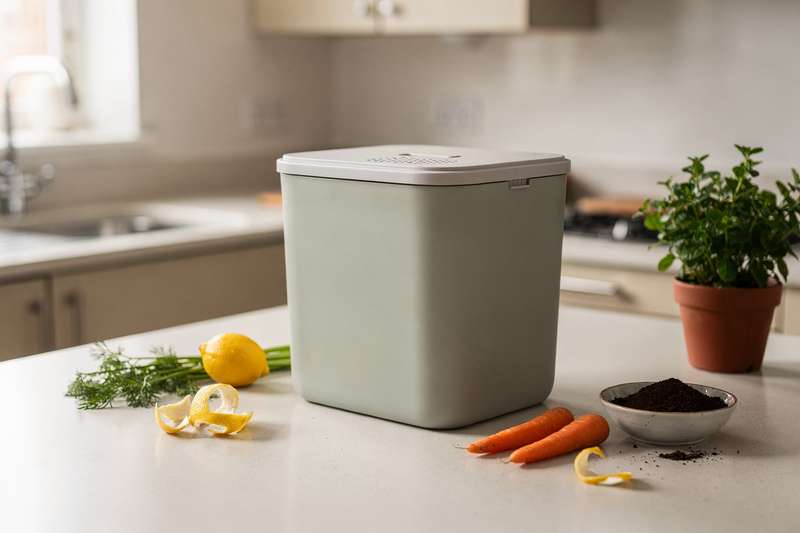
If your kitchen is a galley-style strip and you cook for one or two people most nights, a 1.5–2 litre countertop bin with an activated charcoal filter in the lid is the single most reliable solution available. This is the configuration that dominates the “no smell after three days” category of buyer feedback, and it’s easy to see why: the filter traps the volatile organic compounds responsible for that sour, fermented odour before they escape into the room, while the tight-fitting lid prevents fruit flies from detecting scraps in the first place.
What you’re looking for in this tier is a lid that closes with a definite click or has a soft-close mechanism with a rubber or silicone gasket around the rim. Hinges with some resistance are preferable to flimsy snap lids that pop open if the bin is knocked. The charcoal filter should sit in a dedicated recess inside the lid — not simply resting loose — so it stays in contact with air passing through. Replacement filters cost roughly £3–£8 for a pack of three and should be swapped every two to four months depending on use; bins that use a proprietary size rather than a standard disc make this more expensive over time, so check filter availability before you buy.
Cleaning ease is equally important. The best designs in this range have smooth, near-vertical interior walls with no recessed lip at the base where liquid can pool. A wide opening — ideally the full diameter of the bin — means you can reach in with a cloth or sponge without disassembling anything. Many of the strongest performers here are dishwasher safe up to the top rack, which makes weekly decontamination genuinely painless. Some include a removable inner liner or bucket, which is worth paying a few extra pounds for: you rinse the liner separately and the outer body stays clean indefinitely.
The main tradeoff at this price point is that the charcoal filters do need replacing. Buyers who forget to swap them, or who leave the bin between emptying for longer than four or five days, are the ones who leave negative reviews about smell — the bin itself isn’t failing, the filter is. Set a phone reminder when you fit a new one and this won’t be your experience. Also, these smaller bins fill faster than you might expect if you cook from scratch daily; for a two-person household that makes breakfast and dinner at home most days, plan on emptying every two to three days to keep odour genuinely undetectable.
Best Budget Pick (Under £15)
You can spend less than £15 and still have a functional, reasonably odour-resistant countertop compost bin — but the tradeoffs are real and worth understanding before you add one to your basket. At this price point, you’re typically looking at simple plastic or bamboo-effect designs with a vented lid rather than a sealed one with a charcoal filter. The vents allow passive airflow that slows anaerobic decomposition (the smelly kind), but they don’t block odour the way a filter does.
These bins work best if you commit to emptying them every one to two days — a habit that’s entirely reasonable if you’re living alone and heading out to a food-waste caddy or allotment bin regularly. They’re also well-suited to households that use compostable liner bags consistently, since a fresh bag after each empty prevents biofilm forming on the interior surface, which is the real long-term source of ingrained smell in cheaper bins.
Look for models made from BPA-free plastic or genuine bamboo fibre composite rather than plain coloured plastic, which can absorb odours over time. The lid attachment is the most common point of failure on budget bins — test the hinge if you can, or check that the lid fits snugly without wobble when closed. A stainless steel lip or reinforcing ring around the rim adds longevity at minimal cost.
The honest reality is that a sub-£15 bin used correctly — emptied frequently, lined consistently, cleaned weekly — will serve a solo flat-dweller perfectly well. Where they fail is in households that treat them like a set-and-forget appliance. If you know you’ll sometimes leave scraps accumulating for four or five days, invest in the tier above and get the charcoal filter. But if you’re disciplined about emptying, the budget option is a perfectly sound environmental and financial choice.
Best for Zero Counter Space (Over-Door Hanging Design)
One of the cleverest solutions to the countertop compost problem is the bin that doesn’t need a countertop at all. Over-cabinet-door hanging bins hook onto the inside of an under-sink cabinet door or a larder door, keeping the outer body of your bin entirely off the worktop surface and out of sight. The best versions in the £15–£25 range hold 2–4 litres, include a drip tray to catch any liquid from wet scraps, and have a wide swing-open front panel rather than a top-opening lid, which makes scraping a plate directly into the bin considerably easier.
The key specifications to check before buying are the hook depth (it needs to grip a door panel that’s typically 18–20 mm thick, so look for adjustable or wide-slot hooks) and the material of the inner container. Rust-free plastic or stainless steel inner buckets are essential here because these bins are often fitted inside sink cabinets, which tend to be damp. A powder-coated or painted steel outer that isn’t properly sealed will start to rust at the mounting points within a few months in that environment.
Odour management in over-door bins relies on keeping the lid or front panel firmly closed between uses — which is actually easier here than with countertop designs because you only open the cabinet when you need to add scraps. Some models include a charcoal filter disc in the door panel; others rely on the enclosed cabinet environment to contain smells. Either can work, though the filter version gives you more confidence in warmer weather.
The honest downside of door-hanging bins is capacity. If you cook extensively from fresh ingredients — think a weekly batch of vegetable stock, or regular fruit smoothies — a 2–3 litre door bin will fill within a day or two. They’re ideally sized for a single person who buys some pre-prepped ingredients or for households where the majority of organic waste goes into a separate food-waste caddy collected by the council. For heavier composting use, pair this with a slightly larger countertop bin for overflow.
Best Stainless Steel Option (£30–£50)
Stainless steel countertop compost bins have been a staple of professional kitchen design for decades, and the best domestic versions available today bring that same hygienic, long-lasting quality to flat kitchens at an accessible price. The main advantage over powder-coated steel or plastic is simple: brushed stainless doesn’t absorb odours, doesn’t stain from tomato or citrus scraps, and can be run through the dishwasher repeatedly without degrading. In a kitchen where you’re sharing space with food preparation, that matters.
What separates a genuinely good stainless compost bin from a mediocre one in this price band is the construction of the inner bucket. Look for a removable inner that’s also stainless (not plastic), with a smooth weld seam at the base rather than a pressed seam — pressed seams create a narrow groove where food particles and bacterial biofilm accumulate even after washing. The outer body should be a single piece with no exposed mild steel fastenings or hinges that will rust; check that screws or rivets are stainless or plastic-capped.
Lid design at this tier is usually one of three types: push-to-open with a foot pedal (useful if you’re handling raw meat scraps and don’t want to touch the lid), a swing-top with a gravity-close mechanism, or a flip-top with a charcoal filter fitted inside. For odour control in a small flat, the charcoal filter flip-top is the most effective; the swing-top is the most convenient for quick scraping. Foot-pedal models tend to be slightly taller and are less suited to fitting under overhead cupboards — measure your under-cabinet clearance before ordering.
At £30–£50 you’re also buying longevity. A quality stainless bin, cared for properly, will last five to ten years without the exterior degrading. Factor in filter replacement costs (usually £4–£7 per pack for standard-sized discs) and the total cost of ownership is still considerably lower than replacing a budget bin every couple of years. The tradeoff is weight — stainless steel bins are noticeably heavier than plastic equivalents, which matters if you carry the bin to an outdoor heap rather than using a liner bag.
Best for Two-Person Households (3–5 Litre Capacity)
Two people cooking properly from scratch generate a surprising volume of compostable material: coffee grounds, tea bags, vegetable peelings, eggshells, fruit cores, and the occasional forgotten leftovers. A 1.5-litre bin that’s perfect for a solo flat-dweller will be full by lunchtime in a shared household that batch-cooks at weekends, which means either emptying multiple times daily (a chore) or letting scraps accumulate and smell (the opposite of the goal).
At 3–5 litres — roughly the capacity of a large cereal bowl — you get two to four days of comfortable use for two regular home cooks without the bin becoming a smell problem, provided the lid seal and filter are doing their job. The best examples in this category use powder-coated carbon steel or stainless construction, a charcoal filter lid (check that filter replacements are readily available in standard sizes), and a wide-mouth opening that makes emptying a liner bag genuinely clean and quick.
Pay attention to the base dimensions at this capacity level, because a 5-litre bin can have a footprint of 22 × 18 cm or more — that’s a meaningful chunk of a small kitchen worktop. Some designs compensate by going taller rather than wider (a narrow, cylindrical bin holds the same volume in a smaller footprint), which works well as long as the lid can still be opened without catching on overhead cupboards. Measure your available vertical space if cupboards hang low over your counter.
The other spec worth checking is handle quality. A 5-litre bin full of scraps, lined with a compostable bag, weighs around 2–3 kg — manageable, but only if the handle is firmly attached rather than press-fitted into the body. Riveted metal handles or moulded plastic handles that are part of the body structure are far more durable than stick-on adhesive handles or thin wire bails, which tend to fail within six months of regular use on heavier bins.
Best for Bokashi-Style Fermentation (£30–£55)
If you live in a flat without a garden, a balcony planter, or access to a council food-waste scheme, a standard compost bin creates a secondary problem: where does the full bin’s contents actually go? Bokashi fermentation solves this neatly. Rather than decomposing scraps aerobically (which requires heat and outdoor space), a bokashi system uses inoculated bran to ferment all food scraps — including cooked food, meat, and fish — in a sealed, airtight bucket. The result after two to four weeks is a pre-composted, acidic material that can go directly into a soil planter, be buried in a garden, or be disposed of via a food-waste caddy.
The key specifications for a bokashi kit are the airtight seal (absolutely non-negotiable — if air gets in, you get mould rather than fermentation) and the inclusion of a tap or spigot at the base to drain off the liquid extract every two to three days. That liquid, diluted around 100:1 with water, is an effective liquid fertiliser for plants and prevents the liquid from making scraps soggy and malodorous. The best two-bucket systems let you fill one bucket while the other ferments, maintaining a continuous cycle.
Odour from bokashi is minimal but distinctive — a slightly sour, vinegary smell rather than the rotten smell of aerobic decomposition. When you open the lid to add scraps, you’ll notice it briefly, but it doesn’t permeate the kitchen provided the seal is intact. The bran is the ongoing cost: expect to spend around £8–£15 per bag, which typically lasts two to four months depending on how much you compost. Some brands sell bran spray rather than granular bran, which covers scraps more evenly.
The tradeoff with bokashi is that it’s a system rather than a simple bin — it requires slightly more active management (draining liquid, topping up bran, maintaining the seal) and the fermented output still needs to go somewhere at the end. For flat-dwellers without outdoor space, this usually means finding a willing neighbour with a garden, using a local community composting scheme, or burying it in large planters. It’s not the right choice for someone who wants a passive, low-effort solution. But for zero-waste-minded households who want to compost everything including cooked scraps, it’s the most complete option available.
Best Eco-Material Pick (£20–£35)
If reducing your environmental footprint is the primary motivation for composting in the first place, it feels slightly contradictory to house your fruit peels in a bin made from virgin plastic. The best eco-material compost bins in the £20–£35 range use either recycled post-consumer plastic, bamboo-composite materials, or reclaimed stainless steel, without sacrificing the odour-containment performance you need from a countertop bin.
Bamboo-composite bins deserve a mention for their genuine sustainability credentials: bamboo is one of the fastest-growing plants on earth and sequesters significant carbon during its growth cycle. The composite form — bamboo fibre blended with a small percentage of binding resin — produces a material that’s durable, naturally slightly antimicrobial, and genuinely biodegradable at end of life in industrial composting conditions. The aesthetic is warm and natural, which suits kitchen styles that favour wood, slate, and natural tones.
What to watch for with eco-material bins is the lid mechanism. Bamboo-composite lids can warp slightly with repeated exposure to moisture and steam — common in kitchens — which compromises the seal over time. Look for a model where the charcoal filter does the odour work rather than relying on a perfect gasket seal, since the material can’t guarantee an airtight fit long-term the way stainless steel can. Cleaning is usually fine with a damp cloth and mild detergent; avoid soaking bamboo composite in water.
Recycled-plastic bins are the most practical eco-material option if you prioritise performance alongside environmental credentials. The best versions are made from food-grade recycled HDPE or PP, carry a charcoal filter in the lid, and are fully dishwasher safe. They look and perform identically to virgin plastic equivalents — the environmental benefit is entirely in the manufacturing supply chain. Check for clear labelling about recycled content percentage and whether the bin itself is recyclable at end of life.
What to Look for When Buying a Countertop Compost Bin for a Small Flat
- Activated charcoal filter: This is the single most effective technology for preventing kitchen odour from a compost bin. The filter should sit inside the lid in a dedicated recess, not rest loosely. Check that replacement filters are available in standard sizes (typically 9–11 cm diameter discs) and that they’re reasonably priced — you’ll be replacing them every two to four months.
- Lid seal quality: A soft-close lid with a rubber or silicone gasket gives you passive odour containment even when the charcoal filter is getting old. Look for a lid that clicks shut or has perceptible resistance when closing. Loose, rattling lids are invariably the first complaint in negative reviews.
- Capacity matched to household size: As a rough rule, allow 1–1.5 litres of bin capacity per person per day of scraps generation if you cook from scratch daily. A solo flat-dweller cooking one proper meal per day will fill a 1.5 L bin every day or two; a couple cooking twice daily needs 3–5 litres to avoid constant emptying.
- Ease of cleaning: Smooth interior surfaces with no recessed seams at the base are non-negotiable for long-term odour control. Biofilm builds up in grooves and angles within days. A removable inner liner, dishwasher-safe components, and a wide opening that accommodates your hand and a cloth make the difference between a bin you clean weekly and one you replace every six months.
- Footprint and height: Measure your available counter space and the height clearance under your wall cupboards before ordering. A bin that doesn’t fit under your cupboards ends up on the floor or on the windowsill — neither of which is ideal. Compact cylindrical designs generally offer the best capacity-to-footprint ratio.
- Liner compatibility: Most countertop bins work with standard compostable liner bags (7–10 litre bags typically fit 2–4 litre bins with room to fold over the rim). Check the bin’s stated liner size in the product description rather than assuming — some bins have proprietary shapes that waste a standard bag. Using liners dramatically simplifies emptying and keeps the inner surface clean between washes.
- Material durability in humid conditions: Kitchen environments are warm and often humid. Powder-coated steel should have a factory-applied finish with no chips or thin spots around the handle fixings. Plastic should be BPA-free and UV-stable if it’s near a window. Bamboo composite should be finished with a moisture-resistant sealant. Check for rust complaints specifically in buyer reviews if you’re looking at a metal bin.
Comparison Table
| Pick | Capacity | Odour control method | Ideal for | Approx. price | Cleaning ease |
|---|---|---|---|---|---|
| Best overall (1.5–2 L charcoal filter bin) | 1.5–2 L | Charcoal filter + gasket lid | Solo flat-dweller, daily cooking | £25–£40 | Dishwasher safe, removable liner |
| Best budget (vented lid bin) | 1–2 L | Passive venting + liner bags | Solo, empties every 1–2 days | Under £15 | Wipe-clean interior |
| Best over-door hanging bin | 2–4 L | Enclosed cabinet + optional filter | Zero counter space available | £15–£25 | Removable drip tray, inner bucket |
| Best stainless steel bin | 2–4 L | Charcoal filter + push/swing lid | Hygiene-focused, long-term use | £30–£50 | Fully dishwasher safe |
| Best for two-person household | 3–5 L | Charcoal filter + sealed lid | Two people, batch cooking | £30–£45 | Wide-mouth liner bags, removable inner |
| Best bokashi system | 8–10 L (2-bucket) | Airtight fermentation seal | All food waste inc. cooked scraps | £30–£55 | Drain tap, wipe-clean interior |
| Best eco-material bin | 1.5–3 L | Charcoal filter + bamboo/recycled body | Sustainability-focused buyers | £20–£35 | Damp-cloth clean, some dishwasher safe |
Verdict
For the majority of people reading this guide — solo flat-dwellers or couples in a small UK kitchen who cook regularly and want composting to feel effortless rather than effortful — the best overall pick is a 1.5–2 litre charcoal-filter countertop bin in the £25–£40 range. It handles daily scraps without taking over your worktop, the charcoal filter genuinely eliminates odour when replaced on schedule, and the best examples in this tier are dishwasher safe and built to last three to five years without the finish degrading.
If your kitchen genuinely has no spare counter space, an over-door hanging bin is worth trying before you rule out countertop composting altogether — the enclosed cabinet environment does a surprising amount of the odour-control work for you. And if you want to compost cooked food and meat scraps alongside raw vegetable peelings — something no standard aerobic bin handles well — a bokashi two-bucket system is the only route that works reliably in a flat without outdoor space.
Whatever tier you choose, remember that the bin is only part of the equation. Emptying it regularly (every two to three days for a couple, every three to four for a solo user), using compostable liner bags, and replacing the charcoal filter every two months will give you a genuinely smell-free composting experience in even the smallest kitchen.
We were not paid to feature any specific product in this guide. All opinions are independent and based on publicly available specifications, verified buyer feedback patterns, and category research. Prices shown were accurate at time of writing and may change.
FAQ
How often should I empty a countertop compost bin to prevent smell?
For a one to two person household cooking from scratch most days, emptying every two to three days is the sweet spot. Leaving scraps longer than four to five days is the most common cause of odour problems — even a high-quality charcoal filter struggles once the volume of decomposing material gets large enough. If you find yourself emptying more than once a day, you need a larger capacity bin rather than more frequent trips.
Do charcoal filters in compost bin lids actually work?
Yes, genuinely — activated charcoal (also called activated carbon) is highly porous at a microscopic level and adsorbs the volatile organic compounds responsible for kitchen odour. The key caveat is that filters lose effectiveness over time as the pores fill up; most manufacturers recommend replacing them every two to four months. A filter that’s six months old and never been changed is doing very little, which is why so many “my bin smells” complaints trace back to forgotten filter replacement rather than a faulty bin.
Can I use a countertop compost bin if I live in a flat without a garden?
Absolutely. There are several practical routes for the full bin’s contents: most UK councils now offer weekly food-waste caddy collections that accept raw vegetable scraps and sometimes cooked food — check your local authority’s website for accepted items. Community allotments and shared garden schemes will often take compostable material. If you want to process everything yourself including cooked scraps, a bokashi fermentation system produces a soil conditioner that can go into large balcony planters or be buried in a window box.
What’s the smallest countertop compost bin that still works well?
A 1-litre bin is the practical minimum for daily use — smaller than that and you’ll be emptying it after a single session of cooking. For a solo person generating modest scraps (tea bags, a few vegetable peelings, fruit skins), a 1–1.5 litre bin with a good filter lid works well and has a minimal footprint. Two people cooking daily need at least 3 litres to avoid the bin becoming an inconvenience.
Are compostable liner bags worth using in a countertop bin?
They’re one of the best quality-of-life upgrades you can make to your composting routine. A liner bag means the inner surface of the bin stays clean between empties, which dramatically reduces biofilm build-up and the ingrained smell that develops in bins over months of use without liners. Look for certified compostable bags (EN 13432 or OK Compost Home certified) that are sized to your specific bin — typically 7–10 litres for a standard countertop size — and check whether your council’s food-waste caddy scheme accepts compostable bags before putting them in that stream.
Is stainless steel or plastic better for a countertop compost bin?
Stainless steel is more durable, doesn’t absorb odours over time, and is fully dishwasher safe — making it the better long-term investment if you’re happy to spend £30–£50. Quality plastic bins (BPA-free HDPE or PP) are lighter, often cheaper, and perform comparably for odour control when new, but can start to retain faint smells after twelve to eighteen months of heavy use even with regular cleaning. If budget is the priority, plastic is fine; if you want something that performs identically in year three as it did in week one, stainless steel is worth the extra outlay.