When Your Worktop Is Already Full
You’ve got roughly 60 cm of usable worktop between the hob and the wall. A kettle sits on one end, a toaster on the other, and somewhere in that gap you’re supposed to dry a full dinner service, a saucepan, four glasses and tomorrow’s packed-lunch containers. A standard draining rack takes up more counter than a chopping board. You’ve tried propping dishes against the splashback and towel-drying everything — a routine that takes ten minutes and still leaves water rings everywhere. You’ve also tried stacking damp bowls directly in the cupboard, which is how you ended up with that faint musty smell in the crockery shelf.
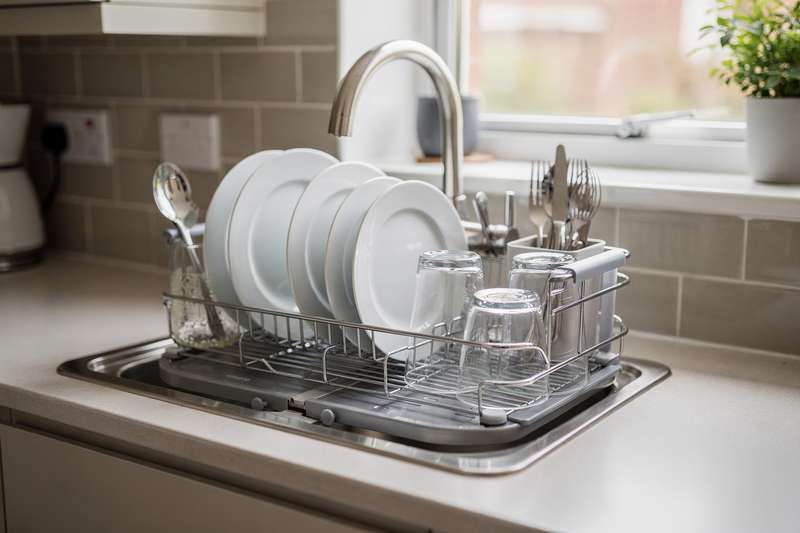
Over-sink dish drying racks exist specifically for this scenario. They sit on the ledge of your kitchen sink — or span the full width of it — so dishes drip straight into the drain rather than onto your worktop. The category sounds simple, but the range of designs, widths, materials and price points is genuinely confusing, especially when most product listings are designed for US-sized double sinks rather than the shallower, narrower single bowls common in UK flats and terraced houses. This guide cuts through that noise and tells you exactly what to look for.
How This Guide Was Put Together
The picks and buying criteria below are based on systematic evaluation across several factors: adjustable width ranges and how they match typical UK sink dimensions (generally 340–500 mm wide for single bowls, 800–1000 mm for 1.5 and double bowl sinks), declared weight capacity and real-world loading stability, material quality (304 stainless steel vs. thinner-gauge alternatives), drainage design, ease of assembly without tools, and the pattern of feedback from verified buyers specifically calling out issues like rust, wobble, and poor fit on shallow-rimmed sinks. Faucet height clearance — often ignored in listings but critical in UK kitchens with standard mixer taps — was also weighed up. Price bands were considered across budget (under £30), mid-range (£30–£60) and more substantial two-tier options above £60, to give you useful picks wherever your budget sits.
Quick Picks at a Glance
| Best for… | Price range | Key feature |
|---|---|---|
| Overall best two-tier over-sink rack | £45–£65 | Adjustable 2-tier, 304 stainless, drains into sink |
| Compact single-bowl UK sinks | £25–£40 | Narrow footprint, expands 39–58 cm, fits small bowls |
| Budget under £30 | £18–£28 | Rollable/foldable mat-style, zero assembly needed |
| In-sink or over-sink dual-mode use | £30–£50 | Expandable bars, sits inside or over sink interchangeably |
| Small households with minimal daily washing | £22–£35 | Countertop-edge design, spout drains into sink, compact |
| 1.5 or double bowl sinks | £55–£80 | Wide-span adjustable frame, multi-section, high capacity |
| Renters (no drilling, no permanent fixtures) | £28–£45 | Suction-cup or pressure-fit legs, tool-free setup |
Best Overall: Adjustable Two-Tier Over-Sink Rack in 304 Stainless Steel
If you only have time to read one section, read this one. A well-designed two-tier adjustable over-sink rack is the format that solves the most problems for the most people. You’re looking for a rack that spans roughly 76–86 cm in its extended position (covering a standard UK 1.5 bowl sink or sitting across a wide single bowl with overhang on each side), drops down to around 68–70 cm for a tighter fit, and stands tall enough — at least 50 cm — to clear a standard UK mixer tap without you having to twist the spout sideways every time you use the sink.
The two-tier layout is the real differentiator here. The lower tier typically holds plates upright in slots and provides a flat drainage area for bowls and pans. The upper tier — accessed via a frame that rises above the lower — holds glasses inverted or provides a hanging rail for cups, and often includes a removable cutlery basket or utensil holder at one end. When you wash up after a full family meal, this means plates, glasses, mugs, and cutlery can all be on the rack simultaneously without anything having to queue on the worktop.
The material to prioritise is 304-grade stainless steel for the main frame. You’ll see listings for racks described simply as “stainless steel” or “rustproof metal” — in practice, thinner-gauge steel (below 1.2 mm) will flex noticeably under load and the surface coating can lift at weld points within a few months, leading to rust spots. Racks explicitly citing 304 grade and heavier-gauge rods tend to hold up significantly better in damp UK kitchens. Look for a declared weight capacity of at least 15–20 kg, which gives you comfortable headroom when loading a full set of stoneware plates rather than just lightweight everyday crockery.
The main tradeoff with two-tier racks is height. UK kitchen units typically sit at 900 mm from floor to worktop, with overhead cabinets starting at around 1350–1500 mm — leaving a clearance zone of roughly 450–600 mm. A rack that stands 55 cm tall with dishes loaded may brush your wall cupboards when you’re trying to slide dishes in from the side. Before buying, measure the gap between the top of your sink rim and the bottom of your overhead cabinet. If that gap is under 50 cm, a single-tier or flat rollable design will serve you better.
Assembly on most two-tier over-sink racks takes 15–25 minutes without tools and is generally straightforward — you’re sliding cross-bars through a main frame and tightening a few knurled thumb-nuts. The weak point to watch is the adjustable-width mechanism: some racks use a simple slide-and-lock bar that can slip under heavy loads. Look for models with a locking collar or friction clamp that positively clicks into place rather than relying purely on tension.
Best for Compact Single-Bowl UK Sinks
The single-bowl sink is the norm in British studio flats, galley kitchens in Victorian terraces, and any kitchen that was built before open-plan layouts became fashionable. These sinks typically measure 340–420 mm wide internally, with a rim that might add another 20–40 mm on each side for the rack’s legs to rest on. That gives you an effective maximum rack span of around 380–500 mm total — significantly narrower than the 76–86 cm figures on many US-targeted products.
For this situation, look specifically for racks whose minimum width setting is in the 39–45 cm range. Some products marketed as “adjustable” only compress down to 68 cm, which still overhangs both sides of a standard single bowl so far that the legs have nowhere stable to sit. A rack built around a 39–58 cm adjustment range is much better matched to UK single-bowl sinks, and the narrower frame doesn’t sacrifice as much capacity as you might expect — you can still stand eight to ten dinner plates upright in slots on a 40 cm rack if those slots are well-spaced.
Drainage design matters more here than with larger spans. Because the rack sits entirely over a single bowl, every drop of water needs to fall straight into that bowl — there’s no room for a drip tray that collects runoff and routes it to the side. Look for racks with angled drainage ribs rather than a flat base, and ensure the legs are height-adjustable so you can tilt the whole unit slightly towards the centre of the sink. Some racks in this category use rubber-tipped legs or small silicone feet; these are welcome additions because they grip the porcelain or steel sink rim without scratching, but check that the feet are replaceable in case they perish.
The honest tradeoff with compact racks is that you simply cannot fit a large casserole dish or a stock pot on them — the width isn’t there. This style works brilliantly for everyday crockery cycles but if you batch-cook at weekends and need to dry a full spread of baking trays and oven dishes, you’ll need to complement it with a drying mat on the worktop for the big items. Think of the over-sink rack as your primary station for plates, glasses and cutlery, and use towel-drying for anything that doesn’t fit.
Best Budget Pick (Under £30): Rollable or Foldable Silicone-and-Wire Mat Rack
Not every kitchen situation calls for a permanent frame structure. If you’re in rented accommodation where you’re not allowed to put anything on the worktop that might scratch it, or you do a single wash-up cycle each evening and want the rack out of the way the rest of the time, a roll-up or fold-flat rack under £30 gives you a drying surface that costs less than a takeaway pizza and stores in a drawer.
The format to look for is a stainless steel wire grid bonded to a silicone or food-grade plastic frame, designed to lay across the sink opening. Some versions are rigid; others are constructed in linked sections so they fold or roll for storage. The wire spacing on good versions is tight enough (around 15–20 mm) to support standard dinner plates without them tipping into the sink, while being open enough to let air circulate and water drip through quickly.
This category has real quality variation. The cheapest versions use thin chrome-plated wire that starts to flake at the chrome layer within a few months in a humid kitchen, leaving rough rust-coloured spots that stain the sink and scratch plates. The better ones use true 304 stainless wire or have a food-safe polymer coating that doesn’t chip. At this price point, it’s worth reading one-star reviews specifically to look for mentions of rust or coating failure — if multiple reviewers mention it appearing within three months, the product isn’t worth saving £5 on.
Capacity is the major limitation. A flat rollable rack gives you one layer of drying space — dishes have to be laid at an angle or propped up, and you can realistically fit six to eight plates and a few glasses before the system becomes unstable. It works for a one- or two-person household with a single daily wash-up; it struggles for a family of four coming home from work and school simultaneously. It’s also less suitable for tall items like wine glasses, which need to be laid on their sides and can roll if the wire gaps are unevenly spaced. But at under £30, it’s the most affordable entry point to the over-sink category and earns its place for those who value flexibility over capacity.
Best Dual-Mode (In-Sink or Over-Sink) Expandable Rack
This is the most versatile format in the category, and it’s underrated. An expandable rack with telescoping or sliding crossbars can be configured to rest inside the sink bowl — sitting on the base of the sink itself, clear of the drain — or flipped into an over-sink position with its legs resting on the sink rim. That dual functionality sounds gimmicky but is genuinely useful: when you need the sink itself for soaking or filling pots, you lift the rack out. When you need full counter space for prep, the rack goes back into the sink. In a small kitchen where every surface has to earn its place, that kind of adaptability is worth paying attention to.
Look for models built from food-grade 304 stainless steel with a weight rating of at least 30 kg in in-sink mode — the base of the sink takes the load when the rack sits inside, and heavier items like cast iron pans can be rested there safely if the frame is robust enough. Extension range in this format typically goes from around 39 cm to 58 cm, covering most UK single-bowl sinks in both modes. A removable cutlery basket that hooks onto the side frame rather than sitting on the base is a nice detail — it keeps knives and forks separate from plates and adds useful vertical organisation without blocking the drain.
The main practical consideration is sink depth. UK sinks vary considerably — some modern single-bowl sinks are as shallow as 150 mm, while older Belfast-style sinks can be 200 mm or deeper. When the rack sits inside a very shallow sink, the uppermost dishes may protrude above the rim and make it awkward to run the tap. Before buying in this format, measure your sink’s internal depth and add that to the rack’s declared height to check whether loaded dishes will clear your tap or spray bar. In deep sinks (180 mm+), this format works particularly well because the rack can sit at the bottom of the bowl while the tap and spray function normally above it.
In over-sink mode, the same rack typically has rubber-tipped feet or silicone grip pads that stop it sliding, and the crossbar tension can usually be adjusted to keep it from rocking. The weak point in most dual-mode racks is the leg mechanism — legs that fold or extend for over-sink use can develop play in the joints over time. Check that the leg-locking mechanism is a positive catch or clip rather than a simple friction fit; the latter tends to slip gradually as the metal wears.
Best for Small Households: Countertop-Edge Rack with Drip Spout
This is a slightly different concept: instead of the whole rack spanning the sink, it sits on the worktop directly adjacent to the sink, with a built-in drainage spout or channel at one end that extends slightly over the sink rim and drips water in. It’s not quite an over-sink rack in the strict sense, but for kitchens where the sink rim is too narrow or sloped to support a traditional over-sink frame, it’s the practical equivalent — you still get a clean, watermark-free worktop.
Typical dimensions for this format are around 30 cm wide and 40–58 cm long (the length being adjustable in better models), with a base height of 10–15 cm. It holds ten plates upright, has a cutlery caddy at one end, and the drainage base channels water to the spout. This is the format that works best for one or two people who wash up once a day — a couple of dinner plates, some mugs, a few glasses, and the cooking utensils.
The advantage over a full over-sink design is that it requires zero measurement of your sink width. You place it wherever there’s a gap of about 30 × 45 cm on your worktop, angle the spout over the sink, and you’re done. That makes it ideal if your sink rim is porcelain-coated cast iron (which can chip if metal rack legs are placed on it) or if the rim is too narrow to support a spanning rack. It also means you have the full width of the sink free for washing up, which some people prefer.
The honest limitation is that this style takes up worktop space — typically 30 × 40 cm or more. In very cramped kitchens that’s a meaningful chunk of workspace. It’s also less efficient at draining than a rack that sits directly over the sink, because the water travels along the base tray before reaching the spout, and unless the tray is properly tilted towards the spout, small puddles can form at the back. If you go this route, make sure the feet are adjustable so you can create a slight forward tilt, or that the tray is moulded with a built-in gradient.
Best for 1.5 or Double Bowl Sinks: Wide-Span Adjustable Frame
If you have a 1.5 bowl or full double-bowl sink — common in UK semi-detached houses and larger kitchen extensions — the landscape changes. You’ve got significantly more rim width to work with (typically 900–1050 mm across the top of the unit), which means you can use a more substantial rack that spans the entire fixture. This gives you serious drying capacity without a single centimetre of worktop real estate used.
What to look for in this tier: an adjustable width range that goes from around 68 cm up to at least 86–90 cm, with robust locking at each end. The frame needs to be made from thicker-gauge steel because the greater span means more flex forces on the main crossbar when you load it with plates. Look for a declared weight capacity of 20 kg or above and, ideally, a central support leg that drops down to the sink base in the middle — this prevents the frame from bowing under a heavy load across a wide span.
Multi-section designs are popular in this format: one half of the rack holds plates and bowls, the other half has a wire grid for pots, cutting boards and pans. Some versions include a hanging rail beneath the top tier for mugs or cups, which maximises the vertical space above the sink. If you’re buying in this category, measure your faucet height carefully. Tall mono-block taps are increasingly common in UK kitchens and can reach 35–40 cm above the sink rim — make sure the rack’s legs clear the tap body and that the rack frame doesn’t restrict the tap’s swivel range.
Assembly on wider racks is generally a bit more involved — expect 20–35 minutes and multiple connection points. The payoff is a setup that, once done, works beautifully: after washing up a full family meal, you simply load everything onto the rack, walk away, and come back to dry dishes in 30–45 minutes without a drop of water on your worktop.
Best for Renters: Suction-Cup or Pressure-Fit Over-Sink Rack
Rental properties in the UK have a specific set of constraints: no drilling, no adhesive that might damage paintwork or tiles, and any marks on the sink could come out of your deposit. Over-sink racks are actually ideal for renters because they don’t require any fixings at all — but the details of how they secure themselves still matter.
The two main non-permanent attachment methods are suction cups and pressure-fit legs. Suction cups create a seal against a smooth non-porous surface — great if your sink rim is glazed ceramic or polished stainless steel, but they won’t grip a textured resin-composite sink or a matte granite composite (increasingly common in UK homes built after 2010). Pressure-fit legs work differently: the adjustable frame is extended until the legs press outward against the inside walls of the sink opening, and the friction holds the rack in place. This tends to be more reliable across a wider range of sink materials, but it only works when the sink has a clear, stable ledge for the feet to press against.
For either system, the key spec to verify is the maximum load the attachment method can handle before the rack shifts. A suction-cup rack loaded with cast iron pans may degrade the cup seal over time, particularly in kitchens that experience temperature changes (hot washing water followed by cold rinsing). For renters who wash up a light load daily, suction cups are absolutely fine. For households washing heavy stoneware and stainless cookware regularly, a pressure-fit or simple over-rim resting design is more reliable long-term.
Tool-free setup is genuinely achievable in this category — the best designs assemble by slotting rods through pre-formed holes and securing them with thumb-turn collars. Keep the assembly instructions (photo them on your phone if paper ones get lost), because taking a pressure-fit rack apart cleanly when you move out is much easier when you can see how it was originally configured.
What to Look For When Buying an Over-Sink Dish Drying Rack
- Sink width and rack adjustment range: Measure the external width of your sink (rim to rim), not just the internal bowl. The rack’s legs rest on the rim, so the rack’s minimum span needs to match the external rim width. For UK single-bowl sinks, this is typically 380–480 mm. For 1.5 bowl or double sinks, it’s typically 800–1050 mm. Many racks on the market are sized for US double sinks starting at 70 cm — read the specs carefully before buying.
- Faucet height clearance: This is the most commonly overlooked measurement. Measure the height of your tap from the top of the sink rim to the top of the spout. The rack’s lowest internal clearance (the underside of the main frame at its lowest point) must exceed this figure. Standard UK mixer taps are typically 25–35 cm tall; tall mono-block designs can reach 38–42 cm. If a rack only offers 22 cm of clearance, you’ll be twisting the tap sideways to use it.
- Steel grade and gauge: Look for 304-grade stainless steel explicitly stated in the specification — not just “stainless” or “rustproof metal.” Rod diameter matters too: 4 mm rods on the main frame are noticeably more rigid than 3 mm rods under load. Thicker gauge also resists the inevitable surface damage from cutlery being knocked against it during loading.
- Drainage design: The whole point of an over-sink rack is that water goes into the sink, not onto the worktop. Check that the base of the rack is angled or has drainage channels, not a flat tray that holds standing water. Removable drip trays can be handy but need to be emptied — they’re more of a worktop-adjacent solution than a true over-sink one.
- Number of plate slots and their spacing: Count the slots shown in the product photos and check the gap between them. UK dinner plates are typically 26–28 cm in diameter; slots wider than 35 mm tend to let plates tip or rattle. The best racks have adjustable or graduated spacing to handle side plates and dinner plates in the same row.
- Cutlery and utensil holders: A rack without a cutlery caddy means knives and forks go in a jumble at the bottom. Look for a caddy that has ventilation holes (not a solid base) so water drains out and doesn’t pool around your cutlery — pooled water leads to rust spots on stainless steel cutlery and is a hygiene concern.
- Ease of cleaning the rack itself: Limescale and soap scum will build up on any wire rack in a UK kitchen, where water hardness is often high. Racks with a smooth, polished surface are much easier to wipe down than those with a matte or textured powder coating, which can trap deposits in the pores. Monthly soaks in a diluted white vinegar solution take care of limescale effectively, but only if you can disassemble the rack easily — check whether the main sections clip apart for cleaning.
Comparison Table
| Pick | Width range | Tiers | Material | Faucet clearance | Best for |
|---|---|---|---|---|---|
| Two-tier adjustable over-sink (overall best) | 68–86 cm | 2 | 304 stainless steel | ~50–55 cm | 1.5 bowl or wide single sink, family use |
| Compact single-bowl rack | 39–58 cm | 1–2 | 304 stainless steel | ~35–45 cm | Small UK single-bowl sinks |
| Rollable/foldable mat rack (budget) | Fits most single bowls | 1 (flat) | SS wire + silicone | N/A (lays flat) | Renters, occasional use, drawer storage |
| Dual-mode in-sink/over-sink expandable | 39–58 cm | 1 | Food-grade 304 SS | ~30–38 cm | Flexible setups, deep UK sinks |
| Countertop-edge with drip spout | 40–58 cm (length) | 1–2 | SS + durable plastic | N/A (countertop) | Narrow-rim or delicate sinks, 1–2 people |
| Wide-span adjustable (double/1.5 bowl) | 68–90+ cm | 2–3 | Heavy-gauge 304 SS | ~50–60 cm | Large families, wide sink units |
| Suction-cup/pressure-fit (renter-friendly) | 40–70 cm | 1–2 | 304 SS + rubber feet | ~35–45 cm | Rental kitchens, no-drill requirement |
Verdict: Which One Should You Buy?
For the majority of UK readers — living in a flat or terraced house, working with a standard single-bowl sink, and washing up for one to three people — the compact adjustable over-sink rack in the 39–58 cm width range is the right call. It fits the sinks you actually have rather than the wide double-bowl sinks these products are usually photographed over. It holds a full everyday crockery set, clears a standard mixer tap, drips directly into your sink without a drip tray to empty, and stores neatly if you want to clear the area for heavy prep.
If you have a 1.5 bowl or double sink and a family of three or more, step up to the wide-span two-tier version — the extra capacity is worth the higher price and the longer assembly time. If your budget is tight and you wash up lightly, the rollable mat-style rack under £30 does the job without any commitment. Whatever format you choose, measure your tap height and sink rim width before you order, because the single most common reason for returning these products is a size mismatch that a two-minute measurement would have caught.
We were not paid to feature any specific product in this guide. All opinions are independent and based on publicly available specifications, verified buyer feedback patterns, and category research. Prices shown were accurate at time of writing and may change.
FAQ
Will an over-sink dish rack fit a standard UK single-bowl sink?
It depends on the rack’s minimum width setting and your sink’s rim-to-rim measurement. Most UK single-bowl sinks measure 380–480 mm across the outside rim. Many over-sink racks on the market are designed for US double sinks and won’t compress below 68 cm — far too wide. Look specifically for racks whose minimum span is 39–45 cm to ensure a secure fit on a standard UK single bowl.
What height tap clearance do I need?
Measure from the top of your sink rim to the top of the tap spout. Standard UK mixer taps are typically 25–35 cm; tall mono-block taps can reach 38–42 cm. The rack’s internal clearance — the distance from the base of the rack frame to its underside at the lowest point — needs to exceed your tap height. Check the product listing carefully, as many manufacturers list the total rack height (including dishes loaded on top) rather than the clearance underneath the frame.
Is stainless steel better than plastic or coated steel for a dish drying rack?
For over-sink racks used daily in a damp kitchen, 304-grade stainless steel outperforms both alternatives over time. Plastic frames can warp with repeated exposure to hot washing water, and powder-coated steel can chip or peel at weld points, leading to rust. Stainless steel is heavier but significantly more durable, and it cleans up with a vinegar solution far more easily than porous coated surfaces. The additional cost compared to coated alternatives is usually recovered within a year by not having to replace a rusted rack.
Can I use an over-sink rack if my sink has a low or wide rim?
If your sink rim is narrower than about 15 mm (some undermount-style sinks have very little ledge), a standard over-sink rack won’t rest safely — the legs need a horizontal surface to sit on. In that case, look at the countertop-edge rack with a drip spout, which sits on the adjacent worktop rather than the sink rim itself. For wide rims (Belfast-style sinks, for instance), check whether the legs are rubber-tipped to protect glazed porcelain from scratching.
How do I stop my over-sink rack getting limescale and rust?
The most effective routine is a monthly soak of removable components in a 50:50 white vinegar and water solution for 20–30 minutes, followed by a rinse and thorough dry. This dissolves limescale deposits before they harden. For the main frame, wipe down with a damp cloth after each use and allow it to air-dry fully — trapped moisture between the rack and the sink rim is the most common cause of rust in UK kitchens, where soft residual water sits against metal surfaces. Avoid abrasive pads on stainless steel; they scratch the surface and create micro-pits where rust can take hold.
Is an over-sink rack practical if I have a dishwasher?
Yes — many dishwasher households still need somewhere to put items that can’t go in the machine: non-stick pans, wooden boards, sharp knives, fine glassware and delicate ceramics. An over-sink rack handles these hand-wash items efficiently without occupying permanent worktop space. A compact single-tier version is typically sufficient in this context since the volume of hand-washing is lower, and it can be folded away or removed when not needed.