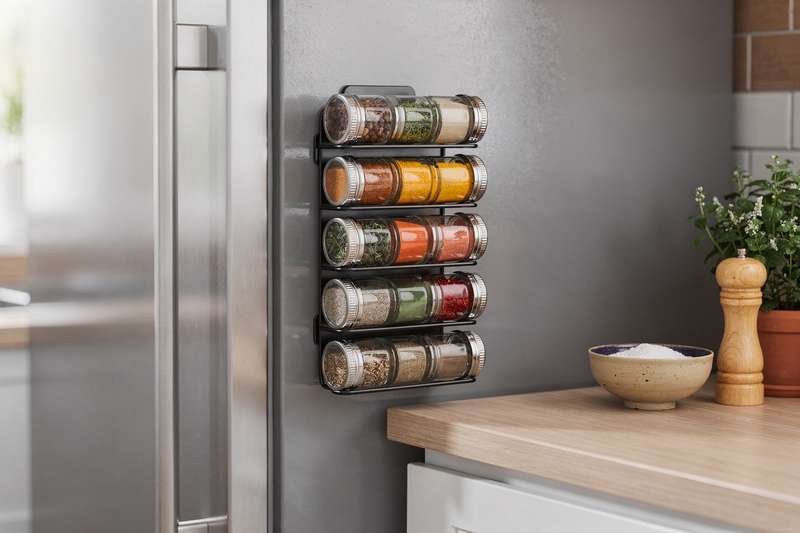
The Problem: A Cluttered Worktop and a Fridge Door That’s Doing Nothing
Picture the scene: you’re halfway through cooking a curry, one hand holding a wooden spoon, the other rummaging through a drawer stuffed with jars, sachets, and mystery tins that have been in there since 2021. Your worktop is already taken up by a chopping board, a kettle, and the casserole dish you haven’t put away. Your spice rack — the one you impulse-bought from a discount homeware shop — is balanced precariously on a shelf, and every time you pull one jar out, two others fall over. You’ve tried putting spices in a cupboard, but out of sight really does mean out of mind, and you end up buying duplicates of cumin every three weeks.
If you live in a UK flat or a terraced house with a small galley kitchen, this isn’t just a minor irritation — it genuinely slows down your cooking and eats into the little bench space you have. The obvious fix is to use the side of your fridge. It’s right there, it’s magnetic, it’s not being used for anything. But you rent, or you don’t want to put holes in tiles or walls, so drilling a wall-mounted rack is off the table entirely. What you need is a magnetic spice rack that sticks firmly to the fridge door or side panel, holds a useful number of jars, and doesn’t slide down or peel off after a fortnight. That’s exactly what this guide is for.
How We Evaluated These Picks
To put this guide together, we looked at the magnetic spice rack category through the lens of what actually matters in everyday UK kitchen use. The criteria we focused on: magnet strength (measured in claimed pull-force and cross-referenced with buyer feedback on whether racks slip or fall), shelf dimensions relative to standard spice jar sizes (Schwartz, Bart’s, and Barts own-brand jars are the UK benchmark), build material and rust resistance since these racks live in a humid kitchen environment, capacity per unit and whether multi-pack options give useful flexibility, ease of repositioning without leaving marks on appliance surfaces, and price-per-shelf value. We also paid close attention to patterns in verified buyer reviews — not just star averages, but the recurring complaints (magnets too weak, rust after six weeks, shelves too shallow for taller jars) and the recurring praise (easy to rearrange, holds heavier jars, looks clean). This lets us give you an honest picture of what each type of product actually delivers day-to-day, not just what the listing claims.
Quick Picks Table
| Best For | Price Range | Key Feature |
|---|---|---|
| Overall value — most kitchens | £20–£35 | 5-pack steel shelves, strong neodymium magnets, two-tier configuration |
| Compact fridges and small spaces | £12–£22 | Slim single-shelf design, lightweight, fits narrow fridge sides |
| Heavy jars (glass, large format) | £25–£40 | Deep shelf lip, industrial-grade magnets rated for higher load |
| Visual tidiness — matching aesthetic | £30–£50 | Powder-coated finish, uniform sizing, white or black colourway |
| Renters wanting zero residue | £15–£28 | Protective felt or rubber pad backing, repositionable without marks |
| Budget buyers — starter set | Under £15 | 2–3 shelves, basic wire or thin steel construction |
| Heavy herb collections (10+ jars) | £35–£55 | 6-pack or larger, tiered layout, reinforced cross-bar design |
Best Overall Pick: A 5-Pack Steel Shelf Set with Neodymium Magnets
For most UK kitchens, a five-shelf magnetic spice rack set is the sweet spot. You get enough shelves to organise a full spice rotation — your everyday herbs and spices, plus the ones you reach for weekly — without covering so much fridge space that it looks chaotic. The best versions in this tier are made from powder-coated steel with a matte finish (usually black or white) that wipes clean easily and doesn’t show fingerprints the way shiny chrome does.
What separates a good five-pack from a frustrating one is the magnet configuration. Look for shelves that use multiple smaller neodymium magnets spread across the back rather than one or two large ferrite magnets. Multiple contact points mean the load is distributed more evenly, which is why these designs are far less likely to tilt or slowly peel away from the fridge surface under the weight of full jars. In real-world use, a well-designed shelf in this category should comfortably hold four standard Schwartz jars (each around 50–60g full) without any slippage on a standard Samsung, LG, or Hotpoint fridge door. The shelf lip — the small raised edge at the front — should be at least 2cm high. That’s the difference between jars staying put when you open the fridge door briskly and one tumbling off every few days.
The main tradeoff with this tier is that the shelves are sized for standard-height jars (roughly 10–11cm). If you use taller supermarket own-brand containers or larger glass jars, you may find the shelves are spaced too tightly if you stack them in a column. The fix is simple — space them further apart — but it does mean you need a tall fridge door panel to make full use of five shelves without them overlapping into the door seal area. On a standard 70cm fridge, four shelves fit comfortably; the fifth gives you flexibility on the side panel.
Rust is the other thing to check before buying. The UK kitchen environment — steam from kettles, condensation from fridge doors — is surprisingly aggressive on cheap metalwork. Powder-coated shelves last significantly longer than plain steel ones. If the listing doesn’t specifically mention powder coating or a rust-resistant finish, that’s a red flag worth taking seriously. Reviewers frequently mention rust appearing within a couple of months on uncoated versions.
Best for Small Kitchens and Compact Fridges: Slim Single-Shelf Designs
Not every kitchen has a large American-style fridge with a big blank side panel. If you’re working with a 50cm integrated fridge, a tall-and-narrow under-counter unit, or a fridge where the door is mostly covered by the door seals and hinges, a slim individual shelf is a much more practical starting point than buying a five-pack and immediately running out of space for them all.
Slim magnetic spice shelves — typically around 25–30cm wide and 8–9cm deep — are designed to hold two or three jars per shelf. They’re lightweight, which means even a moderately strong magnet keeps them firmly in place. The best examples come with a low-profile design that doesn’t protrude more than 10–12cm from the fridge surface, which matters if your kitchen is narrow enough that an open fridge door already reduces the walking space to a squeeze.
The key spec to look for at this end of the market is shelf depth. Some budget slim shelves cut corners and offer only 6–7cm of usable depth, which means standard Schwartz jars sit with about half their base overhanging the shelf edge. That’s fine aesthetically but genuinely risky structurally — the jar is lever-arming against the front lip rather than sitting flat. A shelf depth of at least 8.5cm gives standard jars a proper base of support. You’ll also want to check the lip height; on slim shelves, a 1.5cm lip is the minimum, and 2cm is better.
One genuine advantage of buying individual slim shelves rather than a fixed multi-shelf unit is repositionability. You can move each shelf up or down, or shift them to a different part of the fridge, without committing to a single layout. This is particularly useful if your cooking habits change seasonally — bring the baking spices down to eye level in autumn, and swap them out for barbecue rubs in summer. The tradeoff is that individual shelves cost more per unit than a multi-pack, and if you end up buying six or seven of them, the price quickly matches what a quality five-pack would have cost.
Best for Heavy Jars: Deep-Lipped Shelves with Industrial Magnets
If your spice collection runs to larger glass jars — the kind you buy from Turkish or South Asian grocery shops, or the 75g+ glass jars from Waitrose and Sainsbury’s own ranges — you need shelves built for the extra weight. A standard jar-for-jar comparison: a full 25g sachet-style jar weighs around 100g total, but a full 80g glass jar with a thick base can easily hit 200–250g. Multiply that by four jars per shelf, and you’re asking the magnets to hold over a kilogram per shelf. Cheap magnets will lose grip gradually, and you’ll find the shelf has drifted down by a centimetre or two by the following morning.
Look specifically for shelves where the magnet pull-force per shelf is stated in the listing — anything rated above 3kg hold per shelf is a reasonable marker for glass jar use. Some listings are vague here, but buyer reviews fill in the gap: if multiple people mention holding heavy jars without issue, that’s a reliable signal. The shelf lip on heavy-duty designs should be 2.5–3cm, and the shelf itself should be made from thicker gauge steel (often described as 1mm or 1.5mm steel in listings, versus 0.8mm on budget options). You can usually tell visually: heavier shelves look more solid and have less visible flex when you press down on the front edge.
The depth of the shelf matters even more with heavier jars. A 10–11cm deep shelf allows even a wide-based glass jar to sit fully within the shelf footprint, which reduces leverage on the lip and keeps the magnetic hold stable. If you find a shelf that ticks the weight-rating box but only offers 8cm of depth, it’s a borderline compromise for large jars.
One tradeoff worth flagging: heavy-duty magnetic shelves with more powerful magnets can be harder to slide or reposition on the fridge surface. This isn’t a daily problem, but if you like to rearrange your layout, you’ll notice more resistance. On fridge surfaces with a texture or dimple pattern (common on cheaper fridge models), a strong magnet can also leave very faint impressions in the surface lacquer over time, especially in warm kitchens. If this concerns you, look for models that include a rubber or felt backing pad — these protect the fridge surface while only marginally reducing grip.
Best for Visual Tidiness: Matching Powder-Coated Sets
Some people want their spice rack to be functional; others want it to look like it belongs in an Instagram kitchen. If you fall into the second camp — or, more practically, if you have an open-plan kitchen that’s visible from the living area — the aesthetic details of your magnetic rack actually matter. A mismatched collection of wire shelves in different sizes looks busy and slightly chaotic. A uniform set of matching shelves in a consistent powder-coated finish looks intentional and clean.
The products worth considering here come in two dominant colourways: matte black (which suits grey, anthracite, or dark kitchen schemes and hides grease splashes well) and matte white (which blends with white fridge surfaces and gives a Scandi-minimalist look). Some listings also offer a brushed stainless option, though these are typically pricier and show fingerprints more readily than a matte powder coat.
For visual consistency, buy all your shelves from the same listing or at minimum the same product range. Mixing two different brands almost always results in slightly different shelf heights or lip profiles that look subtly wrong when mounted side by side. The best uniform sets have shelves that are precisely the same width, so when mounted in a vertical column they align into a clean, ladder-like structure on the fridge side. Details like matching end caps (the side pieces that close off the shelf edges) make a significant visual difference compared to open-ended wire designs.
One honest tradeoff: the most visually cohesive sets are often slightly more expensive than their purely functional equivalents, and they sometimes sacrifice a little practical depth for a sleeker profile. A shelf that’s 7cm deep looks cleaner than one that’s 10cm deep, but it holds fewer jar types comfortably. If you use tall or wide jars alongside standard ones, confirm the dimensions before buying a matching set that may not fit your actual collection.
Best for Renters: Felt-Backed, Mark-Free Designs
If you’re renting, the question of whether a magnetic spice rack damages your fridge surface is entirely legitimate. Most modern fridges use a lacquered steel door panel, and strong magnets can very occasionally leave faint marks — either from the magnet itself pressing into the surface over time, or from fine grit getting trapped between the magnet and the surface and scratching it when you slide the shelf.
The safest option is a shelf with a soft backing — either a thin felt pad or a silicone/rubber pad bonded to the back of each magnet. This creates a protective layer between the magnet and the appliance surface, preventing scratches and reducing the risk of surface impressions. It also makes the shelf easier to slide into a new position without lifting it fully off the fridge, which is genuinely convenient when you’re reorganising.
When you’re comparing products in this sub-category, check that the felt or rubber backing covers the full magnet area rather than just small circles around each magnet. Partial coverage can still allow the magnet frame (often a stamped metal plate) to contact the surface and scratch it. Full-coverage backing, even if only 1–2mm thick, provides proper protection across the contact footprint.
One thing to note: felt-backed shelves do have a very slight reduction in effective magnetic pull compared to bare-magnet designs, because the felt adds a tiny gap between the magnet and the fridge surface. In practice, for standard-weight spice jars, this isn’t noticeable. For very heavy glass jars, it can be the difference between a shelf that holds confidently and one that drifts. Read the weight capacity per shelf (listed in the product specs or buyer Q&A) and be a little conservative with glass jar loads if you’re using felt-backed versions.
Best Budget Pick (Under £15): Wire or Thin Steel Starter Shelves
If you want to test whether magnetic fridge storage actually works for your kitchen before committing to a premium set, a budget starter option is a sensible way to begin. You’ll typically be looking at a two or three-shelf pack in a basic wire frame design, usually in chrome or basic black finish. The magnets on these are functional — they’ll hold standard plastic-capped spice jars without issue — but you should approach them with calibrated expectations.
Wire designs have a practical advantage that’s easy to overlook: visibility. Because there’s no solid shelf base, you can see the label on a jar from below as well as above, which makes it easier to identify spices at a glance without pulling every jar out. On the downside, wire shelves offer less support for jars with concave or rounded bases (some spice jar designs don’t sit flat on wire frames and can wobble). They’re also harder to clean if spice powder falls through — though a quick wipe with a damp cloth along the wire is actually faster than scrubbing a solid shelf with residue baked into the corners.
The honest limitation of budget shelves is magnet quality. Cheaper ferrite magnets lose pull strength noticeably in warm environments, and some budget listings use only one or two magnets per shelf. If your fridge is near a cooker or in a south-facing kitchen that gets warm, the magnets can soften enough to let a loaded shelf slowly slide down over several days. If you go this route, test the shelves with your heaviest jars for a week before loading the full collection onto them.
Budget wire shelves also tend to have lower lip heights (sometimes as little as 1cm), which genuinely does lead to jars tipping off when the fridge door is opened with any speed. This is the single most common complaint in low-end reviews, and it’s entirely avoidable by spending a few pounds more. Still, for a renter who wants a low-commitment way to try the concept, a budget starter pack is a reasonable choice.
Best for Large Spice Collections: 6+ Shelf Sets with Tiered Layout
If you cook seriously — multiple cuisines, a dedicated baking shelf, a rotation of whole spices alongside ground ones — you probably have twenty or more spice jars on the go at any time. A five-shelf set won’t cover the whole collection, so you’ll either want a larger pack upfront or plan to buy a second set to extend the layout.
Six-shelf and eight-shelf packs exist in this category and represent genuinely good value per shelf. The build quality on these larger sets is variable, so it’s worth spending a few minutes with the reviews to check whether buyers with full loads (all shelves loaded simultaneously) report any issues with the lower shelves carrying the cumulative weight effect. On a fridge door with multiple loaded shelves, the total magnetic load across all shelves can reach 3–4kg, which is fine for a large fridge with a thick steel door but can be borderline on a thin-gauge door on a smaller integrated model.
Tiered layouts — where some shelves are slightly deeper or taller than others — are worth seeking out at this end of the market. A tiered design lets you put taller jars on the deeper shelves and shorter jars on the slimmer shelves, creating a neater overall profile. Alternatively, some larger sets include a mix of shelf widths: wider shelves (40cm+) for your most-used everyday spices, and narrower shelves for single-jar items like saffron or specialist salts. This kind of flexible configuration is harder to achieve with budget multi-packs that use identical shelves throughout.
One practical note: if you’re buying a large set and planning to cover most of one side panel of your fridge, measure the usable panel space first. The side panel of a standard 60cm UK fridge is typically 170–180cm tall and around 55–60cm wide. But the usable space is reduced by door hinges, model stickers, handles that protrude when the door swings open, and any power cables running down the side. Mark out the usable rectangle with masking tape before ordering, and you won’t end up with shelves that can’t be mounted where you planned.
What to Look For When Buying a Magnetic Spice Rack for Your Fridge
- Magnet type and strength: Neodymium (rare-earth) magnets provide significantly stronger hold than ferrite (ceramic) magnets of the same physical size. For any shelf that will carry more than two or three standard jars, neodymium is worth the small extra cost. Check whether the pull-force per shelf is specified — 2–3kg per shelf is a minimum for glass jars; 1–1.5kg is fine for standard plastic-lidded spice jars.
- Shelf depth: Standard UK spice jars (Schwartz, Bart’s, etc.) have a base diameter of roughly 5–6cm, so a shelf depth of 8.5cm or more gives you a full base of support. Anything less than 8cm means jars are partially overhanging, which puts stress on the front lip and increases the risk of tipping.
- Front lip height: The raised edge at the front of the shelf is what stops jars sliding off when you open the fridge briskly. A 2cm lip is the practical minimum; 2.5–3cm is noticeably more secure with heavier or taller jars.
- Rust resistance: Kitchen environments are humid. Always check for powder-coated, galvanised, or stainless steel construction. Plain steel shelves without a protective coating will rust, typically within a few months in an active kitchen. This is the most common long-term failure mode in budget magnetic racks.
- Backing material: Bare magnets can scratch or mark fridge surfaces over time, especially if fine grit gets trapped between the magnet and the door. Rubber or felt backing pads protect the surface and make repositioning easier. Important for renters, but worthwhile for anyone.
- Shelf width and jar count: A shelf that’s 30cm wide will comfortably hold four standard Schwartz jars side by side with a small gap between them. A 25cm shelf holds three comfortably. If you want to store six or more jars per shelf, look for designs in the 40–45cm range, or plan to stack two shelves at the same height side by side.
- Fridge surface compatibility: Magnetic racks need a ferromagnetic fridge surface — most conventional steel-door fridges work fine, but some modern fridges use aluminium panels or plastic-coated doors that won’t hold magnets at all. Test with a fridge magnet before buying. Stainless steel doors with a high nickel content can also be non-magnetic — this affects some higher-end fridge brands.
Comparison Table
| Type | Typical Price | Magnet Type | Shelf Depth | Rust Resistant | Best For |
|---|---|---|---|---|---|
| 5-pack powder-coated steel shelves | £20–£35 | Neodymium (multi-point) | 9–10cm | Yes (powder coat) | Most kitchens, standard jars |
| Slim individual single shelves | £12–£22 each | Neodymium | 8–9cm | Usually yes | Compact fridges, flexible layouts |
| Heavy-duty deep-lip shelves | £25–£40 | Industrial neodymium | 10–11cm | Yes | Glass jars, heavy loads |
| Matching aesthetic set (matte finish) | £30–£50 | Neodymium | 7–9cm | Yes (powder coat) | Design-conscious kitchens |
| Felt-backed mark-free shelves | £15–£28 | Neodymium (felt-backed) | 8–10cm | Yes | Renters, fridge surface protection |
| Budget wire/thin steel 2–3 pack | Under £15 | Ferrite or basic neodymium | 6–8cm | Often no | Starter testing, lightweight jars |
| Large 6–8 shelf collection set | £35–£55 | Neodymium (multi-point) | 9–11cm | Yes | Large spice collections, serious cooks |
Verdict
For the majority of UK readers — someone with a standard 60cm fridge, a collection of 10–20 jars ranging from Schwartz to own-brand supermarket spices, and a kitchen where worktop space is genuinely at a premium — the best starting point is a five-pack powder-coated steel shelf set with multi-point neodymium magnets. It gives you enough shelves to organise a meaningful collection, the powder coat handles the humid kitchen environment without rusting, and the price point (typically £20–£35) makes it a low-risk purchase compared to a purpose-built wall unit that requires a landlord’s permission or a drill.
Prioritise a front lip of at least 2cm, confirm the shelf depth is 9cm or above, and check that the listing specifically mentions neodymium rather than generic magnets. If you rent and are concerned about fridge surface damage, filter specifically for versions with rubber or felt backing pads — they add maybe £3–5 to the price and give you genuine peace of mind on the deposit front. Avoid the cheapest wire shelves unless you’re purely testing the concept, as the lip height and magnet strength limitations make them a frustrating daily experience with a full spice load.
We were not paid to feature any specific product in this guide. All opinions are independent and based on publicly available specifications, verified buyer feedback patterns, and category research. Prices shown were accurate at time of writing and may change.
FAQ
Will a magnetic spice rack work on my fridge?
Magnetic spice racks work on fridges with ferromagnetic steel door panels — which covers the majority of standard UK fridge-freezers. However, some high-end stainless steel fridges use panels with a high nickel content that are non-magnetic, and a small number of modern integrated fridges have plastic or aluminium outer panels. The quickest test is to hold an ordinary fridge magnet against the surface: if it sticks, your magnetic spice rack will too. Do this before you buy.
Will the magnets scratch or damage my fridge door?
Bare magnets can leave faint marks or scratches over time, particularly if grit gets trapped between the magnet and the surface, or if you slide heavy shelves repeatedly. The simplest protection is choosing a rack with rubber or felt backing pads on the magnets — these create a soft buffer that prevents direct metal-to-metal contact. For rented properties, this is worth specifying as a buying requirement rather than an optional extra.
How many spice jars does a single magnetic shelf hold?
A shelf that’s 30cm wide and 9cm deep will comfortably hold four standard-sized Schwartz or Bart’s spice jars (roughly 5–6cm base diameter) with a small gap between each. A 25cm shelf holds three. If you want to store five or six jars in a row, look for shelves in the 40–45cm range. Keep in mind that mixing taller and shorter jars on the same shelf looks cluttered — grouping by height makes better visual and practical use of the space.
Can I put a magnetic spice rack on the side of the fridge rather than the door?
Yes, and in many kitchens the side panel is actually the better location — it’s often less exposed to the force of opening and closing the door, and it doesn’t interfere with the door seals or hinges. The side panel of a standard 60cm fridge-freezer gives you a large, uninterrupted magnetic surface. Just confirm that the side panel is steel and magnetic (same test as the door: hold a fridge magnet to it). Some fridges have plastic side panels, particularly on older or budget models.
Why do some magnetic spice racks slide down after a few weeks?
The most common causes are: ferrite magnets losing grip in warm kitchen environments, too few magnet contact points distributing the load unevenly, or overloading the shelf beyond the magnet’s rated capacity. Using neodymium magnets with multiple contact points per shelf significantly reduces this problem. If your existing rack is sliding, check whether the shelves are overloaded (try removing one or two jars) and whether the fridge surface is clean and dry at the contact point — grease or condensation can reduce magnetic grip noticeably.
Are magnetic spice racks safe in a kitchen with children?
A properly rated magnetic shelf with a 2cm+ front lip and adequate magnet strength poses very little risk under normal kitchen conditions — jars won’t fly off from the vibration of normal appliance use or routine door opening. The main consideration is shelf height: if you have small children, mounting racks higher up (above their reach) is common sense regardless of magnet strength. Small loose neodymium magnets are a serious hazard if swallowed, but the magnets in shelf-format racks are permanently bonded to the shelf structure and not accessible in normal use.